
Many facility managers focus on equipment upgrades while ignoring the flow dynamics happening inside their pipes and ducts. Turbulence, pressure imbalances, and air entrainment waste energy—and in water loops, they can even cause meters to over-register consumption.
This guide covers proven flow optimization strategies across chilled water, condenser water, and airside systems. We'll also cover a lever most energy audits miss entirely: correcting water meter over-reading in HVAC water loops. With ESG targets and LEED certification requirements tightening in 2025, flow optimization has become less optional and more essential.
Key Takeaways
- HVAC flow optimization spans airside, waterside, and controls, not just individual components
- Turbulent flow wastes energy and can cause water meters to over-register on makeup water lines
- Real optimization requires continuous, automated, systemwide monitoring, not a one-time fix
- Certified flow conditioning devices can cut utility bills with minimal installation disruption
Understanding HVAC Flow Optimization: The Fundamentals
Flow optimization means controlling water and air movement through HVAC systems to minimize energy waste, reduce equipment strain, and ensure accurate performance measurement. It rests on three principles:
- Measure first. You can't optimize what you don't accurately measure.
- Optimize system-wide. Fixing one component while ignoring the rest just shifts the problem.
- Automate continuously. Static, one-time adjustments drift out of tune within months.
Chilled-water and condenser-water loops calculate cooling load using flow rate multiplied by temperature difference (delta-T). Trane's standard formula is Q = 500 × gpm × ΔT, meaning inaccurate flow data throws off your entire load calculation and your energy accounting along with it.
Turbulent flow and air entrainment in pipework don't just reduce hydraulic efficiency. They can also cause commercial water meters serving HVAC makeup water and cooling towers to over-register actual consumption. Your cooling tower might be using less water than your bill suggests; the meter can't tell water from trapped air bubbles.
Accurate measurement is only half the equation. Without ongoing monitoring, efficiency gains fade. A DOE field campaign found median two-year savings of 4% for energy information systems and 9% for fault detection and diagnostics. Unmonitored systems steadily lose efficiency between tune-ups.

Core Waterside Optimization Strategies
Optimizing Pump and Piping Design
Variable primary flow setups with headered pump configurations eliminate wasteful bypass and decoupler losses that plague older constant-flow designs. Pairing VFDs on pumps and cooling towers with real-time load data, rather than fixed setpoints, lets equipment match output to actual demand instead of running flat-out regardless of need.
Key design considerations include:
- Proper pipe sizing to avoid unnecessary friction losses
- Low-flow bypass valves to protect equipment during low-demand periods
- Equipment-specific turndown limits (Johnson Controls, for example, documents centrifugal chillers dropping from a 320 gpm minimum at full load to 157 gpm at 50% load, but not lower without risking tube velocity problems)
Cooling towers have their own turndown constraints. ASHRAE technical guidance recommends designing cooling tower cells for 50% water-flow turndown, though some designs allow more depending on distribution and nozzle configuration. Don't assume a fixed ratio applies universally—check your manufacturer's specifications.
Design efficiency only solves part of the waterside picture. Bill accuracy is the other half—and it rarely shows up in standard energy programs.
Correcting Hidden Water Loss and Meter Over-Reading
Most energy-focused optimization programs overlook the water and sewer side of the ledger.
Air and gas entrainment in cooling tower lines, boiler feed water, and makeup water piping creates turbulent, vortex-driven flow at the meter. The meter registers this turbulence as additional volume—water you're being billed for but never actually receiving.
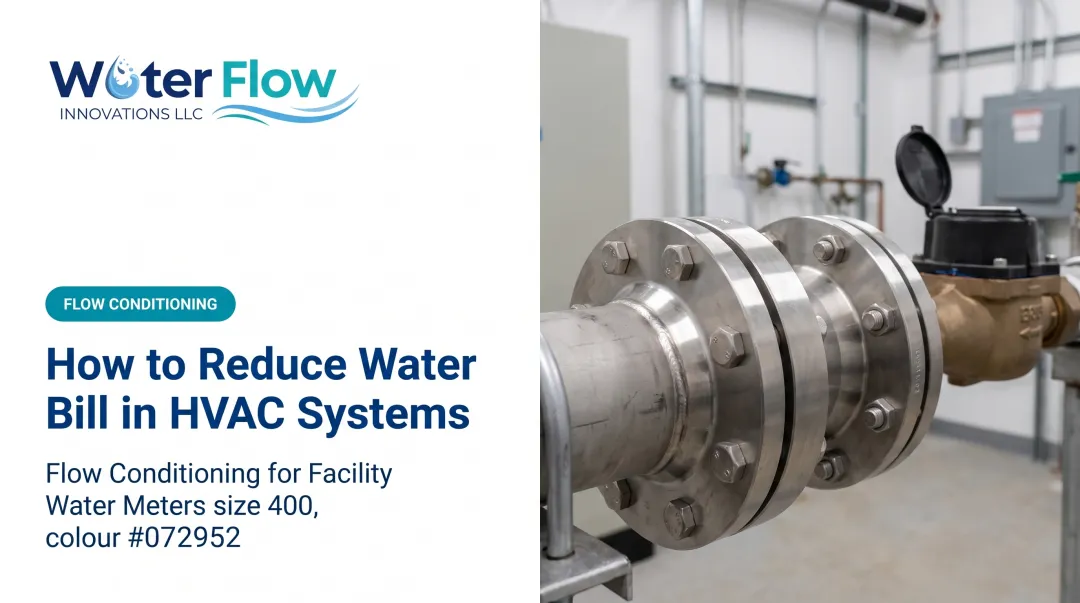
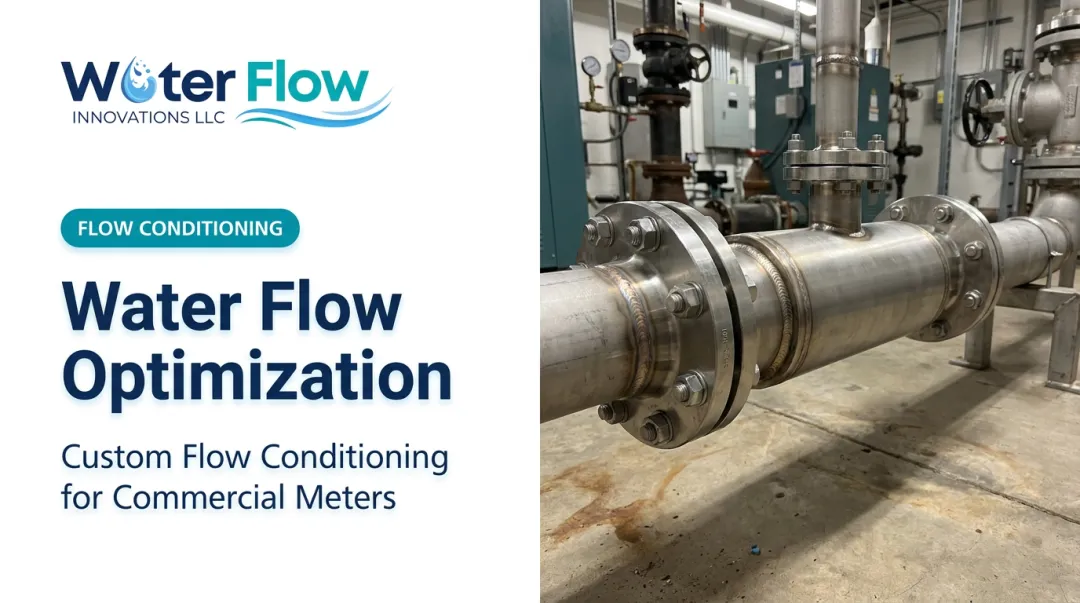
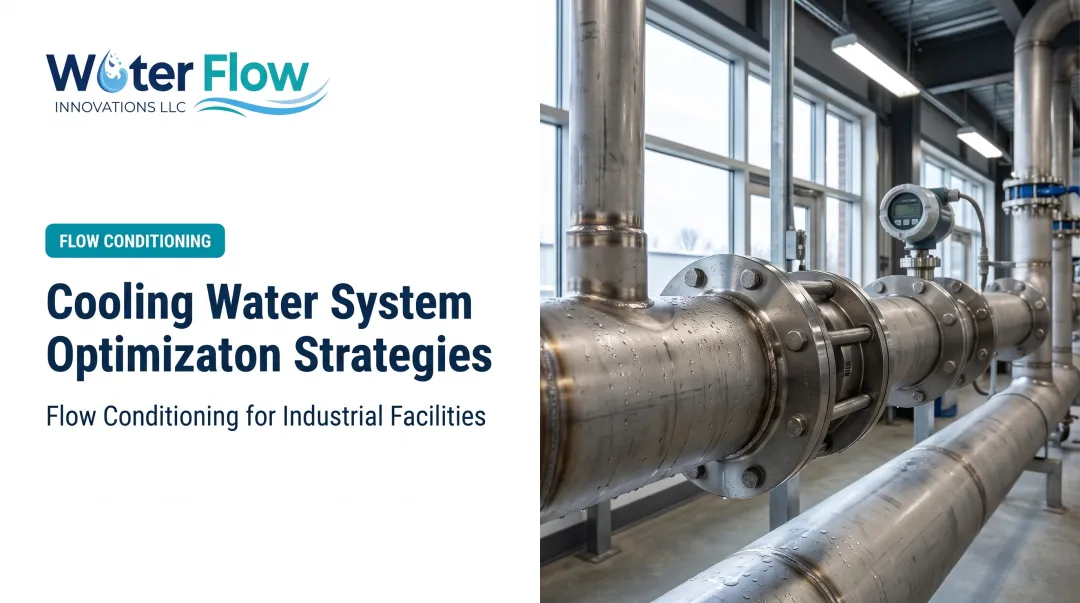
Flow conditioning devices (FCDs) address this directly. These certified devices combine four functions:
- Air and gas removal, creating a homogeneous water column at the meter
- Pressure regulation to stabilize flow and reduce water hammer
- Check valve protection against reverse flow and pressure spikes
- Turbulence elimination to prevent vortex flow at the measurement point
Water Flow Innovation offers FCDs custom-fabricated to facility specifications, covering pipe sizes from NPS ½" to 12" (DN20–DN500) in 316L stainless steel, with titanium and specialty alloys available on request.
Typical install time is about an hour on common pipe sizes and meter types. Devices carry IAPMO, NSF, ANSI, CAN 61, KIWA, GMP, and SQF certifications.
Documented results show a 5–30% average utility bill reduction, with a highest recorded result of 46%, and most customers reaching ROI within 12 months. Savings come from correcting measurement error, not from cutting actual water use, so cooling tower operations, makeup schedules, and HVAC performance stay unaffected.

A 6-month money-back guarantee on the device (installation costs excluded) and a lifetime transferable warranty that follows the property lower the adoption risk for facilities ready to pilot the approach.
Airside Optimization Strategies
Airside work matters to overall HVAC efficiency, but it sits outside the water side of the system. In brief: duct sizing sets the resistance fans must overcome, filters are best replaced on measured pressure drop rather than a fixed calendar, and ASHRAE Guideline 36 resets duct static pressure from VAV damper positions instead of a fixed setpoint.
None of it changes what your water meter records. Waterside flow and the accuracy of the reading at the meter are where water and sewer charges are actually decided, which is the focus of the sections above.

Automation, Controls, and Continuous Monitoring
Retro-commissioning as a one-time event solves problems that exist on the day of the audit. It does nothing for the drift that happens afterward. Continuous, automated optimization instead adjusts controls in real time as load and weather conditions change.
Modern building automation systems (BAS), paired with supervisory optimization software, separate two distinct functions:
- Reliability controls, which keep occupants comfortable and equipment safe
- Energy-reduction controls, which push efficiency without compromising reliability
Fault detection and diagnostics (FDD) sits on top of both, catching performance drift—a stuck damper, a miscalibrated sensor, a valve that won't fully close—before it compounds into larger losses.
DOE's EnergyPlus-based simulation modeled 34 control measures across 14 building types and 16 climate zones. It found an estimated 29% average whole-building energy-saving potential from properly tuned controls.
A separate two-year field campaign across nearly 6,000 buildings reported median savings with payback in one to two years:

- 4% for energy information systems
- 9% for FDD
Measuring and Verifying Your Savings
Optimization claims mean nothing without a baseline. Before implementing any flow changes, you need:
- Utility bill history covering at least 12 months
- Submeter data at the equipment or zone level where available
- BAS trend data showing actual operating conditions, not just setpoints
LEED v4 reinforces this discipline. Its building-level energy metering prerequisite requires monthly consumption tracking at minimum. Advanced energy metering credits go further: they require capturing end uses that represent 10% or more of annual consumption at hourly intervals, retained for at least 36 months.
This measurement discipline pays off beyond the utility bill. Documented, verifiable savings from flow optimization support ESG water-intensity reporting and LEED water-use documentation. Both require auditable, before-and-after data rather than estimates.
A straightforward before-and-after comparison of water and sewer bills, tracked over consecutive billing cycles, gives facility managers a defensible record.
Frequently Asked Questions
What is the $5,000 rule for HVAC systems?
This residential guideline multiplies equipment age by estimated repair cost. If the total exceeds $5,000, replacement is usually more cost-effective. Commercial and industrial facilities should decide based on lifecycle cost and redundancy needs instead.
What is the 2-foot rule in HVAC?
There's no universally documented "2-foot rule" for commercial HVAC clearances. Always follow the specific manufacturer's installation instructions for your equipment, since intake, discharge, and service clearances vary by model.
How often should HVAC flow optimization be reassessed?
Most systems drift out of tune without ongoing monitoring, so reassess at least annually. Continuous monitoring through BAS (building automation systems) and FDD (fault detection and diagnostics) catches issues faster than periodic manual checks.
Can flow optimization reduce water bills, not just energy bills?
Yes. Correcting turbulence-driven meter over-reading on cooling tower and makeup water lines reduces water and sewer charges immediately, separate from any energy savings elsewhere in the system.
Does optimizing HVAC flow require shutting down the system?
Most modern solutions require minimal disruption. Flow conditioning devices, for example, typically install in about an hour, with a brief water shutoff at the meter connection, without affecting downstream HVAC operations.
What reduction do cooling-side corrections typically deliver?
Documented installations average a 5–30% cut in combined water and sewer charges, with a highest documented single result of 46%, showing on the very next billing cycle after installation.
Which cooling-intensive facilities benefit most?
Data centers, HPC and supercomputing centers, healthcare facilities, hotels and hospitality, commercial office buildings, shopping malls, and centralized district energy plants, where makeup water cycles constantly against one meter.