Introduction
Roughly 62,750 professional car washes operate across the United States today, split between conveyor tunnels, in-bay automatics, and self-service bays, according to ICA industry data. Every one of them shares the same recurring headache: the water and sewer bill.
For most operators, combined water and sewer charges rank among the top two or three recurring operating costs, right alongside labor and chemicals. Unlike labor, these costs climb almost automatically as municipal utility rates rise year over year.
Monthly bills vary widely by format. A self-serve bay with a handful of wands looks nothing like a high-volume tunnel running hundreds of cars a day. Car washing is water-intensive.
But rising costs usually trace back to something more specific: equipment condition, rate design, or billing accuracy, not simply more water flowing through the hose.
This article breaks down how these costs build up, what actually drives them, and the practical strategies that reduce them. Those strategies are grouped by the decisions you make, how you manage daily operations, and the surrounding rate and infrastructure context.
Key Takeaways
- Water and sewer costs stack from per-vehicle draw, sewer surcharges, and yearly rate hikes
- Equipment condition, rate tiers, and meter accuracy drive the bill beyond actual water use
- Cut costs at three levels: procurement, day-to-day operations, and rate or infrastructure context
- Durable savings fix the true cost source instead of blanket usage cuts
How Water and Utility Costs Build Up at a Car Wash
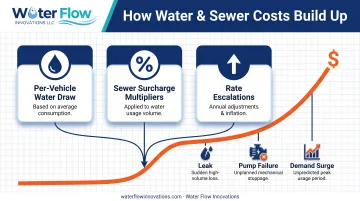
At a car wash, water and sewer costs rarely show up as one obvious line item. They accumulate through three channels: per-vehicle water draw, sewer surcharge multipliers, and rate escalations that stack across billing cycles.
Most of this build-up is compounding rather than sudden. Equipment loses efficiency gradually, and utility rates climb a few percentage points most years—that steady rise adds up fast across billing cycles. Occasional spikes punch through too: a summer demand surge, a failed pump seal, an unnoticed leak.
The Hidden Piece: Sewer Billed on Water That Never Returns
Sewer charges are typically calculated as a percentage of metered water volume, not actual wastewater returned to the sewer system. New York City, for instance, bills sewer at 159% of the water charge, according to NYC's official rate guidance.
That structure creates three hidden cost pockets:
- Water lost to evaporation or carried out on vehicles and towels still gets billed as sewer discharge in many jurisdictions
- Meter inaccuracies inflate readings without any actual change in water use
- RO reject and reclaim makeup water hit the meter at full rates even when little returns to the sewer
None of these show up unless someone audits the bill line by line.
Key Cost Drivers for Car Wash Water and Utility Bills
Not every driver carries equal weight at every facility, but a handful show up consistently across wash formats.
Wash Format and Equipment Baseline
Wash format sets the floor for water draw per vehicle. According to EPA WaterSense:
- Self-service washes average about 15.0 gallons per vehicle
- Reclaim-equipped tunnels average 30-34 fresh gallons per vehicle, versus 65.8-85.3 gallons without reclaim
- Reclaim-equipped in-bay automatics average 43.3-44.8 fresh gallons per vehicle, versus up to 74.1 gallons without reclaim
Reclaim capability makes the single largest early difference in that baseline, often cutting freshwater draw by half or more.
Rate Structures and Sewer Surcharges
Local rate design frequently moves the bill more than any change in actual consumption. Common add-ons that stack on the base rate include:
- Tiered pricing that rises with volume
- Sewer surcharges calculated as a percentage of metered water
- High-strength wastewater fees above certain pollutant thresholds
Equipment Condition and Daily Operations
Pumps, arches, hoses, and reclaim tanks lose efficiency over time and develop leaks that often go unnoticed until the bill spikes. Daily operations shift cost independently of the hardware:
- Cycle times and default pressure settings
- Staff habits at the bay or tunnel
- Daily car volume
The Overlooked Driver: Meter Over-Registration
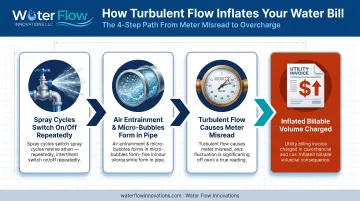
Commercial water meters in high-flow pipes can over-register usage due to turbulence and air entrainment. A wash may be billed for water it never actually received.
Every wash cycle is effectively a pressure event. High-pressure spray systems switching on and off dozens to hundreds of times a day introduce entrained air and micro-bubbles that meters read as billable volume. High-volume tunnels, with hundreds of daily on-off cycles, tend to see this effect most acutely.
No single driver dominates every site. The relative weight depends on wash type, water source, and how the local utility designs its rates.
Cost-Reduction Strategies for Car Wash Water and Utility Bills
Effective strategies fall into three buckets: what you decide before installation, how tightly you manage day-to-day operations, and the rate/infrastructure context surrounding the wash.
Upfront Design and Equipment Choices
These are choices made at the procurement or design stage that set your long-term cost baseline.
- Prioritize reclaim-capable equipment and tunnel controllers offering to-the-inch water delivery with staggered equipment starts
- Specify low-flow nozzles and spray arms - EPA recommends self-service nozzles at no more than 3.0 gallons per minute
- Review your utility rate classification and apply for sewer discharge credits where water never returns to the sewer (often available, rarely claimed)
- Set per-vehicle water allotments in your wash package design so usage is capped by default, not left to staff discretion
A widely cited EPA-documented reclaim upgrade across 13 grocery-chain wash locations averaged 30 gallons saved per car and topped 11 million gallons annually. At scale, equipment choice compounds fast.
Operational Controls and Monitoring
This bucket is about visibility and control while the wash is actively running.
- Install sub-metering or real-time monitoring to catch unusual usage before it turns into an inflated bill
- Run routine maintenance and leak-detection audits on reclaim tanks, pumps, and arches
- Standardize staff training on pressure settings, cycle timing, and shut-off discipline across shifts
- Correct meter inaccuracy at the source so billed volume matches what the wash actually uses
Most operators never think to check the meter itself. Commercial meters can over-register usage in turbulent, air-entrained flow, the exact condition created by hundreds of daily wash cycles.
A certified flow conditioning device aligns billed volume with actual consumption.
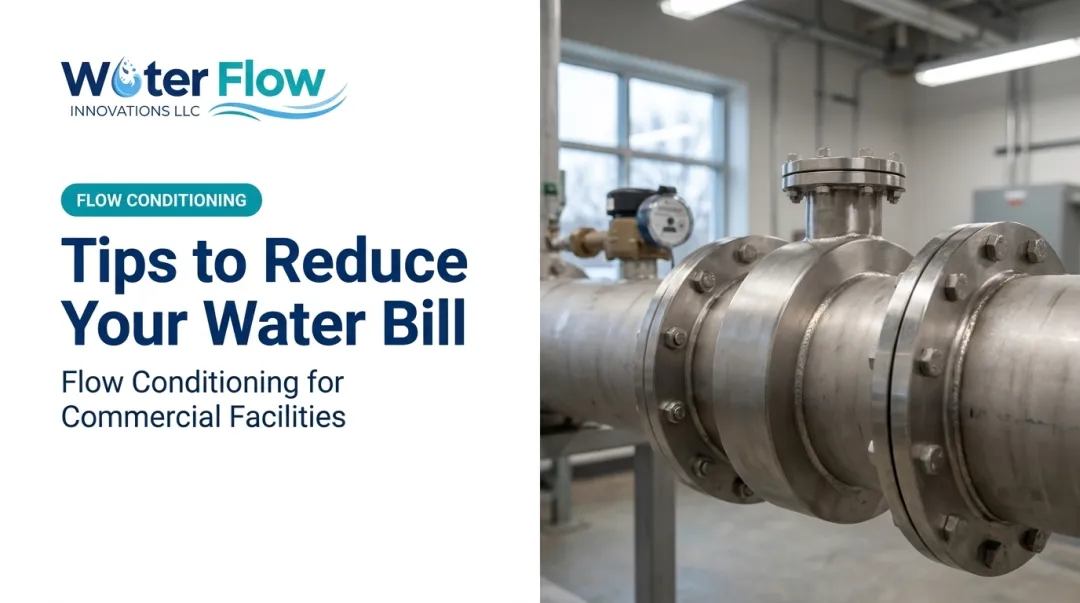
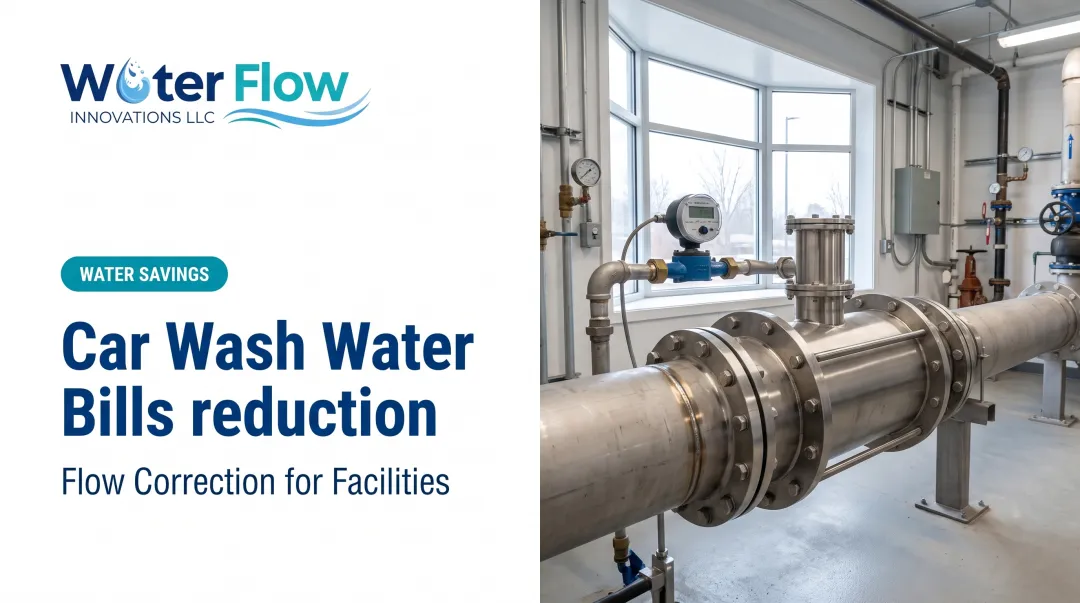
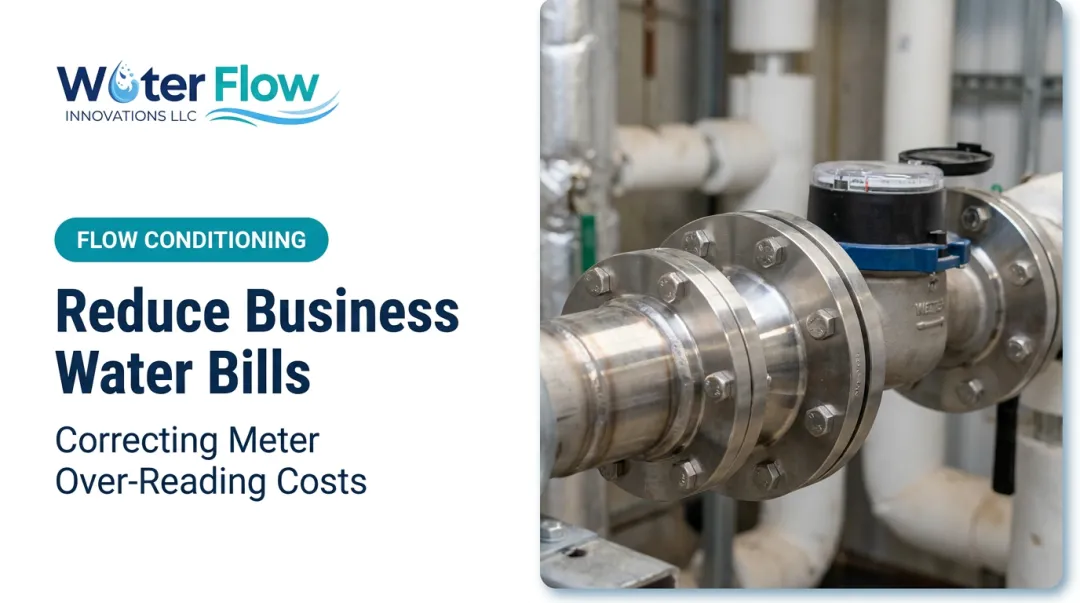
That is the problem Water Flow Innovation's Flow Conditioning Device (FCD) addresses. It installs immediately after the master water meter, not inside the wash system, so spray pressure, rinse performance, and reclaim operation stay unchanged:
- Installation takes about an hour, with a brief water shutoff limited to that window
- Available for pipe sizes from 1/2" up to 12" NPS and larger on request, covering the 1"–4" range typical of most wash facilities
- Works with any meter type - turbine, electromagnetic, ultrasonic, or positive displacement
- Customers see 5–30% average reductions in combined water and sewer charges (46% highest documented)
- Savings show up on the very next billing cycle
- Backed by a 6-month money-back guarantee and a lifetime transferable warranty
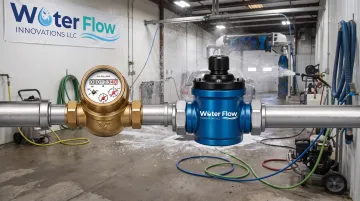
Because sewer charges are calculated from metered water volume, correcting the meter reading reduces both charges at once, without touching chemical use, throughput, or wash quality.
Utility Rates, Rebates, and Site Infrastructure
Sometimes the wash itself runs efficiently, but the surrounding context is what's driving the bill.
- Evaluate alternative water sources, such as well water or reclaimed municipal water, where locally permitted
- Research utility rebates for reclamation system installation; Denver Water, for example, lists reclaim equipment among its commercial car wash rebate categories
- Assess facility-level infrastructure: pipe sizing and pressure regulation affect flow behavior and meter accuracy property-wide, not just at the wash equipment
- Benchmark your bill against typical costs for your wash type and locality
If your rate structure or metering setup looks off compared to peers, that may point to a billing context problem rather than a wash efficiency problem.
Conclusion
Cutting a car wash's water and utility costs starts with pinpointing where those costs originate: equipment, daily operations, rate structure, or billing accuracy. Blanket usage cuts risk wash quality and often miss the real problem.
The most durable savings come from fixing structural issues—correcting meter inaccuracy, reclassifying a mismatched rate, or claiming a sewer credit you're already entitled to. You keep every wash cycle and the customer experience intact.
Start with a line-item review of your water and sewer bills. Many operators recover charges they did not know they were paying.
Frequently Asked Questions
How much water does a car wash typically use per day?
A busy tunnel washing 300 cars a day often uses about 9,000–13,500 gallons before efficiency losses, based on 30–45 gallons per vehicle at reclaim-equipped tunnels and in-bays. Self-service bays run closer to 15 gallons per vehicle, so daily totals scale with format and car count.
What factors drive up a car wash's water bill the most?
The biggest drivers are utility rate structures, sewer surcharges on metered volume, aging or leaking equipment, and meter over-registration from turbulent flow. Any one of these can inflate a bill even when actual water use stays flat.
Do professional car washes use less water than washing a car at home?
Generally, yes. A garden hose without an automatic shutoff can use 148 gallons or more per wash, while reclaim-equipped professional washes average just 30-45 gallons per vehicle.
How can a car wash reduce its water bill?
Work three levels at once:
- Procurement: reclaim systems and low-flow nozzles
- Operations: leak audits and meter correction
- Rates and infrastructure: rebates and benchmarking
How much does a water reclamation system cost and what is the typical payback period?
Cost depends on wash format, throughput, and system capacity, so budget only after a facility-specific quote. Payback tracks local water and sewer rates—ask your vendor for a site-specific ROI using your bills and car count.
Are car washes required by law to recycle water?
It depends on your state and municipality. California requires new in-bay and conveyor washes to recycle or source at least 60% of wash water, while some Texas cities mandate 50% minimums, so check your local ordinance before assuming a requirement applies.
How much does correcting meter over-reading save a car wash?
Documented installations average a 5–30% reduction in combined water and sewer bills, with a highest documented result of 46%, appearing on the very next billing cycle. The saving comes from correcting the reading, not from washing fewer cars.
Why does an over-reading meter raise the sewer bill too?
Most utilities calculate sewer as a percentage of metered water intake, typically 80–120% of the water charge. Every phantom gallon is therefore billed twice, once as water and once as sewer, even though it never entered a drain. Vehicle wash sites — car and truck washes, truck stops, and railway and freight locomotive washing — are high-discharge operations, so the multiplier bites hard.