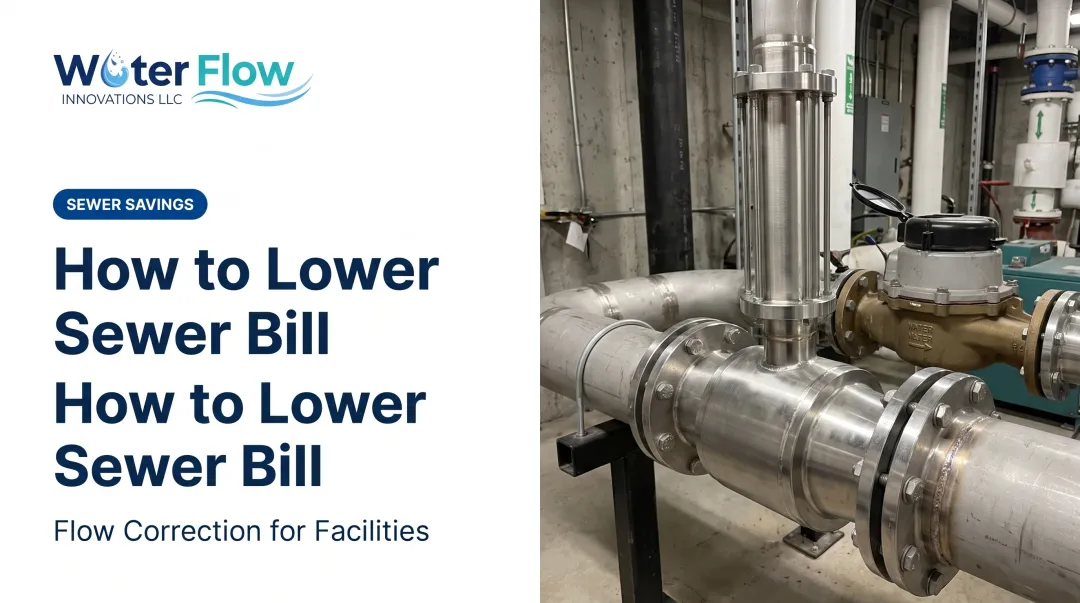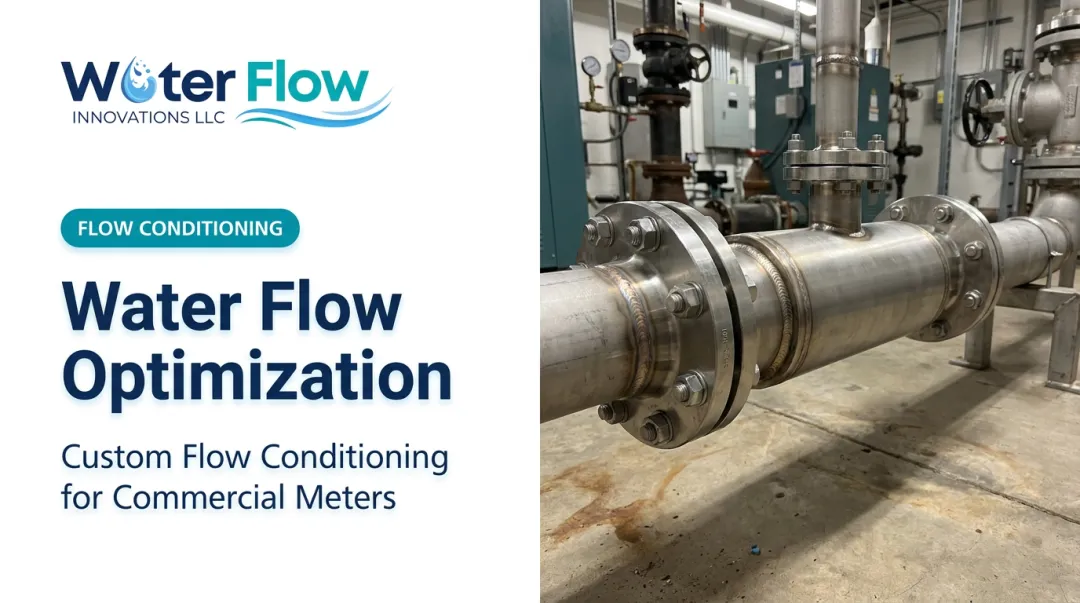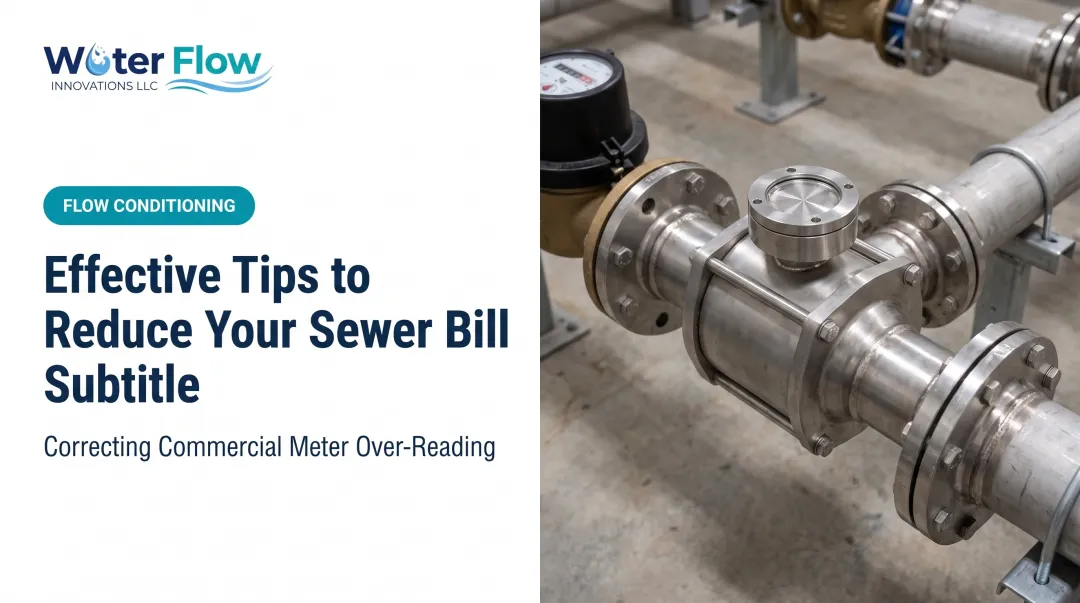
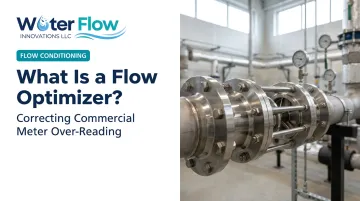
That's where a flow optimizer comes in. It's a device installed near a water meter that corrects turbulent, swirling, or uneven flow at the measurement point, so the meter registers only the water actually delivered.
This article breaks down how flow optimizers work, why they matter for your utility bills, and how to tell if your facility is a good candidate for one.
Key Takeaways
- Flow optimizers correct meter over-reading so bills reflect actual water use
- Turbulence from elbows, valves, and pumps causes inflated meter readings
- Correcting over-reading can cut water and sewer bills by 5-30%
- Multi-stage devices install in about an hour, no downtime
- Certified savings show on the next bill, ideal for ESG and LEED reporting
What Is a Flow Optimizer?
A flow optimizer, also called a flow conditioner, is installed inside a pipeline to convert turbulent or non-uniform flow into a stable, uniform profile. Water meters are calibrated against a specific reference profile, and anything that disrupts it can throw off the reading.
Common disturbances include:
- Elbows and tees that redirect flow and introduce swirl
- Partially closed valves that create asymmetric velocity across the pipe
- Reducers and misaligned flanges that generate uneven pressure zones
- Pumps positioned too close to the meter's inlet
Without correction, this disrupted flow travels downstream, affecting meters, pumps, and other connected equipment.
Industrial flow conditioners have improved measurement accuracy in gas and oil custody transfer for decades, where even small errors carry major financial weight. A growing use case in commercial and municipal buildings is different: correcting water meter over-reading that inflates utility bills.
Turbulent or aerated flow can cause mechanical and turbine-style water meters to register more flow than what's actually delivered. These meters count anything moving through them, water or air, as billable volume.
That's normal meter operation, not a defect: displacement and turbine meters register any movement as flow. Flow optimization technology builds on decades of engineering research into profile correction methods, including tube bundles, perforated plates, and vortex-tab designs, now adapted specifically for potable water billing accuracy.
Flow Optimizer vs. Flow Conditioner: Is There a Difference?
In practice, no. Industry literature uses the terms almost interchangeably. Standards bodies like OIML, ISO, and ASME define "flow conditioner" and "flow straightener," but none have published a formal definition of "flow optimizer."
Think of "flow optimizer" as the billing-focused cousin of the term. "Flow conditioner" tends to describe the measurement-science application, while "flow optimizer" gets used when the goal is reducing utility costs rather than improving custody-transfer accuracy.
How Do Flow Optimizers Work?
Two mechanisms drive most water meter over-reading: entrained air and turbulence.
Air entrainment happens when pressure changes from on-off cycling, variable demand, or system start/stop events pull air bubbles into the water line. Displacement and turbine meters can't distinguish air from water, so both get counted as billed volume. Facilities with frequent valve transitions, like clean-in-place systems in food processing, tend to see this more often.
Turbulence and swirl cause uneven velocity profiles at the meter location, leading to over- or under-registration. PNNL's water metering guidance notes that fittings, valves, and pumps upstream of a meter can reduce accuracy in turbine and compound meters. It recommends specific straight-run distances depending on meter type, since meters are calibrated assuming a fully developed reference flow.
A Compact, Multi-Stage Solution
Older single-function straighteners often needed long straight-run distances, sometimes 15 to 25 pipe diameters, to let flow fully redevelop at the meter. Modern multi-stage optimizers condition flow in a much shorter footprint, often 3 to 5 diameters. Internal vanes, tabs, and staged components straighten flow and equalize velocity across the pipe's cross-section.
Water Flow Innovation's Flow Conditioning Device (FCD) is one example of this approach. It combines four components in a single unit:
- Air and gas separation: creates static back-pressure to produce laminar flow, preventing bubbles from forming at the meter
- Pressure regulation: smooths pressure spikes and surges from cycling equipment while reducing water hammer, engineered for negligible pressure loss downstream
- Check valve: blocks reverse flow, which can pull air back into the line and worsen over-reading (not needed on every installation, depending on site conditions)
- Turbulence elimination: slows velocity just enough at the meter to prevent vortex flow, without reducing overall flow rate
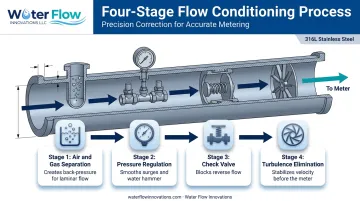
This multi-stage design addresses several flow anomalies at once, in a single compact unit.
Types of Flow Optimization Devices
Flow conditioning has taken several forms over the decades, each with different strengths and trade-offs.
| Device Type | Mechanism | Known Limitation |
|---|---|---|
| Tube bundle / honeycomb | Parallel cells suppress cross-flow and swirl | Highly sensitive to placement distance |
| Perforated plate | Hole geometry redistributes momentum | Adds pressure drop; design trade-offs |
| Anti-swirl vortex tabs | Generates counter-rotating vortices | Limited independent performance data |
| Multi-stage air/turbulence systems | Combines several corrections in one unit | Requires custom fit per pipe and meter |
Placement matters more than many people assume. A NIST study on tube bundle conditioners found a conventional tube bundle produced a baseline shift as large as 1.2% when placed just 7 pipe diameters from the meter. Placement at 17 diameters, by contrast, kept most configurations below 0.2%. In other words, the same device can help or hurt accuracy depending purely on where it sits.
Placement isn't the only variable—device selection also depends on the goal. The two use cases demand different approaches:
- Custody-transfer accuracy in industrial gas or liquid lines requires a distinct design, certification path, and installation standard
- Billing-focused correction for a commercial water bill relies on custom fabrication to the exact pipe size, flange type, and meter model at each site, rather than a generic, one-size-fits-all unit
Why Flow Optimizers Matter for Your Water and Sewer Bill
Facilities can end up paying for water volume that was never actually delivered, simply because the meter over-registers due to turbulence or air. Engineers sometimes call this the "phantom water" problem. Check your flow conditions before assuming a bill spike means higher actual consumption.
There's a dual-savings angle here too. Sewer and discharge fees are frequently calculated from metered water use, not measured separately. So when over-reading is corrected, both charges can drop together, without any change to what's actually consumed.
Water Flow Innovation's FCD is a certified example built specifically for this problem. It carries IAPMO, NSF International, ANSI, CAN 61, KIWA, GMP, and SQF certifications, covering everything from potable water safety to pharmaceutical-grade manufacturing standards. Documented results include:
- 5–30% average water and sewer bill reduction, with a highest recorded result of 46%
- 90% of customers reportedly reaching ROI in under 12 months
- Savings appearing on the very next billing cycle, since no operational change is involved
- Installation completed in about an hour, compatible with any meter type and any standard pipe size (½-inch to 12-inch)
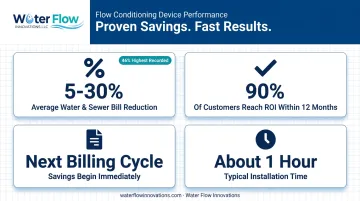
Because the FCD is custom-fabricated to each facility's exact pipe size, flange pattern, and meter model, it fits without replacing existing piping. Operations don't stop beyond the installation window itself.
That documentation also holds up for ESG reporting and LEED certification, since savings show up as verifiable, auditable reductions on real utility bills, not modeled projections. Every unit is backed by a 6-month money-back guarantee and a lifetime transferable warranty that follows the device through ownership changes.
Beyond the Bill: Equipment and Sustainability Benefits
Correcting turbulence doesn't just help the meter. The Hydraulic Institute's ANSI/HI 9.8 standard calls for pump inflow to be uniform, steady, and free of swirl and entrained air. Disrupted inlet conditions can prevent pumps from running at their designed efficiency and can accelerate cavitation-related wear. Stabilizing flow near the meter supports that same principle system-wide.
Accurate metering also supports conservation, since facilities are billed, and tracked, only for water they actually use. That supports water conservation goals and reduces unnecessary strain on municipal treatment and pumping infrastructure.
Who Needs a Flow Optimizer? Industries That Benefit Most
Certain facility types are especially prone to the flow disturbances that drive over-reading, usually because of high-frequency cycling, variable demand, or complex piping layouts. These include:
- Hotels and hospitality — irrigation cycling, laundry, and variable guest demand
- Multifamily and apartment buildings — fluctuating occupancy-driven demand
- Healthcare facilities — 24/7 sterilization, cooling towers, and hygiene systems
- Manufacturing plants — CIP cycles, cooling towers, and parts-wash systems
- Educational campuses — dormitory and cafeteria demand spikes
- Car washes, truck washes, and laundromats — high-frequency on-off cycling
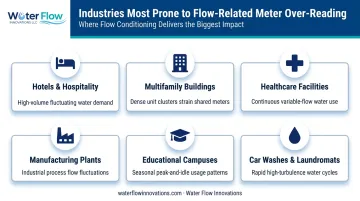
Facilities with frequent elbows, valves, or fluctuating demand patterns tend to see these disturbances more than those with long, straight, low-complexity supply runs.
If your water and sewer bills seem disproportionate to actual usage, and a leak inspection has already come up clean, evaluating flow conditions at the meter is a reasonable next step. Water Flow Innovation offers a free water bill review and savings analysis to help determine whether a facility's numbers point toward this kind of correction.
Frequently Asked Questions
What is a good flow rate for a pump?
There's no universal ideal flow rate. It depends on the pump's design, pipe diameter, and application. Maintaining stable, non-turbulent flow, like a flow optimizer provides, helps pumps run closer to their designed efficiency range.
What is the difference between a flow optimizer and a flow conditioner?
The terms are largely synonymous. "Flow optimizer" tends to emphasize billing and cost outcomes, while "flow conditioner" is more common in measurement-science and industrial contexts.
Can a flow optimizer really reduce my water bill?
Yes, by correcting meter over-reading, a properly certified device like the FCD (Flow Conditioning Device) can lower both water and sewer charges without any change to actual consumption.
How long does it take to install a flow optimizer?
Installation for solutions like the FCD typically takes about an hour, with a brief water shutoff at the meter connection at the meter connection and no interruption to facility operations.
Does a flow optimizer affect water pressure or system performance?
Properly designed flow optimizers are designed for negligible pressure loss and no measurable impact on downstream system performance.
What causes a water meter to over-read in the first place?
Air entrainment, turbulence, and swirl from nearby pipe fittings disrupt the flow profile a meter expects to see, which can cause it to register more flow than actually passes through.
What would suggest a site is a candidate for optimization?
Metered volume that no longer moves with production or occupancy, a sewer charge out of step with actual discharge, several demand sources cycling on one connection, and charges that stayed high after a utility meter swap.
Why does one inflated reading create two charges?
Because sewer is derived from metered intake rather than measured discharge, typically at 80–120% of the water charge. A phantom gallon is therefore billed on both lines despite never having entered a drain.