
Facility managers across manufacturing, food & beverage, and municipal sectors are catching on. Flow stabilization isn't just an equipment-protection strategy anymore. It's a cost-control lever.
This guide covers what causes flow instability, the proven techniques that fix it, and how correcting flow issues can directly cut your utility costs—without touching how much water your facility actually uses.
Key Takeaways
- Turbulence and air entrainment cause water meters to over-register actual usage
- Four core corrections stop over-reading: pressure regulation, turbulence elimination, air/gas removal, and check valves
- Correcting flow issues delivers immediate bill cuts without changing water consumption
- Documented savings average 5–30%, with some facilities reaching up to 46%
What Causes Flow Instability in Industrial Systems
Turbulent vs. Laminar Flow
Pipe flow shifts from smooth (laminar) to chaotic (turbulent) once it crosses a threshold known as the Reynolds number, generally around 2,300 for steady pipe flow, according to ASME's Journal of Fluids Engineering. Above that point, flow becomes unpredictable.
Common culprits in industrial piping include:
- Tees, elbows, and reducers that disrupt velocity profiles
- Partly closed butterfly, check, or control valves
- Screens, probes, and poorly seated flange gaskets
- Undersized straight-pipe runs before meters
McCrometer's research found that meter errors downstream of a disturbed butterfly valve can exceed 50%, with the direction of error depending on meter technology: some meters under-report, others over-report.

Air Entrainment
Air gets into industrial water systems through insufficient pump-suction submergence or cracks in suction piping running below atmospheric pressure. Even small air volumes create frothy, two-phase flow that destabilizes readings.
One controlled study found air-driven turbine rotation reached 14 times the speed tied to a meter's upper calibrated water-flow condition, a factor linked to failure in 5 of 6 tested meters.
Pressure Fluctuations from Variable Demand
Multiple production lines drawing water simultaneously create pressure swings that ripple through the entire system. CIP cycles, cooling-tower makeup, and irrigation zones cycling on and off all contribute to this instability.
Unstable flow does more than skew the meter. It accelerates wear on valves, pumps, and meter internals, raising long-term maintenance spend on top of inflated bills.
Key Techniques for Stabilizing Industrial Flow
Stable industrial flow depends on controlling five failure points: pressure swings, turbulence, entrained air, reverse flow, and fixed-speed pumping. Each has a proven fix.
Pressure Regulation Systems
A pressure-reducing valve automatically converts a fluctuating upstream pressure into a steady, controlled downstream pressure. This single step eliminates a major source of surge-driven instability.
Turbulence Reduction
Two main tools address swirl and uneven velocity profiles:
- Flow straighteners: tube-shaped devices that remove swirl
- Conditioning plates: perforated wafers that remove swirl and velocity-profile asymmetry
Compatibility matters here. McCrometer notes a straightener can actually worsen disturbance at a magnetic meter, so the right tool depends on your meter type.
Air and Gas Removal
Air-release valves continuously discharge accumulated air during operation. Combination valves add air/vacuum function for a broader fix. Entrained air is especially disruptive: it doesn't just skew readings, it can cause frothy flow that damages pump internals over time.
Check Valves for Backflow Protection
Check valves enforce one-way flow, preventing reverse surges that damage equipment or throw off metering accuracy. In one Barcelona pumping-station evaluation, nozzle check valves cut surge-pressure spikes by more than 80%.
Pump Control with VFDs
Variable frequency drives adjust motor speed to match real-time demand rather than running pumps at a fixed rate, which reduces the load swings that destabilise flow in facilities with cycling production lines.
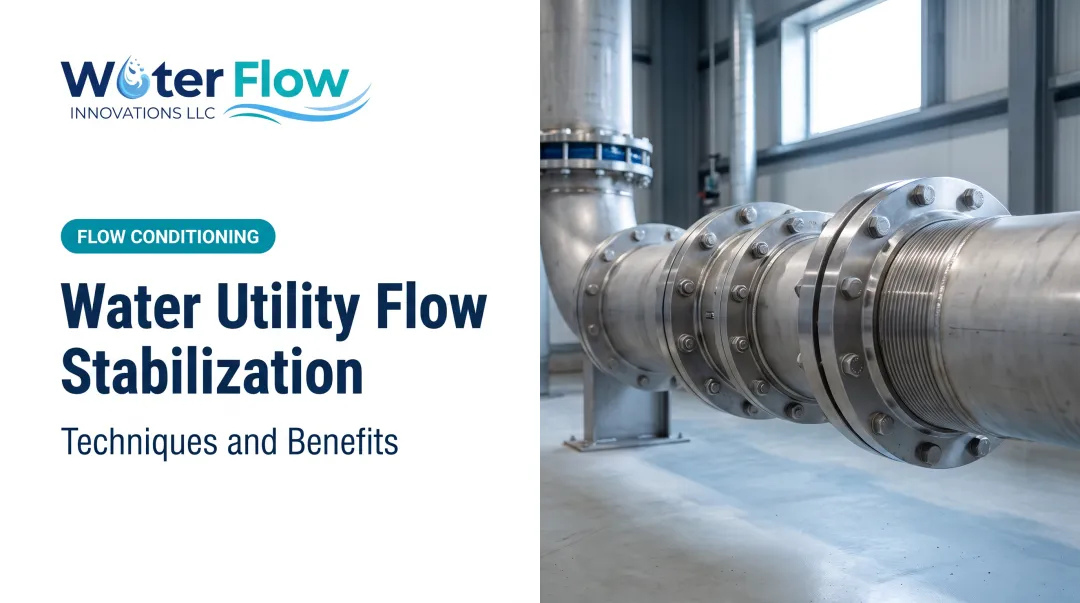
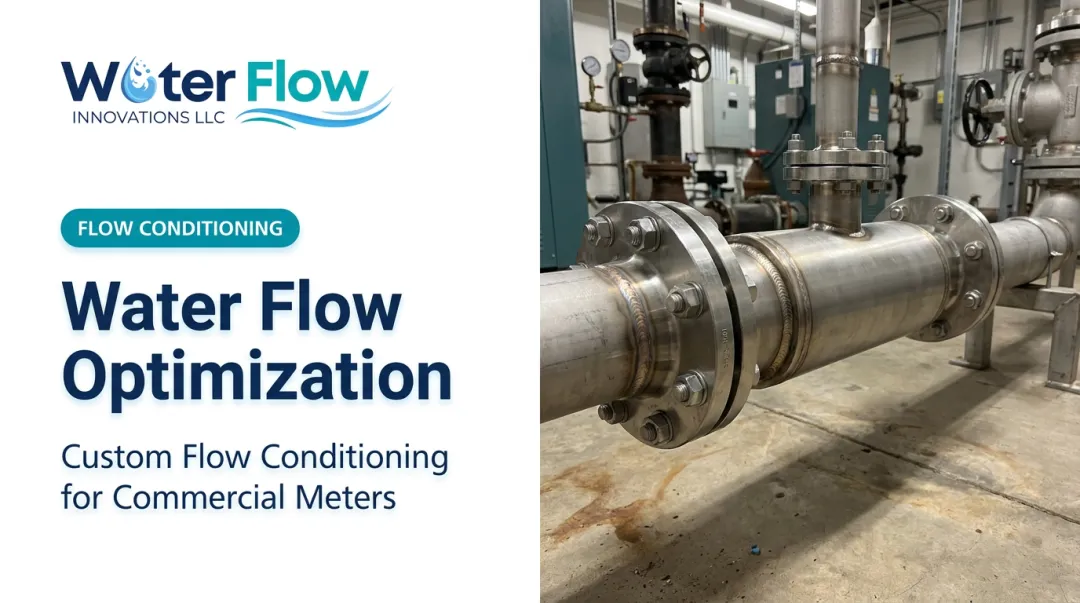
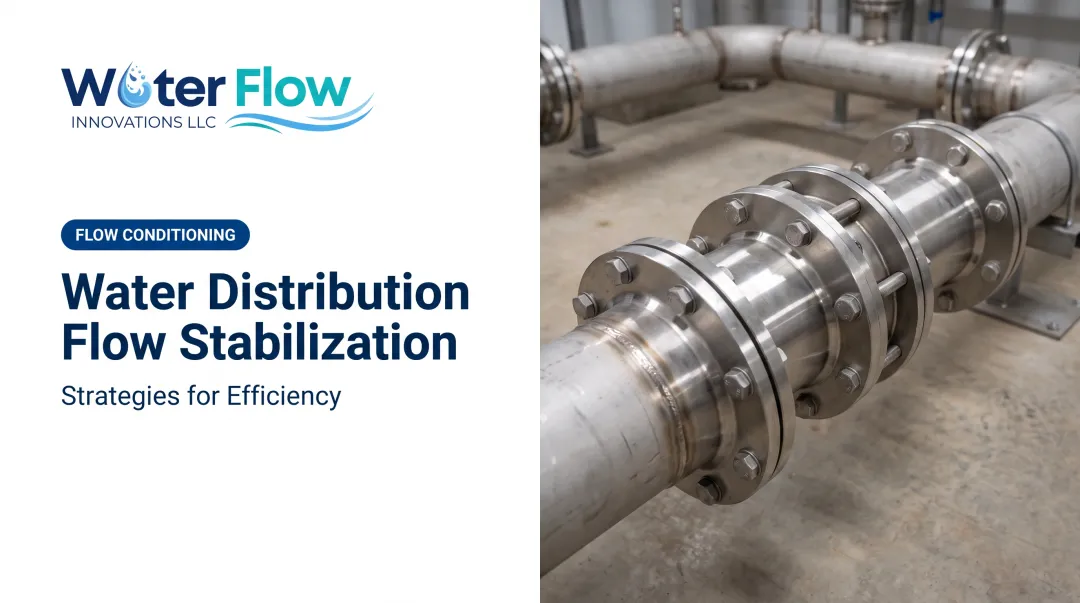
Water Flow Innovation's FCD packages four of these controls—air/gas removal, pressure regulation, check-valve protection, and turbulence elimination—into one unit built to correct meter over-reading without changing system performance.

How Flow Instability Impacts Water Metering and Utility Costs
Here's the mechanism: turbulent, aerated flow passing through a meter registers as volume, even when that volume is partly air, not water. Your meter can't tell the difference. It just counts what passes through.
That over-count then hits your bill twice. Once as water consumption. Again as sewer discharge, since many utilities calculate sewer fees from metered water intake.
The FCD Approach
Water Flow Innovation's Flow Conditioning Device (FCD) targets this exact problem. It's a certified unit installed immediately after the water meter that combines four functions:
- Air/gas separation: creates static back pressure that pushes entrained air back upstream, leaving a homogeneous water column at the meter
- Pressure regulation: moderates surges from on-off cycling and variable demand
- Check valve function: prevents reverse flow and re-entrained air (on configurations where specified)
- Turbulence elimination: slows velocity enough to prevent vortex flow during CIP cycles, tank fills, and other high-volume events
What makes this practical for industrial facilities:
- Installation typically takes about one hour, with a planned shutoff during a low-demand window
- No production lines, cooling systems, or process equipment are modified
- Negligible pressure loss by design means downstream operations run essentially as before
Documented results show average bill reductions of 5-30%, with the highest single documented result at 46%. For high-volume facilities like chemical plants, even a modest correction can translate into six-figure annual savings.
The FCD is built from 316L stainless steel and carries IAPMO, NSF, ANSI, CAN 61, KIWA, GMP, and SQF certifications for drinking-water contact and food/pharmaceutical-grade material standards.

Those same documented savings can support ESG reporting, LEED certification, and other sustainability tracking facilities increasingly need to show.
Measuring and Monitoring Flow Stability
Before implementing any stabilization technique, you need a baseline. Without one, you can't verify whether changes actually worked.
Key metrics to track:
- Flow-rate variance — often measured using coefficient of variation (standard deviation divided by mean)
- Pressure consistency — how much downstream pressure fluctuates under changing demand
- Settling time — how quickly the system stabilizes after a demand change
Modern flow sensors and monitoring software give real-time visibility into these metrics. Bill history is another practical baseline. The EPA recommends pulling 1–2 years of water bills and tracking every metered and unmetered water source before you roll out changes.
Facilities working with Water Flow Innovation can start that review with a free water bill analysis, with no on-site visit required. Submit 12 months of billing history; the analysis flags likely over-reading, estimates facility-specific savings, and recommends FCD sizing. Most customers see results on the next billing cycle.

Industries That Benefit Most from Flow Stabilization
Flow precision isn't equally critical everywhere, but a few sectors feel it most directly:
- Semiconductor manufacturing: some fabs use up to 10 million gallons of ultrapure water per day, where flow consistency affects both process quality and compliance
- Pharmaceutical and life sciences: product preparation and equipment cleaning depend on accurate, stable flow
- Food & beverage production: CIP cycles and bottling-line rinses create the exact pressure-cycling conditions that destabilize flow
- Municipal and healthcare facilities: high throughput with complex piping layouts, where over-reading compounds across large volumes
- Large commercial facilities: hotels, data centers, and multifamily buildings with variable, cyclical demand patterns
Any facility with high water throughput and complex piping can benefit from a systematic flow audit, regardless of industry label. The conditions that cause instability (cycling demand, air entry points, aging fittings) show up everywhere.
Frequently Asked Questions
How long can a centrifugal pump run continuously?
Centrifugal pumps are designed for continuous 24/7 operation when properly maintained. Actual run time depends on duty cycle, cooling, and manufacturer specifications for the specific model.
How do you control the flow of a pump?
Common methods include throttling valves, variable frequency drives (VFDs), bypass control, and pressure-based regulation. Each matches flow output to system demand differently, depending on your setup.
What is the difference between flow stabilization and flow control?
Flow control adjusts the rate or direction of flow to a preselected target. Flow stabilization targets consistency: eliminating turbulence, pulsation, and pressure swings regardless of the set rate.
Can unstable flow damage industrial equipment?
Yes. Turbulence and pressure surges accelerate wear on valves, pumps, and meters, raising maintenance costs and shortening equipment lifespan.
Does flow conditioning reduce actual water consumption?
No. Flow conditioning corrects meter over-reading caused by turbulence and air entrainment; it doesn't change actual usage. Savings show up on the next billing cycle with no operational changes.
What scale of saving does the billing correction produce?
Documented installations average a 5–30% reduction in combined water and sewer charges, with a highest documented single result of 46%, achieved without touching production or process parameters.
What backs the device if the reduction doesn't appear?
A 6-month money-back guarantee on the purchase price, with installation cost non-refundable, so it can be returned if metered consumption does not measurably fall. A lifetime transferable warranty against manufacturing defects also applies.