
But flow type isn't just an academic curiosity. It affects water meter accuracy, energy costs, pressure drop, and equipment wear in commercial and industrial buildings. In fact, turbulent flow — the dominant flow type in nearly every real-world piping system — can quietly inflate your utility bills without you ever changing how much water you actually use.
This article breaks down laminar and turbulent flow, how the Reynolds number determines which one you're dealing with, where each shows up in real facilities, and why turbulence matters more to your bottom line than you might expect.
Key Takeaways
- Laminar flow is smooth and layered; turbulent flow is chaotic and mixed
- Reynolds number classifies flow as laminar, transitional, or turbulent
- Turbulent flow dominates most real-world piping, but it can cause water meters to over-register usage
- Understanding your flow type helps protect equipment, improve efficiency, and catch billing inaccuracies
Laminar vs. Turbulent Flow: Quick Comparison
| Characteristic | Laminar Flow | Turbulent Flow |
|---|---|---|
| Flow pattern | Smooth, parallel layers, no mixing | Chaotic, mixing layers with eddies |
| Velocity | Low, consistent | High, fluctuating |
| Reynolds number | Typically below 2,300 | Typically above 4,000 |
| Energy/pressure loss | Lower, more predictable | Higher, due to friction and mixing |
| Common occurrence | Uncommon in real-world piping | Dominant in municipal and industrial systems |

Those Reynolds number thresholds are engineering conventions, not hard physical laws. The U.S. Department of Energy's fluid flow handbook uses slightly different practical limits — below 2,000 for laminar, above 3,500 for turbulent DOE Fundamentals Handbook. The exact transition point depends on pipe geometry, surface roughness, and disturbances in the system.
What Is Laminar Flow?
Laminar flow describes fluid moving in parallel layers that don't mix. Picture a deck of cards sliding smoothly across a table — each layer glides past its neighbor without crossing over. Facilities chase that behavior when they need predictable flow rates for accurate measurement and process control.
Core benefits of laminar flow:
- Lower pressure loss across pipe runs
- More accurate flow measurement (fewer profile distortions)
- Reduced wear on piping components and fittings
Laminar flow isn't a single fixed state. Fully-developed laminar flow occurs once the velocity profile stabilizes downstream of any disturbance. Entrance-region laminar flow happens closer to the pipe inlet, where the profile is still forming. Engineers designing precision systems need to account for both.
Use Cases of Laminar Flow
Laminar flow rarely happens on its own in commercial piping — it's usually engineered on purpose. Common applications include:
- Cleanroom ventilation for semiconductor manufacturing
- Pharmaceutical labs and biotech production
- Medical IV delivery systems, where flow consistency is a patient-safety issue
In cleanroom settings, the FDA's aseptic-processing guidance requires unidirectional airflow through HEPA filters rated for 99.97% retention of 0.3 micron particles, typically at about 0.45 m/s (90 ft/min), ±20% (FDA Guidance for Industry).
That controlled laminar airstream sweeps particulates away from exposed product. One stray particle can ruin a sterile drug batch or a semiconductor run.

What Is Turbulent Flow?
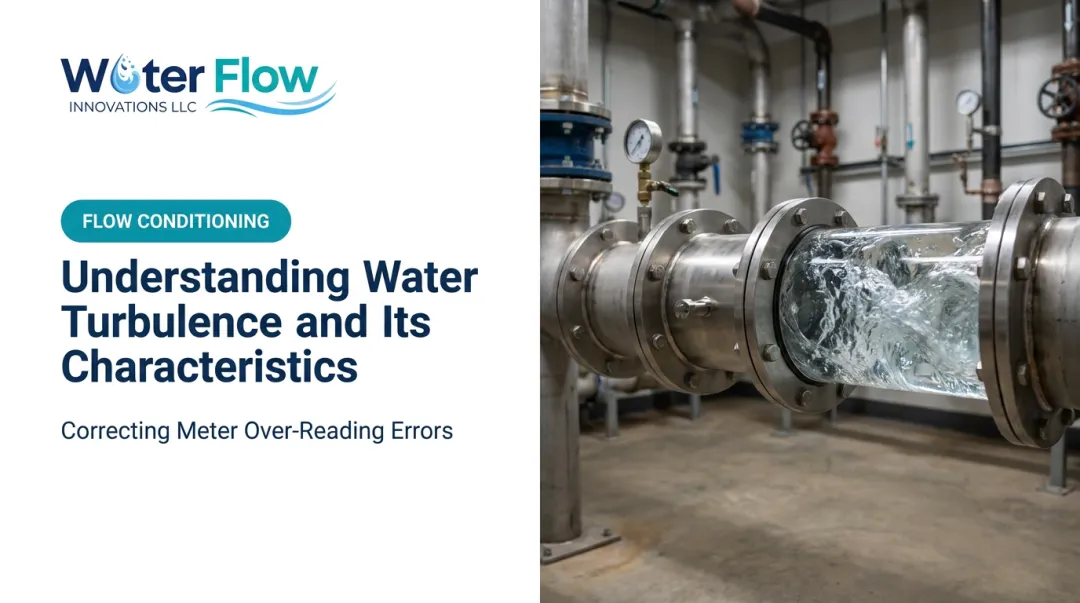
Turbulent flow is chaotic fluid motion filled with eddies, swirls, and constantly shifting velocity and direction — the opposite of smooth laminar layers. Nearly every municipal water main, industrial process line, and commercial HVAC loop operates in this regime. A 2019 water-distribution study confirms that most pipe flows in municipal water systems are turbulent, with only a small fraction operating in laminar or transitional states Shao et al., Advances in Civil Engineering.
That's not necessarily bad news. Turbulence has real upsides:
- Better heat transfer in boilers, cooling towers, and heat exchangers
- Effective mixing for chemical dosing and nutrient distribution
- Stronger wastewater treatment performance — solids stay suspended and aeration improves
Turbulence intensity also isn't all-or-nothing. Transitional flow shows characteristics of both laminar and turbulent behavior, while fully developed turbulent flow is the chaotic, high-Reynolds-number state most industrial systems settle into.
Use Cases of Turbulent Flow
Beyond the mains and process lines already noted, turbulent flow is the norm in:
- Building HVAC recirculation loops
- Industrial batch and continuous process piping
- Large irrigation and agricultural distribution lines
- Campus and municipal distribution networks
Here's the catch: most commercial and industrial water meters are calibrated assuming a specific, stable flow profile. When turbulence — plus air entrainment — disrupts that profile, meter accuracy suffers. According to AWWA, disturbances from elbows, valves, and irregular flow conditions can distort readings, and inferential meters are especially sensitive to velocity profile and swirl AWWA, Opflow.
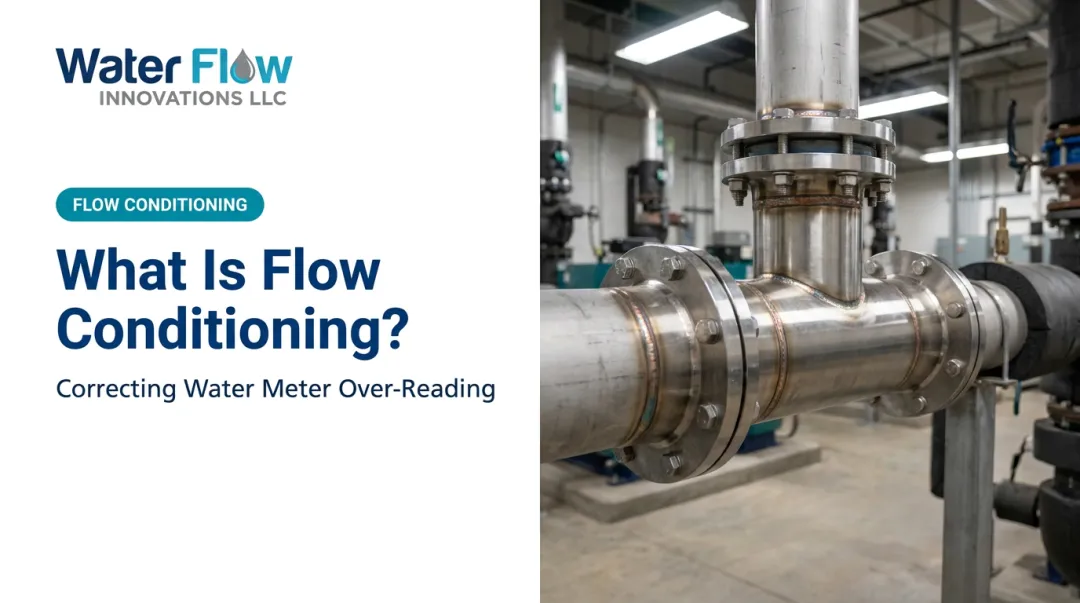
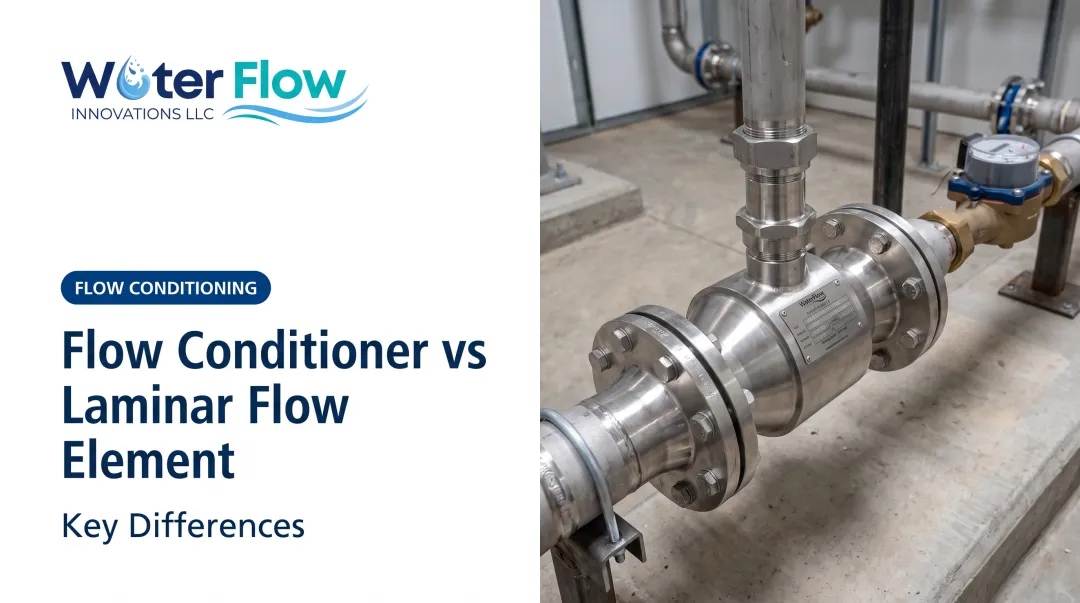
Distorted velocity profiles are what Water Flow Innovation addresses with its Flow Conditioning Device (FCD). Installed on the meter run, the FCD combines four components:
- Air/gas separation — back pressure pushes entrained air and micro-bubbles out of the metered column
- Pressure regulation — smooths on-off cycling surges that pull air into the line
- Check valve — limits reverse flow and water hammer when the installation needs it
- Turbulence elimination — calms vortex flow through the measurement zone

Food & beverage, hospitality, and manufacturing facilities use this to cut meter over-reading from turbulence and air — so billed volume tracks actual consumption more closely.
Laminar vs. Turbulent Flow: Which Is Better?
Neither flow type is universally "better." The right choice depends on:
- Desired outcome: precision measurement vs. effective mixing
- Fluid viscosity: thicker fluids favor laminar behavior naturally
- Velocity requirements: high throughput usually forces turbulence
- Cost: holding a specific flow regime takes deliberate design and operating tradeoffs
When laminar flow wins: Contamination control and measurement precision are critical. Cleanrooms, medical device manufacturing, and pharmaceutical dosing are common examples.
When turbulent flow is preferred: Mixing, heat transfer, or high throughput matter more than smooth layers. That describes most industrial pipelines.
Here's the practical reality for commercial and industrial water systems: turbulence is essentially unavoidable. Pipe diameters, flow velocities, and water viscosity at typical building scale almost always push Reynolds numbers well past 4,000.
Trying to eliminate turbulence outright isn't realistic. Managing its side effects, like meter over-reading, is.
How Turbulent Flow Impacts Water Bills: A Real-World Example
Consider a mid-size hotel or manufacturing plant with a cooling tower, a commercial kitchen, or a CIP (clean-in-place) system. These operations create ideal conditions for meter over-reading:
- Frequent on/off cycling introduces air and micro-bubbles into the line
- Pressure swings from tank fills or wash cycles distort the meter's velocity profile
- Turbulent vortex flow at the meter can register as billable water even when no additional water was consumed
The fix: Installing a flow conditioning device (FCD) immediately after the meter corrects the flow profile in the measurement zone. Installation typically takes about one hour, with no production downtime and negligible pressure loss.
What facilities can expect:
- 5-30% average reduction in water and sewer bills
- Up to 46% savings in the highest documented case
- 90% of customers reach ROI within 12 months
- Savings appear on the very next billing cycle — no ramp-up period

Facilities with cooling towers, CIP systems, pools, or commercial laundry tend to land toward the higher end of that range, because they generate more pressure cycling and entrained air.
You don't need to change water usage habits to see savings. Correcting flow measurement accuracy alone can cut costs. If your facility has unexplained high water bills, a free facility assessment can show whether turbulence-related over-reading is the culprit.
Conclusion
Laminar and turbulent flow each have their place. Laminar flow earns its spot in cleanrooms and precision medical systems. Turbulent flow dominates almost everywhere else, and for good reason: it drives heat transfer and mixing that industrial processes depend on. For commercial and industrial facilities, recognizing turbulence's effect on water metering translates directly into verifiable savings. Those savings show up as a budget line item and a sustainability metric rolled into one.
Frequently Asked Questions
How do you know if flow is laminar or turbulent?
Flow type can be estimated visually (smooth versus chaotic movement) or calculated precisely using the Reynolds number, based on velocity, viscosity, density, and pipe diameter.
Which factors can cause turbulent flow?
High velocity, low viscosity, large pipe diameter, and physical obstructions like valves, elbows, or rough pipe surfaces all push flow toward turbulence.
Does water have turbulent flow?
Yes. Most real-world water systems, including municipal and industrial pipelines, experience turbulent flow due to typical velocities and pipe sizes.
Which flow is better, laminar or turbulent?
Neither is universally better. The ideal flow type depends on the application: precision and contamination control favor laminar, while mixing and heat transfer favor turbulent.
What is laminar-turbulent transitional flow?
Transitional flow is the in-between state, typically Reynolds numbers between 2,300 and 4,000, showing characteristics of both laminar and turbulent flow.
What makes a flow laminar?
Low velocity, high viscosity, and smaller pipe diameter favor laminar flow, producing smooth, parallel, non-mixing layers.
Does turbulent flow change what a facility is billed?
It can. Most meters register whatever passes through them and cannot separate entrained air and gas from water, so turbulence carrying air through the meter is counted as delivered volume and billed accordingly.
What is involved in conditioning that flow at the meter?
A custom-built device is fitted at the municipal supply connection by a licensed plumber or mechanical contractor in about an hour, with a brief water shutoff at the meter connection. Nothing downstream is modified.