
Pick the wrong one and you'll pay for it. Engineers end up with measurement bias, wasted straight-run piping, unnecessary pressure loss, or an expensive re-pipe down the road. This guide breaks down what each device actually does, where each one belongs, and how to decide between them.
Key Takeaways
- Flow conditioners reshape disturbed turbulent flow to mimic a fully developed profile for orifice, thermal, and ultrasonic meters.
- Laminar flow elements (LFEs) force fluid laminar so pressure drop maps linearly to flow rate.
- Core difference: conditioners manage turbulence; LFEs eliminate it by design.
- Choose by flow rate, pipe size, accuracy needs, and whether you need disturbance correction or a precision low-flow instrument.
Flow Conditioner vs Laminar Flow Element: Quick Comparison
| Factor | Flow Conditioner | Laminar Flow Element |
|---|---|---|
| Primary function | Redistributes velocity profile, removes swirl | Forces flow into parallel channels for a linear pressure-flow relationship |
| Flow regime | Turbulent | Laminar (roughly Re < 2,000-2,300, per peer-reviewed Reynolds number research) |
| Common applications | Orifice meters, thermal/ultrasonic gas meters, custody transfer, water utility metering | Pressure-based mass flow controllers, low-flow gas delivery, lab/semiconductor equipment |
| Straight-run requirement | Can significantly shorten upstream straight-run needs versus an unconditioned installation | Built into the instrument body; straight-run isn't the driving factor |
| Pressure drop | Minimized by design while still reshaping the profile | Inherent by design — the pressure differential is the measurement signal |

Straight-run requirements aren't fixed numbers. NIST testing on unconditioned orifice meters found required lengths from 7D after a single elbow (low beta ratio) up to 58D after closely coupled double elbows at high beta ratios.
Conditioners narrow that range considerably. Exact reduction depends on disturbance type, beta ratio, and conditioner design and placement.
What is a Flow Conditioner?
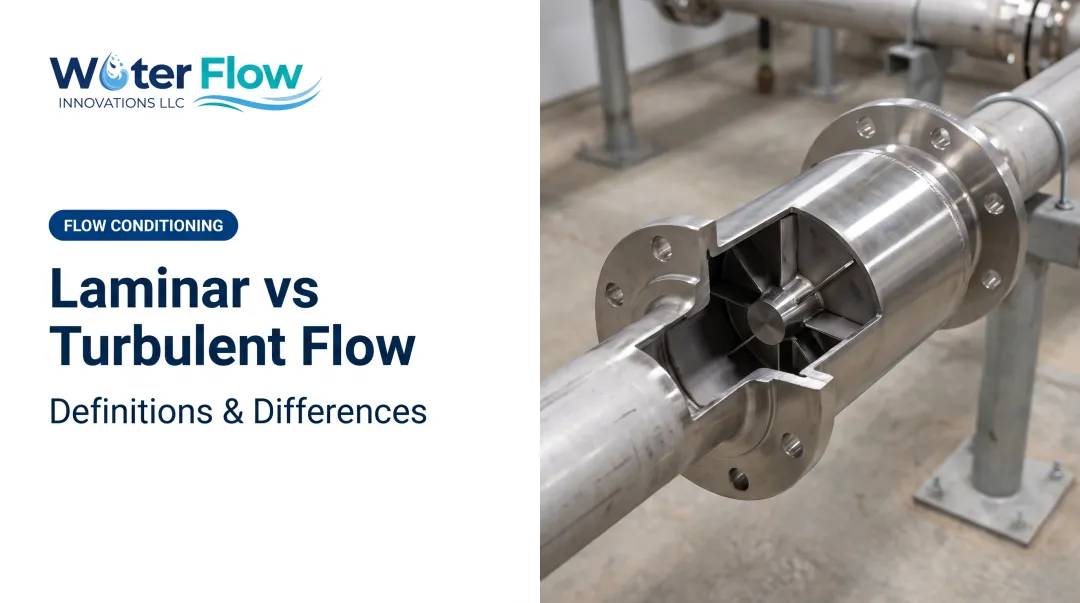
A flow conditioner is a mechanical device, most often a perforated plate or plate assembly, installed inside a pipeline to fix a distorted flow profile at the meter. Elbows, valves, tees, and reducers all leave a fingerprint on the flow: swirl, asymmetric velocity, skewed profiles. A conditioner reshapes that fingerprint back into something predictable.
Straighteners vs. Isolating Conditioners
Per AGA Report No. 3, Section 2.3.1.7, conditioners fall into two camps:
- Flow straighteners (tube bundles, vanes) — remove swirl but have limited ability to fully reproduce the profile the orifice discharge-coefficient tables assume
- Isolating flow conditioners (perforated plates) — remove swirl and redistribute velocity to match that reference profile more closely
For high-accuracy orifice measurement, Axis Measurement notes that AGA and API guidance favor well-developed flow, which isolating plates are built to support.
Vane and tube-bundle straighteners still have a place in less demanding applications where full profile reconstruction is not required.
Beyond Gas Pipelines
Flow conditioning isn't limited to hydrocarbon metering. Water utility metering deals with the same underlying problem: turbulence and air entrainment distort what a meter reads.
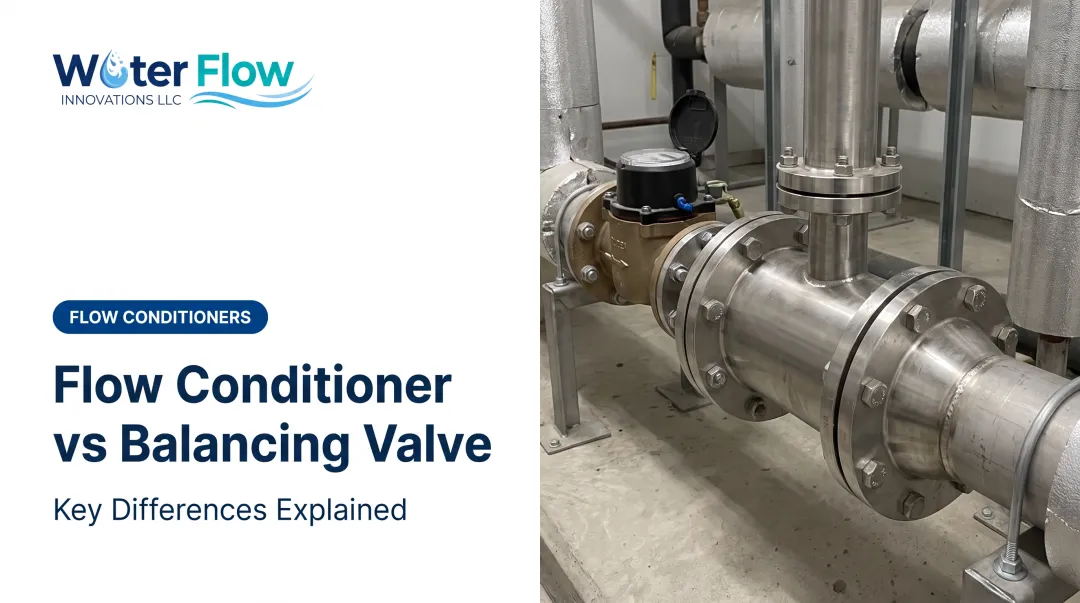
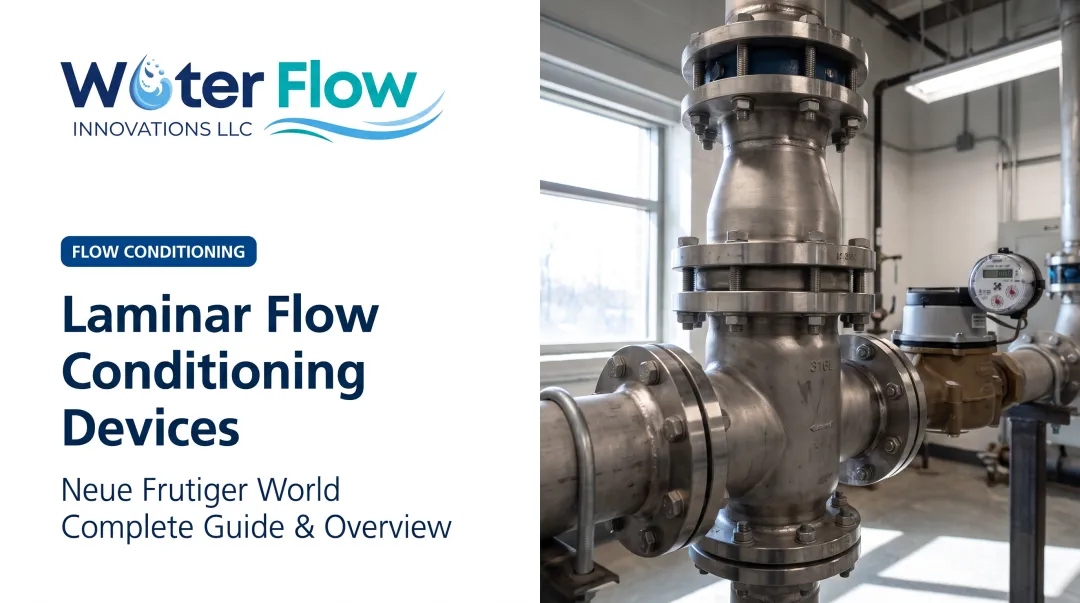
This is where Water Flow Innovation's Flow Conditioning Device (FCD) fits in. The certified, custom-fabricated unit installs at a commercial or industrial water meter and addresses air entrainment, pressure surges, reverse flow, and turbulent vortex flow.
Those conditions can make a meter count more volume than the facility actually receives, and the design does it without a measurable impact on downstream system pressure.
Use Cases of Flow Conditioners
- Industrial gas/liquid pipelines with orifice, ultrasonic, or thermal meters where full straight-run isn't physically available
- Commercial/industrial water metering, where turbulence and air bubbles inflate billed consumption
- Retrofit installations where re-piping to gain straight-run distance is cost-prohibitive
How well a conditioner works still depends on layout. NIST Technical Note 1367 tested a 52 mm orifice meter with a single elbow 17D upstream and found a -0.74% discharge-coefficient deviation from baseline with no conditioner installed.
Adding a 19-tube bundle 12D upstream of the orifice (just 5D downstream of the elbow) brought the coefficient back to essentially baseline. The same testing showed 12D wasn't always enough at larger beta ratios. Conditioner performance is configuration-specific, not a guaranteed fix regardless of placement.

What is a Laminar Flow Element?
A laminar flow element (LFE) is a precision component, typically a bundle of capillary tubes or an etched-plate stack, that forces fluid through narrow parallel channels. This lowers the Reynolds number enough to guarantee laminar flow, where pressure drop scales linearly with flow rate under the Hagen-Poiseuille relationship.
With a pressure differential reading across the element, you can calculate volumetric flow directly.
Two Design Approaches
- Full-flow LFEs: All incoming flow passes through the capillary array; a differential-pressure sensor reads the total drop. Alicat's design works this way, and its product line spans 0.5 SCCM to 12,000 SLPM full scale.
- Bypass-style LFEs: Used in thermal mass flow meters. A small, matched fraction of flow is diverted through a sensor tube in parallel with the bypass element, and total flow is inferred from the calibrated split ratio.

Use Cases of Laminar Flow Elements
- Semiconductor manufacturing: NIST-documented working LFEs operate across 1-1,000 sccm with flow uncertainty around 0.15%
- Life sciences and lab instrumentation: Stable, repeatable flow without dependency on gas thermal properties
- Precision low-flow gas delivery: Bronkhorst's bypass LFEs cover under 1 mL/min up to 20 L/min
That range illustrates the niche well: LFEs aren't built for high-volume industrial pipeline flow. They're built for situations where sub-percent repeatability at very low flow rates actually matters.
Flow Conditioner vs Laminar Flow Element: What's Better?
Neither option wins in every case. The right choice comes down to four questions:
- What flow regime are you actually dealing with? Turbulent industrial or utility flow points toward a conditioner. Naturally low-flow, clean gas applications point toward an LFE.
- How much straight-run do you have? Constrained piping layouts favor a conditioner that can shrink the required upstream distance.
- What accuracy level do you need, and at what flow rate? Sub-1% repeatability at sccm-level flows is LFE territory.
- Are you correcting a disturbance, or building the measurement principle? Conditioners fix an existing turbulent profile. LFEs create the laminar condition that pressure-based calculation needs.
Choose a flow conditioner when you need to:
- Retrofit an orifice, thermal, or ultrasonic meter in a turbulent line with limited straight-run
- Correct suspected water meter over-registration from turbulence and entrained air
Choose an LFE when you need to:
- Spec a pressure-based mass flow controller for clean, dry gas at low flow rates
- Support precision work such as semiconductor tools or lab instrumentation
Real-World Example: Correcting Water Meter Over-Reading with Flow Conditioning
Consider a mid-size hotel or food-processing facility with water and sewer bills that keep climbing despite no obvious change in operations. Maintenance checks the fixtures, looks for leaks, finds nothing. The usage numbers on the meter simply don't match what the facility believes it's consuming.
This is a common pattern. Turbulent flow near the meter — from nearby elbows, valves, pump cycling, or CIP operations — combined with entrained air can cause a meter to spin faster than the actual water passing through it.
Peer-reviewed testing on water meters during pipe-refilling events found over-registration of 0.45 to 0.86 m³ (about 120–230 gallons) per filling event, with air driving meter rotation at roughly 14 times the equivalent water-flow velocity in some cases.
Rather than replacing the meter or re-piping the facility, the fix is a certified flow conditioning device installed immediately after the meter:
- A free bill review identifies whether usage patterns suggest over-registration
- A custom-fabricated FCD is sized to the facility's exact pipe and meter specifications
- Installation takes about one hour, with only a brief water shutoff
- Savings show up on the next billing cycle, with no waiting or ramp-up period
Documented results across installations average 5-30% reduction in combined water and sewer costs, with a highest recorded result of 46%. Most customers reach full ROI in under 12 months.

Over-billing from meter distortion is usually invisible until someone audits the bills. If your facility's water costs feel disconnected from actual usage, that's worth a second look. Water Flow Innovation offers a no-cost bill review to check.
Conclusion
Flow conditioners and laminar flow elements serve opposite flow regimes and different goals. One manages turbulence upstream of a meter or process. The other removes it entirely so a laminar measurement principle can work.
The right choice avoids wasted straight-run piping and prevents measurement error. In water applications, it also stops meter over-reading that can drive over-billing for years unnoticed.
Frequently Asked Questions
What is a flow conditioner?
A flow conditioner is a device, usually a perforated plate, installed in a pipeline to redistribute a disturbed flow profile. It restores a repeatable, near-fully-developed turbulent profile ahead of a measurement device.
What is a laminar flow element?
A laminar flow element (LFE) is a precision component that forces fluid through small parallel channels into a laminar regime. That creates a linear relationship between pressure drop and flow rate, so flow can be calculated directly.
What are the different types of flow elements?
Common measurement devices include orifice plates, laminar flow elements, and thermal mass flow elements. Flow conditioners or straighteners stabilize the profile those devices measure.
What are the two types of laminar flow elements?
Bypass-style LFEs divert a small, matched fraction of flow through a sensor tube for measurement. Full-flow LFEs route the entire flow through the capillary array for a direct pressure-drop reading.
Can a flow conditioner improve water meter accuracy?
Yes. Certified flow conditioners correct turbulence, air entrainment, and pressure surges that cause water meters to over-register. That cuts inflated water and sewer bills without changing actual usage.
How do I know if I need a flow conditioner or a laminar flow element?
It depends on your flow regime and goal. Turbulent industrial or utility flow calls for a conditioner; low-flow, pressure-based precision gas control calls for an LFE.
Where in the line does the conditioner belong for utility billing?
At the municipal supply connection, immediately after the billing meter and upstream of the facility's systems, custom-built to the site. It sits on the service line rather than inside a process measurement loop.
What approvals should such a device hold on potable water?
Certification to IAPMO, NSF, ANSI, CAN 61, KIWA, GMP, and SQF, plus EPA WaterSense compliance. The unit is built from 316L stainless steel in the USA.