Introduction
Chemical processing plants run on precision. Dosing pumps need exact water volumes. Cooling loops need stable flow. Cleaning cycles need consistent pressure.
Yet turbulence, swirl, or entrained air moving through the pipe upstream can quietly throw off every one of those numbers.
Utility costs keep climbing. Wastewater service costs rose 4.4% in 2025, outpacing inflation by 1.8 percentage points, according to NACWA's Cost of Clean Water Index.
Stricter EPA discharge and dosing-compliance rules, plus equipment wear from turbulent flow, make flow distortion an expensive problem to ignore.
This article breaks down what water flow conditioning actually does, why it matters specifically in chemical processing, the main technique categories available, and how to pick the right one for your pipe run and budget.
Key Takeaways
- Flow conditioning corrects turbulence, swirl, and entrained air at the meter, dosing pumps, or process equipment
- Poor flow conditions distort metering accuracy, skew chemical dosing ratios, and accelerate equipment wear
- Three main categories: mechanical straighteners, perforated plate conditioners, and integrated multi-stage systems
- Choose based on distortion root cause, available straight-pipe run, and certification needs
- Certified systems like Water Flow Innovation's FCD correct meter over-reading and cut utility bills without affecting production
What Is Water Flow Conditioning?
Water flow conditioning refers to engineered devices or techniques installed inline to normalize a fluid's velocity profile, strip out swirl, remove entrained air or gas, and stabilize pressure before the water reaches sensitive downstream equipment.
It corrects problems created by real piping conditions: elbows that induce swirl, tees that split flow unevenly, pumps that inject turbulence, and partially open valves that distort the velocity profile.
Where it's typically installed:
- At the flow meter, to protect billing and process accuracy
- Ahead of chemical dosing pumps, where flow instability skews concentration
- Before static mixers, heat exchangers, and reactor feed lines, where uniform flow improves performance
- In front of control valves, where turbulent inlet flow causes erratic response
Every one of these components was designed and calibrated assuming a uniform, fully developed flow profile. Real piping rarely delivers that on its own — which is exactly the gap flow conditioning fills.
Why Is Flow Conditioning Important in Chemical Processing?
Accurate flow directly supports three things chemical facilities depend on: correct dosing ratios, reliable utility billing, and clean regulatory or ESG reporting. When flow is turbulent, swirling, or carrying entrained air, meters can over- or under-register. Every downstream calculation built on that number inherits the error.
How Meter Errors Actually Add Up
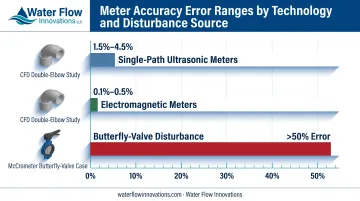
Disturbed flow creates more than minor noise. A CFD-based study of a double-elbow configuration found flow-rate bias of 1.5% to 4.5% for single-path ultrasonic meters and 0.1% to 0.5% for electromagnetic meters. Those results applied when the meter sat less than 40 pipe diameters downstream of the disturbance (Weissenbrunner et al., 2016).
Some real-world disturbances are far worse. McCrometer documented cases where a butterfly valve caused errors exceeding 50% on certain meter types. The direction of error (over- or under-reading) depends heavily on meter technology and disturbance type (McCrometer, 2023).
What this means on the plant floor:
- Wrong chemical concentration when dosing pumps run off an inaccurate flow signal
- Wasted chemical inventory, or under-treatment that creates compliance exposure
- Inflated water and sewer bills when meters over-register
- Faster wear on valve seats, pump seals, and meter internals, raising long-term maintenance costs
Left unaddressed, these effects compound quietly. A slightly wrong dosing ratio rarely trips an alarm; it just costs money and creates risk over months, not minutes.
Types of Water Flow Conditioning Techniques
Flow conditioning isn't one-size-fits-all. Swirl, profile distortion, air entrainment, and pressure fluctuation are four different problems, and each responds better to a different fix. Facilities often select or combine techniques based on pipe geometry, chemical properties, and how tight the accuracy requirement is.
Type 1: Mechanical Flow Straighteners
Mechanical straighteners are passive tube-bundle or vane-type devices installed inline to remove rotational swirl. Water is forced through multiple parallel channels or vanes that dampen the rotational velocity component, untwisting the flow.
They're purely mechanical, with no moving parts and no active correction for anything other than swirl. ISO 5167-2 specifies a common design: a 19-tube bundle with outside diameter between 0.95D and D, and tube length of 2D to 3D.
Strengths:
- Low cost and virtually no maintenance
- Effective, reliable swirl removal
- Simple to specify and install
Trade-offs:
- Requires generous straight-pipe runs: some ISO configurations call for at least 30D between the fitting and the meter
- Does nothing for air entrainment or pressure surges
- A 2023 CFD study found tube bundles can generate strong jets and blockage effects immediately downstream, even while successfully removing helical motion (Yin et al., 2023)
Best suited for lines with adequate straight-pipe length where swirl from an upstream elbow or pump is clearly the dominant problem — not a stand-in for a broader flow-quality fix.
Type 2: Perforated Plate / Multi-Hole Flow Conditioners
A perforated plate conditioner uses a calibrated pattern of holes across the pipe cross-section to flatten the velocity profile in a short distance. Flow gets forced through variably sized holes engineered to redistribute velocity toward something closer to a fully developed profile — fast.
This is profile correction, not primarily swirl removal, and it comes with a real trade-off: higher permanent pressure loss. Typical thick perforated plates carry pressure-loss coefficients around 2 to 5, generally higher than tube bundles (Brown et al., 2013, FLOMEKO technical paper).
Strengths:
- Much shorter installation footprint than straighteners. Some ISO plate configurations need as little as 17D versus 30D for tube bundles
- Corrects profile distortion caused by nearby valves or elbows quickly
- Widely documented in metering standards, so specification is straightforward
Trade-offs:
- Higher pressure drop than mechanical straighteners
- Holes can foul or clog in chemical slurries carrying particulates
- Still limited help for air entrainment or pressure surges
This makes perforated plates a strong fit for space-constrained retrofits upstream of a flow meter, where there simply isn't room for a long straight run — provided the process water is reasonably clean.
Type 3: Integrated Multi-Stage Flow Conditioning Systems
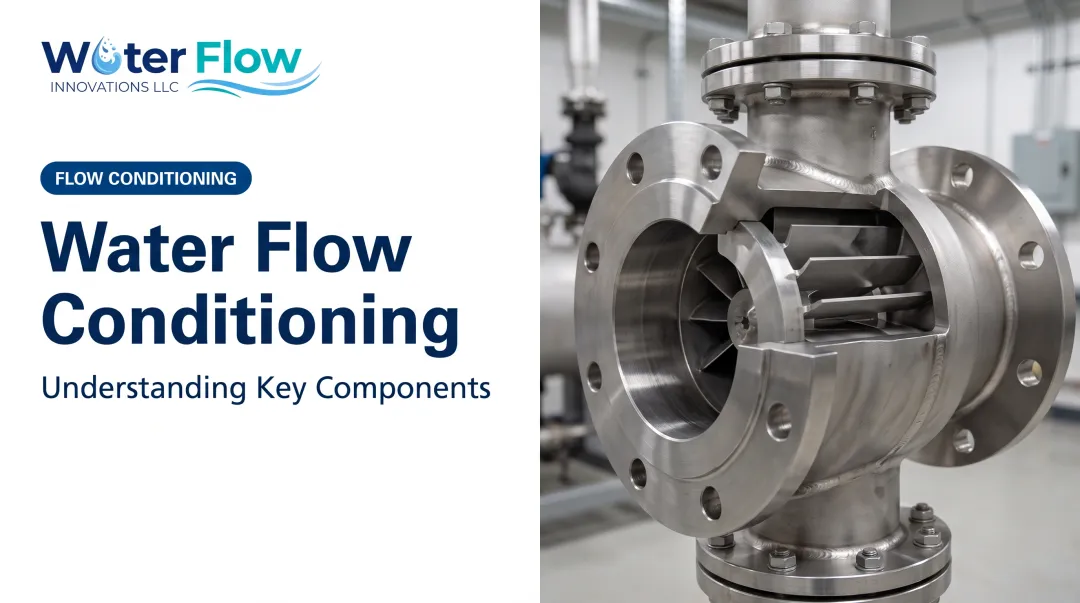
Integrated multi-stage systems combine several corrective functions — air and gas elimination, pressure regulation, backflow prevention, and turbulence elimination — inside a single inline device. Instead of fixing one root cause, they address several at once.
How the correction sequence typically works:
- Air and gas separation creates static back-pressure that establishes laminar flow back through the meter, so the meter reads a homogeneous water column instead of a water-air mixture
- Pressure regulation smooths water hammer and pressure surges from pump cycling or variable demand, preventing new air from being reintroduced
- A check valve blocks reverse flow through the meter, since reverse flow is a common way air re-enters the line after initial purging
- Turbulence elimination slows velocity at the meter just enough to prevent vortex flow — the spinning pattern that causes meters to over-count, especially during CIP cycles or tank filling
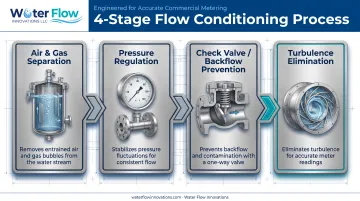
Water Flow Innovation's Flow Conditioning Device (FCD) is built around this four-component sequence. It's fabricated in 316L stainless steel (titanium and specialty alloys available on special order) and certified to IAPMO, NSF, ANSI, CAN 61, KIWA, GMP, and SQF standards — a certification spread that matters for chemical plants producing food-grade, pharmaceutical-grade, or regulated chemistries.
Key strengths:
- Corrects meter over-reading at the source rather than just flattening a velocity profile
- Negligible pressure loss: conditions flow without restricting it, so cooling-tower makeup, reactor cooling supply, and steam feed pressure stay unchanged
- No production shutdown required; installation takes about 1 to 2 hours after the municipal meter, ahead of internal distribution
- Documented savings for chemical manufacturing customers average 5% to 30% (highest recorded 46%)
- About 90% of customers reach ROI in under 12 months, with savings on the next billing cycle
Trade-offs:
- Higher upfront investment than a passive straightener. FCD units are custom made, sized to pipe diameters from NPS 1/2" to 12"
- Primary value is metering accuracy, billing correction, and equipment protection rather than lab-grade profiling for analytical instrumentation
Reactor cooling cycles, steam pressure events, and CIP demand swings often drive both dosing inconsistency and inflated utility bills. In those plants, this category solves more problems per install than either passive alternative.
How to Choose the Right Flow Conditioning Technique
The right technique depends on your specific distortion problem, piping constraints, and desired outcome — not on which device is most familiar or most talked about.
Factors to Consider
- Diagnose the root cause first. Determine whether swirl, profile distortion, air entrainment, or pressure fluctuation is actually driving your accuracy problem before you spend on a fix
- Assess your straight-pipe run. Mechanical straighteners typically need the longest upstream distance; perforated plates need less; integrated systems are generally the most space-efficient
- Weigh budget against payback period. A $2,000 straightener and a $15,000 integrated system solve very different problems — match spend to the actual issue, not the biggest available fix
- Check certification requirements. NSF/ANSI, IAPMO, and CAN 61 matter most for facilities producing food-grade, pharmaceutical, or export-regulated chemistries
What to Check Before Finalizing Your Choice
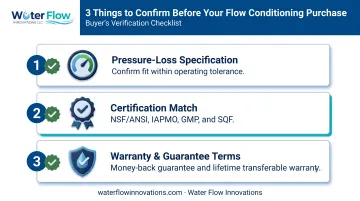
Don't default to a multi-stage system when a simple mechanical straightener would fix pure swirl. Before you commit budget, confirm three things:
- Pressure-loss specification fits your operating tolerance. A perforated plate's pressure-loss coefficient of 2-5 may be fine for one process and unacceptable for another
- Certifications match your compliance needs. For chemical processing, NSF/ANSI and IAPMO are usually the first items a procurement or QA team checks; GMP and SQF matter more for food-grade or pharmaceutical-intermediate producers
- Warranty and guarantee terms are documented. Water Flow Innovation backs the FCD with a 6-month money-back guarantee (device cost only, no questions asked) and a lifetime transferable warranty that stays with the equipment through any ownership change
Water Flow Innovation offers a free savings analysis that reviews your water bills, meter type, pipe size, and operating profile so you can confirm which conditioning approach fits before you buy.
Conclusion
Flow conditioning keeps dosing ratios accurate, meters honest, and equipment from wearing out ahead of schedule in chemical processing. Different root causes call for different fixes, from a simple mechanical straightener for a pure swirl problem to an integrated multi-stage system when air entrainment, pressure surges, and turbulence occur together.
Facilities evaluating options for metering accuracy and utility savings can request a free water bill review and savings analysis from a certified provider like Water Flow Innovation. That review identifies the right fit for pipe size and process demands, with no purchase commitment required to get the numbers.
Frequently Asked Questions
What is a chemical feed pump?
A chemical feed (dosing) pump injects precise, metered amounts of chemicals into a water or process stream. Its dosing accuracy depends heavily on stable, well-conditioned upstream flow. Turbulence or entrained air can throw off the ratio.
What chemicals are used to treat chilled water systems?
Chilled water treatment typically involves corrosion inhibitors, biocides, and scale inhibitors. Accurate dosing of each depends on consistent flow conditions upstream of the injection point.
What causes water meters to over-read in chemical processing facilities?
Entrained air or gas bubbles, turbulence, and pressure surges from pumps and valves can cause a meter to register more volume than actually passed. Reactor cooling cycles and steam system events are common culprits in chemical plants specifically.
How much straight pipe length do flow conditioners typically need?
Traditional mechanical straighteners often need 20 to 30+ pipe diameters of straight run to work effectively. Compact perforated plates need less, and integrated multi-stage systems are generally designed for tight installation footprints.
Can water flow conditioning reduce utility bills without changing actual water usage?
Yes. Correcting meter over-reading lowers billed volume, not actual consumption. Water Flow Innovation customers in chemical manufacturing typically see 5% to 30% savings, with most reaching ROI in under 12 months.
Do flow conditioning devices affect water pressure or production output?
Well-designed integrated conditioners, like the FCD, are engineered for negligible pressure loss. Installation happens at the municipal meter connection, so cooling, process water, and steam systems remain unaffected.
What sizes and materials is the FCD available in?
The FCD is custom-built for each plant and installed at the municipal supply connection, upstream of cooling, process water, and steam systems. Construction is 316L stainless steel, made in the USA.
Is flow conditioning the same as chemical water treatment?
No. Treatment changes what is in the water — corrosion inhibitors, biocides, scale control. Flow conditioning changes only how the water moves, removing entrained air and turbulence so the meter measures accurately. It alters no water chemistry and affects no dosing ratio.