
Facility managers rarely think about this until the water bill looks wrong. The meter isn't broken. It's reading a distorted flow profile, and in many cases, that means facilities are paying for water they never used. This guide breaks down how velocity profile conditioners actually work mechanically, not just what the marketing claims.
Key Takeaways
- A velocity profile conditioner reshapes turbulent or swirling flow into a stable pattern at the meter
- Piping disturbances like elbows and valves can cause meters to over-read actual usage
- Conditioning happens in stages: initiation, core operation, regulation, and output
- Velocity profile conditioners install immediately after the main meter in commercial, industrial, and municipal facilities
- Correcting the flow profile, not replacing the meter, is often the real fix for inflated bills
What Is a Velocity Profile Conditioner?
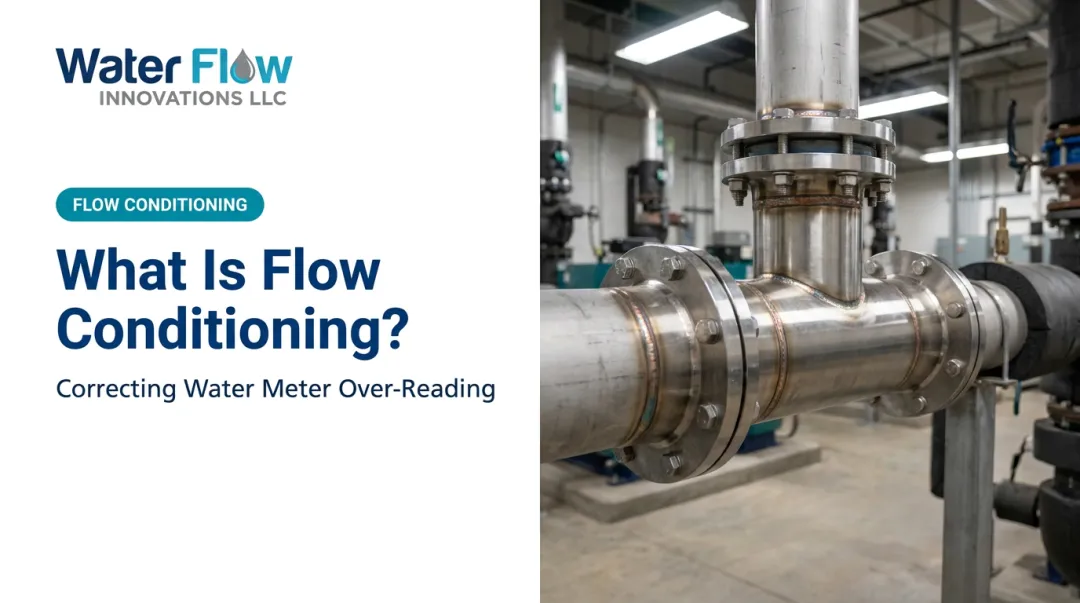
A velocity profile conditioner is a device installed in a pipeline that reshapes turbulent, asymmetric, or swirling flow into a stable, predictable velocity profile at the meter or measurement point. Think of it as a translator between messy real-world plumbing and a meter that was calibrated under ideal lab conditions.
Here's why that matters: elbows, valves, tees, and pumps all distort flow. A 2023 peer-reviewed study of large water meters found that disturbances like Y-filters and double elbows could shift meter readings by as much as 15% in either direction, depending on the meter technology and spacing involved.
What it's not:
- A filter — it reshapes flow; it does not remove particulates
- A standalone pressure regulator — though some multi-stage systems include one
- A long straight pipe run — it delivers similar correction in far less space
Why They're Still Needed Today
Modern ultrasonic and electromagnetic meters are more sophisticated than older mechanical models, but they still need a reasonably stable inlet condition to read accurately. Most real facilities simply don't have 10-20 pipe diameters of straight run available before the meter. That space constraint is exactly why conditioners exist.
Common Types
- Tube bundles — reduce swirl using multiple parallel tubes
- Honeycomb or straightening vanes — break up circumferential motion
- Perforated plates — redistribute velocity across the pipe cross-section, though they add some pressure loss
- Multi-stage systems — combine several correction methods in one unit; Water Flow Innovation's FCD addresses turbulence, air entrainment, and pressure together

How Does a Velocity Profile Conditioner Work?
Conditioning isn't a single action. It happens through a sequence of stages inside the pipeline, all before flow reaches its destination.
Initiation
Conditioning starts the instant water enters the device, right after it's passed a disturbance like an elbow, tee, or pump. The process runs continuously and automatically, with no operator input required.
The most common driver is insufficient straight pipe upstream of the meter. The conditioner essentially substitutes for that missing straight run.
Core Operation
The central job here is breaking up swirl and turbulence, then redistributing velocity evenly across the pipe's cross-section. For water systems, this can involve:
- Air or gas separation
- Turbulence reduction elements
- Directional flow correction
A flatter, more symmetric velocity profile means the meter downstream sees flow much closer to the calibrated reference condition it was designed for.
Regulation and Control
Well-designed conditioners maintain consistent output even as flow rates and pressures shift throughout the day. Components like check valves and pressure regulation elements help keep things stable without disrupting overall system performance.
This stage matters because a poorly regulated conditioner could actually introduce new turbulence or unwanted pressure loss — defeating its own purpose.
Output and Result
The end result is a stable, repeatable flow profile presented to the meter. That corrected profile allows the meter to register only the water actually delivered, rather than an inflated reading caused by turbulence or air entrainment.
A 2020 laboratory study found that a 90%-closed butterfly valve placed immediately upstream of one ultrasonic meter produced errors as extreme as +293%. Real facility conditions are rarely that severe, but the study confirms the mechanism is real and measurable.

Why Flow Profile Distortion Leads to Inflated Water Bills
Most commercial and industrial meters are calibrated in lab conditions using ideal straight-run flow. Real facility piping almost never replicates that setup.
Turbulence and air entrainment can cause velocity- and inferential-type meters to register higher flow than what's actually passing through. That directly inflates water and sewer charges—often by 5–30%, with documented cases up to 46%.
Common causes of a distorted flow profile include:
- Elbows, tees, and valves installed too close to the meter
- Air entrainment from pumps, tanks, or elevation changes
- Sudden pipe-diameter changes that create swirl
- Insufficient straight-run length upstream of the meter
Here's the tricky part: the issue is often invisible. The meter isn't malfunctioning—it's doing exactly what it was built to do. It's reading a distorted flow profile, which is why so many facilities never think to question the bill.
Where Velocity Profile Conditioners Are Used
Conditioners are typically installed immediately after the main water meter, right after the service entry point into a facility. That placement gives the unit the best chance to correct flow at the measurement point.
They fit especially well when:
- Retrofit sites lack room for long straight-pipe runs
- Lines range from small commercial branches to large industrial mains
- Meters are mechanical, ultrasonic, or electromagnetic
Industry Variation
Manufacturing plants, hotels, hospitals, multifamily buildings, and municipal facilities use flow conditioning for the same core reason: accuracy at the meter. The mechanical principles stay consistent across sectors.
What changes by site is practical, not theoretical:
- Pipe size and available lay length
- Meter type and manufacturer requirements
- Layout of elbows, valves, and other upstream disturbances
How Water Flow Innovation's FCD Corrects Distorted Flow Profiles
Water Flow Innovation's Flow Conditioning Device (FCD) is a certified velocity profile conditioner that corrects distorted flow at the meter—stopping the over-reading that inflates water and sewer bills.
The FCD uses a four-component system:
- Air and gas separation — keeps entrained air away from the measurement zone
- Pressure regulation — manages flow and pressure entering the meter, reducing water hammer
- Check valve (on select models) — prevents reverse flow and additional hammer
- Turbulence elimination — slows velocity enough to prevent vortex formation at the meter
These components work together in a negligible pressure loss design. Facilities see no impact on water delivery or system performance.

Certifications:
- IAPMO
- NSF International
- ANSI
- CAN 61
- KIWA
- GMP
- SQF
Installation typically takes about one hour for straightforward configurations. More complex industrial setups can take longer.
The FCD is custom-fabricated for any pipe size from 1/2" to 12" and works with any meter type. Every unit includes:
- A 6-month money-back guarantee
- A lifetime transferable warranty that stays with the property through ownership changes
Documented results include:
- 5–30% average reduction in water and sewer bills
- 46% highest documented savings
- Full ROI within 12 months for roughly 90% of customers
Conclusion
Understanding flow profile distortion explains why a meter can register more water than a facility actually used. Turbulence, swirl, or air entrainment upstream distorts the signal the meter receives, so the reading no longer matches true volume.
For facilities evaluating high water costs, the smarter first step is checking whether the flow profile reaching the meter can support an accurate reading—before blaming usage patterns. A conditioned velocity profile lets the meter measure what actually passes through the pipe.
Frequently Asked Questions
What is the typical velocity profile for turbulent flow?
Turbulent flow lacks the smooth, parabolic shape of laminar flow. It shows a flatter central profile with a steep velocity gradient near the pipe wall. The pattern is chaotic but statistically predictable, and conditioners normalize it for accurate metering.
How do I know if my facility's water meter is over-reading?
Watch for unexplained high water or sewer bills that don't match your actual usage patterns. A flow conditioning assessment can help identify whether profile distortion is inflating your readings.
Does installing a velocity profile conditioner affect water pressure or system performance?
Properly engineered conditioners, like the FCD, are designed for negligible pressure loss. Facilities typically see no disruption to water pressure or daily operations.
How long does it take to install a flow conditioner?
Installation typically takes about one hour for straightforward configurations, with a brief water shutoff at the meter connection and no major plumbing changes required. More complex industrial setups may take longer.
Can a velocity profile conditioner work with any type of water meter?
Yes. Conditioning addresses the flow profile itself, so it works across mechanical, ultrasonic, and electromagnetic meters without requiring meter replacement.
How quickly can facilities expect to see savings after installation?
Corrected readings typically show up on the very next billing cycle, since the fix addresses measurement accuracy immediately rather than requiring a ramp-up period.
What approvals should a conditioner on a potable line hold?
Certification to IAPMO, NSF, ANSI, CAN 61, KIWA, GMP, and SQF, together with EPA WaterSense compliance. The unit is fabricated from 316L stainless steel in the USA.
Can conditioning be standardized across an estate of sites?
Yes. Every site with its own metered municipal connection is a separate installation, so results compound and the before-and-after billing evidence aggregates cleanly for corporate benchmarking and capital planning.