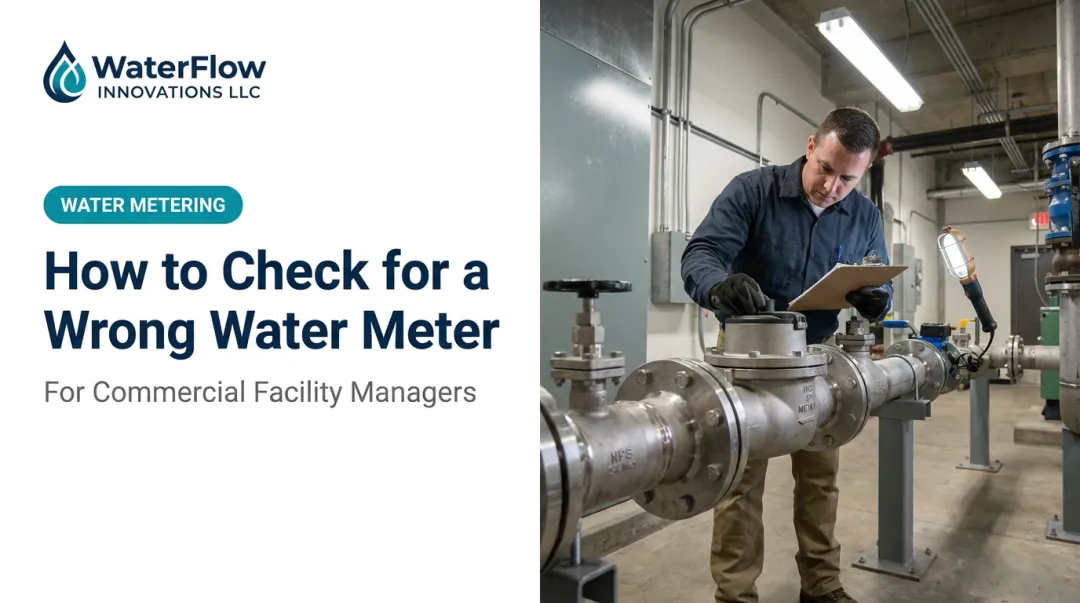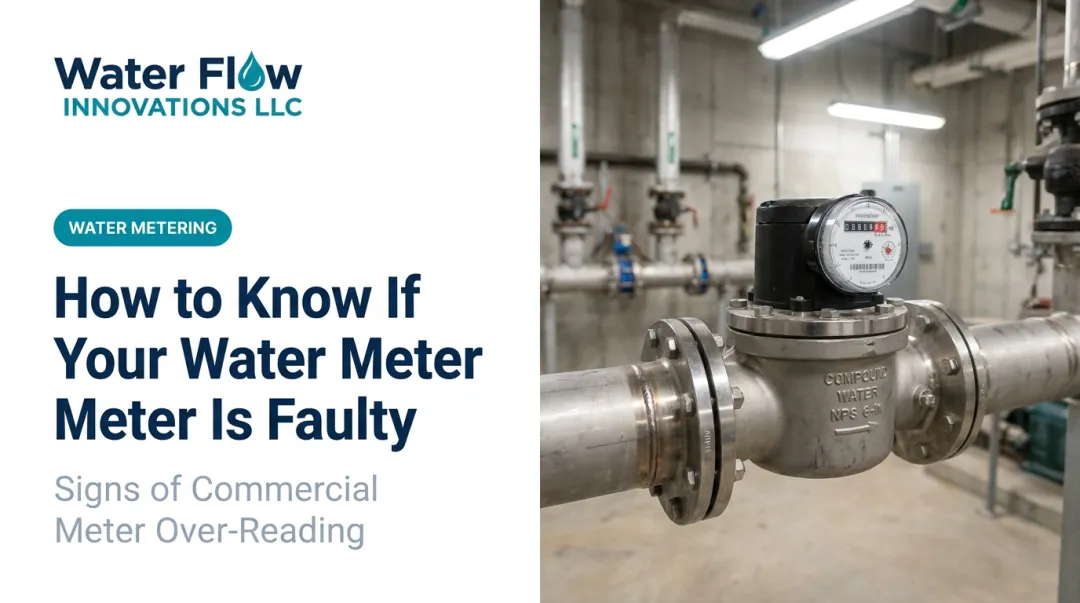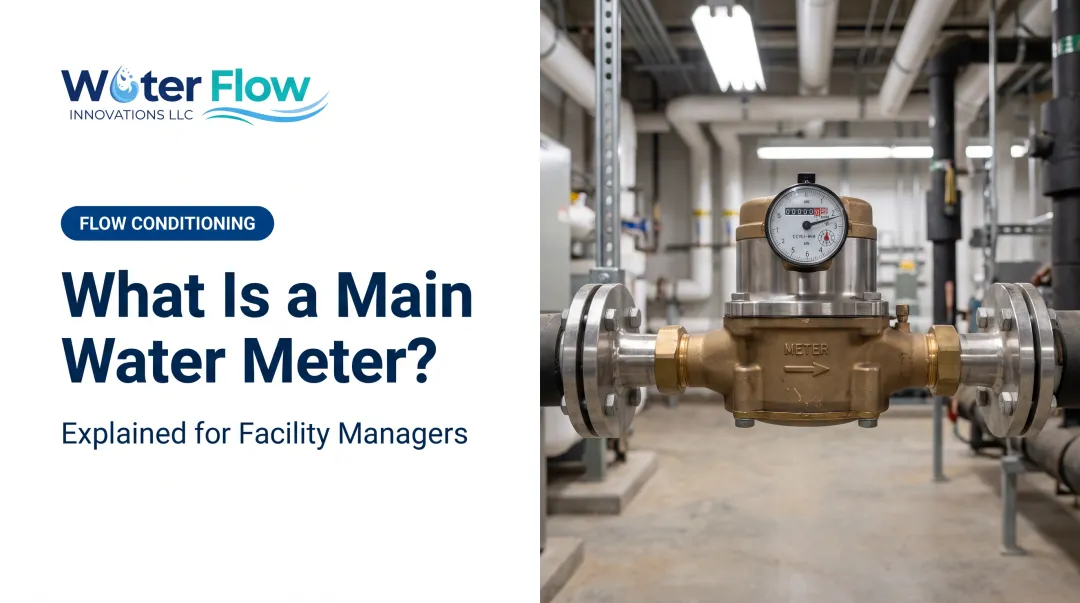

Meters degrade for a handful of predictable reasons: age, internal wear, debris, poor installation, or electronic faults in the case of smart meters. None of these announce themselves loudly.
This guide walks through the six most common signs of a faulty water meter, how to confirm the problem before calling anyone, whether you should fix or replace it, and how to prevent it from happening again.
Key Takeaways
- Six signs to watch: bill spikes, physical damage, meter-area leaks, bad digital readouts, odd noises, abnormal fixture pressure
- Fix or replace? Cosmetic wear can often be monitored; confirmed inaccuracy usually means replacement
- Confirm before you call: rule out leaks first, then run a bucket test and track readings for several days
- Who to contact: commercial facilities usually start with the utility; high-usage sites may need a metering specialist
What Is a Water Meter and How Should It Work?
A water meter records the volume of water passing into your facility so the utility can bill accurately.
Three main types exist:
- Mechanical (positive-displacement) meters: use a nutating disc or piston that displaces a fixed volume with each cycle. Common on smaller service lines.
- Turbine and jet meters: count rotor revolutions caused by water striking internal blades. Common in larger commercial applications.
- Ultrasonic and electromagnetic meters: have no moving parts. They infer flow acoustically or through electromagnetic signals.
A meter does not have to be broken to bill you incorrectly. According to a manufacturer summary of AWWA accuracy standards, meters should register within 98.5%–101.5% at normal flow, with different low-flow tolerances by meter type.
Drift outside that range—or errors from turbulence and air in the line—can inflate readings with no visible malfunction.

6 Signs of a Faulty Water Meter
Most meter faults follow a handful of predictable, observable patterns. Catch these early and you'll save yourself months of overpayment.
Sign 1: Unexplained Spike in Water Bills
Your bill jumps sharply, but nothing in your facility has changed. Same occupancy, same fixtures, same habits.
Likely causes:
- Internal meter fault causing over-registration
- A hidden leak between the meter and your fixtures
- Tampering (rare, but it happens)
- Turbulent or aerated flow causing the meter to register air as water
That last cause is easy to overlook. A meter can be functioning exactly as designed and still bill you for volume you never used, simply because of how the water is moving when it passes through.
Sign 2: Visible Damage, Corrosion, or Cracks on the Meter Body
Walk out and look at the meter itself. Rust on the housing, hairline cracks, a fogged-over dial you can't read clearly — these are all red flags.
Common causes:
- Age and normal wear
- Freezing temperatures
- Improper installation
- Poor water quality eating away at internal components over time
Sign 3: Water Leakage Around the Meter
Pooling water or a consistently damp patch of ground (or floor, for indoor meters) near the housing usually points to a poor seal or a ruptured internal fitting.
This isn't always a metering accuracy problem; it's often an installation or hardware issue. Either way, it needs attention before it causes structural or water-quality problems.
Sign 4: Abnormal or Blank Digital Display
Smart and electronic meters can fail in ways mechanical meters can't: a blank screen, frozen numbers that never update, or a garbled readout.
Usual suspects:
- Dead or low battery
- Sensor or circuit failure
- Communication line issues between the meter and the utility's network
A dead display doesn't automatically mean the underlying measurement is wrong. It often just means the meter, register, and communication endpoint need to be diagnosed separately.

Sign 5: Unusual Noises Coming From the Meter
Clicking, humming, or rattling near the meter box is worth investigating.
Likely causes:
- Debris caught in the internal mechanism
- Damage to moving parts
- Unstable supply pressure shaking the assembly
Sign 6: Abnormal Water Pressure at Fixtures
Flow that's noticeably weaker or, less commonly, stronger than usual can point back to the meter or the supply feeding it.
Likely causes:
- Partial blockage inside the meter
- Installation error
- Fluctuations in the supply network itself
How to Confirm a Faulty Water Meter
Jumping straight to a replacement request wastes time and, if you're a commercial facility, money. Confirm the fault first.
Step 1: Rule Out Leaks First
The EPA notes that any meter movement during a two-hour period with all water use off probably points to a leak, not a meter fault. Turn off every fixture and appliance, then watch the low-flow indicator for 15-30 minutes.
Follow up with:
- Food-coloring toilet test in restrooms (color in the bowl after 10 minutes means a flapper leak)
- Visual check for damp walls, flooring, or ceilings near supply lines
- Overnight isolation of process equipment, irrigation, cooling towers, and other intermittent loads
Step 2: Run an Accuracy (Bucket) Test
Record your starting meter reading, fill a container of known volume, then compare the difference against what the meter logged.
A meaningful discrepancy suggests inaccuracy rather than actual usage. AWWA accuracy tolerances vary by flow rate and meter type. A bucket test is a useful screening tool, not a lab-grade calibration. Escalate real discrepancies to a formal utility test.
Step 3: Track Readings Over Several Days
Log daily readings at the same time each day. Compare them against your known usage patterns. Erratic jumps with no corresponding activity are a strong signal something's off.
Step 4: Understand a Hidden Cause: Meter Over-Registration
Here's what many facility managers never hear: a "fully functional" meter can still over-read.
Turbulence, air entrainment, and pressure irregularities near the meter can cause it to register air and turbulent flow as billable water, even though nothing is mechanically wrong.
Water Flow Innovation's Flow Conditioning Device (FCD) addresses this. Installed immediately after the meter, it removes air and gas from the water column, stabilizes pressure, and cuts turbulence at the measuring element—without changing actual usage or operations.
On commercial and industrial sites with on-off cycling, CIP processes, or pump systems, that turbulence is often why a "faulty" meter tests fine mechanically but still inflates the bill.

When Should You Fix vs Replace a Faulty Water Meter?
Most residential meter repairs and replacements fall to the utility. Commercial facilities, however, usually carry more direct responsibility and cost exposure.
| Scenario | Recommended Action |
|---|---|
| Minor cosmetic damage, readings still accurate | Monitor. Protect with a meter box; no replacement needed. |
| Confirmed inaccurate readings beyond tolerance | Replace. Request a utility inspection and meter swap. |
| Meter is old (15-20+ years) but reading normally | Test first. Verify accuracy before replacing; age alone is not enough. |
| Accurate meter, but high bills from flow turbulence | Fix the root cause. Address pipe conditions with flow conditioning rather than replacing a functioning meter. |
That last row trips people up the most. AWWA research has found no strong correlation between meter age and accuracy: some meters fail early, others perform well past 20 years. Age alone shouldn't drive a replacement decision. Testing should.
Preventive Measures to Avoid Future Meter Issues and Billing Losses
Prevention protects you from both outright meter failure and the slow drain of chronic overpayment.
Practical steps that catch problems early:
- Inspect meters monthly and log readings so usage trends show up early
- Protect outdoor meters with a proper enclosure against freezing and debris
- Install a pressure regulator where surges are common to reduce internal wear
- For commercial and industrial sites, add a certified flow conditioning device
When turbulent flow causes meters to over-read, a flow conditioning device addresses the billing loss at the source. Water Flow Innovation's FCD is IAPMO, NSF, ANSI, CAN 61, KIWA, GMP, and SQF certified, and many facilities see savings on the next billing cycle.
Documented results include:
- 5–30% average reductions on water and sewer bills (up to 46% in the highest case)
- Full ROI for 90% of customers in under 12 months
- About one hour to install, with negligible pressure loss and no operational disruption

Frequently Asked Questions
Why is my water meter going up when I am not using water?
This usually points to a hidden leak on the customer side of the meter. In rare cases, a stuck or faulty mechanism causes false registration with no water moving.
Can a water meter give wrong readings?
Yes. Meters can misread due to age, mechanical wear, electronic faults, or turbulence-induced over-registration, even while functioning as designed.
What should I do if my water meter reading is wrong?
Run a bucket or accuracy test and rule out leaks first, then contact your utility about a meter check. Commercial facilities seeing over-registration from turbulent flow should consult a flow conditioning specialist.
How often should I check my water meter?
A monthly visual check, plus periodic accuracy testing, is a good baseline. Check more closely before and after seasonal usage changes.
When should I replace my water meter?
Replacement makes sense after 15-20 years of service, or once testing confirms inaccurate readings beyond standard tolerance. Age alone isn't a reliable trigger.
How can I tell if it's a faulty meter or a leak elsewhere on my property?
Run the no-water test, check toilets and other fixtures for silent leaks, and log readings over several days. Continuous movement with everything off points to a leak; erratic or inflated totals with no steady creep more often point to a meter or flow issue.
How long does it take to correct turbulence-driven misreading?
About one hour, with water off for that hour only, regardless of pipe size or meter type. A licensed plumber or mechanical contractor fits the device on the main line after the meter, so downstream operations continue unchanged once water is restored.
Which facilities most often find the meter, not a leak, is the cause?
Sites where several demand sources cycle on one connection: hotels, hospitals, multifamily and apartment buildings, laundromats and commercial laundries, car and truck washes, restaurants, supermarkets, and food and beverage plants.