Trap Survey
A detailed facility survey identifies failed steam traps, flash steam loss, condensate hammer, and condensate return issues that may be driving excess water, sewer, and fuel costs.

Reduce steam waste, condensate hammer, and avoidable utility costs with targeted Steam Trap Services for commercial and industrial facilities. Water Flow Innovation assesses failed traps, flash steam loss, condensate return issues, and repair opportunities, then schedules work around operations to help lower fuel, water, and sewer expenses without disrupting production.
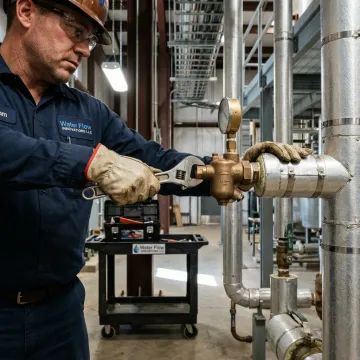
Assessment, repair, and replacement services that reduce steam waste and improve facility utility performance.
A detailed facility survey identifies failed steam traps, flash steam loss, condensate hammer, and condensate return issues that may be driving excess water, sewer, and fuel costs.
Failed or inefficient steam traps are replaced with appropriate industry-standard components, helping preserve live steam, remove condensate properly, and improve system reliability.
Targeted condensate return repairs help reduce water hammer, improve recovery, and limit wasted makeup water so facilities can operate more efficiently.
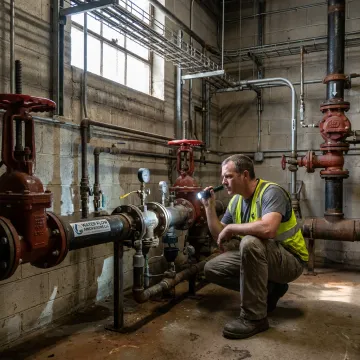
Water Flow Innovation starts with a facility steam system assessment and trap survey to identify failed steam traps, flash steam loss, condensate hammer, and condensate return issues that may be increasing water, sewer, and fuel expenses.
Findings are reviewed by component and system area, including failed traps, condensate return performance, and flash steam recovery opportunities. This helps prioritize repairs that can improve reliability, reduce waste, and support measurable utility savings.
Repairs and replacements are scheduled around facility operations whenever possible, often during planned maintenance windows. This approach helps industrial, healthcare, food and beverage, municipal, and semiconductor facilities limit operational impact while correcting key steam losses.
Technicians replace failed steam traps and address related condensate return or flash steam recovery equipment using industry-standard components and installation practices. Installed equipment is supported by a per-component warranty for added confidence.
Once repairs are complete, the system can begin reducing steam waste from the first operation. Facilities may see improvements in fuel use, condensate return, water demand, sewer discharge, and overall steam system stability.
Water Flow Innovation combines steam system insight with a measurable utility savings mindset.
Assessments target failed traps, flash steam loss, condensate hammer, and condensate return inefficiencies.
Repairs are scheduled around facility operations to reduce production interruptions and downtime.
Steam improvements can lower fuel demand while supporting reduced makeup water and sewer costs.
Installed equipment uses industry-standard practices and includes per-component warranty support.
Utility-saving specialists for commercial and industrial facilities.
Water Flow Innovation helps commercial and industrial facilities across the United States reduce avoidable utility costs through practical, measurable system improvements. From its headquarters in Coopersburg, Pennsylvania, the company supports facilities with steam systems in sectors such as food and beverage, semiconductor manufacturing, healthcare, municipal operations, and industrial production. Its steam system repair work focuses on failed steam traps, flash steam loss, condensate hammer, and condensate return problems that can inflate water, sewer, and fuel bills simultaneously. The team’s broader utility-saving approach emphasizes certified solutions, minimal operational disruption, and facility-specific recommendations that can be implemented around maintenance windows and production requirements.
A steam trap automatically discharges condensate, air, and non-condensable gases from a steam system while holding live steam inside the process. Working traps improve heat transfer, return condensate efficiently, and protect equipment from water hammer. Failed traps do the opposite: they blow live steam to the condensate return or atmosphere, waste fuel, force additional makeup water into the boiler, and raise water, sewer, and energy costs simultaneously, because the makeup water is drawn through the same metered municipal connection.
Reliability depends on the application, operating pressure range, load profile, and condensate return design rather than on any single trap type. In practice it comes from selecting the correct trap for the duty, installing it properly, and surveying it on a schedule. Water Flow Innovation starts with a steam system assessment that identifies failed traps, misapplied traps, and related condensate return problems before recommending any repair or replacement, so the spend goes where the measurable loss actually is.
The three categories are mechanical, thermostatic, and thermodynamic. Mechanical traps respond to condensate level, thermostatic traps respond to temperature difference, and thermodynamic traps respond to flow velocity and pressure change. Each suits particular duties across drip legs, steam mains, tracing lines, process coils, and heat exchangers. Correct selection is what determines long-term performance, because a trap that is the wrong type for its duty will fail early regardless of build quality.
Wherever condensate must be removed from steam distribution or process equipment without losing live steam. Typical locations are drip legs, steam mains, heat exchangers, process coils, tracing lines, and low points in piping. Placement is only part of it: strainer protection, isolation valves, correct sizing, and condensate return routing all determine whether the trap performs and whether it can be serviced without disrupting production.
The common indicators are rising fuel bills, visible flash steam loss, condensate hammer, poor heat transfer, slow process recovery, excessive boiler makeup water, and unusual condensate return behavior. Industry data indicates roughly 30% of steam traps in an average facility are failed at any given time. A trap survey confirms whether traps are leaking through, blocked, undersized, or misapplied, and quantifies the loss so repairs can be prioritized by cost impact rather than by guesswork.
Repairs are scheduled around your operating schedule and planned maintenance windows. Work begins with a site assessment and trap survey, followed by targeted repairs or replacements of failed traps, condensate return equipment, and flash steam recovery components. Most corrections are made using existing isolation points without a broad shutdown, which matters at facilities running continuous schedules such as breweries and distilleries, dairy and food processing, paper mills, hospitals, and district energy plants.
Steam trap service cuts fuel consumption by stopping live steam loss, improves condensate recovery, and reduces the volume of boiler makeup water drawn from your metered municipal supply. Less makeup water means lower billed water and, because most utilities calculate sewer as a percentage of metered intake, lower sewer charges as well. Facilities that pair steam system repair with water meter accuracy correction typically see reductions across fuel, water, and sewer rather than on a single expense line.
Water Flow Innovation provides a per-component warranty on equipment installed as part of steam system repair work. Coverage depends on the component, its operating conditions, and the scope of the repair. Industry-standard components and installation practices are used throughout, with recommendations driven by the assessment findings, quantified system losses, condensate return condition, and the operating requirements of the facility.
Every gallon of condensate not returned has to be replaced with makeup water drawn through your metered municipal connection, and that intake is metered on a line that also drives your sewer charge, typically calculated at 80% to 120% of the water charge. Failed traps therefore hit the utility bill twice over. Boiler feedwater and steam conditioning also cycle with production load, and that high-frequency demand introduces air and turbulence at the meter, adding meter over-reading on top of the genuine makeup volume.
Yes, and at steam-intensive sites the two address different halves of the same utility bill. Steam trap repair reduces the actual volume of makeup water you consume; the Flow Conditioning Device corrects billing for water you never consumed, delivering documented water and sewer reductions averaging 5-30% with a highest documented result of 46%. Facilities such as breweries and distilleries, dairy and meat processing, paper mills, textile mills, laundries, hospitals, universities, and centralized district energy plants commonly qualify for both.
Get practical answers before scheduling your facility assessment.
Steam system assessment and repair support for commercial and industrial facilities throughout the United States.
United States
Service Area
Industrial & Commercial
Facility Types
Maintenance Windows
Scheduling
Tell us where your facility operates and what system issues you are seeing.

Recognized plumbing and mechanical product certification.
Confirms compliance with public health standards.

Supports recognized performance and safety standards.
Share your facility details, steam system concerns, or utility cost goals, and Water Flow Innovation will help identify the right next step.
For immediate assistance, feel free to give us a direct call at 1-844-934-8258. You can also send us a quick email at Info@WaterFlowInnovations.com.
For immediate assistance, feel free to give us a direct call at 1-844-934-8258. You can also send us a quick email at Info@WaterFlowInnovations.com.