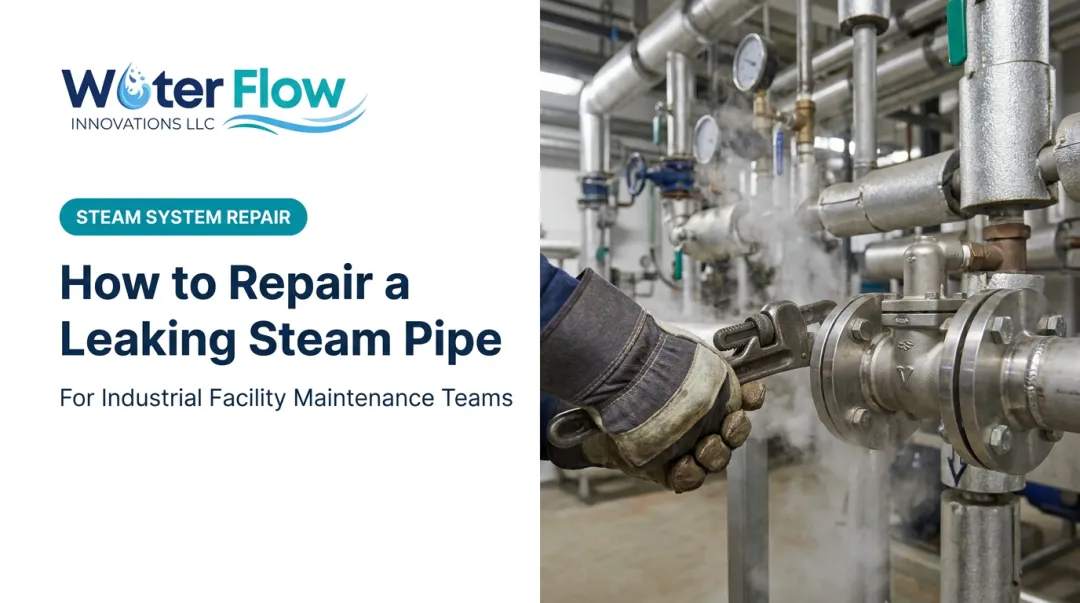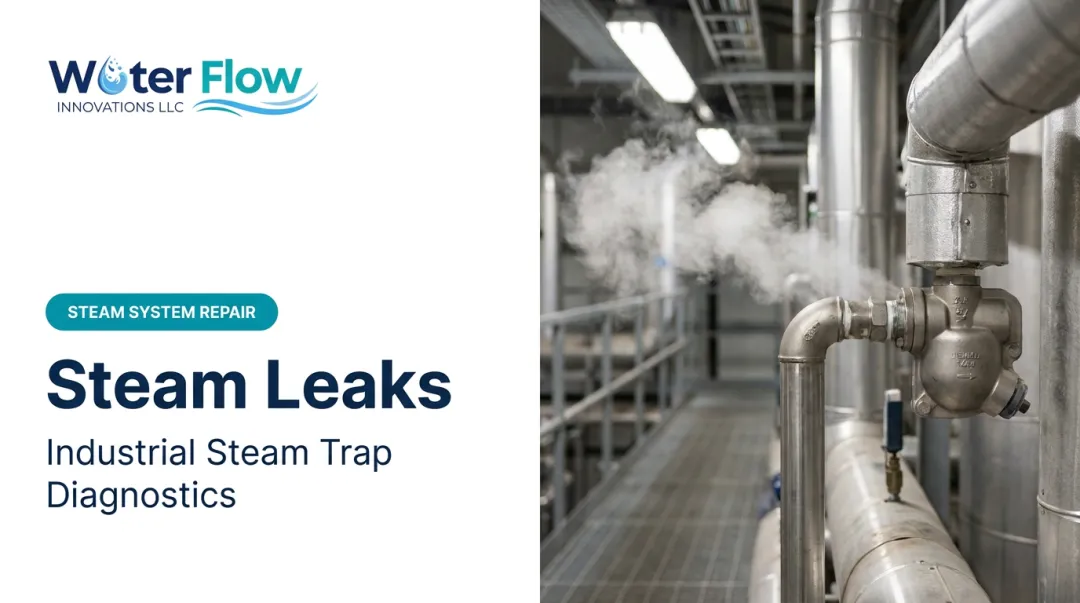

Over time, thermal cycling, erosion, corrosion, and worn packing take their toll. Leaks develop. Stems stick. Seats erode. Left alone, these problems waste energy and create real safety risk.
This guide covers the most common steam valve problems, a step-by-step repair process, how to decide between fixing and replacing, and when the job needs a certified professional.
Key Takeaways
- Most failures trace to packing, bonnet, or seat leaks, stuck stems, seat erosion, or water hammer damage
- Minor wear is usually repairable; cracked bodies or repeat failures often mean replacement
- Diagnose, isolate and depressurize, repair or replace parts, then test before returning to service
- Pressure-relief and safety valves must go through a VR-stamp certified shop
What Is a Steam Valve?
A steam valve is a mechanical device that controls, isolates, or throttles steam flow and pressure inside a piping system. Depending on type, it either fully opens/closes a line (gate valves), throttles flow (globe valves), or prevents backflow (swing checks).
Key components include:
- Seat – the contact surface that creates shutoff
- Disc – the closure member that presses against the seat
- Stem – transmits motion from the handwheel or actuator to the disc
- Packing – seals around the stem to prevent leakage
- Bonnet – houses the packing and mounts to the valve body
These are wear components, not permanent fixtures. High-temperature, high-velocity steam erodes seats, degrades packing, and stresses every seal over thousands of open/close cycles. Periodic repair is required maintenance that keeps the valve safe and code-compliant.

Common Problems With Steam Valves and Why They Fail
Most steam valve failures aren't random. They follow patterns tied to erosion, corrosion, and thermal stress that repeat across nearly every facility.
Steam Leaks (Bonnet, Packing, or Seat)
Symptoms: hissing sound, visible vapor plume, moisture around the valve body.
Likely cause: worn packing, an eroded seat, or loose fittings. According to the Department of Energy, a single 30-lb/hr leak at 115 psig running continuously costs roughly $1,182 per year in wasted steam. That's just one leak at one valve on one line.
Valve Won't Fully Open or Close
Symptoms: stiff handwheel, incomplete shut-off, inconsistent downstream pressure.
Likely cause: scale buildup, a seized stem, or debris trapped on the seat.
Water Hammer or Vibration
Symptoms: banging noise, pipe movement, sudden pressure spikes.
Likely cause: improper valve sizing, condensate buildup, or abrupt opening/closing. A high-velocity condensate slug striking a valve or elbow can cause serious damage. Industry analyses, including coverage in Plant Engineering, frequently cite water hammer in premature steam-system component failures.
Corrosion or Erosion Damage
Symptoms: pitted seat or disc, reduced pressure control, visible surface wear.
Likely cause: dissolved oxygen in the steam, continuous high-velocity contact, or lack of protective coating. Flashing combined with corrosive fluid can strip a protective oxide layer and accelerate damage far beyond what either factor causes alone.
Ignore these problems long enough and the consequences compound: wasted energy, ASME compliance exposure, and unplanned shutdowns that cost far more than the original repair would have.

How to Fix a Steam Valve (Step-by-Step)
Skipping proper diagnosis is the number one reason valve repairs fail again within months. Confirm the root cause first, then fix it.
Step 1: Identify the Exact Problem
- Observe symptoms: leaks, stiffness, unusual noise, pressure loss
- Check gauges and logs against normal operating baselines
- Note when the issue occurs: at startup, under load, or continuously
Step 2: Isolate, Depressurize, and Confirm Root Cause
Block in the line, lock it out, and vent to atmosphere until the gauge reads zero. Never loosen packing-gland or bonnet bolts while the valve is under pressure. That is a documented safety requirement.
From there, determine whether the issue is mechanical (worn seat or packing), scale-related, or tied to how the valve was originally installed.
Step 3: Repair Based on the Identified Problem
- Eroded seat or disc: Lap or machine the seat for a uniform finish. Replace the seat ring if damage runs deep.
- Worn packing: Remove old packing with a corkscrew puller, polish the stuffing box, and install staggered graphite or PTFE rings.
- Scale or debris: Clean components thoroughly and install an upstream strainer to prevent recurrence.
Step 4: Reassemble, Test, and Validate
- Torque fasteners to manufacturer IOM values, referencing ASME PCC-1 practices for bolted joints
- Hydrotest the valve body per the manufacturer's specification (typically 1.5x the ASME B16.34 pressure rating at 100°F, not simply 1.5x MAWP)
- Run a live-steam test and watch for leaks, noise, or vibration
- Confirm the valve fully opens, closes, and holds pressure as expected
Skipping this last step is how a "fixed" valve ends up leaking again within weeks.

When Should You Fix vs. Replace a Steam Valve?
The right call depends on repair cost, safety risk, and how much service life the valve has left.
| Scenario | Fix | Replace |
|---|---|---|
| Minor seat erosion or packing wear | Lapping and repacking usually restore function cheaply | Only if this is a repeat failure in a short timeframe |
| Cracked body or major wall-thickness loss | Not advisable once wall loss becomes significant | Required for safety and code compliance |
| Repair cost vs. new valve cost | Makes sense when repair cost is well below a new unit | Consider once repair cost climbs close to replacement cost |
| Pressure-relief or safety valve | Only permitted in a VR-stamp certified shop under National Board oversight | Consider if certified repair isn't available on your timeline |
There's no single industry-wide wall-thickness percentage or cost ratio that applies to every valve. Size, material, and pressure class all factor in. A proper fitness-for-service evaluation, not a rule of thumb, should guide the final decision on borderline cases.
Pressure-relief and safety valves sit in a different category entirely. Repair work on these must go through a shop holding a VR Certificate of Authorization under National Board NBIC Part 4 and NB-514 guidelines. This isn't a formality — it involves witnessed sample repairs and independent capacity testing to confirm the valve still performs to spec.
Preventive Maintenance and Mistakes to Avoid
Catching problems early costs far less than emergency repairs, and it keeps facilities off the unplanned-downtime list.
Preventive actions worth building into your schedule:
- Inspect seals monthly and check operation quarterly
- Measure body and bonnet wall thickness annually with calibrated equipment
- Exercise seldom-used valves quarterly to prevent seizing
- Insulate bonnets to reduce thermal cycling stress
- Install upstream strainers to keep debris off the seat
Common mistakes that undo good maintenance work:
- Treating symptoms (tightening a packing gland) instead of diagnosing the actual cause
- Skipping the post-repair pressure test
- Using incompatible replacement gaskets or packing material
- Ignoring lockout/tagout procedures during disassembly

Steam valve work rarely happens in isolation. It's usually part of a broader look at steam system losses.
Facilities that address failed steam traps, condensate return, and flash steam recovery alongside valve maintenance tend to catch more issues before they become expensive. Water Flow Innovation provides this kind of steam system repair work for industrial facilities.
Correct diagnosis prevents the repeat failures that eat up maintenance budgets. Knowing where the fix-vs-replace line sits saves both money and downtime.
Frequently Asked Questions
Can a broken steam valve stem be fixed?
Minor stem damage like bending or light scoring can often be repaired, or the stem can be replaced individually. Severe corrosion or a sheared stem usually means replacing the whole valve.
How often should steam valves be inspected?
Plan on visual checks every six months and a full teardown inspection annually during scheduled outages. High-severity service may need more frequent attention.
Can steam valve repair be done in-house?
Operators can typically handle basic tasks like repacking a stem. Seat machining and any relief valve work require certified technicians following NBIC guidelines.
What causes a steam valve to leak?
Worn packing, an eroded seat, scale buildup, and repeated thermal cycling are the primary culprits. Fixing the root cause during repair is what keeps the leak from coming back.
How much does steam valve repair typically cost?
Cost varies widely based on valve size, pressure class, and the extent of damage. Repair is usually far cheaper than replacement, unless the body or bonnet has significant wall loss.
Is a leaking steam valve dangerous?
Yes. Beyond wasted energy, a leaking valve can contribute to water hammer and, in some cases, create over-pressure conditions that become a real safety hazard if ignored.
Is repair work on steam valves warranted?
Warranty terms depend on the component and repair scope, so confirm them in the repair quote. Where a flow conditioning device is installed alongside, it carries a 6-month money-back guarantee on the purchase price plus a lifetime transferable warranty against manufacturing defects.
Which industries see the highest steam valve wear?
Plants with aggressive duty cycles and frequent thermal cycling: chemical manufacturing, oil and petroleum refineries, paper mills, textile mills, concrete and cement manufacturing, food and beverage processing, and centralized district energy plants.