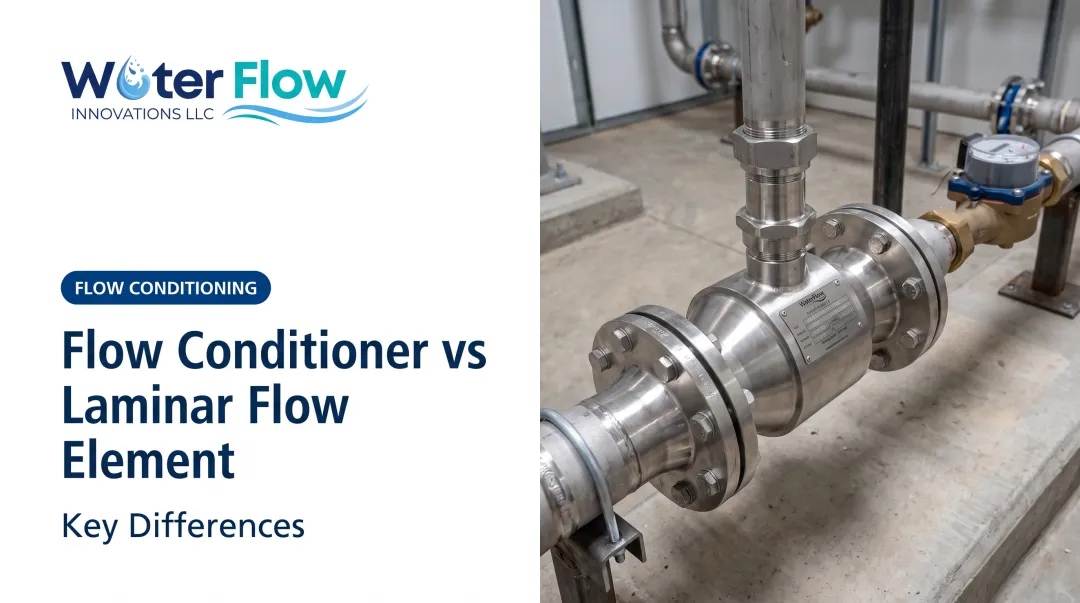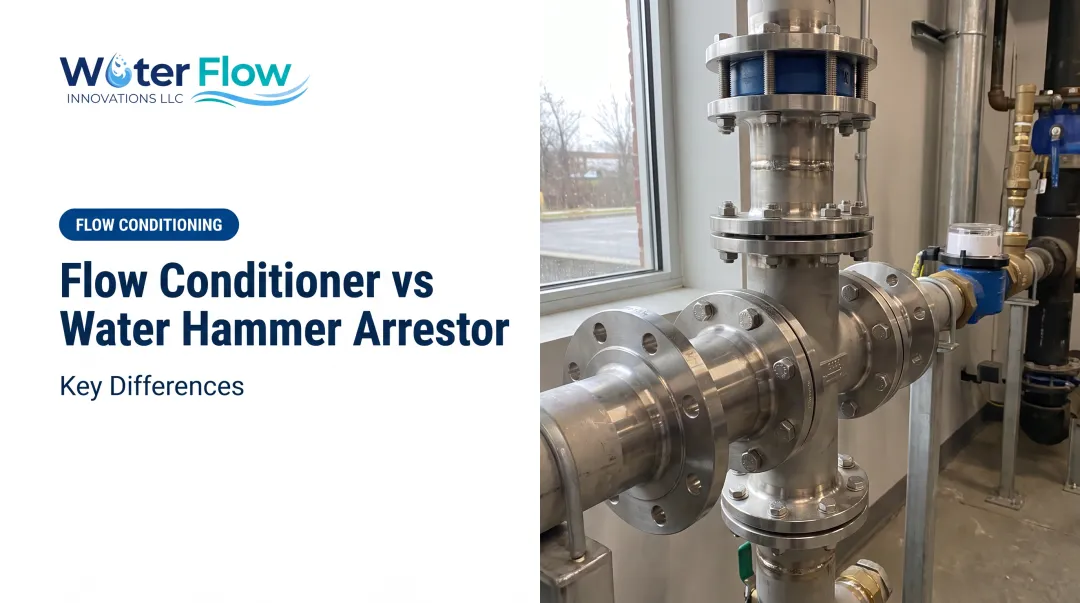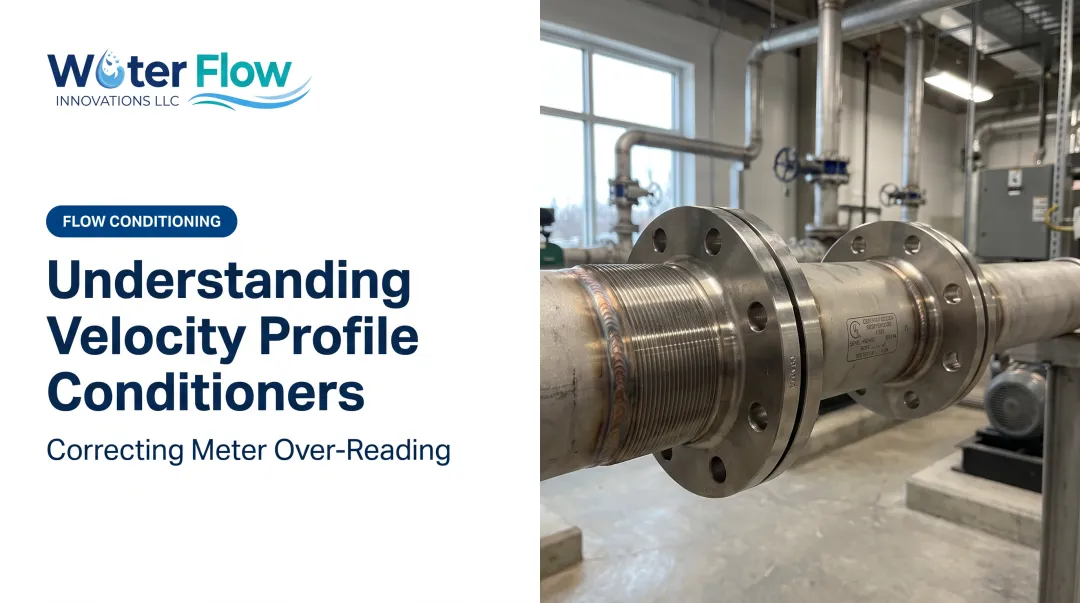

One device protects your water meter's accuracy. The other protects your building's comfort. Confusing the two means you might fix the wrong problem entirely, spending money on a balancing valve when your real issue is meter over-reading, or vice versa.
This guide breaks down exactly what each device does, where it belongs in your system, and how to tell which one your facility actually needs.
Key Takeaways
- Flow conditioners correct turbulent or swirling flow so meters read accurately. This hits your utility bill.
- Balancing valves even out flow across zones for proper heating and cooling. This affects comfort, not billing.
- Both devices can (and often do) exist in the same building, solving completely separate problems.
- Flow conditioners correct turbulent or swirling flow so meters read accurately. This hits your utility bill.
- Balancing valves even out flow across zones for proper heating and cooling. This affects comfort, not billing.
- Both devices can (and often do) exist in the same building, solving completely separate problems.
- Choose by symptom: high water bills → flow conditioning; uneven temperatures → balancing.
Flow Conditioner vs Balancing Valve: Quick Comparison
| Criterion | Flow Conditioner | Balancing Valve |
|---|---|---|
| Primary function | Straightens turbulent flow for accurate meter reading | Throttles flow to equalize distribution across circuits |
| Typical placement | Immediately after the water meter | Pump discharge or individual terminal units |
| Impact on water bills | Can reduce over-billing from turbulence-induced meter over-reading | No direct billing impact: governs internal distribution only |
| Pressure drop | Generally 0 PSI, up to 3–5 PSI in high-volume conditions | Intentional and adjustable, used as the control mechanism |
| Common systems | Municipal/industrial metering, process flow measurement | HVAC hydronic loops, multi-zone plumbing |
Notice the pressure drop difference. A flow conditioner is engineered to avoid restricting flow. A well-designed unit has virtually no impact on system performance. A balancing valve's entire job is creating resistance on purpose.

What Is a Flow Conditioner?
A flow conditioner corrects turbulent, swirling, or asymmetric flow profiles so a downstream meter can measure water accurately. According to AWWA's research on flow conditioning, disturbed velocity profiles, swirl, and turbulence directly affect meter accuracy, which is exactly why conditioners exist.
Here's the connection that matters for facility managers: accurate metering equals accurate billing. When water passes through elbows, valves, or pumps just upstream of a meter, it doesn't arrive as a smooth, uniform column. It arrives twisted, choppy, sometimes carrying entrained air. Mechanical and turbine meters interpret that chaos as more water than actually passed through.
Common Design Approaches
Conditioners come in several forms:
- Perforated plates — flat plates with drilled holes that break up swirl
- Tube bundles — parallel tubes that straighten flow paths
- Combination units — multi-function devices such as Water Flow Innovation's Flow Conditioning Device (FCD)
The FCD addresses more than one failure mode in a single custom-fabricated unit:
- Air and gas separation creates back-pressure that pushes entrained bubbles back into the water column
- Pressure regulation reduces water-hammer events from valve cycling
- A check valve, when specified, stops reverse flow and keeps air from re-entering
- Turbulence elimination slows velocity just enough to prevent vortex formation during high-volume events like CIP cycles or tank fills

Use Cases of Flow Conditioners
Flow conditioners get installed just immediately after a commercial or industrial water meter wherever piping geometry creates disturbance — think tight meter pits, closely-spaced elbows, or pump discharge lines. Federal water-metering guidance from PNNL confirms that nearby fittings and valves introduce turbulence that decreases accuracy, which is why straight-run requirements exist in the first place.
Sectors where this matters most:
- Food & beverage production (CIP cycles create major turbulence)
- Multifamily and high-rise buildings
- Hospitals and healthcare campuses
- Municipal and government facilities
- Industrial manufacturing plants
Facilities in these categories often see 5–30% average bill reductions after correcting meter over-reading, with documented cases reaching as high as 46%. Across these industries the pattern holds: any facility metering pressurized water can face turbulence-driven inaccuracy.
What Is a Balancing Valve?
A balancing valve, whether manual or automatic, regulates and equalizes flow rate across multiple zones or terminal units in a hydronic system. Its job has nothing to do with measurement accuracy. It's purely about distribution.
Without balancing, water takes the path of least resistance. Zones closest to the pump get flooded with flow; distant zones or upper floors get starved. That's why one wing of a building runs hot while another can't get warm.
Manual vs. Automatic Balancing Valves
| Type | How it works | Best suited for |
|---|---|---|
| Manual (Circuit Setter, Quickset) | Pressure-dependent; technician sets and locks flow during commissioning | Stable systems with predictable loads |
| Automatic/PICV | Pressure-independent; self-adjusts as conditions change | Variable-load systems, VAV boxes, AHUs |
Danfoss's AB-QM product line, for example, combines control, balancing, and flow limitation with an internal differential-pressure regulator — useful in systems where pump pressure fluctuates throughout the day.
Use Cases of Balancing Valves
Balancing valves get installed at pump discharge and at each hydronic terminal unit during commissioning. Schools, hospitals, office towers, and multifamily buildings with multi-zone heating and cooling loops all depend on this step.
The evidence for comfort improvement is solid, even if energy-savings claims deserve a skeptical eye. A 2014 DOE/NREL field study of a Chicago-area multifamily retrofit found that temperature spread across units fell from 22.1°F to 15.5°F after a hydronic distribution retrofit. That is a meaningful comfort gain, even though gas use didn't drop as expected.
A separate Minnesota school district case documented one building pumping roughly 50% less water than a similarly sized comparison building after installing cloud-connected balancing valves district-wide. That's a manufacturer-reported figure, so treat the payback timeline as a projection rather than an audited result. The flow-reduction outcome itself is still a useful benchmark.

Flow Conditioner vs Balancing Valve: Which Do You Need?
This isn't really a "which is better" question. These devices solve entirely different problems, and plenty of facilities need both — just in different parts of the building.
Choose a flow conditioner if:
- Your water bill has climbed without a corresponding usage increase
- You suspect turbulence or air entrainment near your meter
- You need documented savings data for ESG or sustainability reporting
Choose a balancing valve if:
- Tenants or occupants report uneven heating/cooling between zones
- One part of your hydronic loop is starved for flow while another runs excess
- You're commissioning a new multi-zone system
If you're dealing with both symptoms (high bills and comfort complaints), that's not unusual. It typically means you need a flow conditioner at the meter and balancing work somewhere in the distribution loop. The two address different points in the system and often work best together.
Real World Example: Correcting Meter Over-Reading with a Flow Conditioner
Facilities across sectors — hospitals, correctional facilities, food and beverage plants, hotels — routinely discover the same pattern: water and sewer bills climb steadily even though nothing about their operations has changed. No new equipment, no expanded production, no added occupancy. Just a bill that keeps creeping up.
The usual culprit: turbulent flow and entrained air at the meter, causing consistent over-registration of consumption that has nothing to do with actual water use.
Water Flow Innovation addresses this with its FCD, custom-fabricated per facility and matched to exact pipe size, meter model, and flange configuration. The process stays deliberately unobtrusive:
- Site assessment using existing water bills and meter configuration data
- Custom fabrication of the FCD to the facility's exact specifications
- Installation immediately after the meter, typically in about an hour with a brief water shutoff
- No changes to internal process equipment, kitchen lines, or tenant units
Documented outcomes across installations include:
- 5–30% average reduction in combined water and sewer bills
- Peak documented savings of 46%
- 90% of customers reach full ROI in under 12 months

Because sewer fees are typically calculated off metered water use, correcting the meter often cuts both charges at once.
If your water bill trend doesn't match your usage trend, don't assume you're simply using more water. Investigate meter accuracy first.
Facilities can request a free Water Bill Review & Savings Analysis from Water Flow Innovation. No on-site visit is required for the initial review, and the online calculator provides a rough estimate in about 30 seconds.
Conclusion
Flow conditioners and balancing valves solve different core problems: one protects measurement accuracy, the other protects distribution. A facility with unexplained high water bills has a metering problem. A facility with uneven comfort across zones has a distribution problem. Knowing which symptom you're dealing with determines which fix actually solves it.
Correcting meter over-reading produces immediate, visible savings on the next billing cycle. Proper balancing improves comfort and system efficiency over the life of the equipment. Larger or older buildings often need both evaluated before choosing a fix.
Frequently Asked Questions
Do I need a professional to install a balancing valve?
Yes. Balancing valves require a trained HVAC technician or certified balancing contractor for proper sizing, adjustment, and commissioning readings. Improper balancing can create worse distribution problems than none at all.
Which device is best for regulating flow: a flow conditioner or a balancing valve?
A balancing valve is the correct tool for regulating flow rate itself. A flow conditioner doesn't regulate flow. It corrects the flow profile so a meter can measure accurately.
Should a balancing valve be installed on the flow or return line?
Placement varies by manufacturer and system design. Some manufacturers, like Victaulic, recommend return-line installation for automatic balancing valves to reduce noise and entrapped air. Always follow the specific product's installation guidance.
What is another name for a balancing valve?
Common alternate names include "circuit setter," "flow control valve," and "flow limiting valve," depending on the manufacturer and whether the product combines balancing with additional control functions.
How do I know if my water meter is over-reading?
Compare billed consumption against actual usage patterns. If bills climb without a corresponding operational change, that's a red flag. A free bill review from Water Flow Innovation can help diagnose turbulence-related over-reading.
Can a flow conditioner and balancing valve be used in the same system?
Yes. They serve entirely different functions and typically sit in different parts of a building's water or HVAC infrastructure. Use a flow conditioner near the meter and balancing valves throughout the hydronic loop.
How long does adding the conditioner near the meter take?
About an hour, with a brief water shutoff at the meter connection. A licensed plumber or mechanical contractor fits it at the municipal supply connection, so the hydronic loop and its balancing valves are never touched or rebalanced.
What does the meter-side correction typically return?
Documented installations average a 5–30% reduction in combined water and sewer charges, with a highest documented single result of 46%, from measurement accuracy rather than reduced flow.