Rising water and sewer rates, combined with growing drought risk, are pushing plant managers to act now rather than later. As of late July 2026, nearly 48% of the Lower 48 states were experiencing drought conditions of at least "moderate" severity, according to drought.gov's current conditions tracker.
But cutting water use isn't just about closing taps. Hygiene requirements, aging equipment, and even meter accuracy all shape your real-world results. This guide walks through the exact steps to reduce consumption, the plant-specific variables that determine your savings, the mistakes that quietly sabotage good intentions, and a billing factor most facilities never think to check.
Key Takeaways
- Cleaning and sanitation drive most water use in food plants — start reduction efforts there
- A pre-project water audit predicts whether your reduction program will actually deliver measurable savings
- Equipment upgrades, recycling, and staff training together often yield double-digit % reductions with no hygiene tradeoff
- Usage reduction and water bill accuracy are separate savings levers: fix only one and you leave money on the table
How to Reduce Water Use in Food Processing Plants: Step-by-Step
Every food plant is different, but the sequence below applies almost universally. Skipping steps, especially the first one, is the most common reason water reduction programs fail to show measurable results.
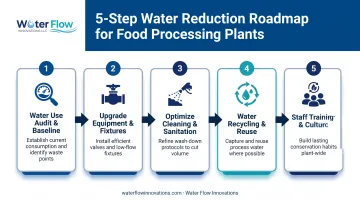
Step 1: Conduct a Water Use Audit and Establish a Baseline
Total site water use tells you almost nothing useful. You need consumption broken down by production line, shift, and cleaning cycle, ideally using temporary flow meters at key points.
Your baseline should also capture two things plants routinely miss:
- Wastewater volume — since sewer charges often mirror or exceed water charges
- Hot water use — since heating costs stack on top of the water bill itself
The EPA's WaterSense guidance recommends reconciling every source meter against end-use estimates. If more than 10% of your water remains unaccounted for, that's a flag worth investigating before you spend a dollar on upgrades.
Step 2: Upgrade to Water-Efficient Equipment and Fixtures
Flow-regulating valves, pressure regulators, and low-flow fixtures in wash-down and welfare areas are the most straightforward upgrades available. For reference, the EPA reports that high-efficiency pre-rinse spray valves can run 20-37.5% below the federal flow standard. A single valve swap often pays for itself in 5-8 months in commercial kitchen settings.
That figure applies to kitchen dishwashing, not production washdown directly, but it shows how fast fixture-level changes can pay back.
Equipment design matters too. Open-chassis conveyors and quick-release guards cut cleaning time and water volume, since sanitation crews spend less time chasing hidden soil in hard-to-reach spots.
Step 3: Optimize Cleaning and Sanitation Processes
This is where the biggest wins typically live. The EPA's Lean and Water Toolkit notes that equipment cleaning can represent 50-70% of total water use in food, beverage, and pharmaceutical facilities.
Three tactics cut water use without weakening hygiene outcomes:
- Dry-clean before wet washing — sweep or scrape solids off surfaces so wash water isn't doing double duty as debris removal
- Inspect nozzles regularly — worn or misaligned nozzles waste water while cleaning less effectively
- Match chemical concentration and temperature to the soil load, reducing the pressure and volume needed to achieve the same result
Switching from time-based rinses to condition-based rinse control (using conductivity, turbidity, or visual checks) prevents the chronic over-rinsing that happens when operators default to "longer is safer."
Step 4: Implement Water Recycling, Reuse, and Recirculation
Machine-level reuse, such as CIP systems that filter and reuse rinse water for main wash cycles, can cut consumption. Government case studies show that bundled water-efficiency programs, including recycling, deliver initial savings above 30% at food manufacturing sites. Those results reflect combined measures, not reuse alone.
Reuse isn't automatic, though. It has to be risk-assessed by application:
- Appropriate: non-product-contact water, pre-rinse stages, cooling water makeup
- Not automatically appropriate: final rinses or any water contacting ready-to-eat product without validated pathogen controls
Step 5: Train Staff and Build a Water-Conscious Culture
Operator behavior is often the largest source of invisible waste. Open hoses left running, removed nozzle restrictors, and inconsistent spray technique can undo the savings from every upgrade above.
Visible tracking matters here. Post water KPIs on production boards and review them the same way you'd review yield or downtime. That habit keeps behavior change from fading once the initial project excitement wears off.
Key Factors That Determine Your Water-Saving Results
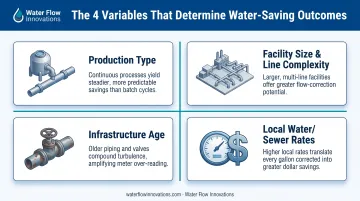
Identical equipment upgrades can produce very different savings depending on your plant's specific characteristics. Four variables explain most of that gap.
Production Type: Batch vs. Continuous
Batch operations require cleaning between runs, often for allergen separation or product changeovers, which multiplies sanitation-driven water use. Continuous-process facilities see smaller relative gains from cleaning-frequency changes because they defer sanitation to the end of a run instead of repeating it between batches.
Facility Size and Line Complexity
Larger or multi-line facilities have more cleaning points, more nozzles, and more places for nozzle failures to hide. Bigger sites benefit from phased pilots on one line before rolling changes plant-wide. That approach gives the clearest before/after comparison without noise from unrelated variables.
Age and Condition of Existing Infrastructure
Aging pipework, worn nozzles, and outdated valves drive consumption up over years before anyone flags it. Facilities running older infrastructure typically see the highest percentage savings from upgrades simply because there's more slack to remove.
Local Water/Sewer Rates and Regulatory Pressure
High tariffs and discharge fees change your payback math entirely. Rate schedules vary widely. Chicago's water rate alone climbed 5.00% in 2023 and 3.37% in 2024, with sewer billed at 100% of the water charge. Facilities in water-stressed regions or with tiered sewer billing see faster ROI on the exact same improvements as a facility paying flat, low rates.
Common Mistakes That Undermine Water Reduction Efforts
Even well-intentioned programs stumble in predictable ways:
- Skipping the baseline audit: changes based on assumptions make it impossible to prove or troubleshoot results later
- Cutting rinse time or pressure without hygiene team sign-off: risks food safety compliance and can trigger corrective actions under sanitation rules
- Installing nozzle restrictors without addressing behavior: restrictors get removed the moment they slow down manual cleaning
- Treating reduction as a one-time project: consumption creeps back up without ongoing monitoring and maintenance
A water program that isn't revisited quarterly tends to drift back toward its old baseline within a year or two.
Beyond Usage: Why Your Water Bill May Still Be Inflated Even After Cutting Consumption
Here's something none of the steps above can fix: water meters can over-register due to air entrainment and turbulent flow inside pipes. This is a metering accuracy problem. Your plant can cut consumption by 20% and still get billed for water it never actually received.
CIP cycling, scalding, chilling, and the on/off demand spikes typical of food production create exactly the turbulent flow conditions that cause this over-registration.
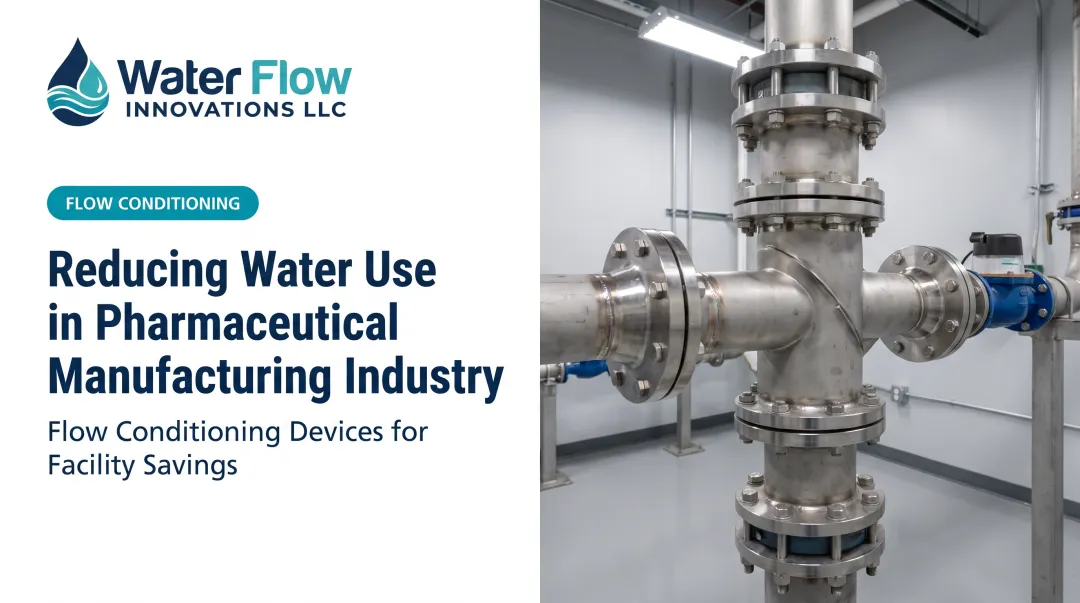
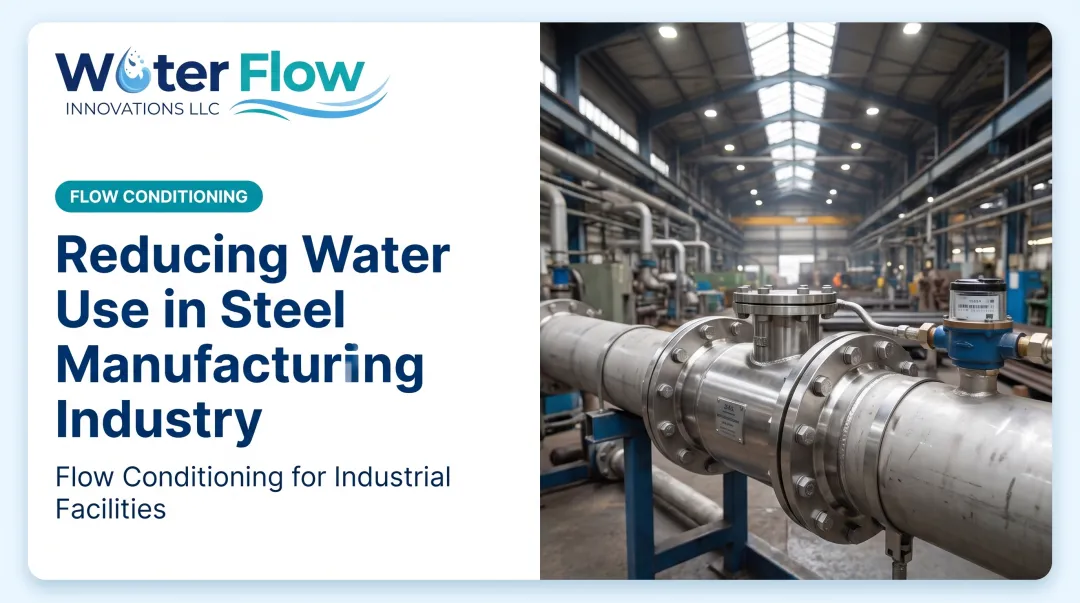
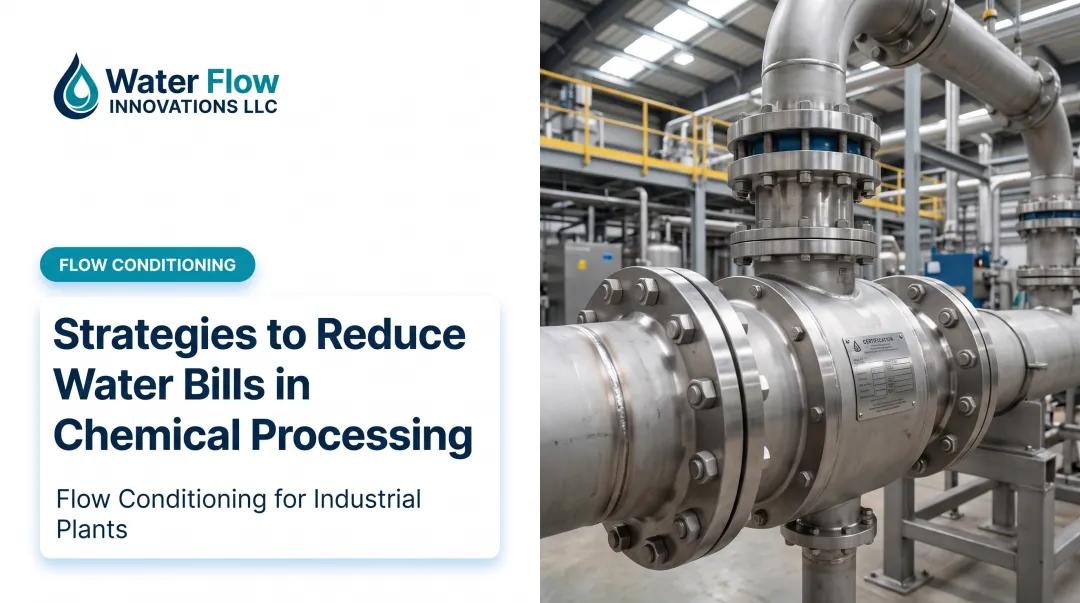
How the Flow Conditioning Device Works
Water Flow Innovation builds the Flow Conditioning Device (FCD) specifically to correct this problem. It's certified to IAPMO, NSF, ANSI, CAN 61, KIWA, GMP, and SQF. Those certifications matter directly to food processing facilities working under GMP and SQF quality frameworks.
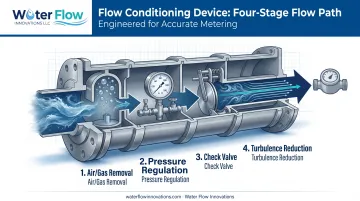
The FCD uses a four-component system:
- Air/gas removal: clears entrained air and micro-bubbles from the column the meter sees
- Pressure regulation: smooths pressure fluctuations from CIP and demand cycling
- Check valve: prevents backflow-related turbulence
- Turbulence elimination: straightens flow into a laminar pattern the meter can measure accurately
Where It Sits and What It Does to Your Bill
The FCD installs immediately after the municipal water meter, upstream of every internal system: CIP lines, wash-down headers, hot water, and cooling. One installation corrects meter accuracy for the entire facility at once, without touching HACCP plans or sanitation cycles.
Because most utilities calculate sewer charges as a percentage of metered water intake, correcting the meter reduces both bills simultaneously. Documented results show an average 5-30% reduction in combined water and sewer costs, with 46% documented in individual cases. Savings typically show up on the very next billing cycle.
Practical details that matter for a plant that can't afford downtime:
- Installation takes about one hour, performed by a licensed plumber or mechanical contractor
- Works with any pipe size (NPS 1/2" to 12") or meter type, including turbine, electromagnetic, or ultrasonic
- Causes no operational disruption; internal water storage covers the brief supply interruption during install
- 90% of customers reach full ROI in under 12 months
Treat the FCD as a complement to usage reduction, not a substitute. You can cut actual consumption and stop overpaying for water you never received. Because savings show up as a clean before-and-after utility bill comparison, they support ESG reporting, LEED water efficiency credits, and CDP water disclosures without added measurement infrastructure.
Water Flow Innovation backs the device with a 6-month money-back guarantee and a lifetime transferable warranty.
Conclusion
Meaningful water reduction in food processing plants comes from pairing a solid baseline audit with targeted equipment and process upgrades, then locking in the gains through staff behavior change. Skip the audit, and you're guessing. Skip the training, and last year's upgrades erode.
Your facility's specific mix of production type, size, infrastructure age, and local rates determines which steps pay back fastest — no universal sequence works everywhere.
Usage reduction and billing accuracy are both worth pursuing, and they're not the same problem. Before you assume your water bill reflects only what your plant consumes, check whether the meter itself is inflating costs.
Frequently Asked Questions
How do I save water in the food industry?
Start with an audit of current use. Then upgrade equipment (low-flow fixtures, better nozzles), optimize cleaning schedules and chemistry, recycle water where appropriate, and train staff to stop avoidable waste such as idle running hoses. Then check billing accuracy separately — it is a different lever.
What is the biggest source of water waste in food processing plants?
Cleaning and sanitation, particularly manual hose-down cleaning and over-rinsing, typically account for the largest avoidable water losses, often 50-70% of total facility use. That same high-frequency wash-down cycling is also a leading driver of meter over-reading.
How much water can food processing plants realistically save?
Savings vary by facility, but combined equipment, process, and behavioral changes often cut use by 10% or more. The largest gains tend to appear at older or less-monitored sites. Billing corrections stack on top of these, since they address a separate problem.
Is water recycling safe in food and beverage manufacturing?
Yes, when limited to non-product-contact or pre-rinse applications with proper filtration and a documented risk assessment. Recycled water requires food safety team validation before any use in high-risk zones.
How do I calculate ROI for water conservation investments?
Include the full cost of water, heating energy, wastewater treatment, chemicals, and labor, not just the water rate itself. Most facilities see payback within one to a few years, depending on the intervention.
Can a food processing plant reduce water costs without reducing usage?
Yes. Correcting meter over-reading from air entrainment or turbulent flow lowers utility bills immediately without changing actual consumption. Documented installations average a 5–30% reduction in water and sewer charges, with a highest documented single result of 46%.
How does meter over-reading affect our sewer bill, not just our water bill?
Most utilities calculate sewer as a percentage of metered water intake, typically 80–120% of the water charge. Every phantom gallon is billed twice, even though it never entered a drain — a significant exposure for food and beverage plants, dairy, meat and poultry processing, seafood processing, and bakeries, which all discharge heavily.
Will installing a Flow Conditioning Device disrupt production?
Installation takes about one hour, with a brief water shutoff at the meter connection, and is fitted after the meter upstream of all plant systems. CIP cycles, wash-down, and process water delivery are unaffected, since negligible pressure loss is a design characteristic.