
For commercial and industrial facilities, sizing directly affects meter accuracy, system performance, and how fast you recoup your investment. A conditioner that reshapes velocity profile can protect metering accuracy, but only when it's matched to your actual pipe, flow range, and pressure conditions, not a generic spec sheet.
This guide breaks down the sizing fundamentals: what factors actually matter, which mistakes cost facilities the most, and how to build a decision framework that fits your specific application.
Key Takeaways
- Condition turbulent, air-entrained flow first—stabilizers deliver accurate meter readings and steady pressure
- Size to pipe diameter, flow range (min/normal/max), pressure conditions, and meter type
- Undersizing restricts flow and drops pressure; oversizing wastes capital and space
- Match manufacturer specs to real site conditions—not guesswork—for the fastest ROI
What is a Water Flow Stabilizer?
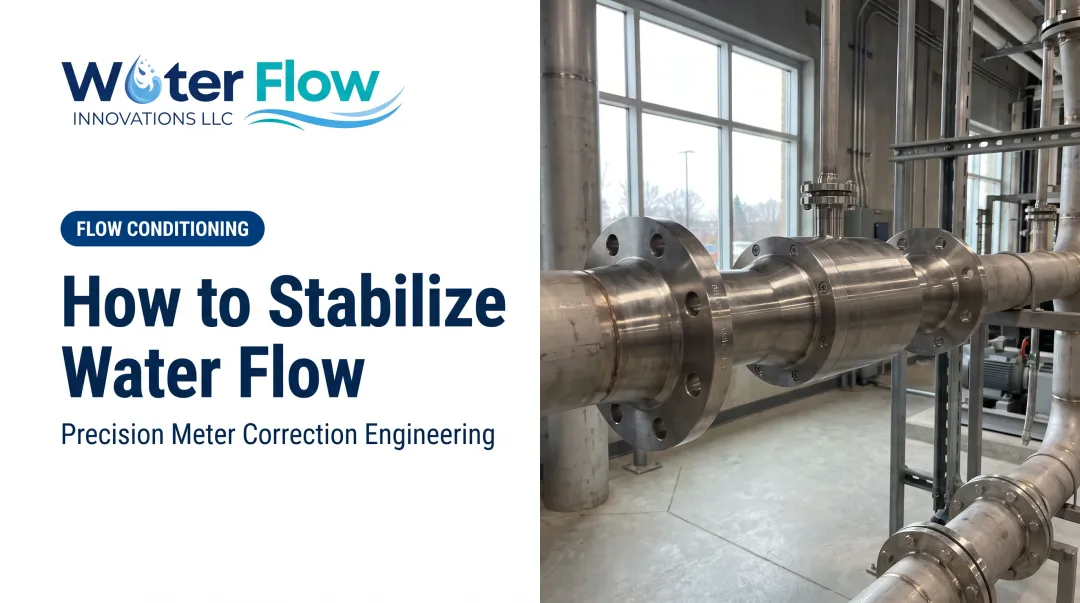
A water flow stabilizer, often called a flow conditioner, is a device installed in a water line to correct turbulent or air-entrained flow at the meter or downstream equipment. Industry bodies like AWWA describe the goal simply: minimize the gap between disturbed flow and the smooth, fully developed flow a meter is designed to read accurately.
You'll find a few physical types on the market:
- Inline flow conditioners: tube bundles or vane assemblies that straighten swirl
- Capillary/insert restrictors: limit flow by adding resistance (not the same as true conditioning)
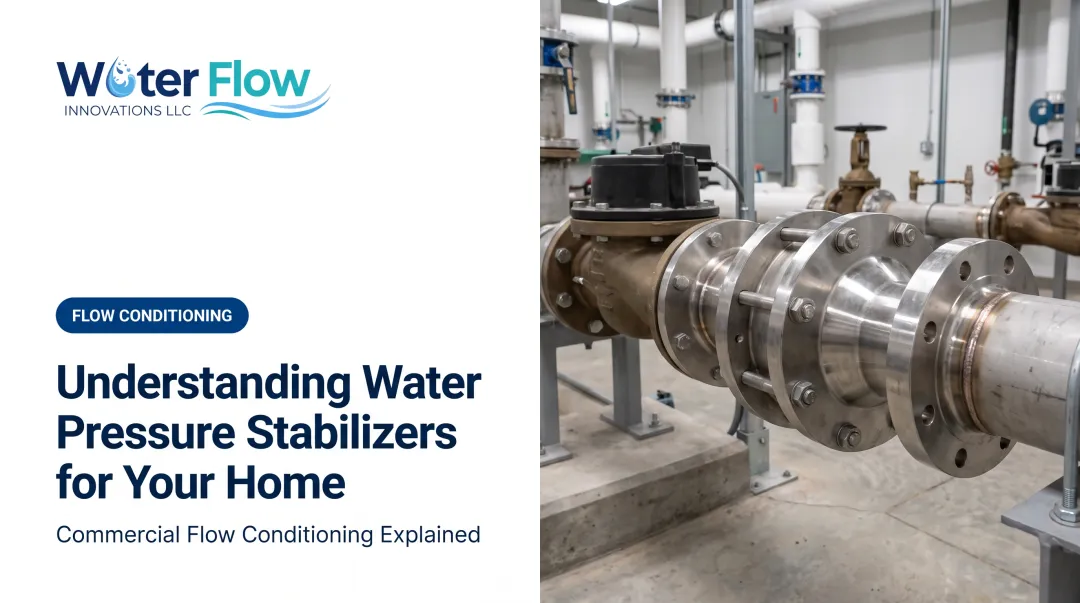
- Multi-component flow conditioning devices (FCDs): combine several correction stages in one assembly
Core Components of a Water Flow Stabilizer
Sizing decisions come down to how each internal component reacts to your specific flow conditions. Typical internals include:
- Air/gas removal element: Strips entrained air that causes turbulence and skews readings by distorting mechanical or ultrasonic meter signals
- Pressure regulation component: Holds downstream pressure steady when upstream pressure swings, working with existing system pressure rather than replacing a full regulator
- Check valve: Blocks backflow that would disrupt conditioning and damage internals; only required where site-specific backflow risk exists
- Turbulence elimination section: Straightens the flow profile the meter sees—the piece most tied to sizing math, since correction depends on pipe diameter and velocity

What to Consider When Sizing a Water Flow Stabilizer
Correct stabilizer sizing depends on your facility—not a generic chart. Pipe size, flow variability, and application type all change what "correct" looks like.
Those specs (GPM, pipe diameter, pressure) map straight to business outcomes: accurate billing, fewer unplanned outages, and steady performance from day one through day 500.
Pipe Size and Diameter Compatibility
The stabilizer needs to match your existing pipe's actual inside diameter and schedule, not just the nominal label. A mismatch forces extra fittings, adds installation cost, and can introduce new pressure loss at the transition point.
This matters across every commercial building type, from a 2-inch line in a small office to a 12-inch main in an industrial plant.
Flow Rate Range (Minimum, Maximum, Normal)
Sizing only for peak flow is one of the most common errors. Facilities rarely run at peak demand around the clock, so a device tuned only for maximum flow can underperform during normal or low-flow periods.
Valve sizing offers a useful parallel here. The standard liquid sizing formula is:
Cv = Q × √(G / ΔP)
where Q is flow in gpm, G is specific gravity, and ΔP is the pressure differential. Calculate this at your minimum, normal, and maximum flow points, not just one snapshot, because both Q and ΔP shift as demand changes throughout the day.

Upstream and Downstream Pressure Conditions
Pressure differential determines whether you need a single-stage or multi-stage conditioning approach. A large pressure drop between upstream and downstream conditions can signal cavitation risk, which damages equipment over time.
A well-sized unit should produce negligible pressure loss across the system. If your design shows a meaningful pressure hit, that's a sign the sizing needs another look.
Meter Type and Compatibility
Different meter technologies respond to turbulence differently:
- Mechanical/turbine meters — sensitive to upstream fittings and disturbed flow
- Magnetic meters — need a full pipe and correct electrode orientation to avoid bubble interference
- Ultrasonic meters — accuracy bands often vary between normal and extended-low flow ranges
A properly sized stabilizer should work regardless of which meter technology sits downstream, preventing distorted readings caused by turbulent or aerated flow.

Application and Facility Type
Sizing requirements shift by industry. A data center runs continuous, relatively steady cooling-tower makeup flow around the clock. A car wash, by contrast, sees short bursts of high-volume demand tied to vehicle throughput, with a typical touchless wash using more than 100 gallons per car.
Facilities across healthcare, hospitality, agriculture, and manufacturing all bring different demand curves to the sizing conversation. Size to your facility's actual demand curve, not a generic industry profile.
Installation Constraints and Timeline
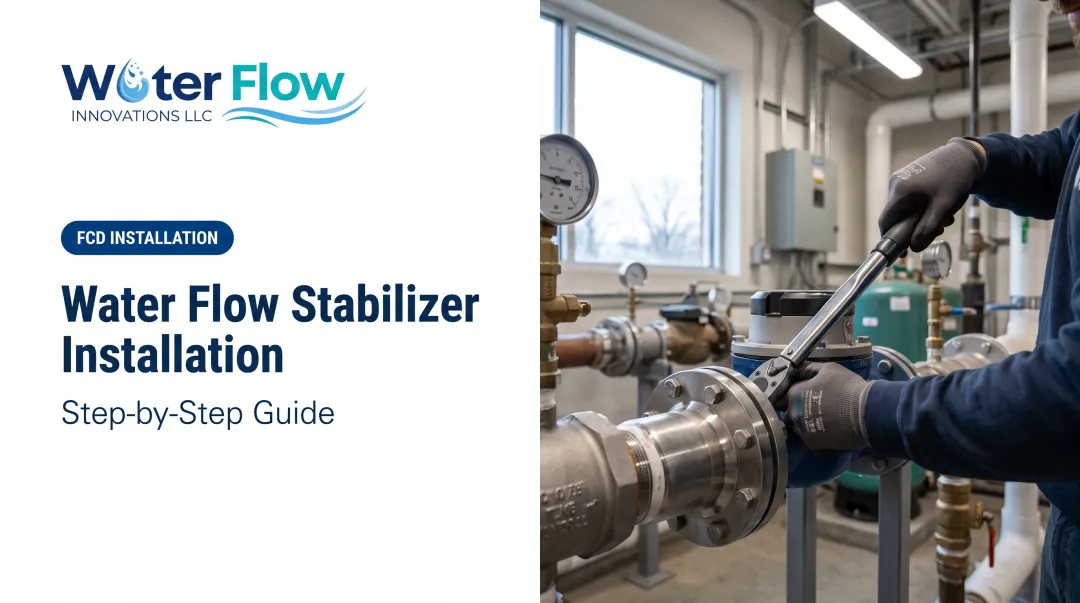
Available space, pipe orientation, and access to the meter location all shape which configuration works. Most straightforward installations take about one hour, minimizing disruption to operations. More complex industrial configurations may run longer, so a site survey ahead of time helps set realistic expectations.
Common Sizing Mistakes to Avoid
Even experienced facility teams fall into a few predictable traps:
- Peak-flow-only sizing leaves poor performance during the low-flow periods that dominate most operating days
- Incompatible pipe materials or fittings create leak risks and force costly mid-install adapter purchases
- Unverified certifications (NSF, ANSI, IAPMO, and local code) lead to compliance problems after installation
- Overlooking meter model and install specs yields a unit that doesn't match flange type, bolt pattern, or real flow characteristics
How Water Flow Innovation Can Help
Water Flow Innovation's Flow Conditioning Device (FCD) is engineered to correct meter over-reading without disrupting system performance, regardless of pipe size or meter type. It's custom-fabricated for each facility's exact pipe diameter, flange configuration, and meter model, rather than shipped as a generic off-the-shelf part.
The FCD's proprietary 4-component system (air/gas removal, pressure regulation, check valve, and turbulence elimination) directly addresses the sizing factors covered above. Each unit is built around your actual meter size, main pipe diameter, water pressure, and installation layout, confirmed through a site review before fabrication.

What you get with a sized unit:
- Certified to IAPMO, NSF, ANSI, CAN 61, KIWA, GMP, and SQF standards
- Works with any pipe size (½" to 12") and any meter type
- Installation typically takes about one hour, with minimal operational disruption
- Buy or lease options available, including volume financing
- 6-month money-back guarantee, no questions asked
- Lifetime transferable warranty
Properly sized FCDs typically cut water and sewer bills by 5–30%. Those documented results support ESG reporting, LEED water-efficiency credits, and broader sustainability goals.
Request a free water bill review to see whether an FCD fits your meters and layout.
Conclusion
Correct sizing matches pipe size, flow range, and application to a specific device built for those conditions. The biggest unit on the spec sheet or the most popular model in your industry is rarely the right fit.
Pressure conditions, meter compatibility, and facility type all shape the right specification, and none of them should be treated as an afterthought. Facility demand also changes over time through renovation, added equipment, or shifting occupancy. Review stabilizer performance periodically rather than assuming day-one sizing holds forever.
Frequently Asked Questions
What is the formula for calculating water flow?
Basic flow rate is volume divided by time (Q = gallons ÷ minutes), giving you GPM. For sizing valves and stabilizers, the Cv formula (Cv = Q × √(G/ΔP)) factors in pressure differential and specific gravity too.
What is a normal GPM for a commercial building?
Commercial and multifamily facilities often run from tens of GPM into the hundreds or thousands, depending on fixture count, process loads, and peak demand. Exact figures vary by building type and how the system operates day to day.
How do I know what size water flow stabilizer I need?
Pipe diameter, minimum/normal/maximum flow rate, and upstream/downstream pressure conditions together determine correct sizing. Confirming your meter size, pipe size, line pressure, and PRV configuration—often through a free water bill review—gives the most accurate answer.
Can a water flow stabilizer be installed on any pipe size?
Properly engineered stabilizers, like Water Flow Innovation's FCD, are custom-built to fit pipe sizes from ½ inch through 12 inches. The key is custom fabrication matched to your meter and flange specs, not a generic fit.
Does an oversized flow stabilizer cause problems?
Yes. Oversizing can lead to inadequate turbulence reduction at normal flow rates while wasting capital and installation space. Bigger isn't better if it doesn't match your actual operating conditions.
How long does it take to install a water flow stabilizer?
Installation is typically about one hour for straightforward configurations, with a brief water shutoff at the meter connection and minimal disruption to facility operations. More complex industrial setups may take somewhat longer.
What return should a correctly sized unit produce?
Documented installations average a 5–30% reduction in combined water and sewer charges, with a highest documented single result of 46%. Correct sizing is what determines where in that range a given site lands.
What approvals should the fabricated unit hold?
Certification to IAPMO, NSF, ANSI, CAN 61, KIWA, GMP, and SQF, together with EPA WaterSense compliance. The unit is fabricated from 316L stainless steel in the USA.