Introduction
A modern petrochemical complex burns through water at a scale most outsiders never imagine. Cooling towers, boiler feedwater, desalting units, and process reactions demand constant high-volume flow—often millions of gallons per day. Many plant managers now call their sites "water factories" that also produce fuel and chemicals.
That dependency is colliding with two rising pressures. Water and sewer utility costs keep climbing across most US markets, and discharge regulations keep tightening at the federal, state, and international level. Together, these forces are pushing operators to treat water strategy with the same rigor as feedstock costs.
This guide covers the treatment and recycling techniques petrochemical plants use to cut consumption, control discharge risk, and lower utility spend—plus one often-overlooked cost lever: water meter accuracy. Together, they form a practical water management program that reduces both usage and cost.
Key Takeaways
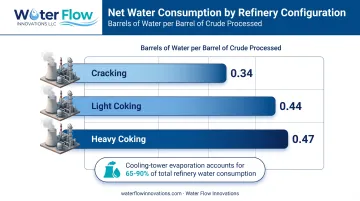
- Refinery water models put consumption at 0.34–0.47 barrels of water per barrel of crude processed, depending on configuration
- Strong programs blend cooling and boiler treatment, wastewater treatment, and reuse to cut both intake and discharge volumes
- Global frameworks (US Clean Water Act, EU Water Framework Directive, Saudi National Water Strategy) push operators toward proactive water stewardship
- Meter over-registration can silently inflate utility bills, making metering accuracy a fast, non-disruptive addition to any conservation plan
Why Petrochemical Facilities Face Mounting Water Management Challenges
Petrochemical plants don't use water the way most industrial facilities do. They use it constantly, in enormous volumes, across systems that can't tolerate downtime.
Where the Water Actually Goes
Inside a typical refinery, water flows into several distinct systems:
- Cooling towers — by far the largest consumer, offsetting evaporative losses from distillation columns, condensers, and heat exchangers
- Boiler feedwater — for steam generation used in distillation and process heating
- Process water — desalting, quenching, and reaction-related uses
- Potable and sanitary systems — smaller in volume but still permitted and metered
- Fire suppression — held in reserve, rarely drawn but always accounted for
A 2018 peer-reviewed refinery model found that cooling-tower evaporation accounts for roughly 65%–90% of total refinery water consumption, with the exact figure depending heavily on refinery configuration.
The same study modeled net water consumption at 0.34 barrels per barrel of crude for cracking configurations, 0.44 for light coking, and 0.47 for heavy coking. No two plants share an identical water profile.
Why the Effluent Is So Hard to Treat
Petrochemical wastewater isn't just "dirty water." It typically contains hydrocarbons, heavy metals, volatile organic compounds, and spent caustics from desalting and cracking operations. Each contaminant category demands a different treatment approach, which is why multi-stage treatment trains exist rather than a single catch-all process.
Water is also no longer a cheap input. Rising feedwater treatment costs, discharge compliance costs, and the energy required to move and heat water have pushed it onto the cost-management radar, not just the environmental one.
Regional risk compounds the problem. The World Resources Institute projects that the entire population of the Middle East and North Africa could face extremely high water stress by 2050, a region that also hosts a substantial share of global refining and petrochemical capacity.
Parts of Asia-Pacific face the same overlap of scarcity and refining density. Plants in these regions confront both pressures at once, with little room to treat either as optional.
Core Water Management Techniques in Petrochemical Processing
No single technology solves petrochemical water demand. Instead, plants layer several techniques together, each targeting a different part of the water cycle.
Cooling Water Treatment
Scale, corrosion, and biological fouling undermine cooling tower efficiency. Plants control them through:
- Chemical dosing: scale and corrosion inhibitors, biocides for microbial control
- Side-stream filtration: removing suspended solids before they concentrate in the loop
- Blowdown management: controlled removal of concentrated water to limit dissolved-solids buildup
Because cooling represents the single largest water draw in most facilities, the biggest lever is often structural: converting once-through cooling systems to semi-closed recirculating loops.
Once-through systems pass water through a single time before discharge. Recirculating loops reuse it repeatedly, cutting freshwater intake substantially, though they still require makeup water for evaporation, blowdown, and drift.
Boiler Feedwater Treatment
Steam systems demand extremely pure water. Any scale or corrosion inside a boiler can trigger costly downtime. Demineralization and ion exchange processes strip out the ions responsible for both problems before water ever reaches the boiler.
The highest-value technique here is often the simplest: condensate recovery. Condensate carries roughly 15–20% of the heat energy from the original steam, plus the value of water that's already been treated. Returning it to the boiler instead of discharging it to drain reduces makeup water demand and the chemical treatment load that comes with it.
Wastewater Treatment & Zero Liquid Discharge
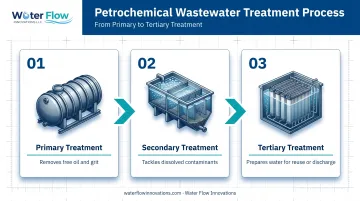
Petrochemical wastewater treatment generally runs through three stages:
- Primary treatment: API separators remove free oil and grit from desalter effluent
- Secondary treatment: dissolved air flotation and biological treatment tackle dissolved and emulsified contaminants
- Tertiary treatment: membrane bioreactors and polishing steps prepare water for reuse or discharge
Zero liquid discharge (ZLD) systems push this further, aiming to eliminate liquid discharge entirely by recycling nearly all process water.
BPCL's Bina Refinery in India illustrates the concept in practice: the facility reports recycling 100% of its ETP-treated water through reverse osmosis into a demineralized-water stream, while separately maintaining ZLD status across its operations. That's a strong example of what's achievable, though it applies to treated-effluent volume specifically, not total refinery demand.
Desalination & Membrane Filtration
Reverse osmosis, ultrafiltration, and nanofiltration each play distinct roles: producing high-purity process water, treating produced water for reuse, and stripping salinity, hardness, and fine particulates before water re-enters cooling or boiler systems. These membrane technologies have moved from pilot projects to standard equipment in many modern treatment trains.
Water Reuse & Recycling Programs
Reuse programs tie the other techniques together. The Yorktown Refinery in Virginia, for example, shifted from potable water to reclaimed water for cooling and process use starting in 2002, reaching about 80% of its projected reclaimed-water target in the first year of operation. Programs like this show that measurable, sustained gains are achievable when reuse becomes a standing operational priority rather than a one-off project.
Regulatory Drivers & Environmental Compliance
Compliance isn't optional, and it isn't getting simpler. Petrochemical operators answer to a stack of overlapping frameworks:
| Jurisdiction | Key Requirement |
|---|---|
| United States | EPA effluent guidelines (via NPDES) cover process, ballast, and cooling water discharges for 140+ refineries |
| Texas | Water Code Chapter 26 bans unauthorized industrial discharge; TCEQ permit required before release |
| European Union | Water Framework Directive requires River Basin Management Plans; Zero Pollution Action Plan sets non-binding 2030/2050 targets |
| Saudi Arabia | National Water Strategy 2030 prioritizes demand management and industrial reuse of treated effluent |
The pattern is consistent worldwide: regulators expect operators to manage water proactively before enforcement forces the issue. EPA's petroleum refining effluent guidelines apply across topping, cracking, petrochemical, lube, and integrated refinery subcategories — meaning almost no facility type is exempt.
Beyond avoiding fines, compliance documentation has a second life: it feeds directly into ESG disclosures and sustainability reports, turning a regulatory obligation into a reporting asset.
Reducing Water Costs: The Hidden Factor of Meter Accuracy
Every technique above addresses actual water usage. But there's a separate problem that has nothing to do with consumption: meter accuracy.
Commercial and industrial water meters measure everything that passes through them, not just water. They can't distinguish between real water volume and the entrained air, micro-bubbles, and turbulent vortex flow that accompany water in high-flow industrial piping. The meter counts all of it as billable consumption.
Petrochemical plants generate these exact conditions in two ways:
- Cooling tower makeup demand: often measured in millions of gallons per day, cycling continuously against ambient temperature and process load
- Boiler feedwater pressure variation: high-pressure steam systems cycling against municipal supply, forcing air into the water column with every pressure event
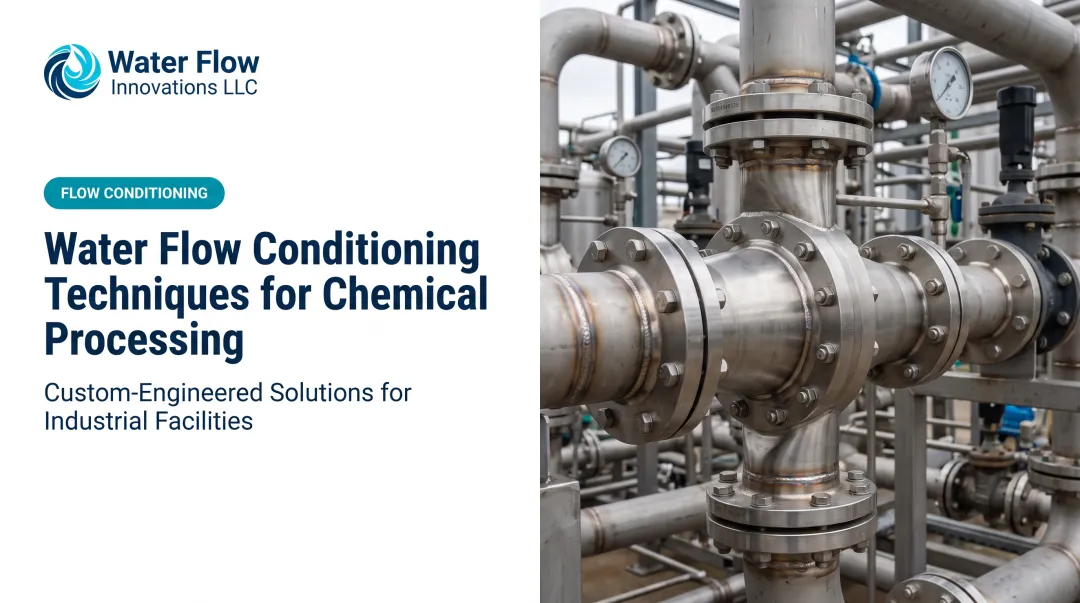
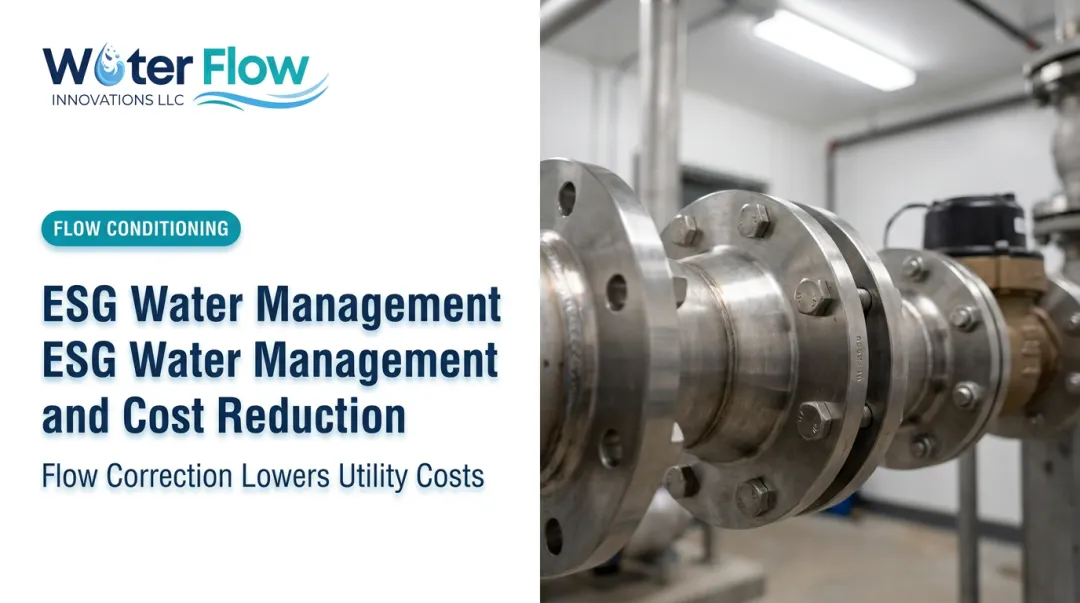
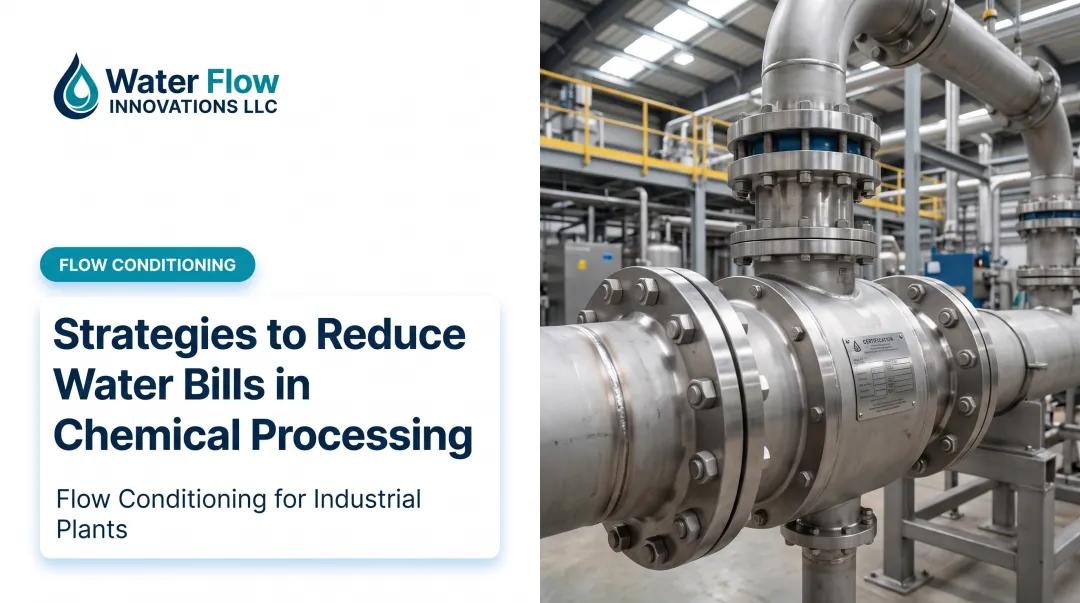
Water Flow Innovation offers a certified fix for this specific problem: the Flow Conditioning Device (FCD). Four components work together, installed immediately after the water meter and before internal distribution:
- Air and gas separation
- Pressure regulation
- Check valve
- Turbulence elimination
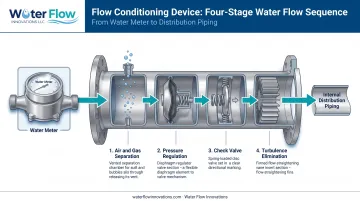
The device is IAPMO, NSF, ANSI, CAN 61, KIWA, GMP, and SQF certified. It fits any pipe size from ½" to 12" NPS (up to DN500 metric) and works with any meter type.
Installation typically takes about an hour, with negligible pressure loss. Cooling tower pressure, boiler feedwater delivery, and every downstream process stay exactly as they were.
This matters most at scale. Documented results across industrial and chemical facilities show:
- 5–30% average reduction in water and sewer bills, with a highest documented result of 46%
- Savings appear on the very next billing cycle, with no ramp-up period
- 90% of customers reach full ROI within 12 months
At refinery-scale intake volumes, even a 5% correction can produce five-figure monthly savings. Because sewer charges are typically calculated from metered water intake, correcting the meter reduces both line items at once.
This addresses billing accuracy rather than usage, so it runs alongside any existing treatment or recycling program without disrupting operations. Before-and-after utility bills are directly usable for ESG water intensity metrics, LEED water efficiency credits, and CDP water security disclosures.
Building a Water Management Strategy: Steps to Get Started
A strong water program follows a logical sequence rather than a scattershot list of upgrades.
- Run a full water audit across cooling, boiler, process, and sanitary systems to flag high-use areas and quality needs. Tools like the WBCSD Global Water Tool help with first-level screening before a deeper site assessment.
- Map and prioritize initiatives with process engineering, EHS, and operations. Weigh capital cost against water, sewer, and compliance savings in one cost-benefit review.
- Set measurable targets and check for funding or incentive programs that offset upgrade costs.
- Pair conservation with cost-correction. Treatment and reuse cut how much water the plant needs; flow conditioning corrects how accurately that water is billed. Together they show the full savings opportunity.
The strongest programs treat these as complementary layers, not competing priorities. Each step closes a different gap in the water balance.
Frequently Asked Questions
Do refineries use a lot of water?
Yes. Refineries are among the most water-intensive industrial facilities, using substantial water for every barrel of crude processed. Cooling represents the single largest share of that use, often accounting for the majority of total consumption.
How can I save water to reduce my water bill?
Start with a process water audit, then recycle and reuse treated water and correct meter over-reading with flow conditioning. Used together, these steps cut both consumption and billed volume.
What is zero liquid discharge (ZLD) and why does it matter for petrochemical plants?
ZLD refers to treatment systems designed to eliminate liquid discharge by recycling nearly all process water. It reduces both environmental impact and freshwater withdrawal, making it a benchmark for facilities under tightening discharge regulations.
How much water does it take to refine one barrel of crude oil?
Modeled refinery data puts consumption at roughly 0.34 to 0.47 barrels of water per barrel of crude, varying by refinery configuration and recycling rate. Coking configurations tend to sit at the higher end of that range.
What certifications should industrial water treatment and flow equipment have?
Look for NSF, ANSI, IAPMO, and KIWA certifications, which signal tested safety, drinking-water contact suitability, and performance to recognized industry standards.
Can water management improvements support ESG and sustainability reporting?
Yes. Documented reductions in consumption, discharge, and billing errors provide verifiable metrics for ESG disclosures, CDP water security reporting, and green certifications like LEED.
Does installing a flow conditioning device require a unit shutdown?
No. Installation takes about an hour, with a brief water shutoff at the meter connection, and the device sits on the main line after the municipal meter, upstream of all plant systems. Cooling water, process water, and steam systems are unaffected beyond the brief shutoff.
What happens if a refinery sees no measurable reduction?
The device carries a 6-month money-back guarantee on its purchase price, with installation cost non-refundable, so it can be returned if metered consumption does not measurably fall. A lifetime transferable warranty against manufacturing defects also applies and stays with the facility through a change of ownership.