Introduction
Water flow measurement is the process of quantifying how much water moves through a pipe, so utilities and facilities can bill accurately, track usage, and keep systems running as designed. It sits behind nearly every operational decision in a distribution network — from a city's main lines down to the meter outside a hospital or hotel.
This matters most to municipal utility operators, industrial and commercial facility managers, and engineers who rely on metering data every day. Get the reading wrong, and you face inflated bills, billing disputes, compliance risk, or a network drifting out of balance with no clear signal why.
Here's the problem: most people assume a meter reading always equals actual water delivered. It doesn't. This article explains what flow measurement is, why distribution systems depend on it, how the technology works, what throws off accuracy, and where common assumptions fall apart.
Key Takeaways
- Meters convert a physical flow property (velocity, displacement, pressure) into a billable rate or volume
- Distribution systems rely on measurement for billing, leak detection, pressure balancing, and compliance
- Turbulence, entrained air, and installation geometry can skew accuracy more than flow volume itself
- Over-registration from aerated or turbulent flow inflates water bills without any increase in actual use
What Is Water Flow Measurement?
At its simplest, water flow measurement uses instrumentation to detect a flow-related physical property (rotation, induced voltage, sound wave timing, or pressure drop) and convert it into a number: gallons per minute, cubic meters per hour, or a cumulative total.
The goal isn't complicated: produce a reliable, repeatable figure that reflects how much water actually passed through a specific point in the system. That number then feeds billing, operational monitoring, and regulatory reporting.
Two concepts often get mixed up with flow measurement:
- Water quality monitoring tracks chemical or microbial characteristics of the water itself, not volume or rate
- Flow control regulates or restricts flow using valves; measurement only observes and registers it
A meter never adjusts what's happening in the pipe. It just reports on it, accurately or not.
Why Water Flow Measurement Matters in Distribution Systems
Utilities and facilities measure flow for four practical reasons:
- Billing accuracy between suppliers and end-users
- Balancing supply and demand across pressure zones
- Catching non-revenue water losses
- Meeting regulatory reporting obligations
Distribution systems place specific demands on that measurement. Meters need to:
- Stay consistent across zones with different pressure profiles
- Hold up under fluctuating demand, from overnight lows to peak-hour surges
- Comply with plumbing and utility codes that mandate metering at service connections
When measurement fails, the consequences compound quickly. Leaks go undetected. Pressure zones drift out of balance. Billing disputes pile up. Reporting gaps create compliance risk.
The Regulatory and Operational Reality
Metering is both a code requirement and a best practice. Washington's plumbing code, for example, has required meters on direct service connections since 2007, with only narrow exceptions for emergency interties. AWWA's M6 manual similarly guides utilities on meter selection, installation, and testing across the industry.
Measurement points exist at multiple scales: municipal main distribution, industrial and commercial service connections, and sub-meters inside multi-tenant or campus facilities. None of this is a one-time check. It is an ongoing process that runs for as long as water moves through the system.
The EPA's water audit guidance puts average water loss across U.S. systems at 16%, with up to 75% of that loss potentially recoverable. A meaningful share of that figure traces back to apparent losses: meter inaccuracies and billing data errors, not just physical leaks.
How Water Flow Measurement Works
Every meter does the same basic job: detect a physical property that correlates with flow, then convert that signal into a volumetric reading through calibrated internal logic.
That property might be mechanical rotation, ultrasonic pulse timing, electromagnetic induction, or a pressure differential, depending on meter type. What all of them need is water moving through a straight pipe section in fully developed flow—with a stable velocity profile—before it reaches the sensor.
Installation geometry drives most of the variance here. Elbows, valves, and pumps upstream or downstream of the meter disturb that flow profile, and disturbed flow means a less reliable reading.
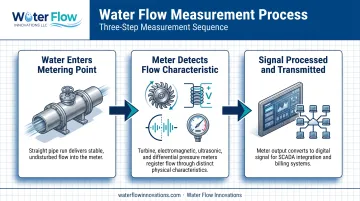
Step 1: Water Enters the Metering Point
Water enters through a main line, service connection, or sub-meter. The flow profile at this stage should be fully developed: smooth, predictable, and free of the swirl that elbows or valves upstream can introduce.
Step 2: The Meter Technology Detects the Flow Characteristic
Different meter types detect different physical properties:
- Mechanical/turbine meters measure rotor spin speed, since each blade sweeps a fixed fluid volume
- Electromagnetic meters measure voltage induced by water moving through a magnetic field
- Ultrasonic meters measure sound travel-time differences between sensors
- Differential pressure meters measure the pressure drop across a restriction like a Venturi tube
Meter choice depends on water type, pipe size, and expected flow conditions. There's no universal "best" option.
Step 3: The Signal Is Processed and Transmitted
The raw signal (a rotation rate, a voltage, a timing difference, or a pressure delta) gets converted into a standardized output: a digital display, a pulse signal, or a remote transmission feeding a SCADA platform or billing system. This is where the physical event becomes a billable number.
Key Factors That Affect Water Flow Measurement Accuracy
Accuracy isn't guaranteed just because a meter is installed correctly on day one. Several variables shift readings over time, and some of them have nothing to do with actual water usage.
Water quality and entrained air. Sediment and mineral content play a role, but entrained air and upstream turbulence are the more common culprits behind inflated readings. A meter can't distinguish air from water. It registers both as billable volume.
Installation conditions. Physical setup has a direct effect on accuracy:
- Pipe diameter, material, and orientation
- Flow velocity range the meter will see
- Straight-run distance from the nearest elbow, valve, or pump
Research on electromagnetic meters recommends at least 5 pipe diameters of straight run before and after the meter. Ten diameters is treated as essentially free of velocity-distribution error, though the exact requirement depends on meter technology and manufacturer specifications.
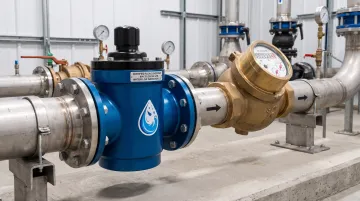
Equipment selection. Choosing the right meter technology for the application matters. Where turbulence or air entrainment is unavoidable (right after a pump, a valve, or a tight pipe routing), a certified flow conditioning device installed immediately after the meter can normalize the flow reaching the sensor.
This is the specific problem Water Flow Innovation's Flow Conditioning Device is built to solve: it corrects chronic meter over-registration caused by air entrainment and turbulent flow, without altering actual water delivery or system pressure. It's certified to IAPMO, NSF, ANSI, CAN 61, KIWA, GMP, and SQF, which is relevant for any device installed on a potable water line.
Scale and throughput. High-demand facilities such as hospitals, data centers, and industrial plants need meters rated for wide flow ranges and continuous duty. They also need periodic calibration. AWWA-attributed testing schedules call for in-service testing every 5 years for meters between 1 and 4 inches, and annually for meters larger than 4 inches.
Regulatory and documentation needs. NSF/ANSI/CAN 61 certification governs health effects from materials in contact with drinking water. Facilities increasingly pair that requirement with documented, verifiable flow data for billing disputes, ESG reporting, or sustainability program requirements.
Common Issues, Misconceptions & When Measurement May Fall Short
The biggest misconception in flow measurement is simple: people assume a meter reading always equals exact water usage. It doesn't. Turbulence, entrained air, and meter wear can cause both over- and under-registration, depending on conditions.
"Bigger flow means bigger error" doesn't hold up. Even a small air pocket or a short straight-pipe run can cause disproportionate inaccuracy, regardless of total flow volume. One study of intermittent water supply found expelled air accounting for 32% to 62% of incoming water volume during pipe-filling events, and that error scaled almost linearly with air volume, not flow rate.
Turbulence doesn't automatically mean over-registration. A 2016 study on flow meters positioned downstream of pipe elbows found under-registration in most tested scenarios for both ultrasonic and electromagnetic meters. Direction and magnitude of error depend on the specific technology and installation, not a blanket rule.
A few clarifications worth keeping straight:
- Measurement isn't control. A meter quantifies flow; it doesn't regulate or adjust it.
- Replacement isn't always the answer. If a facility suspects billing anomalies, a calibration audit or flow conditioning assessment is often more appropriate than assuming the meter needs full replacement.
- Air and turbulence aren't leaks. Poor flow conditions can inflate a meter reading even when no water is lost from the system.
Before swapping hardware, identify whether error stems from installation conditions, entrained air, or true meter wear. That diagnosis protects billing integrity and avoids unnecessary replacement cost.
Frequently Asked Questions
What are the five main components of a water distribution system?
A distribution system typically includes pipes, pumps, valves, storage tanks, and control/metering instrumentation. Together, these components move and manage water from treatment to end users.
Which software is used for water distribution modeling?
EPANET and Bentley's WaterGEMS (part of OpenFlows Water) are the most widely used hydraulic modeling tools. Both simulate flow, pressure, and demand scenarios across a network to support planning and design decisions.
What are the most common types of flow meters used in water distribution systems?
Mechanical/turbine, electromagnetic, ultrasonic, and differential pressure meters are the four common types. Each suits different water types, pipe sizes, and flow conditions, so meter choice depends on the specific application.
How often should water meters be calibrated for accuracy?
Calibration frequency depends on meter type and size, usage intensity, and utility requirements. AWWA guidance recommends about every 5 years for meters 1 to 4 inches, and annually for meters larger than 4 inches.
Can inaccurate flow measurement increase a facility's water bill?
Yes. Turbulence or entrained air can cause a meter to over-register usage, inflating water and sewer charges without any actual increase in consumption. Flow conditioning solutions are designed specifically to correct this.
What causes a water meter to over-read actual water usage?
The primary causes are entrained air, turbulent flow, and improper installation geometry near valves, pumps, or elbows. Any of these can distort the meter's reading independent of actual water delivered.
How much network downtime does a correction require?
None beyond the connection itself. A licensed plumber or mechanical contractor fits the custom-built unit at the metered supply point in about an hour, with a brief water shutoff at the meter connection.
What backs the device once it is in service?
A 6-month money-back guarantee on the purchase price, with installation cost non-refundable, so it can be returned if metered consumption does not measurably fall. A lifetime transferable warranty against manufacturing defects also applies.