
Introduction
Your occupancy hasn't changed. Your fixtures haven't changed. Yet the water and sewer bill keeps climbing. For facility managers running retrofit buildings, this is a familiar and frustrating puzzle—and one that can stem from how the meter reads flow, not from how much water the building actually uses.
Water flow conditioning devices (FCDs) address that measurement problem. Unlike low-flow fixtures or graywater reuse, which cut consumption, flow conditioning targets meter over-registration caused by air, turbulence, and unstable flow profiles. When those conditions are present, documented projects often see water and sewer bill reductions in the 5–30% range.
This guide covers how these devices work and which retrofit buildings tend to be strong candidates. It also compares flow conditioning with other conservation measures and explains how to evaluate a project without disrupting daily operations. Actual savings always depend on site-specific conditions and need proper before-and-after verification.
Key Takeaways
- Flow conditioning improves how a meter measures flow, not necessarily how much water your fixtures or processes use.
- Start any evaluation with meter type, pipe conditions, pressure, air entrainment, and billing history.
- A credible project requires compatibility checks, code compliance review, and measured before-and-after data.
- Conditioning complements leak repairs, pressure management, and efficient fixtures—it does not replace them.
What Are Water Flow Conditioning Devices?
A water flow conditioning device is an inline plumbing component, or assembly of components, installed near a water meter to stabilize incoming flow before measurement. Think of it as a conditioning stage between your municipal supply and the point where your utility bills you for every gallon that passes through.
Conditioning vs. Reduction
This distinction matters. Low-flow fixtures and reuse systems reduce the actual volume of water delivered to a building. Flow conditioning works differently: it aims to improve meter registration accuracy, potentially reducing billable over-reading without changing the amount of water your occupants or processes actually use.
Several conditions can interfere with accurate meter measurement:
- Entrained air or micro-bubbles that a meter may register as billable volume
- Turbulence and vortex flow, often triggered by on-off cycling or variable demand
- Pressure changes that create unstable flow near the measurement point
- Poorly developed flow profiles approaching the meter
Badger Meter, a major meter manufacturer, specifically recommends a flow straightener with turbine meters to prevent false readings caused by liquid swirl. That's manufacturer-level confirmation that flow conditions near a meter genuinely affect what gets measured, at least for certain meter types.
Common Components in a Conditioning Assembly
Configurations vary by manufacturer, but most assemblies combine elements that target the conditions above:
- Air or gas separation elements that remove entrained air meters can register as volume
- Pressure regulation to stabilize supply conditions at the measurement point
- Check-valve protection against reverse flow that can disrupt meter readings
- Turbulence-reduction geometry that straightens flow before it reaches the meter
Why Retrofit Buildings Are a Distinct Case
Existing buildings come with fixed pipe routes, legacy meter arrangements, and operating schedules that can make full plumbing replacement expensive and disruptive. A retrofit-friendly device needs to work within what's already there, not require tearing out walls.
Before considering a device, ask:
- What meter type and model is currently installed?
- Is there documented evidence of unusual flow behavior?
- Do recent billing changes align with occupancy and operations?
- Can installation happen without compromising required pressure for fixtures, fire protection, or process equipment?
How Flow Conditioning Works in Retrofit Buildings
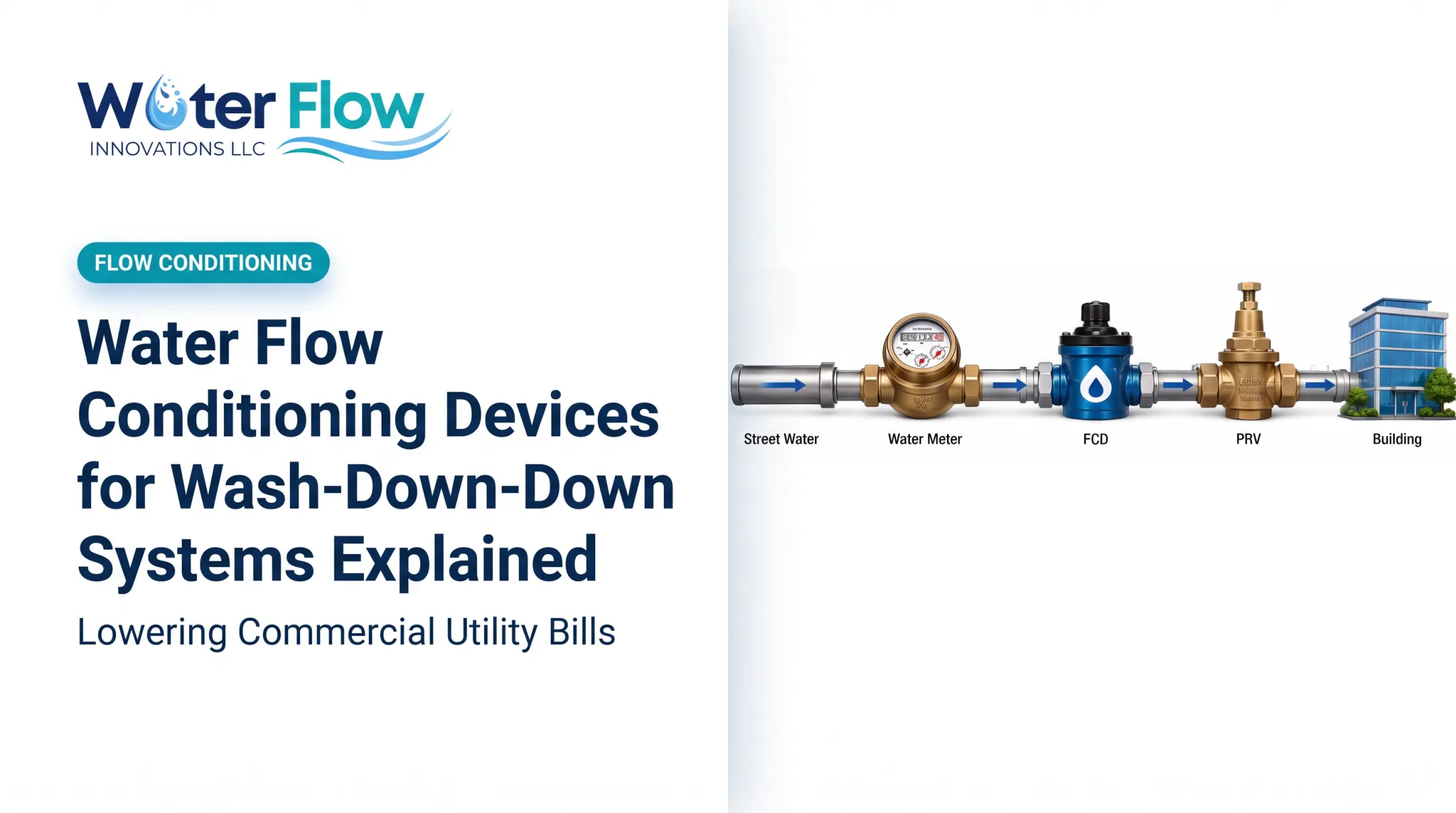
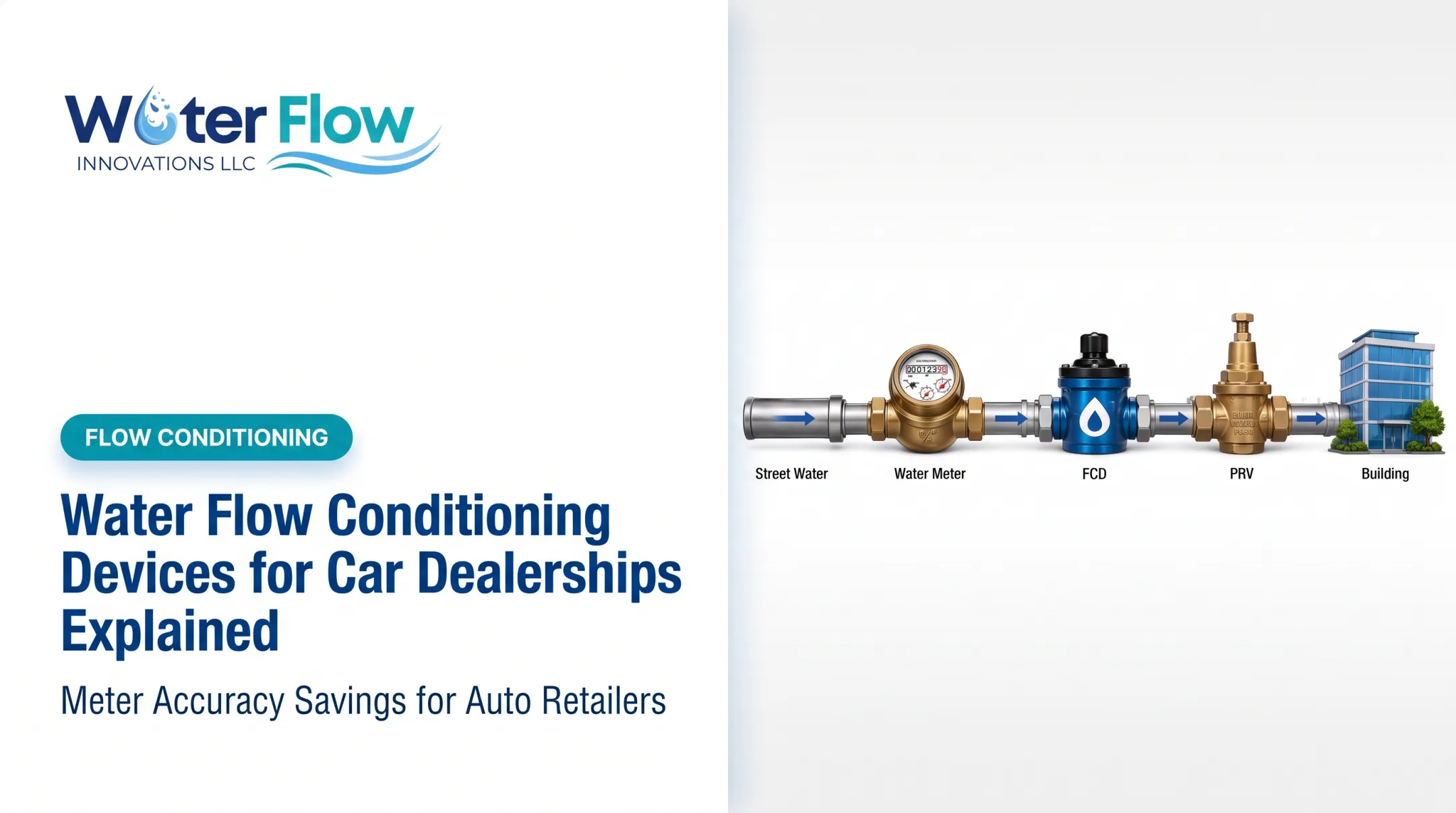
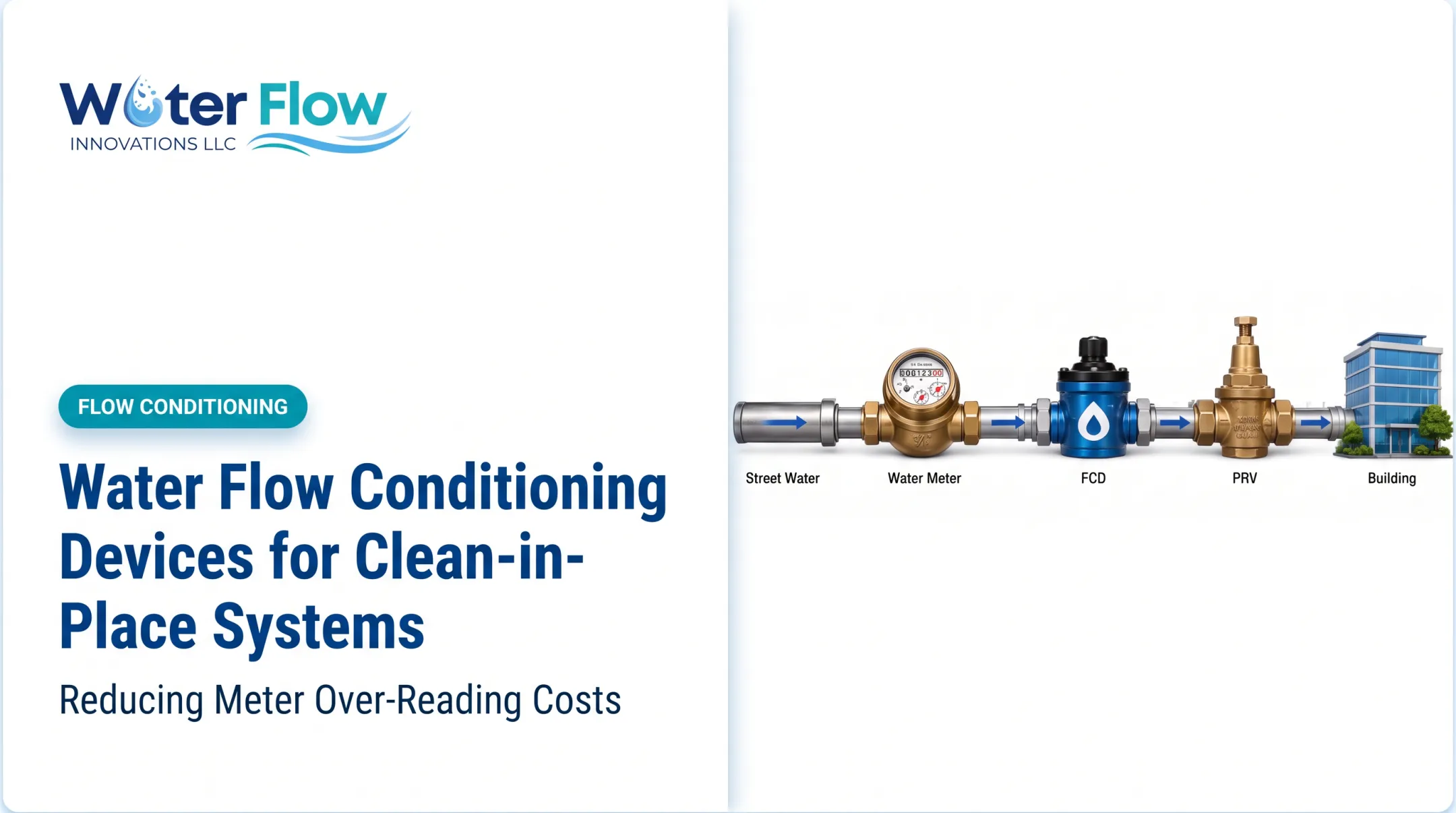
Picture the flow path: water enters the building's incoming service, passes through a conditioning assembly, then reaches the meter. If air pockets or turbulent flow are present at that point, they can affect what the meter records.
That doesn't mean every meter under those conditions over-registers. It means the conditions exist and merit investigation.
Air and Gas Management
Dissolved air and free (entrained) air aren't the same thing. Dissolved air stays in solution within the water. Free air separates out as bubbles, often triggered by pressure drops near partly open valves or changes in pipe geometry.
Some conditioning assemblies use static back pressure to keep free air and gas bubbles from reaching the meter, so the meter sees a more homogeneous water column.
Pressure Stabilization
Pressure regulation within a conditioning assembly can reduce abrupt velocity or pressure changes, particularly water hammer from cycling equipment. Any design must preserve the pressure required downstream for fixtures, process equipment, and fire protection systems. This isn't optional engineering detail. It's the line between a working retrofit and one that creates new problems.
Check Valves Aren't Backflow Preventers
Some conditioning assemblies include a check valve to manage reverse flow. This is worth stating plainly: a check valve is not a certified backflow-prevention assembly. A single check valve lacks the independently tested, field-testable design of an approved backflow assembly. If your jurisdiction requires certified backflow protection, that's a separate system entirely.
Turbulence and Meter Technology
Meter manufacturers often specify straight-pipe runs, installation orientation, or upstream strainers precisely because turbulence and poorly developed flow profiles affect measurement. Requirements vary significantly by meter technology:
| Meter Type | Typical Installation Sensitivity |
|---|---|
| Positive displacement | Generally no straight-run requirement; works best horizontal |
| Turbine | Needs developed, steady upstream flow; swirl can cause false readings |
| Electromagnetic | Partial filling or air content can create proportional error |
| Ultrasonic | Some designs alarm on empty pipe rather than measuring air as water |
| Compound | Accuracy can shift at low/high-flow changeover points |
A 2019 AWWA Water Science study on magnetic flowmeters found that local turbulence downstream of a conditioner was four times higher without one, yet accuracy deviations weren't proportional to that turbulence. Don't assume every disturbed meter over-registers, or that conditioning automatically fixes it. The specific meter technology and installation matter.
Water Flow Innovation's FCD uses a four-component approach: air and gas separation, pressure regulation, an optional check valve, and turbulence reduction. It is designed for negligible pressure loss and installs on the incoming service ahead of the meter, before internal distribution.

One caveat applies regardless of device or vendor: flow conditioning is not a substitute for correcting leaks, unauthorized connections, faulty meters, incorrectly sized piping, or billing errors. Those are separate problems requiring separate fixes.
Which Buildings May Benefit?
<strong candidates share a few traits: Strong candidates share a few traits:
- Substantial water and sewer charges
- Stable or well-documented operating patterns
- Accessible incoming water service
- Billed volume that doesn’t match expected usage
Building types where this evaluation is commonly worthwhile include:
- Hotels and extended-stay properties
- Multifamily and high-rise apartment buildings
- Hospitals and healthcare facilities
- Schools, universities, and dormitories
- Manufacturing and food & beverage production facilities
- Data centers and municipal buildings
- Car washes and similar high-volume water users
Screening Checklist
Before pursuing a project, gather basic facts:
- Meter details — note location, type, size, model, and serial number
- Pipe access — can the assembly go in without major excavation or shutdown?
- Pressure range — what is the PSI before and after any backflow device?
- Flow variability — does demand cycle on and off, or stay steady?
- Site constraints — flag water-quality limits or tight installation space early
Where Extra Caution Applies
Some systems need additional scrutiny before any inline change:
- Potable-water systems subject to health-code review
- Industrial process water with tight chemistry tolerances
- Healthcare applications with critical pressure requirements
- High-rise pressure zones
- Fire protection services — conditioning devices cannot be installed on fire lines
- Any system under direct authority-having-jurisdiction oversight
Building age alone doesn’t establish suitability. A newer building can still have measurement or flow-profile issues; an older one may need leak repair or pressure correction first.
When system performance or code compliance is uncertain, bring in a licensed plumbing professional, meter specialist, or utility representative before moving forward.
Where Flow Conditioning Fits Among Water-Saving Retrofits
Facility teams often ask how flow conditioning compares with other efficiency measures. The honest answer: it solves a different problem.
Low-flow fixtures and pressure-reducing valves reduce the actual volume of water delivered. The EPA documented a 470-room hotel retrofit at Hilton Palacio del Rio that saved 26 million gallons and $80,000 annually in water and sewer costs after toilets, aerators, and showerheads were replaced.
That is demand reduction, not meter correction—and the two should not be confused.
Leak detection and submetering identify actual water losses that conditioning can't fix. A stuck valve or hidden leak won't show up as "corrected" by an inline device; it's lost water that needs repair, not re-measurement.
Greywater reuse, rainwater harvesting, and cooling-tower optimization reduce demand or reuse water but typically require significant design, storage, treatment, and permitting investment. These are longer-term capital projects compared to an inline retrofit.
A sensible sequence for most buildings:
- Confirm meter accuracy and rule out leaks so you know whether the problem is measurement, loss, or both
- Correct pressure issues where present, since PRVs change delivery force rather than meter behavior
- Layer in efficiency measures based on water/sewer rates, operational risk, and payback expectations

Use the snapshot below to match each measure to disruption level and what actually changes:
| Measure | Disruption | What It Changes |
|---|---|---|
| Flow conditioning | Low (brief shutdown) | Measurement conditions at the meter |
| Low-flow fixtures | Moderate (per-fixture work) | Actual delivered volume |
| Leak repair | Varies by leak location | Actual water loss |
| Greywater reuse | High (design, storage, treatment) | Water sourcing and reuse |
How to Evaluate and Implement a Retrofit
Build a Real Baseline
A single utility bill tells you almost nothing. Pull several billing cycles, meter readings, occupancy or production data, operating schedules, and any existing submeter data. You'll compare post-installation results against this baseline.
Site Assessment Essentials
A proper assessment documents:
- Pipe diameter and meter model
- Flow direction and pressure readings
- Valves, strainers, and available straight-pipe length
- Access constraints and water quality
- Locations where air could be entering the system
Air commonly enters water lines through municipal line repairs, pump cavitation, temperature shifts, or vacuum formation during service disruptions. Water traveling more than roughly 30 feet through a pipe commonly transitions into turbulent flow, which is why upstream conditions matter so much at the meter.
Confirm Compatibility and Approvals
Before installation, verify manufacturer instructions, meter-maker requirements, applicable plumbing codes, potable-water standards, backflow rules, and utility approval. Skipping this step is the most common way retrofit projects stall mid-installation.
Planning Installation Without Disrupting Operations
For occupied buildings:
- Schedule any shutdown during a genuine low-demand window
- Notify affected tenants or departments in advance
- Protect critical operations and document pre-installation conditions
- Coordinate directly with the utility if the meter itself will be disturbed
Water Flow Innovation's materials describe FCD installation at roughly one hour, with minimal shutdown requirements and no tenant access or lease amendments needed for master-metered properties. Confirm current installation terms directly with any vendor before committing.
Verify, Don't Assume
Post-installation verification should include meter readings, billing data, pressure checks, and normalized comparisons that account for occupancy, weather, and production changes. One unusually quiet month isn't proof of savings; a full billing cycle comparison, adjusted for known variables, is.
Calculate financial performance using your site's actual water and sewer rates, installation cost, and verified savings, not a generic industry payback claim. Water Flow Innovation's documentation references a six-month money-back guarantee and a lifetime transferable warranty; confirm specific current terms with the vendor before signing anything.
Keep a measurement and verification record. It's useful for ESG reporting, LEED documentation, and internal capital planning, but keep documented results clearly separated from projections.

What to Look for in a Flow Conditioning Device
Certifications and Materials
Check certification scope carefully, not just the presence of a logo:
- NSF/ANSI/CAN 61 covers health-effects criteria for drinking-water contact
- IAPMO certification should specify the actual standard tested against
- KIWA marks vary by market; confirm relevance to US installations
Material matters too. Prefer 316L stainless steel for most commercial and industrial lines. Titanium or specialty alloys are the better fit for pharmaceutical and other high-purity applications.
Hydraulic Performance
Ask vendors directly about:
- Pressure loss under actual operating conditions
- Maximum and minimum flow range
- Pressure and temperature limits
- Compatibility with your specific meter and pipe arrangement
- Maintenance requirements
Installation Requirements
Confirm service clearances, isolation valve placement, required orientation, and whether the device needs electrical power or controls. Bypass arrangements matter too, especially for facilities that can't tolerate any future downtime for maintenance.
A Buyer's Checklist
- Total installed cost (not just unit price)
- Independent test results or field references, if available
- Warranty terms and return provisions
- Documented savings measurement method
- Operational risk and expected disruption during installation
Treat "no change in water usage" claims with care. A device may improve billing accuracy or reduce meter over-registration. Require supporting measurement before accepting any claim that actual water consumption went down.

Conclusion
Flow conditioning is a targeted option when meter registration, air entrainment, or unstable flow is inflating water and sewer charges above actual use. It is not a cure-all. It works best as one piece of a broader water-management strategy that also reviews leaks, pressure, fixtures, and process demand on their own.
Before you select a device, take these steps:
- Pull your billing and meter history
- Arrange a qualified site assessment
- Confirm meter and code compatibility
- Request a documented savings-verification plan
Water Flow Innovation provides free bill reviews and savings analysis so you can confirm fit before purchase or lease.
Frequently Asked Questions
What is a mechanical water flow meter?
A mechanical meter measures flow through moving mechanical elements, such as a rotor or displacement disc, rather than electronic sensing. Physical movement means installation conditions and flow profile can directly affect accuracy.
What does a water flow conditioning device do?
A flow conditioning device manages conditions near a meter—such as entrained air, pressure variation, and turbulence—that can interfere with accurate measurement. Results depend on the specific product design and whether the site conditions actually match the problem it addresses.
Does a flow conditioning device reduce the amount of water a building uses?
Not directly. It targets billing accuracy—specifically meter over-registration—rather than actual consumption. Any savings claim should be confirmed with independent before-and-after verification rather than assumed.
Can flow conditioning devices be installed in existing commercial buildings?
Yes, provided pipe and meter compatibility is confirmed and local codes are reviewed. Most installations require only a brief planned shutdown, but a qualified professional should assess the site first.
How can a facility verify whether a flow conditioning retrofit saves money?
Compare several billing cycles before installation against post-installation bills, normalized for occupancy, weather, and operational changes. Meter readings and pressure checks should support the billing comparison, not replace it.
Is a flow conditioning device a replacement for leak detection or low-flow fixtures?
No. It addresses a different potential cost driver, meter measurement conditions, rather than actual water loss or consumption. It generally works best alongside leak repair, efficient fixtures, and pressure management, not instead of them.