That's the uncomfortable part. In systems left unmaintained for three to five years, 15% to 30% of installed steam traps can fail, according to the U.S. Department of Energy. Every one of those failures is quietly costing you money, water, or both.
This article breaks down what steam trap management actually involves, what neglect really costs, how to test traps the right way, and how to build a program that keeps working long after the initial survey.
Key Takeaways
- Unmanaged steam traps fail at 15-30% within a few years, per DOE benchmarks
- Failures split into blow-through (energy loss) and blocked (safety risk) types
- Combine visual, temperature, and ultrasonic testing for full failure coverage
- Effective programs rely on benchmarking, root cause analysis, and ongoing tracking
- Facilities cutting steam costs should also verify water meter accuracy
What Is Steam Trap Management?
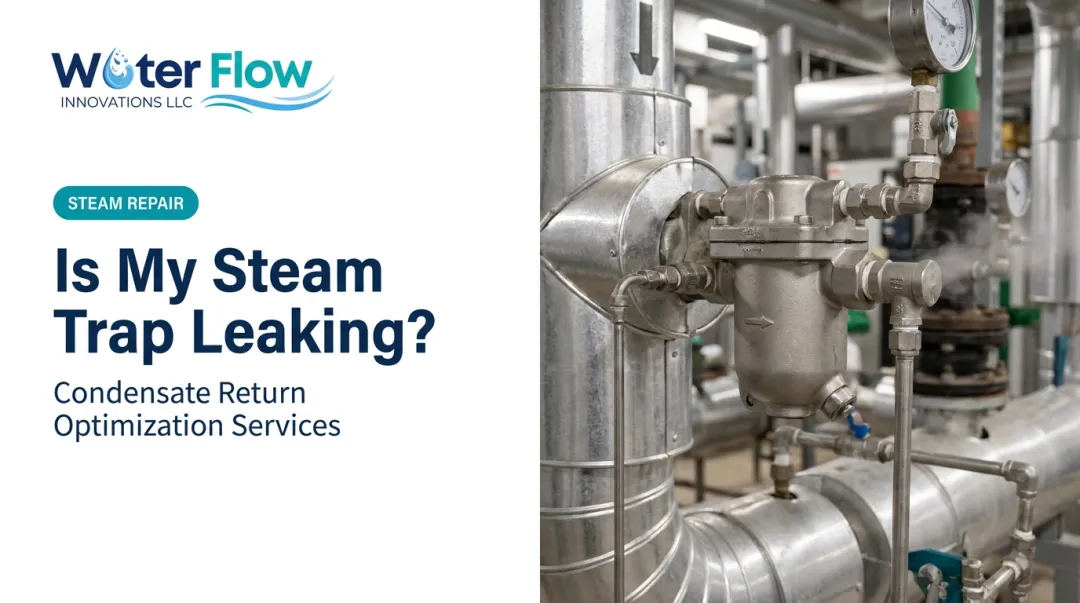
A steam trap has one job: let condensate and non-condensable gases out while keeping live steam in. Simple concept, but the mechanics behind it are more delicate than most people assume.
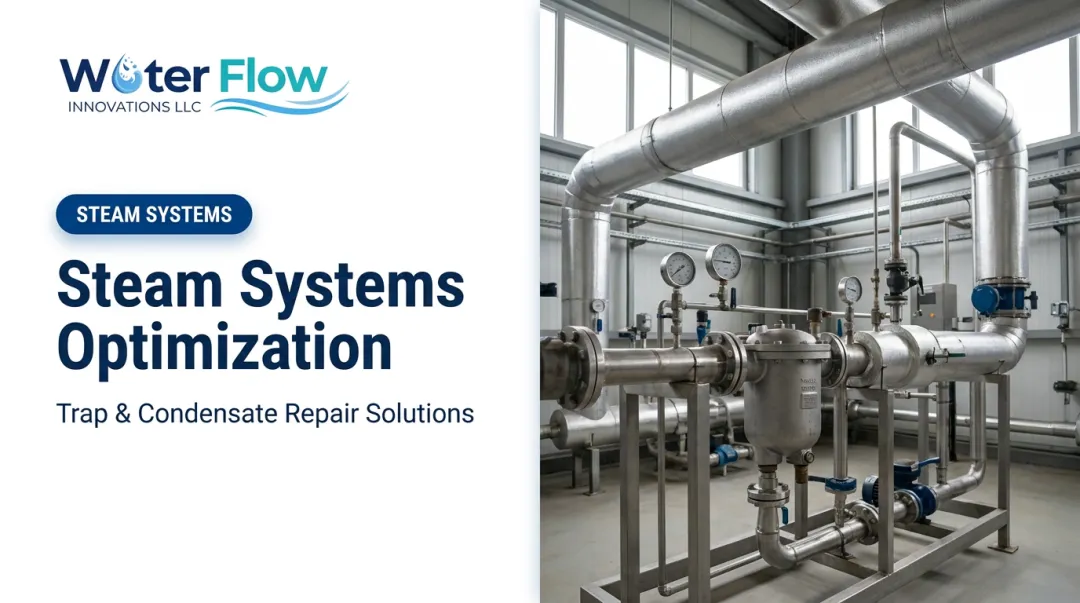
Steam trap management means overseeing that entire function, not just swapping a trap when it fails. Best-practice programs treat the trap as part of a larger "steam trap station," which typically includes:
- Isolation valves on either side, so the trap can be serviced without shutting down the line
- A strainer to catch debris before it damages the trap mechanism
- A test valve for checking discharge without disturbing the line
- A check valve to stop backflow, depending on the design
- A blowdown valve for manual flushing, standard on some designs and optional on others
Not every station includes all five elements listed above. What matters is inspecting the whole assembly, not just the trap body.
Two Failure Modes, Two Different Problems
Every trap fails eventually, regardless of build quality. How fast depends on trap type, application, operating pressure, condensate load, and how the piping is configured around it. When a trap fails, it fails in one of two directions:
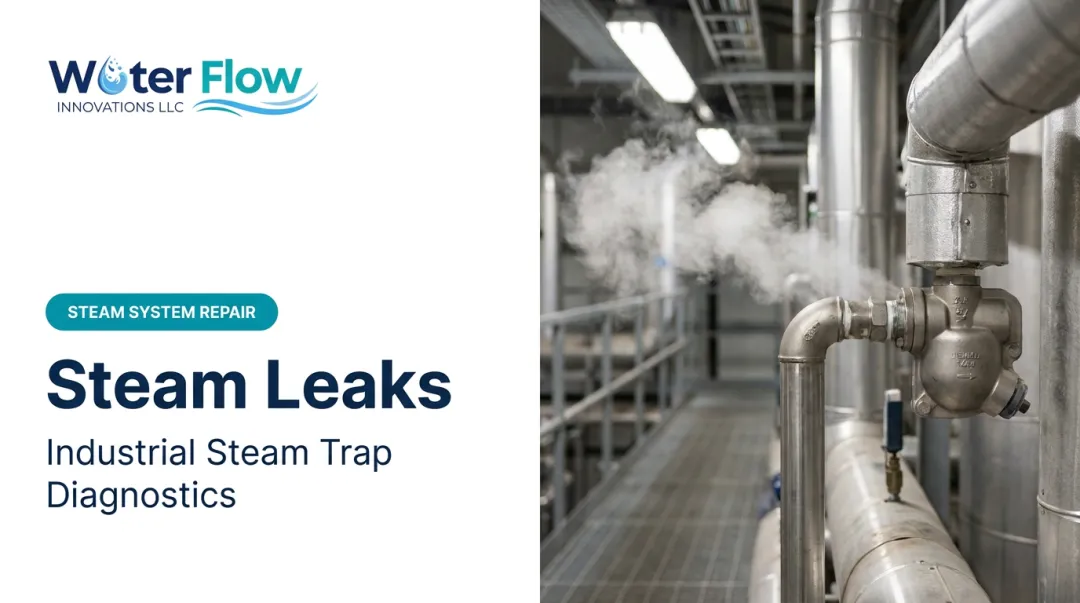
- Blow-through (leaking): The trap sticks open and passes live steam into the condensate system. Production keeps running fine, so nobody notices except on the fuel bill.
- Blocked (stuck closed): The trap stops discharging condensate entirely, causing backup, water hammer, and sometimes product quality issues. This one gets noticed fast because it interferes with the process.
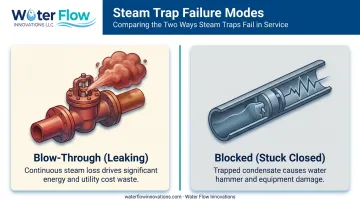
That difference matters for how urgently you respond. A blocked trap on a critical line needs attention today. A leaking trap might not shut anything down, but left alone for a year, it can cost more than the replacement ever would.
Look Beyond the Trap Itself
The more advanced approach is managing the Condensate Discharge Location (CDL): the trap plus the drainage piping, valves, and fittings around it.
A trap can test fine in isolation while the piping around it is undersized, sloped wrong, or feeding a return line that's already backed up. Inspecting the CDL as a whole catches problems a trap-only check would miss.
The True Cost of Poor Steam Trap Management
Steam trap neglect doesn't announce itself. It shows up as a slow bleed across three utility bills at once, and most facilities never connect the dots.
The failure math is worse than people expect: facilities without an active maintenance program can see 15% to 30% of their trap population fail within three to five years, compared to under 5% in systems with regular testing and repair.
What a Single Blow-Through Trap Actually Costs
Steam loss through a failed trap follows Napier's formula, where the rate depends primarily on line pressure and orifice size. DOE's own example illustrates the scale:
- A trap stuck open on a 150-psig line with a 1/8-inch orifice loses roughly 75.8 lb/hr of steam
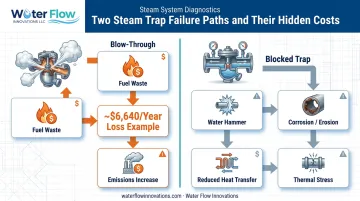
- Run continuously for a year, that's enough to cost around $6,640 annually at $10 per 1,000 lb of steam
- Multiply that across dozens or hundreds of traps, and the number stops looking small
Higher pressure and larger orifices mean bigger losses. A high-pressure line with a worn seat can lose far more than this example.
Blocked Traps and Wasted Steam Bring Added Costs
A stuck-closed trap doesn't waste steam directly, but the consequences can be more expensive to repair. Common outcomes documented by Armstrong International's monitoring research include:
- Water hammer that damages pipe fittings and valve seats
- Corrosion and erosion from wet steam sitting where it shouldn't
- Reduced heat transfer in heat exchangers, sometimes flooding or stalling equipment entirely
- Thermal stress and, in some processes, direct product quality loss
These issues often cost more to fix than the failed trap itself, especially when a blockage goes unnoticed for months. Leaking traps add a separate cost on top of this: every pound of steam lost represents fuel burned for nothing, and that fuel use ties directly to combustion emissions. Facilities tracking ESG metrics or sustainability reporting can use trap survey data to document a legitimate emissions reduction.
Why It Keeps Getting Ignored
Given the numbers, why does this stay unaddressed for years at most facilities?
- Individual traps are cheap and low-visibility compared to major equipment
- Capital budgets get prioritized toward boilers, chillers, and production lines
- Few facilities have in-house steam specialists who know what to look for
- Savings from repairs are rarely tracked back to specific traps, so the ROI case never gets made internally
Steam Trap Testing Methods and Inspection Frequency
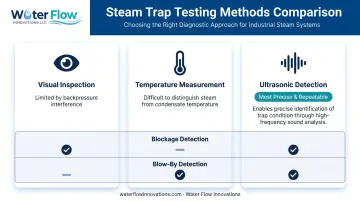
No single test method catches every failure. That's why the most reliable programs combine three approaches instead of relying on one.
Visual Inspection
Technicians open a test valve and watch what comes out. A continuous, heavy discharge or an oversized steam plume usually signals a problem. It's a useful first screen, but it has real limits:
- Opening the test valve changes the trap's backpressure, which can temporarily mask or exaggerate a fault
- It only works where discharge is visible, not on closed condensate return systems
- Reading it correctly takes experience, since flash steam looks a lot like a leak to an untrained eye
Temperature Measurement
Contact pyrometers and infrared devices check the trap's surface temperature. A cold trap usually means a blockage, and comparing upstream and downstream readings helps estimate operating pressure.
The catch: saturated steam and condensate can register at nearly the same temperature. This method is strong at catching blocked traps but weak at confirming whether steam is actually blowing through.
Ultrasonic Detection
Ultrasonic instruments listen for the specific high-frequency signature of proper trap cycling, which sounds distinctly different from steam blowing through. This is the most precise and repeatable method available, and it forms the backbone of most predictive maintenance programs today.
The best diagnosis combines all three, testing at the trap body plus upstream and downstream of it, rather than trusting any single reading in isolation.
How Often Should You Test?
Testing frequency should scale with line pressure:
| Pressure Class | Recommended Testing Frequency |
|---|---|
| High (150+ psig) | Weekly to monthly |
| Medium (30-150 psig) | Monthly to quarterly |
| Low (below 30 psig) | Annually |
Most new programs start on a quarterly cycle. Once failure rates drop below roughly 3%, many facilities shift to biannual testing, since the population has stabilized enough to justify the longer interval.
Facilities without an in-house testing program don't need to handle this alone. Water Flow Innovation provides steam trap testing and replacement as part of its steam system repair services, helping teams establish a testing cadence without adding headcount.
Building a Steam Trap Management Program: Best Practices
A one-time survey tells you where you stand today. It doesn't keep failure rates low. That takes a structured, ongoing program.
Assign Ownership
The AIChE recommends pulling together a cross-functional team spanning maintenance, energy or environmental staff, production, and reliability engineering. One designated steam team leader should be accountable for coordinating surveys, tracking repairs, and reporting results.
Build a Centralized Database
Every trap should have a record covering:
- Location and application
- Trap type, size, and pressure rating
- Installation date and inspection history
- Repair or replacement actions taken
Without this, you're guessing at trends instead of tracking them. A database lets you see which trap types, applications, or areas fail repeatedly.
Fix the Root Cause, Not Just the Symptom
Replacing a failed trap with an identical model just resets the clock on the same failure. Root cause analysis asks why it failed: undersized for the load, wrong type for the application, oversized orifice, or incorrect installation, before choosing a replacement.
Add Continuous Monitoring Where It Makes Sense
Wireless, IoT-based trap monitors are increasingly used alongside manual surveys. They flag failures between scheduled test cycles, which matters most on high-pressure or critical lines where a failure between quarterly checks can get expensive fast.
This is what a structured steam system repair service delivers. A survey identifies every failed trap and quantifies its cost, then repair and a verification pass confirm the fix actually worked, replacing the guess-and-replace cycle that never gets checked.
Beyond Steam: Why Water Efficiency Deserves the Same Attention
Facilities running steam systems are also, by definition, heavy consumers of boiler feedwater. That makes them prime candidates for a utility inefficiency that hides in plain sight, much like a failed trap: water meter over-registration.
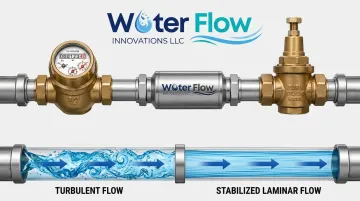
Turbulent flow and air entrainment inside commercial and industrial piping can cause meters to read more volume than actually passed through. The meter isn't broken.
It's registering exactly what moves through the measurement zone, air bubbles and turbulence included. The result: inflated water and sewer charges even when actual consumption hasn't changed.
This is exactly the kind of hidden cost Water Flow Innovation addresses with its certified Flow Conditioning Device (FCD), installed just after the main water meter.
The FCD stabilizes flow through four components working together: air and gas separation, pressure regulation, a check valve, and turbulence elimination. The result is a clean, laminar water column instead of a mix of water, bubbles, and vortex flow.
The documented results:
- 5-30% average reduction in water and sewer bills
- 46% highest documented result on record
- 90% of customers reach full ROI within 12 months, with savings starting on the very next billing cycle
Installation takes about an hour, involves a brief water shutoff, and doesn't touch downstream systems, steam included. The device is IAPMO, NSF, ANSI, CAN 61, KIWA, GMP, and SQF certified, and built from 316L stainless steel.
For facilities already tightening up steam trap programs, this is a natural parallel move. One fixes actual steam and water loss at the trap; the other fixes measurement accuracy at the meter. Running both together typically produces the largest combined reduction across water, sewer, and fuel bills, and it starts with a free bill review, not a commitment.
Frequently Asked Questions
How often should steam traps be tested?
High-pressure lines warrant weekly-to-monthly testing, medium pressure monthly-to-quarterly, and low pressure annually. Most programs start on a quarterly cycle and shift to biannual testing once failure rates fall below about 3%.
What is the average failure rate of steam traps in an unmanaged system?
Facilities without an active maintenance program can see 15-30% of their trap population fail within three to five years. Well-managed programs keep that number under 5%.
What are the warning signs of a failed steam trap?
Continuous hissing or an oversized steam plume signals blow-through, while a cold trap body points to a blockage. Ultrasonic testing catches both, making it the preferred diagnostic method.
How much can a single failed steam trap cost a facility annually?
Cost depends on line pressure and orifice size. The U.S. Department of Energy estimates annual losses around $6,640 for a 150-psig line with a 1/8-inch orifice, with larger orifices or higher pressures costing more.
What's the difference between visual, temperature, and ultrasonic steam trap testing?
Visual inspection catches major failures but requires opening a test valve and reading flash steam. Temperature testing spots blockages but struggles to confirm live-steam leaks. Ultrasonic testing remains the most precise and repeatable method.
Can hidden utility inefficiencies beyond steam affect my facility's bills?
Yes. Water meter over-registration from turbulent flow is a similarly invisible cost, inflating water and sewer bills without any change in usage. Flow conditioning devices can pair with a steam trap program for combined savings.
What warranty covers installed steam system components?
For the flow conditioning device itself, a 6-month money-back guarantee covers the purchase price, with installation cost non-refundable, alongside a lifetime transferable warranty against manufacturing defects that stays with the facility through a change of ownership.
How long does it take to install a flow conditioning device alongside a trap program?
About one hour, with water off for that hour only. It is fitted on the main line after the meter by a licensed plumber or mechanical contractor, so boilers, traps, and condensate return equipment need no shutdown beyond that brief window.