
Introduction
Your water and sewer bill climbs again, but occupancy is flat, operations have not changed, and no one added fixtures. Pressure still feels inconsistent at peak demand, and pipes hiss when large loads kick on.
Many facility and property managers chase these symptoms with fixture upgrades or leak checks, only to find the real culprit is upstream: turbulent, air-laced water moving past the meter in a way that distorts what gets measured. That over-reading can inflate bills by 5–30% without any increase in actual use.
Point of entry (POE) flow conditioning is a whole-property solution installed where water enters a building, before it splits off to individual fixtures. Instead of treating water chemistry, it corrects how water physically moves through the pipe.
This guide covers what POE flow conditioning actually is, how it differs from point-of-use treatment, the mechanics behind meter accuracy issues, and what to look for in a certified system.
Key Takeaways
- POE flow conditioning treats the entire water supply at the main line, not just one fixture.
- Turbulent or aerated flow near a meter can distort readings: direction and size vary by meter type and configuration.
- Point-of-use (POU) systems only treat water at a single tap or appliance, unlike whole-supply POE.
- Proper conditioning can improve fixture performance and correct flow-related measurement inaccuracies.
What Is Point of Entry (POE) Flow Conditioning?
A POE system installs on the main water line before it branches to sinks, appliances, and irrigation. Everything downstream benefits from a single installation point.
The Core Mechanics
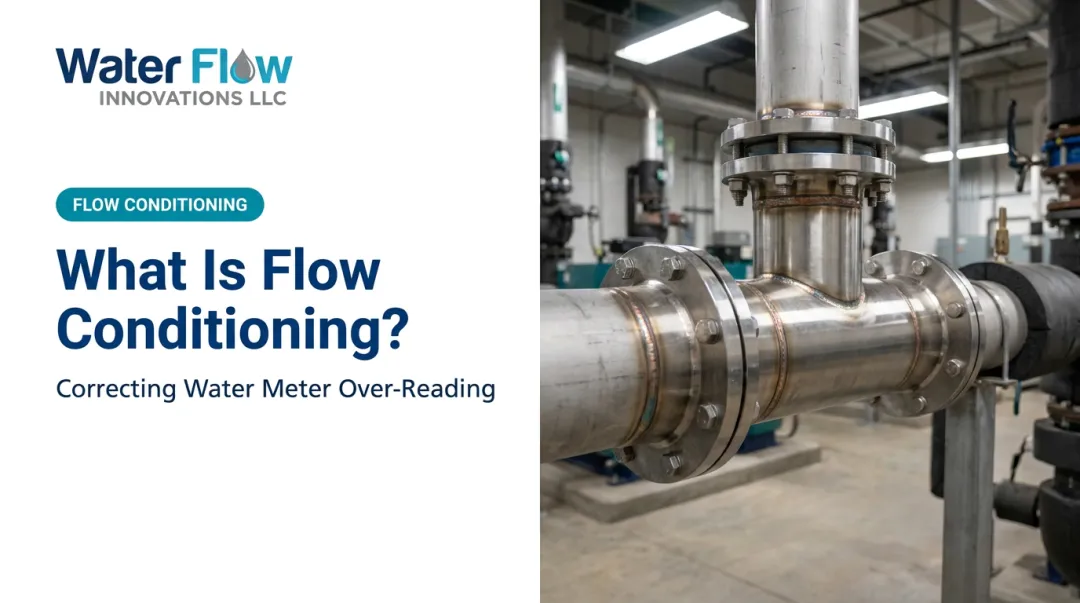
Flow conditioning works by smoothing out the water's velocity profile as it passes toward the meter and plumbing system. Bends, valves, pumps, and short pipe runs upstream can all distort that profile, creating swirl and turbulence.
According to a technical review published by the American Water Works Association, inferential meters are particularly sensitive to these disturbances. Velocity profile, swirl, and turbulence near a meter can alter its reading, though the direction and magnitude depend on the specific meter type and piping configuration.
A conditioner paired with an adequate straight pipe run helps recreate a stable, fully developed flow in the measurement zone.

Not the Same as Filtration or Softening
- Filtration/softening — removes contaminants, minerals, or particles; changes water chemistry.
- Flow conditioning — addresses flow dynamics and measurement accuracy; doesn't touch water composition or taste.
Common Components
Most flow conditioning devices combine several functions:
- Air/gas separation — encourages a homogeneous water column through the measurement zone.
- Pressure regulation — reduces water hammer and surge from on-off cycling.
- Check valve — prevents reverse flow that could reintroduce air after purging.
- Turbulence-reducing chamber — slows velocity enough to prevent vortex flow.
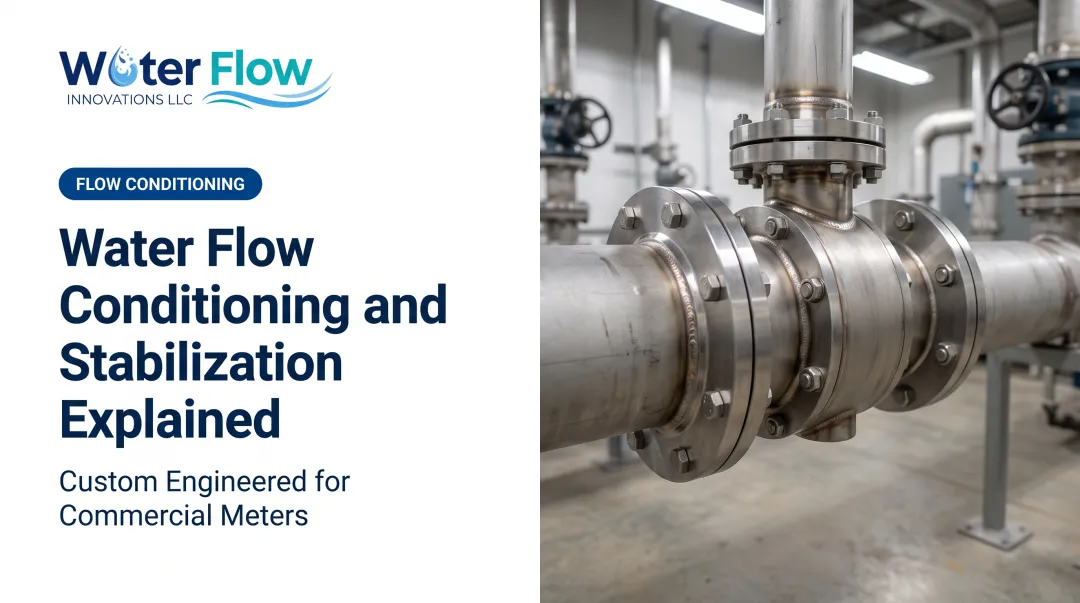
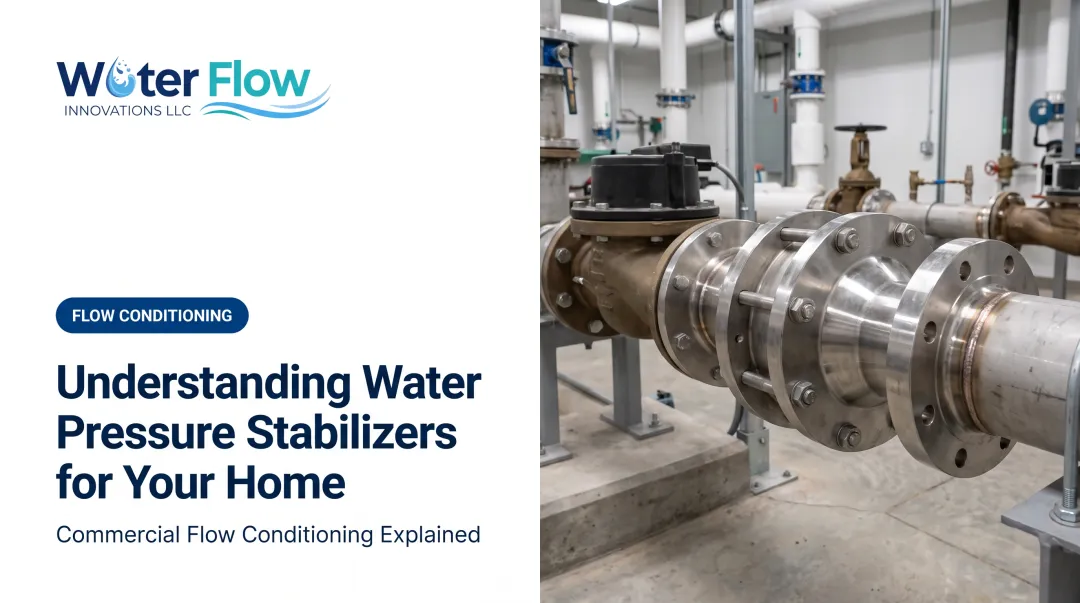
Water Flow Innovation offers a certified example of this approach: the Flow Conditioning Device (FCD), a custom-fabricated 4-component system built in 316L stainless steel and sized for the exact pipe and meter it serves. Rather than restricting flow, it's engineered for negligible pressure loss while correcting the irregularities that can confuse a meter's measurement zone.

POE vs. Point of Use (POU): Understanding the Difference
The EPA defines point-of-entry treatment as occurring where water enters the building, while point-of-use treatment happens at the specific tap or appliance where water is consumed.
| Feature | POE | POU |
|---|---|---|
| Treatment location | Main line, whole-property | Single fixture or appliance |
| Examples | Flow conditioners, whole-house filters, softeners | Under-sink reverse osmosis, faucet filters |
| Coverage | Every downstream fixture | One tap only |
Many properties benefit from combining both:
- POE stabilizes flow at the main line so every downstream fixture benefits.
- POU refines drinking water at a single tap for taste or targeted contaminant removal.
Neither approach replaces the other. They solve different problems.
Why Flow Conditioning Matters for Your Home Water System
Meter Accuracy and Billing
Turbulent flow doesn't automatically inflate every bill, but the mechanism is well documented. A peer-reviewed study of 80mm Woltman meters found that a valve positioned close to the meter (with minimal straight pipe between them) produced errors as high as +42% to +45% in some configurations, while other setups produced slightly negative error.
Spacing the disturbance further from the meter reduced the error dramatically. The takeaway: disturbance-related error is real, but it's configuration-specific—not a fixed percentage every property should expect.
Research on intermittent water systems found a separate issue: discharged air pockets during refill can spin a mechanical meter's measuring element so it registers air as water. That differs from ordinary turbulence in a pressurized line, but it shows how much air and irregular flow can skew meter accuracy.

Beyond the Bill
Flow conditioning has effects beyond measurement:
- Reduces mechanical strain on valves, fittings, and appliances from turbulence-related wear
- Stabilizes pressure for more consistent shower, appliance, and irrigation performance
- Leaves water chemistry unchanged: it corrects movement, not composition
A property that combines a certified flow conditioner with routine plumbing maintenance typically sees smoother day-to-day performance, independent of any billing correction.
Choosing and Installing a POE Flow Conditioning System
What to Evaluate
- Certification listings: prefer NSF/ANSI/CAN 61 and IAPMO marks, and know what each covers
- Compatibility: match pipe size, material, and meter type
- Installation footprint: plan straight-run space; some meters need 5–30 pipe diameters clear
NSF/ANSI/CAN 61 addresses health-effects safety for materials in contact with drinking water. It does not certify hydraulic performance or savings claims. IAPMO marks show compliance with a specific listing program. ANSI accredits standards and certifiers; it does not certify products itself.
The Installation Process
Licensed professional installation at the main line is the standard approach. A straightforward main-line setup often takes about an hour; multiple meters or tight mechanical rooms can take longer.
Pressure loss matters. A conditioner that restricts flow defeats its purpose, so normal water use should feel the same after install.
Water Flow Innovation's FCD is built to that bar: IAPMO, NSF/ANSI/CAN 61, KIWA, GMP, and SQF listings; custom fabrication to pipe spec (NPS 1/2" through 12", plus custom sizes); and negligible pressure-loss design. Coverage includes a lifetime transferable warranty (stays with the property if ownership or management changes) and a 6-month money-back guarantee on the device.

Flexible Acquisition
When comparing providers, ask about:
- Purchase vs. lease options for capital planning
- Warranty length and transferability
- Money-back guarantee terms and exclusions (installation labor is often non-refundable even when the device is covered)
How Much Does a Point of Entry System Cost?
Costs vary widely based on:
- System type — filtration, softening, and flow conditioning have different components and price drivers
- Pipe size — larger diameters generally mean more material and more complex fabrication
- Installation complexity — available straight-run space, upstream layout, and access all factor in
As a reference point, Water Flow Innovation builds every FCD to order, with pipe size as the primary driver across its 1/2-inch to 12-inch standard range. Home and light-commercial jobs usually fall toward the lower end of that band; larger building mains are what push price up.
Rather than guessing at a number, start with a free water bill review. That evaluation looks at billing cycles, meter type, pipe configuration, and usage profile before you size a system, so you avoid over- or under-buying capacity.
Frequently Asked Questions
How much does a point of entry flow conditioning system cost?
Price depends mainly on pipe size, meter type, and how the unit is specified for your line. Costs vary widely because every system is a custom build, so a quick meter and piping review is the reliable way to get a firm quote.
What is the difference between point of entry and point of use?
POE sits on the main water line and affects the whole property, including flow through the water meter. POU serves one fixture only and does not correct turbulence or air issues at the meter.
What is a point of entry (POE) flow conditioning system?
A POE flow conditioning system installs at the main water line and stabilizes flow for the entire property, covering downstream fixtures, appliances, and the meter.
How does flow conditioning affect water meter accuracy?
Turbulent or aerated flow near a meter can push readings above actual usage. How large the error is depends on meter type and pipe layout. Flow conditioning steadies the stream so the meter records volume more accurately.
Can POE flow conditioning reduce my water bill?
Yes. When meter over-reading comes from turbulent or aerated flow, correcting it often cuts water and sewer bills by about 5–30%, with a highest documented single result of 46%. Savings still depend on your meter and piping, so a bill review is the best way to estimate results.
Do I need a professional to install a POE flow conditioning system?
Yes. Placement relative to the meter, keeping pressure loss negligible, and meeting local plumbing codes all affect long-term performance, so professional installation is the standard approach.
Would asking the utility for a new meter be simpler than POE conditioning?
It rarely resolves the issue. A replacement meter still registers whatever reaches it, entrained air included, so the same over-reading returns while the turbulence at the point of entry continues unchanged.
What cover applies to a POE installation?
A 6-month money-back guarantee on the device purchase price, with installation cost non-refundable, so it can be returned if metered consumption does not measurably fall. A lifetime transferable warranty follows the property on a change of ownership, subject to a transfer fee.