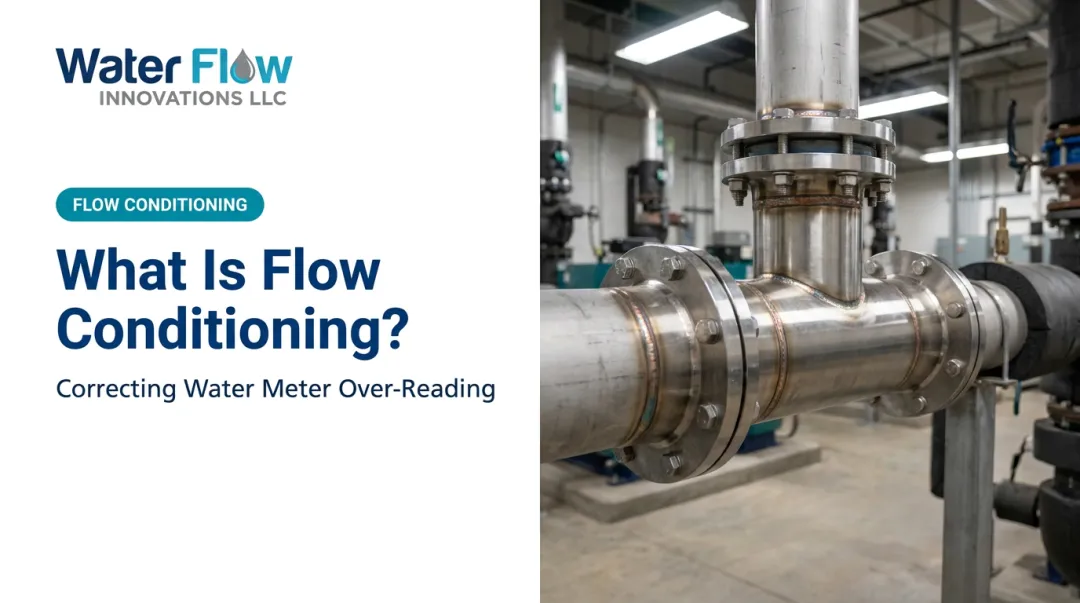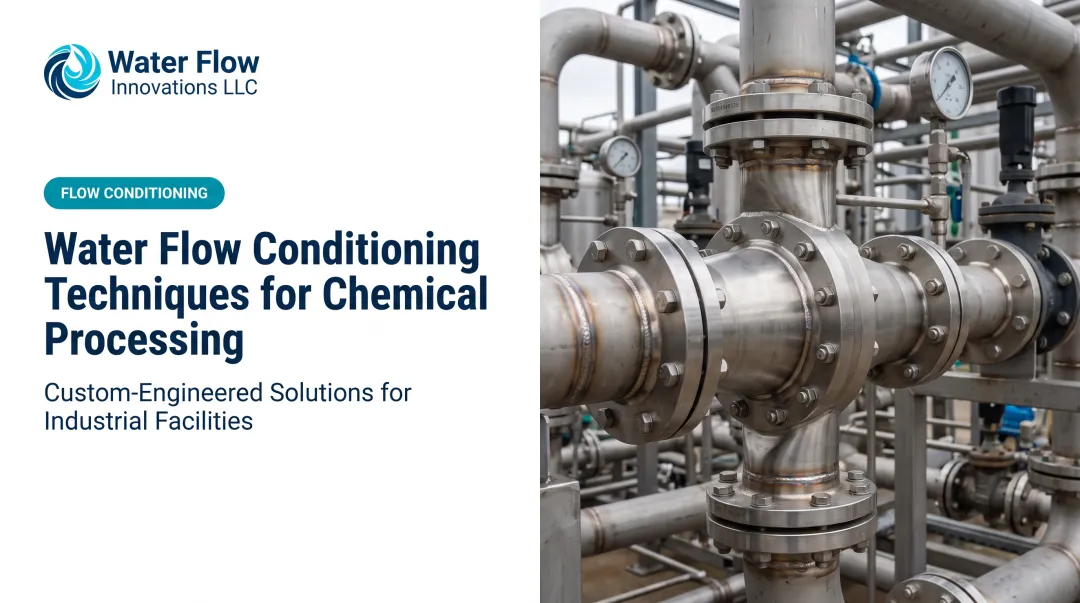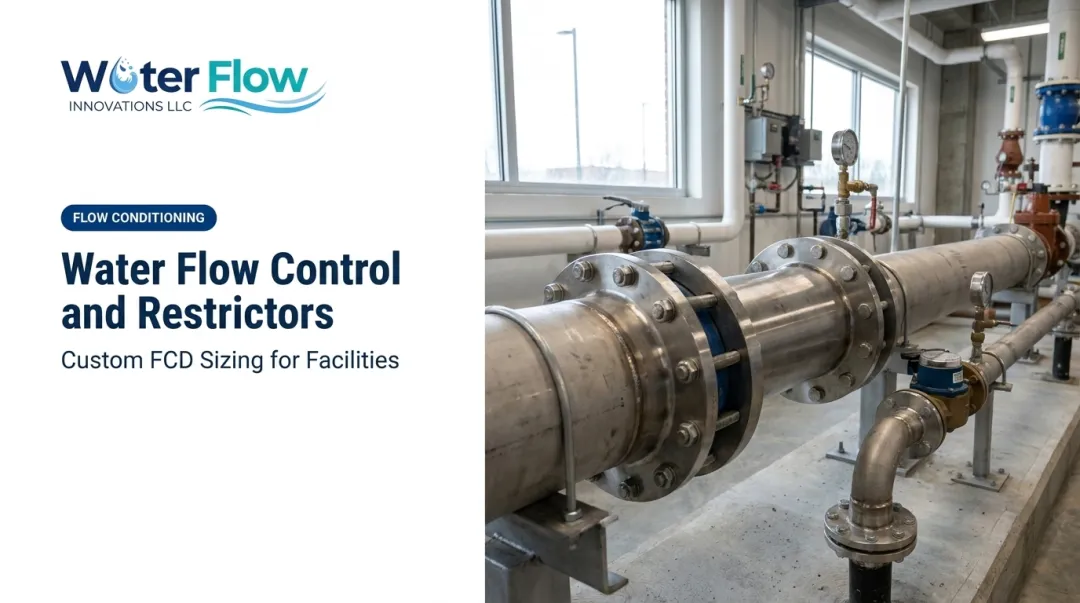

Water flow conditioning is the engineering practice of stabilizing that flow — removing air, smoothing turbulence, and regulating pressure — at the meter or process point. Pacific Northwest National Laboratory notes that fittings and valves near a meter create turbulence that decreases the accuracy of most meters, a problem that gets worse as facilities age and pipe configurations get more complex.
This guide breaks down the components that make flow conditioning systems work, and why they matter for utility bill accuracy.
Key Takeaways
- Turbulence and entrained air degrade meter accuracy; error size depends on meter type and installation
- Complete systems combine air/gas removal, pressure regulation, a check valve, and turbulence elimination
- Certified devices from Water Flow Innovation document 5-30% average bill reductions, with a top result of 46%
- Proper conditioning also protects equipment from cavitation and pressure-related wear
What Is Water Flow Conditioning and Why It Matters
Flow conditioning treats the physical behavior of water as it moves through a pipe, correcting turbulence, air pockets, and pressure spikes in the water being measured or used. It's a mechanical fix, not a chemical one.
Here's why it matters: a meter designed to count water molecules doesn't distinguish between water and air. When entrained air bubbles pass through a positive-displacement meter, they can inflate the reading. KOBOLD's technical documentation confirms that entrained air or gas can cause measurement errors in positive-displacement meters. Commercial turbine meter guidance makes the same point: eliminate air and sudden surges, or registration suffers.
Three distinctions matter on site:
- Flow conditioning is not filtration. It doesn't remove contaminants. It addresses turbulence, air, and pressure behavior in the flow stream.
- Meter placement matters. Fittings, elbows, and valves installed too close to a meter introduce turbulence that many meters simply weren't designed to handle.
- The error isn't always predictable. Turbulence and air degrade accuracy, but the size of that error depends on meter age, type, and site conditions. A facility-specific assessment beats any generic percentage.
The Four Key Components of a Flow Conditioning System
A comprehensive flow conditioning device isn't a single-function device. It integrates four distinct engineering functions working in sequence, rather than solving one narrow problem in isolation.
Component 1: Air and Gas Removal
Entrained air bubbles take up volume in the pipe, and a meter counting volume will count that air right along with the water. Flow conditioning devices address this by creating a static back-pressure zone (a compression chamber) around the meter connection.
This pressure zone displaces air and gas bubbles back into the main water line and out of the measurement point, leaving a more homogeneous water column passing through the meter.
Component 2: Pressure Regulation
Inconsistent pressure creates velocity spikes, and velocity spikes distort flow measurement while stressing downstream fixtures. Stabilizing pressure keeps flow moving at a consistent rate through the meter.
- Well-designed conditioners are built for negligible pressure loss in normal operation
- Under high-volume, open-discharge conditions, pressure may drop roughly 3-5 psi, often a benefit in over-pressurized systems
- Custom-engineered units can maintain or even boost psi for pressure-critical operations like pharmaceutical or electronics manufacturing
Component 3: Check Valve Function
A check valve prevents backflow and the pressure fluctuations that come with it. Reversed flow can pull previously purged air back into the line, undoing the work of the air removal stage.
By preventing water hammer and reverse flow, this component maintains steady flow direction and more reliable meter registration. Not every installation needs one; it depends on the system's existing backflow protection.
Component 4: Turbulence Elimination / Flow Straightening
The final stage slows water velocity enough at the meter to prevent the spinning, vortex-style flow pattern that causes over-counting. Internal geometry, such as vanes or straightening elements, converts a chaotic flow pattern into a smoother, more uniform one heading into the meter.

Water Flow Innovation's FCD is engineered for this negligible-pressure-loss outcome, meaning the straightening effect doesn't come at the cost of system performance or reduced water delivery downstream.
How Flow Conditioning Components Work Together
The four components run as one sequence, not four devices bolted together. Flow moves through them in order:
- Water enters at the existing pipe connection, immediately downstream of the meter's supply side
- Air and gas separate in the compression zone and return to the main line
- Pressure stabilizes, removing the spikes that distort readings
- Check valve blocks backflow and water hammer
- Turbulence elements straighten the flow at the meter
That sequence matters because of the vena contracta: the point just downstream of a valve or restriction where the flow area is smallest and velocity peaks.
Valmet's engineering documentation explains that pressure drops sharply at the vena contracta. If pressure falls below the water's vapor pressure, vapor bubbles form. When those bubbles collapse downstream, cavitation follows—a real cause of equipment wear, not just a metering nuisance.

Once flow is conditioned in that order, the unit itself stays simple to place. Installation fits inline with existing plumbing, works with any meter type and any standard pipe size (½-inch to 12-inch), and usually takes about an hour for straightforward setups. Industrial sites with complex piping can take longer.
Types of Flow Control and Conditioning Devices
It's easy to lump these devices together, but each serves a distinct job:
| Device Type | Primary Function |
|---|---|
| Flow control valves | Maintain a constant flow rate (GPM) regardless of pressure changes |
| Pressure-reducing/sustaining valves | Regulate static or flowing pressure to a target setpoint |
| Check valves | Allow flow in one direction only, preventing backflow |
| Flow conditioners/straighteners | Correct velocity profile and remove turbulence at the meter |
The key distinction: flow control valves regulate how much water moves through a pipe, while flow conditioning devices correct how accurately that movement gets measured. One manages rate. The other manages measurement quality. Confusing the two often leads facilities to install the wrong equipment for the problem they're trying to solve.
Benefits of Properly Conditioned Water Flow for Commercial Facilities
Correcting meter over-reading produces results that show up almost immediately:
- Cuts water and sewer bills, since most utilities base sewer charges on metered water use
- Protects valves and fixtures from cavitation and pressure-related wear
- Delivers savings on the next billing cycle, with no multi-month wait
- Supplies before-and-after utility bills as auditable data for ESG reports, LEED credits, and sustainability programs
Water Flow Innovation documents an average 5–30% reduction in water and sewer bills across its customer base, with a top documented result of 46%. The company also reports that 90% of customers reach ROI within 12 months.

These gains apply across manufacturing plants, hotels, hospitals, multifamily buildings, universities, data centers, and many other facility types, regardless of pipe size or meter model. A corrected reading reflects billed consumption more accurately. It should not be presented as proof of reduced water usage unless separate consumption data supports that claim.
Choosing and Installing a Flow Conditioning Solution
Choosing a Flow Conditioning Solution
Not every flow conditioner improves meter accuracy. When you evaluate options, hold vendors to three criteria:
- Certifications — look for IAPMO, NSF, ANSI, CAN 61, and KIWA marks, which address health, safety, and material suitability for drinking-water contact
- Compatibility — the device should fit your existing pipe size and meter type without requiring a system overhaul
- Negligible pressure loss design — confirm the manufacturer can demonstrate this, not just claim it
Water Flow Innovation custom-fabricates each FCD in 316L stainless steel to match your exact pipe size (NPS ½" through 12"), flange type, and meter model. You can buy or lease, and each unit includes a 6-month money-back guarantee and a lifetime transferable warranty that stays with the property through ownership changes.

Most units install in about an hour on existing pipework. Before you commit, request a free facility assessment. That review covers your bills, meter configuration, pipe details, and operational patterns (cooling towers, CIP cycles, irrigation zones) and produces a facility-specific savings projection before you spend a dollar.
Frequently Asked Questions
What are the different types of water flow control valves?
Flow control valves maintain a constant flow rate, pressure valves regulate psi, check valves stop backflow, and conditioners correct turbulence at the meter. Each addresses a different part of the system.
What is a flow control system?
It's a combination of components (valves, regulators, and conditioners) working together to manage flow rate, pressure, and flow quality within a piping network. No single device handles all three.
How does water flow conditioning reduce utility bills?
It corrects meter over-reading caused by turbulence and entrained air, so the meter reads closer to actual water delivered. Bills then reflect real usage rather than an inflated count.
Does flow conditioning affect water pressure or system performance?
Properly designed devices create negligible pressure loss and cause no operational disruption. In some high-volume scenarios, a small 3-5 psi drop can actually help stabilize an over-pressurized system.
How long does it take to install a flow conditioning device?
Straightforward installations typically take about an hour, with a brief water shutoff at the meter connection. Complex industrial configurations may take longer. A pre-installation site survey helps flag those cases.
Is flow conditioning the same as water filtration?
No. Filtration removes contaminants from water; flow conditioning addresses flow behavior (turbulence, entrained air, and pressure stability) that affects how accurately a meter registers what passes through it.
Would swapping the meter achieve the same outcome?
Rarely. Any meter counts what reaches it, entrained air included, so a replacement reproduces the same over-reading while the turbulence upstream continues. The flow itself has to be corrected.
What savings has the conditioning component produced?
Documented installations average a 5–30% reduction in combined water and sewer charges, with a highest documented single result of 46%, from measurement accuracy rather than restricted flow.