Introduction
Walk through almost any manufacturing plant, hospital basement, or food processing facility, and you'll hear it before you see it: the hiss and knock of pipes carrying steam. It's invisible, constant, and essential to modern industry.
Steam generation isn't a minor line item either. A DOE-backed Lawrence Berkeley National Laboratory study found that steam production accounted for 37% of the fossil fuel burned by US industry, translating to roughly 6.1 quadrillion Btu of boiler energy annually.
Here's the problem: most facility managers know steam powers their operations, but few track what it costs to make. Fuel, water, chemical treatment, and maintenance costs add up fast, often invisible until the annual budget review.
This article breaks down what industrial steam actually is, how it's produced, the different types you'll encounter, and typical temperature and pressure ranges. We'll also cover a cost factor most facilities overlook entirely: water measurement accuracy.
Key Takeaways
- Steam generation consumes over a third of US industrial fossil fuel use, a major hidden operating cost.
- Latent heat makes steam roughly five times more efficient at transferring energy than hot water alone.
- Three steam types (saturated, superheated, wet) serve very different industrial purposes.
- Every pound of steam starts as feedwater, tying water accuracy directly to your utility bill.
What Is Industrial Steam?
Industrial steam is water vapor generated and held under controlled pressure and temperature conditions for a specific job, whether that's heating, powering a turbine, sterilizing equipment, or driving a chemical process. This distinguishes it from the steam rising off your morning coffee, which is uncontrolled and at atmospheric pressure.
The science behind why steam works so well comes down to two types of heat:
| Heat Type | What It Does | Energy Required |
|---|---|---|
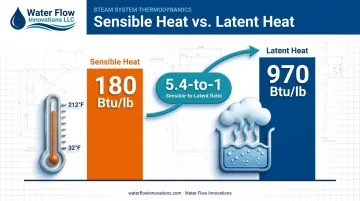
| Sensible heat | Raises water's temperature without changing its state | About 180 Btu per pound (32°F to 212°F) |
| Latent heat | Converts that same water into vapor at the boiling point | Roughly 970 Btu per pound at atmospheric pressure |
That's nearly a 5.4-to-1 ratio. In practice, it means steam carries far more usable energy per pound than hot water at the same temperature, making it the go-to medium for efficient heat transfer.
Industries Built on Steam
That efficiency is why steam infrastructure underpins production across several sectors, including:
- Manufacturing (process heat, drying, chemical reactions)
- Food and beverage (pasteurization, cooking, sanitation)
- Pharmaceutical and biotech (sterilization, clean steam)
- Hospitals (autoclaves, laundry, heating)
- Hotels and universities (laundry, space heating, kitchens)
Generating that steam requires enormous volumes of feedwater. Every pound of steam that leaves a boiler started as a pound of water entering it. That relationship is exactly why water measurement accuracy becomes a real cost factor, as later sections explain.
How Is Industrial Steam Generated?
At its core, steam generation is straightforward: fuel burns in a furnace or burner, and that heat transfers into feedwater sitting inside a pressure vessel. Heat moves through radiation, convection, and conduction until the water reaches its boiling point and converts to vapor.
Common fuel sources include:
- Natural gas
- Fuel oil
- Coal
- Biomass
- Electricity
Fuel choice affects efficiency, emissions, and operating cost. Electric boilers, for instance, typically run at 95-99% efficiency compared to 70-85% for well-maintained fossil-fuel units, according to Lawrence Berkeley National Laboratory. The tradeoff comes down to upfront equipment cost, fuel availability, and whatever your local electricity grid runs on.
Fire-Tube vs. Water-Tube Boilers
Fuel selection is only half the equation; boiler design determines how that heat actually gets used. The key design difference is simple: in fire-tube boilers, hot combustion gases pass through tubes surrounded by water. In water-tube boilers, it's reversed, with water traveling inside the tubes while hot gas passes around them.
| Boiler Type | How It Works | Best Suited For |
|---|---|---|
| Fire-tube | Hot gases pass through tubes surrounded by water | Low-to-medium pressure needs, lighter industrial loads |
| Water-tube | Water travels inside tubes while hot gas passes around them | High-pressure, high-output demands, including power generation |
Steam Generators vs. Steam Boilers
Manufacturers use these terms somewhat differently, but the practical distinction usually comes down to design philosophy. Single-coil steam generators use low water content, start up quickly, and take up less floor space. They're built for on-demand production.
Multi-tube steam boilers, by contrast, hold more water reserve capacity. They suit continuous, high-volume steam needs where output can't fluctuate.
Either way, feedwater quality plays a critical role. Poorly treated feedwater causes scale buildup and corrosion inside the boiler, degrading heat transfer efficiency over time. Getting that feedwater volume measured accurately matters too, a point we'll return to shortly.
Types and Classifications of Industrial Steam
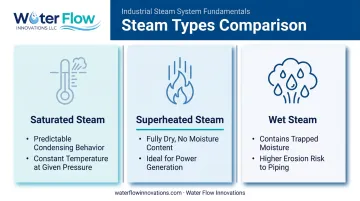
Industrial steam typically falls into three categories based on temperature and moisture content:
- Saturated steam sits exactly at its boiling point for a given pressure. It's the most common industrial type, condensing predictably to release heat efficiently.
- Superheated steam is heated beyond its saturation point at that same pressure. It's fully dry and used mainly in power generation, where preserving energy through expansion matters most.
- Wet steam contains a mixture of liquid and vapor. Trapped moisture reduces heat-transfer efficiency and can cause erosion or waterhammer in piping.
There's also a purity-based classification worth understanding:
- Plant/utility steam may contain boiler treatment chemicals and isn't suitable for direct product contact.
- Clean steam meets stricter quality standards for direct-contact sterilization in pharmaceutical and food applications.
Dryness Fraction and Purity Standards
The dryness fraction describes what percentage of a steam sample is actually vapor versus trapped liquid. Steam with 10% entrained water by mass has a dryness fraction of 0.90.
Regulated industries test steam quality against formal benchmarks. According to ISPE's guidance on steam quality and testing, steam supplied for sterilization applications must meet three key thresholds:
- Dryness fraction of at least 0.95
- Non-condensable gases below 3.5 mL per 100 mL of condensate
- Superheat under 25°C after atmospheric expansion
EN 285 governs testing requirements for large steam sterilizers used across healthcare and pharma settings.
Industrial Steam Applications by Industry
Steam does more heavy lifting across industry than most people realize. Major functional uses include:
- Process heating for chemical reactions and product drying
- Electricity generation through steam turbines
- Sterilization and autoclaving
- Humidification
- Cleaning and sanitization
These functions map directly onto specific sectors:
| Industry | Primary Steam Use |
|---|---|
| Food & Beverage | Pasteurization and CIP (clean-in-place) cleaning cycles |
| Pharmaceutical & Biotech | Sterilization with clean steam meeting Water for Injection standards |
| Hospitals & Hotels | Laundry operations and building heat |
| Manufacturing (Pulp, Paper, Chemical, Refining) | Process heat for production operations |
These figures show just how large that footprint is. A DOE process-heating assessment found that steam-based systems supplied 32% of all US manufacturing process-heating energy in 2010, equal to 2,290 trillion Btu. Fuel-based systems covered another 64%, with electric systems making up the remainder.
Steam Temperature & Pressure Ranges
Pressure and boiling point move together. Increase the pressure on water and its boiling point rises with it — that relationship is exactly why steam tables exist, mapping how much pressure yields what temperature.
Low-pressure steam-heating boilers are capped at 15 psig under ASME Section IV, corresponding to a saturation temperature of roughly 250°F. That's the code boundary, not an arbitrary number.
High-pressure systems tell a different story, running far hotter than that low-pressure ceiling. DOE's representative combined heat and power (CHP) steam turbine examples illustrate the range:
| System Size | Pressure | Temperature | Approx. Output |
|---|---|---|---|
| Small | 300 psig | 450°F | ~250 kW |
| Mid-size | 650 psig | 650°F | ~3 MW |
| Large | 800 psig | 750°F | ~25 MW |
Superheated steam can exceed the saturation temperature at a given pressure, and that's exactly why power plants favor it. Extra thermal energy translates into more available work during turbine expansion, plus it delays condensation, reducing droplet erosion risk on turbine blades.
These pressure and temperature choices carry real financial weight beyond the turbine room. Poor pressure and temperature management wastes both fuel and water. Oversized pressure drops force boilers to work harder than necessary, and that inefficiency compounds when the feedwater going into the system isn't measured accurately in the first place.
Why Water Quality and Meter Accuracy Matter for Steam Systems
Here's the piece most facility teams miss: steam generation is inherently water-intensive. Every pound of steam produced requires makeup feedwater, and that feedwater has to come from somewhere, usually the municipal supply line.
That makes water measurement accuracy a direct line item on your operating budget, one finance teams should track like any other cost center.
The problem: industrial water meters commonly over-read in high-volume feedwater and utility lines. Turbulent flow and air entrainment, both common during steam system cycling, boiler makeup surges, and condensate return events, cause meters to register more volume than actually passed through. Facilities end up paying for water they never consumed.
How Water Flow Innovation Addresses This
Water Flow Innovation designs a certified Flow Conditioning Device (FCD) built specifically for facilities with high-volume, variable-demand water lines, including food and beverage plants, pharmaceutical manufacturers, hospitals, and industrial operations with heavy steam demand.
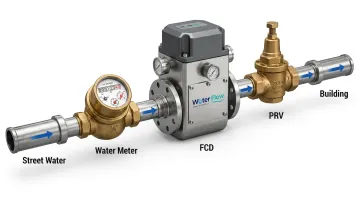
The FCD installs on the main municipal supply line immediately after the meter, not on internal boiler feedwater piping, so it corrects billing accuracy without touching steam generation equipment or process systems downstream. It works through four components:
- Air and gas separation, which removes entrained bubbles in the measurement zone
- Pressure regulation, reducing water hammer from on-off cycling common in boiler feed patterns
- Check valve protection, preventing reverse flow and re-entrainment
- Turbulence elimination, stopping the vortex flow that causes meters to over-count
Facilities using the FCD see a documented 5-30% average reduction in combined water and sewer bills, with 46% the highest documented single result and about 90% reaching full ROI in under 12 months. Because the device sits upstream of the entire system, boiler feed pressure, condensate return, and steam distribution all continue operating exactly as before. The only thing that changes is what the meter actually bills.
For facilities also dealing with steam trap failures or condensate losses, which affect an estimated 30% of steam traps industry-wide, Water Flow Innovation's steam system repair services address that volume-reduction side separately. Run alongside meter correction, trap repair adds a second layer of measurable savings, tackling consumption losses that meter correction alone doesn't touch.
Frequently Asked Questions
How is industrial steam generated?
Fuel combustion in a boiler heats feedwater inside a pressure vessel until it converts to vapor. Heat transfers via radiation, convection, and conduction, with fuel choice and boiler design determining overall efficiency.
What is industrial steam used for?
Industrial steam powers process heating, electricity generation via turbines, sterilization and autoclaving, humidification, and industrial cleaning. Applications span manufacturing, food production, pharma, healthcare, and hospitality.
How hot is industrial steam?
Temperature depends entirely on pressure. At atmospheric pressure, saturated steam sits at 212°F (100°C), but superheated steam in power applications can run considerably hotter, often exceeding 700°F at high pressure.
What are the three types of industrial steam?
Saturated steam sits at its boiling point for a given pressure. Superheated steam is heated beyond that point and stays fully dry. Wet steam contains trapped liquid moisture, reducing its heat-transfer efficiency.
What is the difference between industrial steam and residential steam heating?
Industrial steam operates at far higher pressures and volumes to support process heating and power generation. Residential steam heating runs at low pressure, typically under 15 psig, purely for space heating.
How much water does industrial steam generation consume?
Steam systems typically need 1.1 to 1.3 pounds of feedwater for every pound of usable steam, once blowdown and system losses are factored in. That volume makes accurate water measurement essential to controlling total operating costs at any steam-heavy facility.
Which industries depend most heavily on industrial steam?
Breweries and distilleries, dairy and food and beverage processing, meat and poultry processing, paper mills, textile mills, pharmaceutical and biotech plants, healthcare facilities, laundromats and commercial laundries, and centralized district energy plants.
Does boiler makeup water affect the water bill as well as the fuel bill?
Yes. Every pound of feedwater is drawn through the metered municipal connection, and that demand cycles with production load. The cycling entrains air at the meter, so facilities pay for both real makeup volume and phantom volume on top of it.