
Because of this, some operators look into water flow conditioning devices. The goal isn't to cut attraction performance or skip water-quality controls. It's to address inaccurate or inflated meter readings caused by entrained air and turbulent flow — a measurement problem, not a usage problem.
This article defines the technology, walks through where it might apply in a park setting, covers selection and installation basics, and explains how to verify whether the investment actually produces savings you can measure.
Key Takeaways
- Flow conditioning manages air, pressure, and turbulence in the pipe before water reaches the meter, so readings track actual usage
- Does not replace leak detection, water conservation, treatment, filtration, pump maintenance, or regulatory compliance
- Financial impact depends on site conditions, meter type, utility billing rules, and documented before-and-after data
- Involve facilities, engineering, finance, water quality, and utility stakeholders before any installation decision
What Is a Water Flow Conditioning Device and How Does It Work?
A water flow conditioning device sits in the pipe upstream of a water meter and stabilizes flow conditions before measurement happens. It doesn't treat water, soften it, boost pressure, or detect leaks. It addresses hydraulic disturbances that can cause a meter to misregister.
What It Is Not
It's easy to confuse flow conditioning with other equipment that lives in the same mechanical room. Here's the distinction:
| System | What it does | What it does NOT do |
|---|---|---|
| Flow conditioning device | Stabilizes air, pressure, and turbulence before the meter | Treat, filter, or soften water |
| Water treatment/filtration | Removes contaminants, adjusts chemistry | Correct meter measurement accuracy |
| Pressure booster pump | Increases pressure to meet demand | Address air entrainment at the meter |
| Leak detection system | Identifies physical water loss | Fix turbulence-related meter errors |
Why Meters Misregister
Three documented mechanisms can distort a meter reading:
- Entrained air during refilling. A 2025 laboratory study found meters registered 33% to 63% of displaced air volume as water during pipe refilling—common when parks cycle pumps and fill features on a schedule.
- Turbulence from upstream fittings. Elbows, reducers, and valves disturb the flow profile. McCrometer's guidance notes propeller meters can read high or low; magnetic meters often under-report.
- Pressure fluctuations. Pump cycling or valve swings can briefly drive reverse flow through a meter in some plumbing layouts.
Water Flow Innovation's Flow Conditioning Device (FCD) counters these mechanisms with four functions:
- Air/gas displacement that keeps an air-free water column moving through the meter
- Pressure regulation across normal operating ranges
- Check-valve protection against reverse flow
- Turbulence reduction that slows velocity enough to limit vortex formation
Correcting a meter reading is not the same as reducing actual water consumption. A properly sized and installed device causes negligible pressure loss, but a given park still needs engineering data to confirm that: pipe size, meter model, pressure range, and flow profile.

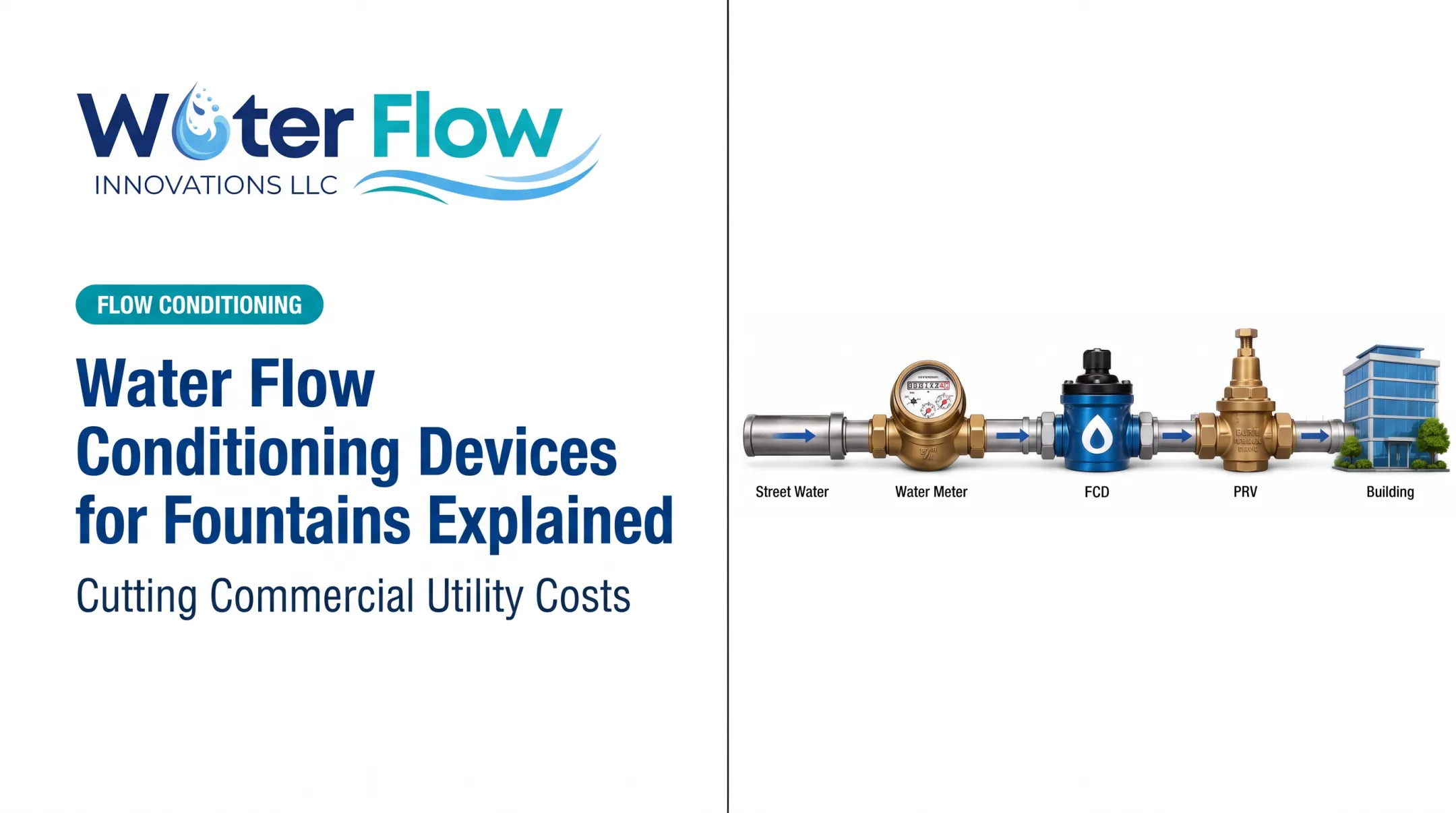
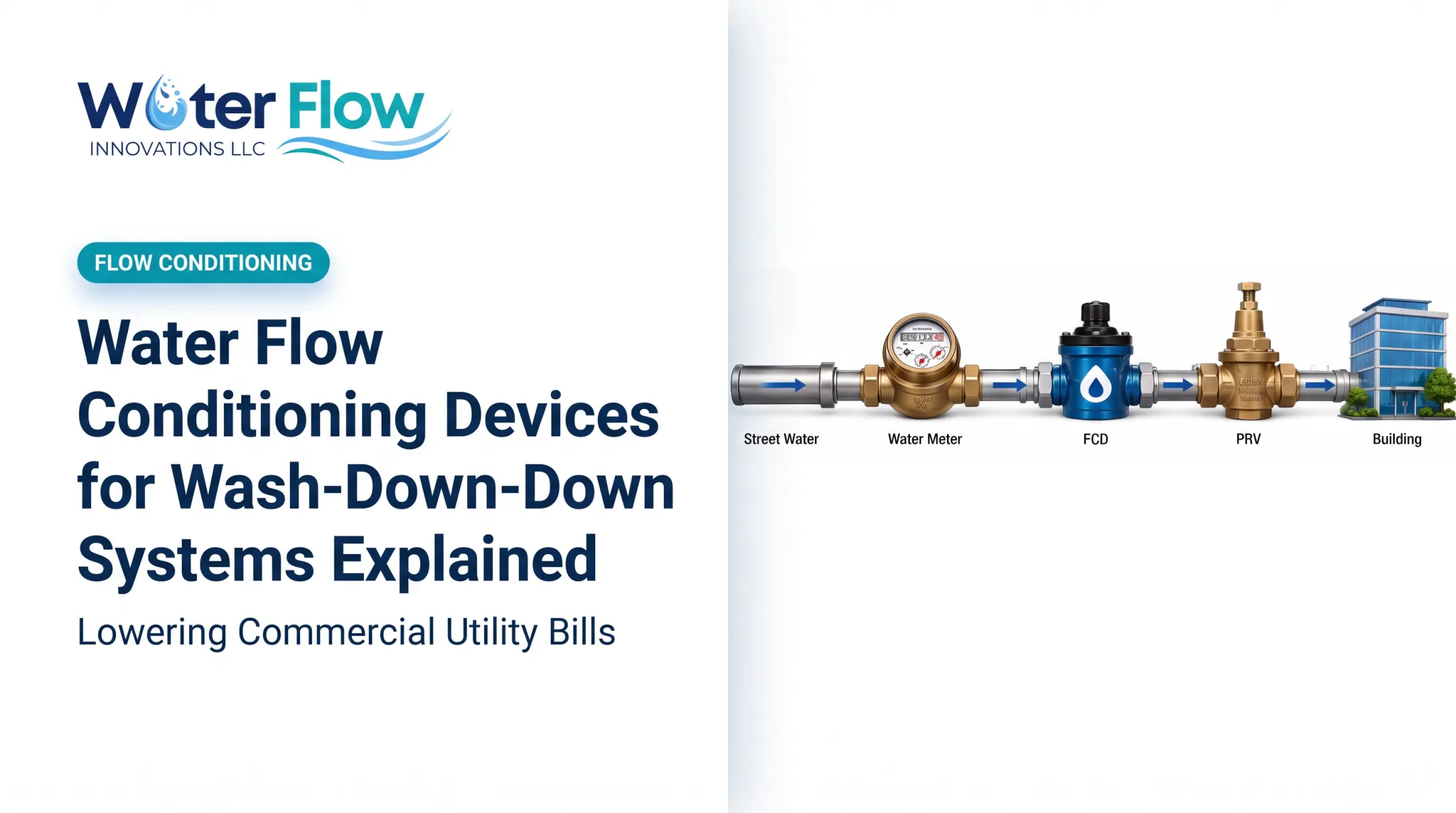
Simple flow path: incoming service line → flow conditioning device → water meter → internal distribution → attractions, fountains, kitchens, and restrooms.
Where Theme Parks Can Use Water Flow Conditioning Devices
Theme parks have several high-demand zones, each with its own flow pattern:
- Water rides, lazy rivers, and wave pools (large recirculating volumes with pump cycling)
- Splash pads and interactive fountains (frequent on/off cycling throughout the day)
- Show fountains (scheduled bursts tied to performance times)
- Cooling systems supporting indoor attractions
- Irrigation for landscaped areas
- Restrooms and food service (simultaneous demand during peak guest hours)
Why Theme Parks Differ From Office Buildings
A typical commercial building has relatively steady flow. A theme park doesn't. Rapid flow swings come from events a steady-state building rarely sees:
- Attraction start-up and pump cycling
- Filtration backwash
- Choreographed show sequences
- Simultaneous restroom use during parades or show changes Those swings are exactly why placement and sizing need a park-specific look—not a generic commercial template.
Where Installation Might Make Sense
Potential installation points include:
- The incoming domestic water service at the master meter
- Dedicated branches feeding major attractions or zones
- Irrigation system connections
- Other independently metered segments Final placement depends on a site assessment. A flow conditioning device complements existing pumps, filtration, chemical treatment, backflow preventers, and storage tanks. It does not replace them.
Water-Type Requirements Still Apply
Each water type carries different material, backflow, and sanitation rules:
- Potable (domestic) water
- Recreational water (pools, splash pads)
- Irrigation water
- Reclaimed water For aquatic loops, the CDC's Model Aquatic Health Code requires filtration flowmeters to read within 5% of design flow and meet specified NSF/ANSI certifications. Those aquatic-loop rules do not automatically apply to an incoming-service installation.
Pre-Selection Diagnostic Checklist
Before choosing an installation point, review:
- Meter location, type, and age
- Pipe size and material
- Pressure profile and flow variation throughout the day
- Known air-entry points
- Billing history for unusual spikes
- Recent plumbing or attraction modifications
Potential Operational and Financial Benefits
Accurate, consistent metering supports better budgeting, clearer utility-bill review, and faster identification of unusual cost changes. For a park juggling dozens of metered connections, that visibility alone has value.
The Water-Sewer Connection
Many utilities calculate sewer charges as a percentage of metered water volume. When that's the case, correcting an over-registering meter can affect both charges simultaneously.
Sewer billing rules still vary by municipality. Some exclude water that never returns to the sewer system, such as irrigation. Confirm your local tariff structure before assuming both charges move together.
What Flow Conditioning Can Support
- Clearer utility-bill review and anomaly detection
- Documentation for ESG reporting, LEED submissions, or internal sustainability targets
- Capital-planning decisions based on verified facility costs
- Reduced water and sewer charges where billing rules link the two
Water Flow Innovation’s FCD is IAPMO, NSF, ANSI, CAN 61, KIWA, GMP, and SQF certified. It supports a range of pipe sizes and meter types and installs without changing normal water usage patterns. Verify these specifics against current product documentation before purchase.
What Flow Conditioning Cannot Fix
A device addresses measurement accuracy, not these issues:
- Physical leaks in the distribution system
- Excessive or poorly scheduled irrigation
- Inefficient fixtures or failed valves
- Poor pump selection
- Unauthorized usage
- Billing errors unrelated to flow conditions
How to Choose and Install a Device at a Theme Park
Before you request a device recommendation for a theme park line, collect these site details:
- Pipe diameter and material
- Meter manufacturer and type
- Normal and peak flow rates
- Pressure range and water temperature
- Fluid classification (potable, irrigation, reclaimed)
- Installation orientation, clearance, and access requirements
Compatibility and Documentation
Confirm the device will work with existing meters, pumps, backflow assemblies, filtration equipment, chemical systems, and attraction controls.
Require written confirmation of:
- Pressure loss figures and flow capacity
- Materials and certifications
- Any local water utility or authority-having-jurisdiction requirements
Installation Planning
- Coordinate scheduling with engineering and operations so attraction downtime stays limited
- Isolate the line during a low-demand window
- Set bypass or contingency procedures where rides cannot go fully offline
- Record pre-install pressure, flow, and billing baselines for before/after comparison
- Inspect after install for leaks, pressure shifts, meter behavior, and normal attraction operation

Water Flow Innovation devices are typically installed in about an hour, with buy-or-lease options, a six-month money-back guarantee, and a lifetime transferable warranty. Confirm commercial terms in writing before you sign.
How to Measure Savings, ROI, and Ongoing Performance
A single billing cycle won't tell you much. Build a multi-month baseline before you judge results.
Pull together:
- Utility bills and meter readings
- Operating schedules and attraction run time
- Weather conditions and irrigation demand
- Known leaks, shutdowns, or outages
EPA commercial water benchmarking guidance recommends at least one year of baseline data, with three or more years preferred to account for seasonal variation.
Comparing Before and After
When evaluating post-installation data:
- Use consistent time periods (same season, same park hours)
- Account for special events, attendance swings, and attraction additions
- Factor in any utility rate changes
- Reconcile the main meter against submeters or zone-level readings to separate meter-related improvement from actual demand changes
A Simple ROI Formula
ROI = (Verified recurring utility savings − Installation and maintenance costs) ÷ Investment
Confirm whether savings come from water charges, sewer charges, or both. That split changes your payback timeline.
Water Flow Innovation reports a 5% to 30% average water and sewer bill reduction, a highest documented result of 46%, and ROI under 12 months for most customers. These are company-reported figures. Only site-specific validation shows whether they apply to your facility.

Ongoing Monitoring
After installation, keep reviewing:
- Monthly bill trends against baseline
- Meter comparison data
- Pressure readings
- Maintenance logs
- Returns to abnormal flow or billing patterns
Frequently Asked Questions
What is a water flow conditioning device?
It's equipment designed to improve flow conditions before a water meter by managing entrained air, pressure variation, and turbulence. It addresses measurement accuracy, not water treatment.
How does a flow conditioning device work?
It typically combines air/gas displacement, pressure regulation, check-valve protection, and turbulence reduction. The exact configuration depends on pipe size, meter type, and site conditions.
Can flow conditioning devices reduce theme park water bills?
Potential savings depend on existing meter behavior, system conditions, and local utility billing rules. Verified before-and-after data, not assumptions, determines actual impact. Results reflect billing improvement, not reduced physical water use.
Are flow conditioning devices the same as water filters or treatment systems?
No. Flow conditioning addresses hydraulic and metering conditions. Filtration and treatment address water quality, contaminants, chemistry, or biological control. Those are separate functions entirely.
Where should a flow conditioning device be installed in a theme park?
Common locations include the incoming service line or specific metered branches. Final placement requires reviewing the meter, piping layout, flow profile, and applicable code or utility requirements.
How can a theme park verify whether a device is delivering savings?
Build a documented baseline, then compare post-installation data over a comparable period. Reconcile meter and billing records, adjust for operating-context changes, and have engineering or finance review the results.