
Misdiagnosing one for the other wastes maintenance budget, sends technicians chasing phantom leaks, and can leave real pipe damage unaddressed. This guide breaks down what causes each, how they show up in commercial and industrial buildings, and how to tell them apart before you spend money on the wrong fix.
Key Takeaways
- Pressure surge (water hammer) is a one-time transient pressure spike from a sudden velocity change, such as valve slams or pump trips
- Flow turbulence is an ongoing, chaotic flow condition at high Reynolds numbers, not a single event
- Both cause noise, vibration, and equipment stress, but need different diagnostics and different fixes
- Turbulence also drives water meter over-reading in commercial facilities, inflating bills with no increase in actual usage
Pressure Surge vs Flow Turbulence: Quick Comparison
| Factor | Pressure Surge | Flow Turbulence |
|---|---|---|
| Cause | Rapid valve closure, pump trip, sudden flow stoppage | High velocity, elbows, fittings, obstructions, high Reynolds number |
| Nature | Transient pressure wave, one-time event | Continuous, chaotic velocity/pressure fluctuations |
| Speed | Propagates near the speed of sound in the pipe/fluid system | Normal flow velocity, but chaotic in direction |
| Primary risk | Pipe rupture, joint failure, valve damage | Meter over-reading, energy loss, erosion, noise |
| Detection | Pressure transducer spike readings | Reynolds number calculation, flow visualization, meter accuracy audits |
The core split is simple: surge is an event, turbulence is a condition. That difference shapes how you diagnose each problem and what fix actually works.
What Is Pressure Surge?
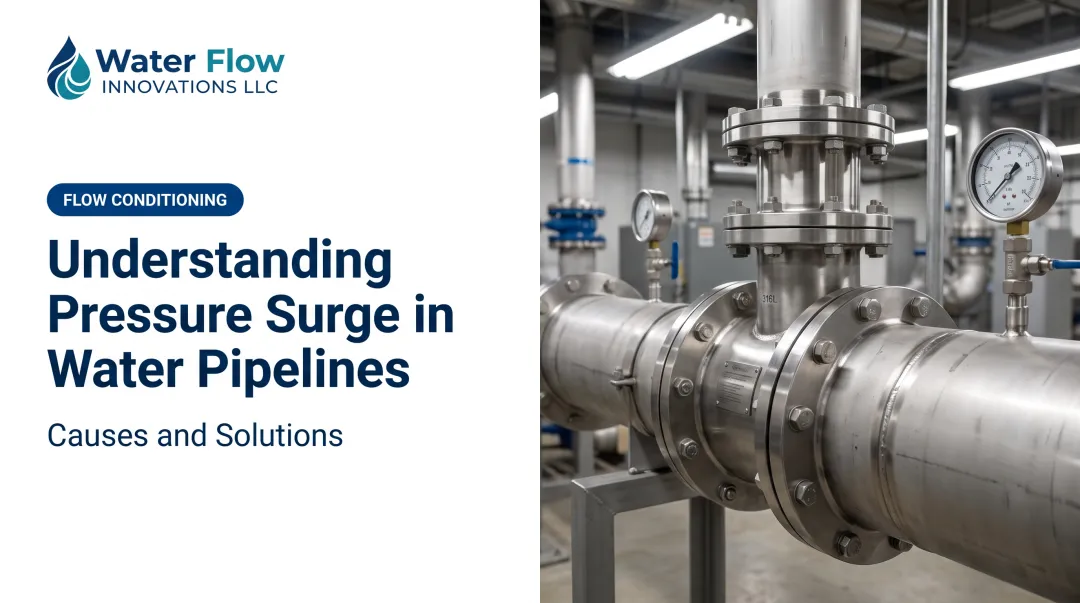
Pressure surge, commonly called water hammer, happens when a moving column of water is forced to stop or change direction suddenly. That kinetic energy has to go somewhere, and it converts almost instantly into pressure energy, producing a shockwave that travels through the pipe.
Engineers estimate surge magnitude using the Joukowsky equation:
ΔP = ρ × a × |Δv|
Where ΔP is the pressure change, ρ is fluid density, a is the pressure wave velocity through that specific pipe system, and Δv is the change in flow velocity.

ASME treats this equation as a first approximation, not an absolute figure. Actual wave speed depends heavily on pipe material, diameter, wall thickness, and restraint conditions, so a system-specific calculation always beats a generic rule of thumb.
Common triggers include:
- Rapid valve closure (the single most frequent cause)
- Pump startup or shutdown
- Sudden pump trips from power loss
- Fire suppression system activation
The pressure wave can also leave a vacuum behind it strong enough to collapse or implode pipe sections, according to the Hydraulic Institute's guidance on mitigating water hammer.
Use Cases and Impact of Pressure Surge
Surge shows up most in municipal water systems, high-rise buildings with long vertical risers, and industrial process piping with frequent valve cycling. Fire suppression systems in commercial buildings are a particular hot spot, since standpipe and sprinkler valves often open or close quickly under emergency conditions.
The damage isn't always immediate. A 2020 ASME study found that dynamic hoop stress from repeated surge events can reach up to four times the calculated static stress on a pipe wall, enough to cause fatigue cracking even in pipes that look fine on paper. That same research identified water hammer as an initiator in nearly all the underground water-main breaks it analyzed.
The financial stakes are serious at scale. A 2018 AWWA analysis projected $1 trillion in US water main breaks over 25 years, noting that better control of water hammer (through smarter valve, hydrant, and pump operation) could meaningfully reduce that total.
What Is Flow Turbulence?
Turbulence is chaotic fluid motion, full of irregular velocity and pressure fluctuations. It sits at the opposite end of the spectrum from laminar flow, where fluid moves in smooth, parallel layers.
Whether flow is laminar or turbulent comes down to the Reynolds number, a dimensionless value calculated from velocity, pipe diameter, fluid density, and viscosity. According to a 2023 engineering reference on internal pipe flows:
- Re ≤ 2,300 — laminar flow
- 2,300–4,000 — transitional (unpredictable, sensitive to disturbances)
- Re > 4,000 — turbulent flow

In real buildings, turbulence forms constantly downstream of elbows, valves, reducers, and tees—anywhere flow direction or pipe geometry changes abruptly.
How Flow Turbulence Affects Meter Accuracy
This is where turbulence gets expensive. Mechanical water meters are designed to spin in proportion to smooth, laminar flow. When air bubbles, micro-bubbles, or turbulent eddies hit the measurement chamber, the meter can spin faster than actual water delivery, registering consumption that never happened.
A 2022 peer-reviewed study found meters over-registering by 0.45 to 0.86 cubic meters from air discharge during intermittent pipe filling, with turbine speeds reaching up to 14 times normal rotation. Five of six tested meters failed under these conditions.
Industries where this hits hardest:
- Manufacturing (CIP cycles, cooling towers, batch fills)
- Hospitality (laundry, pool systems, irrigation)
- Healthcare (sterilization, HVAC makeup water)
- Multifamily housing (irregular demand cycling)
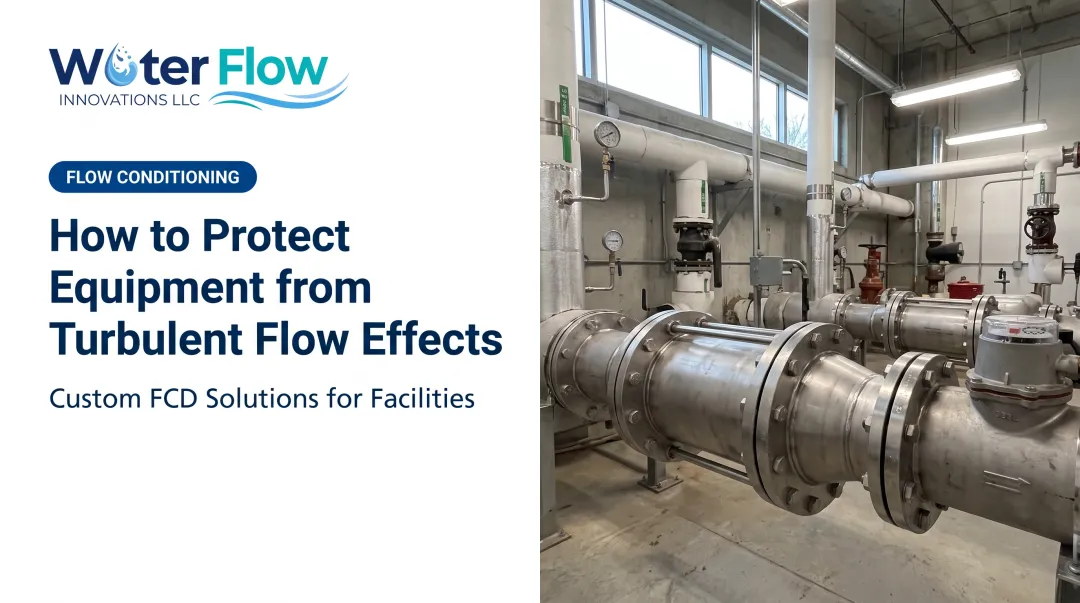
Water Flow Innovation's Flow Conditioning Device (FCD) targets this over-read directly. The custom-fabricated 316L stainless steel unit installs immediately after the meter (NPS ½" to 12") and combines four functions:
- Air/gas separation creates back-pressure for a homogeneous water column, so the meter measures water, not air
- Pressure regulation smooths flow at the meter inlet and reduces hammer and surge from cycling demand
- A check valve prevents reverse flow and blocks air from re-entering after purging
- Turbulence elimination slows velocity enough to stop the vortex spin that drives over-counting
The FCD carries IAPMO, NSF, ANSI, CAN 61, KIWA, GMP, and SQF certifications.

Pressure Surge vs Flow Turbulence: Which Should You Address First?
Weigh these factors before deciding where to spend your maintenance dollars:
- System age and valve types — older quick-closing valves increase surge risk
- Noise complaints — banging or hammering near valves points to surge
- Utility bill anomalies — high water/sewer bills without matching usage growth point to turbulence
- Meter accuracy concerns — over-reading can inflate bills even when surge and turbulence signs are mild
Quick rule of thumb:
- Hear banging or hammering near valves? Investigate surge first.
- Bills disproportionate to actual consumption? Investigate turbulence and meter accuracy first.
Some facilities need both fixes. Turbulent flow near fittings can create localized, surge-like pressure fluctuations even without a dramatic valve slam. Solving one issue sometimes reduces symptoms of the other.
Real-World Impact: Correcting Turbulence-Driven Meter Errors
Picture a mid-size hotel or manufacturing facility with water and sewer bills climbing steadily, even though occupancy or production hasn't changed. Laundry cycles, pool fill events, and cooling tower makeup all run on and off throughout the day—each restart introduces air and turbulence at the meter.
Facility engineers usually catch this by comparing metered billing against actual process water balances. When the numbers don't reconcile, and physical leak checks come back clean, the mismatch traces back to how the meter is reading flow, not how much water is actually being used.
The fix: a Flow Conditioning Device sized to the facility's meter and pipe configuration, installed on the customer side of the meter. Installation takes about an hour, requires only a brief planned water shutoff, and doesn't touch production lines, guest areas, or process equipment.
Documented outcomes across FCD installations:
- 5–30% typical water and sewer bill reduction
- 46% highest single documented result
- 90% of customers reach full ROI within 12 months
- Immediate savings on the very next billing cycle

Turbulence-driven billing errors stay invisible until someone audits the numbers. If your bills have crept up without a clear operational reason, that's worth a closer look.
Water Flow Innovation offers a free water bill review and savings analysis to check whether your meter is over-reading before you spend a dollar on the fix.
Conclusion
Pressure surge is a transient event: sudden, damaging, and tied to specific triggers like valve closures and pump trips. It calls for surge protection strategies—slower valve closures, surge tanks, and pressure-relief devices.
Flow turbulence is different. It is a persistent flow condition that inflates water bills and stresses fittings over time, so the fix is flow conditioning, not surge suppression. Diagnose by symptoms first: banging noise points one way; unexplained high bills point the other.
Getting the diagnosis right protects infrastructure from fatigue damage, cuts unnecessary operational costs, and gives facility managers verifiable savings data for ESG reporting. Treat the phenomenon you actually have, and you stop spending on the wrong fix.
Frequently Asked Questions
At what point is flow turbulent?
Flow typically becomes turbulent above a Reynolds number of roughly 4,000, though transition can begin around 2,300. The exact point depends on velocity, pipe diameter, and fluid viscosity in your specific system.
What is the main difference between pressure surge and flow turbulence?
Surge is a sudden pressure spike from a rapid velocity change, a single transient event. Turbulence is a continuous, chaotic flow pattern that persists as long as conditions (velocity, fittings, obstructions) remain the same.
Can flow turbulence cause water hammer?
Turbulent flow near fittings or valves can contribute to localized pressure fluctuations. Classic water hammer is almost always triggered by sudden valve or pump action, not turbulence alone.
How do you know if your water meter is over-reading due to turbulence?
Compare actual usage patterns and process water balances against billed consumption. A professional flow assessment can confirm whether turbulence or air entrainment is inflating your meter readings.
What is the most common cause of pressure surge in commercial buildings?
Rapid valve closures are the most frequent trigger, followed by pump start/stop cycles and fire suppression system activations.
How can facilities reduce turbulence-related water bill inflation?
Installing a certified flow conditioning device immediately after the meter removes air entrainment and stabilizes flow, correcting inaccurate readings without changing actual water usage.
What goes into that professional flow assessment?
A free review of your water and sewer bills together with meter size, pipe size, line pressure, and PRV configuration. Those inputs confirm whether over-reading conditions exist and size the correction, with no site visit or commitment needed.
Which operations generate the most surge-and-turbulence cycling?
Sites with constant start-stop demand: car and truck washes, laundromats, food and beverage and dairy processing, breweries and distilleries, chemical manufacturing, metal finishing, and irrigation-heavy operations such as golf courses and agriculture.