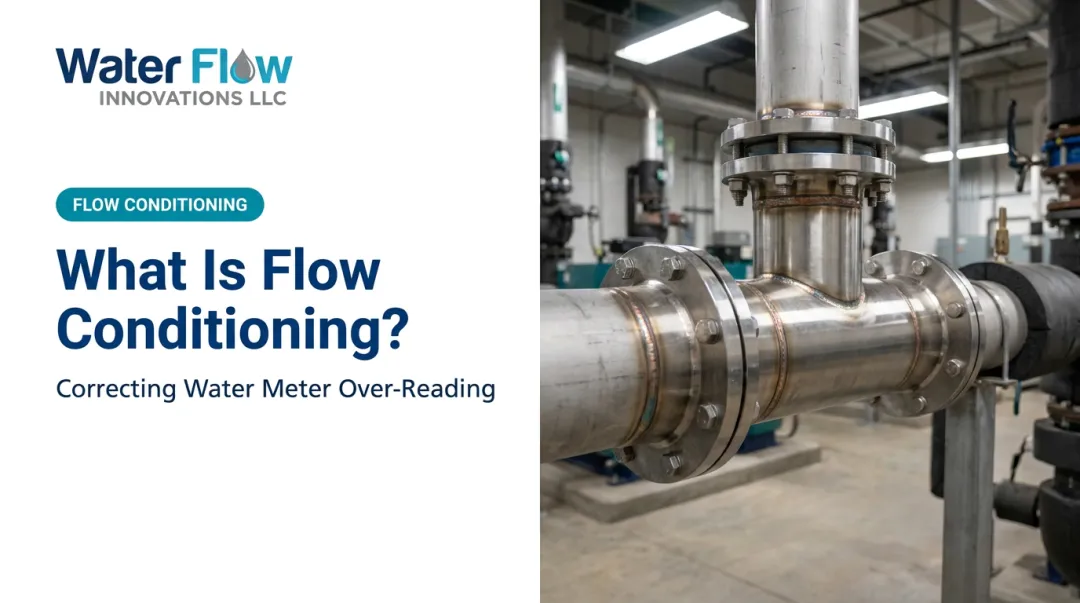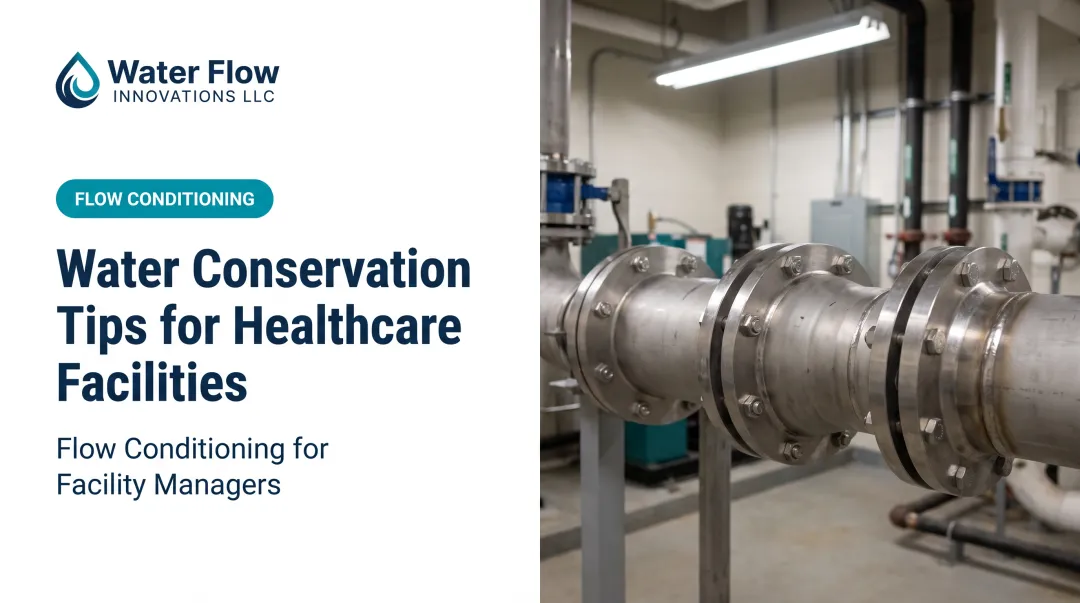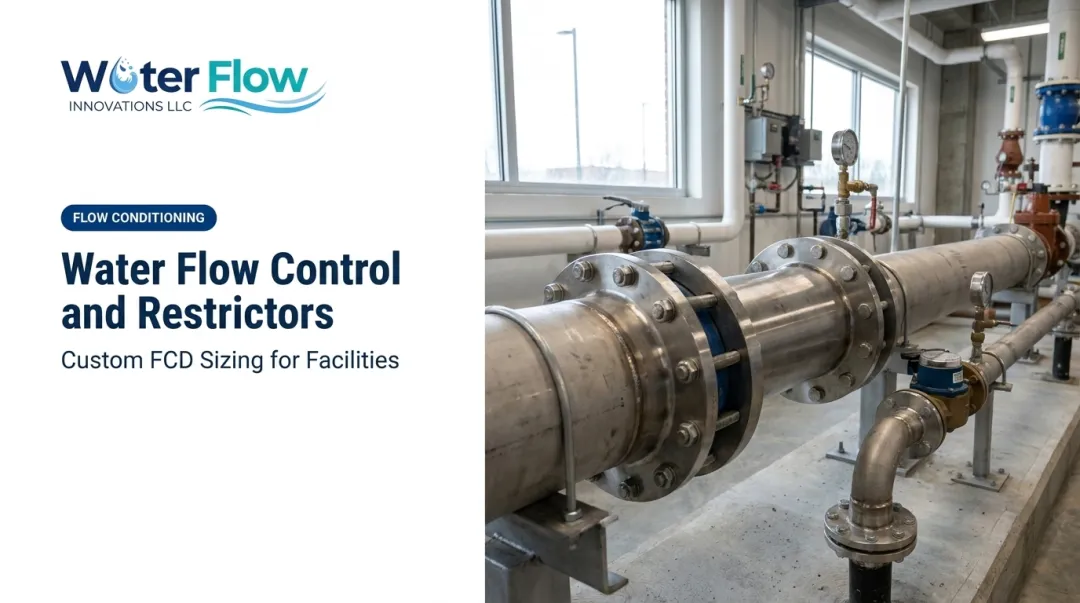
That nonstop demand makes water and sewer bills one of the largest, least-scrutinized line items on a hospital's operating budget. Administrators are told to cut costs without touching patient care, staffing, or compliance. Utilities rarely make that list.
Here's what often gets missed: the problem isn't always how much water a facility uses. It's how accurately the meter measures what passes through it. Complex hospital plumbing — pumps, risers, pressure-reducing valves — can distort the flow profile a meter depends on for accurate readings. Flow conditioning technology addresses exactly that, without touching operations.
Key Takeaways
- Hospital pumps, boosters, PRVs, and multi-riser layouts create turbulence that makes meters over-read.
- Flow conditioning restores a stable profile and corrects billing without changing water use.
- Typical installs take about an hour with no shutdown of critical care operations.
- Facilities often cut water and sewer bills 5–30% once meter over-reading is corrected.
- Verified savings data supports ESG, LEED, and sustainability reporting.
The Hidden Culprit: Why Hospital Water Meters Can Over-Read
Water meters are calibrated in laboratory conditions: smooth, fully developed, swirl-free flow. Real hospital plumbing rarely looks like that.
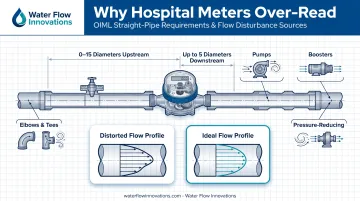
The International Organization of Legal Metrology (OIML), the body that sets global water meter standards, identifies bends, tees, valves, and pumps as disturbance sources. Those disturbances affect accuracy through velocity-profile distortion and swirl (OIML R 49-2:2024). Feed a meter turbulent or uneven flow, and the numbers it produces are no longer reliable.
Air Entrainment in Complex Hospital Plumbing Systems
Multi-story hospitals rarely run a single straight pipe from meter to fixture. Booster pumps, backflow preventers, and pressure-reducing valves are stacked into the system to hold consistent pressure across floors and departments.
Each of those components is a documented disturbance source under OIML guidance. Accurate metering still depends on a filled, air-free line. Hospitals are not "losing water" to air; this equipment creates the conditions metrology standards warn can compromise reading accuracy.
Turbulent Flow from Pumps, Valves, and Pressure-Reducing Stations
Federal guidance from PNNL's Federal Energy Management Program recommends at least 5 pipe diameters upstream and downstream for compound and turbine meters. Nearby fittings and valves introduce turbulence that reduces accuracy for most meter types (PNNL/FEMP).
Meter-specific standards go further. OIML's classification system requires anywhere from 0 to 15 pipe diameters upstream and up to 5 diameters downstream, depending on meter class and whether a flow straightener is installed.
A retrofitted hospital mechanical room rarely meets those conditions:
- Multiple elbows and tees packed into a tight footprint
- Pressure-reducing stations placed close to the meter out of necessity
- Short pipe runs left from decades of renovations and space constraints
Few hospitals have a long, straight run into the meter. That is normal for institutional buildings, not a design flaw. It still leaves hospitals more exposed to distorted flow than a simple retail or office supply line.
How Flow Conditioning Technology Works
Flow conditioning is an established metrology function, not a new gadget. OIML defines a flow straightener as hardware that reduces swirl and regulates the velocity profile so a meter can read flow the way it was calibrated to (OIML D 7). In practice, it restores the smooth, developed flow profile a meter expects, right in the measurement zone.
One clarification matters here: flow conditioning is a metering and billing accuracy solution. It doesn't disinfect water, adjust chemistry, or replace a filtration or treatment system. It corrects how flow behaves physically as it passes through the meter.
The 4-Component System Inside a Flow Conditioning Device (FCD)
Water Flow Innovation builds its FCDs around four functions that work together:
- Air and gas separation – produces a laminar, bubble-free water column through the measurement zone.
- Pressure regulation – smooths pressure at the meter entry point, reducing water hammer from on-off cycling.
- Check valve protection (on select configurations) – prevents reverse flow and pressure spikes that can reintroduce air.
- Turbulence elimination – slows velocity just enough to prevent vortex flow without restricting throughput.
For a hospital, the pressure detail matters most. The FCD is built for negligible pressure loss as a core design characteristic.
Sterile processing and surgical suite supply cannot tolerate pressure swings. System pressure at every downstream connection remains effectively unchanged before and after installation.
The device is also built to fit the facility, not the other way around. It's custom-fabricated per pipe size (NPS ½" up to 12", or DN20–DN500) and works with any meter type or brand — meaning a hospital's domestic, process, and irrigation lines can each be fitted without replacing existing meters.
Key Benefits of Flow Conditioning for Healthcare Facilities
Flow conditioning delivers three practical wins for healthcare facilities: lower utility spend, zero clinical disruption, and audit-ready sustainability data.
Correcting meter accuracy hits the bill twice. Many municipalities calculate sewer charges from metered water volume, so a corrected reading can cut both the water and sewer portions at once.
Check your local tariff. Some cities, such as Phoenix, base sewer charges on a seasonal average rather than direct metered use, so the exact mechanics vary by jurisdiction.
Across its installed base, Water Flow Innovation documents:
- 5–30% average water and sewer bill reduction
- 46% highest single documented result
- 90% of customers at full ROI in under 12 months
- Next billing cycle savings, with no ramp-up period
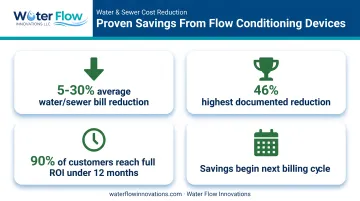
For a hospital finance team, that timeline is a clean budget data point—results show up without waiting multiple quarters.
Zero Risk to Clinical Operations
Because the FCD installs after the municipal meter and requires no change to internal distribution, there's no exposure for:
- Sterilization and autoclave cycling
- Washer-disinfector wash and rinse parameters
- Infection control protocols
- Regulatory or accreditation compliance
Supporting ESG and Sustainability Reporting
Before-and-after utility bills give sustainability auditors independently verifiable evidence, not a modeled estimate. That documentation can support:
- LEED water efficiency credits
- WELL Building Standard submissions
- Green Guide for Healthcare metrics
- GRESB water intensity data and broader ESG disclosures
Flow conditioning corrects measurement, not necessarily consumption. It complements water quality and treatment programs (chemical dosing, scale control, disinfection); it does not replace them. Hospitals that run both address two separate problems: water quality and billing accuracy.
Why Water Flow Innovation Is the Right Partner for Healthcare Facilities
Water Flow Innovation provides FCDs that eliminate meter over-reading. Each unit is built to meet the regulatory bar healthcare facilities must clear for equipment on a potable water line.
Certifications Built for Regulated Healthcare Environments
Each FCD carries seven certifications relevant to institutional and regulated procurement:
- IAPMO – plumbing and mechanical product standards
- NSF International – drinking water contact material safety
- ANSI – national safety and performance standards
- CAN 61 – Canadian drinking water compliance
- KIWA – international water product certification
- GMP – relevant to pharmaceutical and sterile processing environments
- SQF – relevant to hospital food service operations
For a facilities team facing Joint Commission review or a value analysis committee, third-party certification decides whether a device clears procurement or stalls in review.
Fast, Non-Disruptive Installation
Installation happens at the meter connection point, typically a mechanical room or vault. It takes about one hour, sometimes closer to two on larger connections.
The work needs only a brief planned water shutoff coordinated with the facility's chief engineer, not a clinical service interruption. No access to patient floors, operating suites, or occupied clinical space is required.
Risk-Free Guarantee and Flexible Terms
Water Flow Innovation backs every FCD with:
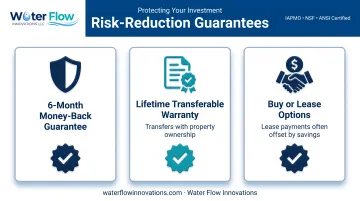
- 6-month money-back guarantee with no questions asked
- Lifetime transferable warranty that moves with the property through ownership or management changes
- Buy or lease options, with lease payments often structured to fall under savings from day one
The company serves commercial and industrial facilities across all 50 states, including hospitals, surgery centers, dialysis clinics, and senior living campuses. Each unit is custom-fabricated to the facility's exact pipe size, flange type, and meter model.
Frequently Asked Questions
What causes water meters to over-read in healthcare facilities?
Booster pumps, backflow preventers, and pressure-reducing valves—common in multi-story hospitals—disturb the flow profile that meters need for accurate readings. Standards bodies such as OIML list these components as known disturbance sources.
Will a flow conditioning device disrupt hospital water pressure or patient care operations?
No. The FCD is designed for negligible pressure loss. Installation usually takes about an hour, with a brief water shutoff at the meter connection, so sterilization, HVAC, and patient care systems keep running unchanged.
How quickly can a hospital or clinic see savings after installing a flow conditioning device?
Savings typically appear on the very next water and sewer billing cycle. Across Water Flow Innovation's customer base, 90% reach full ROI in under 12 months.
Does flow conditioning affect critical water quality used for medical device processing or sterilization?
No. Flow conditioning corrects metering accuracy only. It does not change water chemistry, purity, or the critical and utility water categories used in sterile processing.
Can flow conditioning savings be used for LEED, ESG, or sustainability reporting?
Yes. Savings appear as verifiable third-party utility bill data, so they can support LEED submissions, ESG disclosures, and other sustainability reporting.
What is the difference between a flow conditioner and a water treatment system?
A flow conditioner corrects meter accuracy for billing purposes; a water treatment system manages pathogens, scale, or chemical water quality. They address separate problems and can be used together.
How much can a healthcare facility expect to save?
Documented installations average a 5–30% reduction in combined water and sewer bills, with a highest documented single result of 46%. The device carries a 6-month money-back guarantee plus a lifetime transferable warranty.
Why does an over-reading meter inflate the sewer charge as well?
Most utilities calculate sewer as a percentage of metered water intake, typically 80–120% of the water charge. Every phantom gallon is therefore billed twice, once as water and once as sewer, even though it never entered a drain. Sterile processing departments, central laundry, and cooling towers all draw from the same connection, so the correction reduces both lines at once.