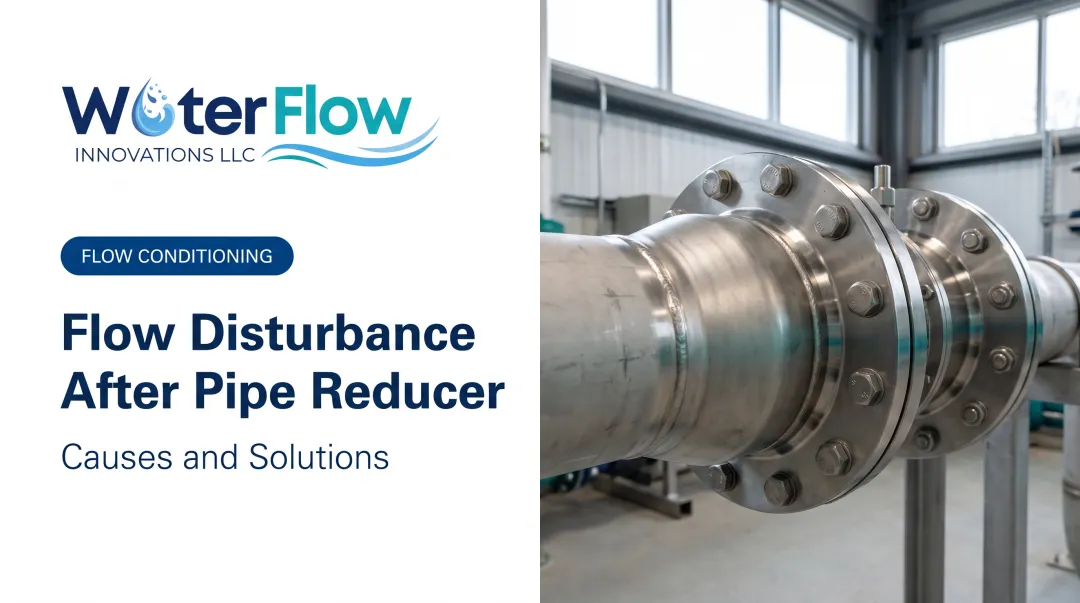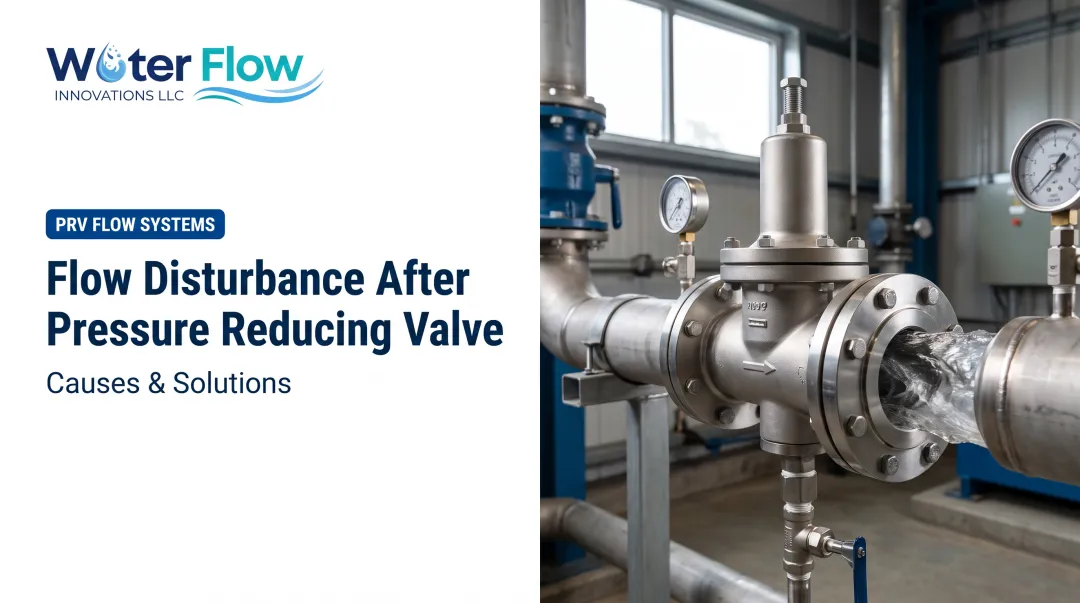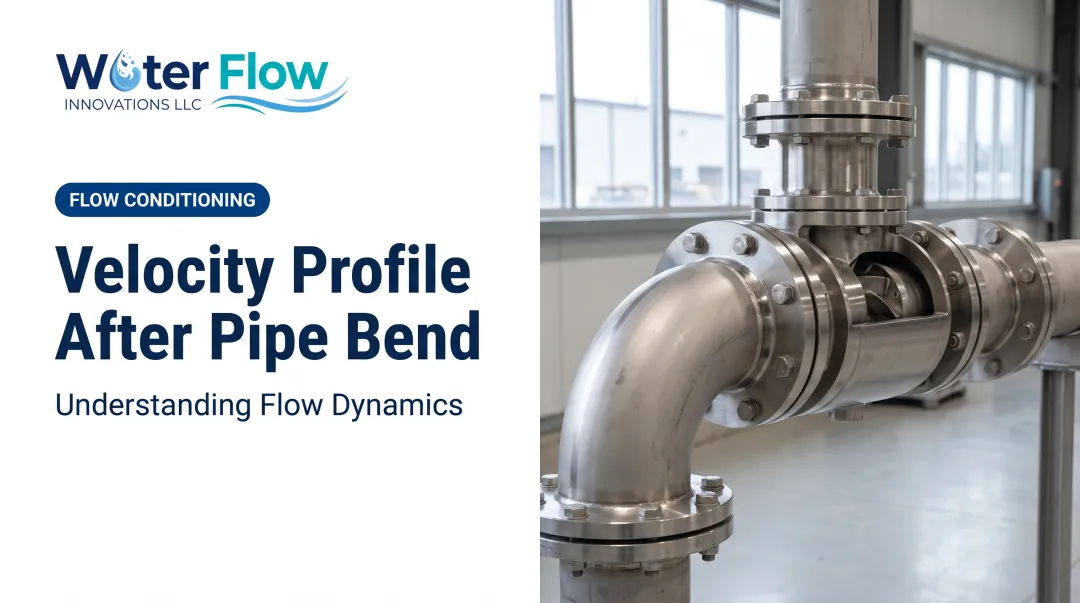

It's common. Elbows, valves, pumps, air entrainment, and insufficient straight-run pipe all disrupt the flow pattern meters expect. Left uncorrected, it can silently affect utility bills, equipment wear, and compliance reporting.
This article breaks down what causes distortion, how to diagnose and fix it step-by-step, when to fix versus replace equipment, and when it's time to call a specialist like Water Flow Innovation.
Key Takeaways
- Turbulence, swirl, air entrainment, and poor pipe layout near meters cause most flow profile distortion
- Most cases resolve on-site with flow conditioning—not full re-plumbing or meter replacement
- Diagnose the pattern, isolate the root cause, apply conditioning, then validate the results
- Call a specialist when space is tight, straight runs aren't possible, or in-house diagnosis stalls
What Is Flow Profile Distortion?
Flow profile distortion happens when the velocity of water across a pipe's cross-section becomes uneven instead of following the expected symmetrical pattern. Under ideal conditions, fluid moves in either a parabolic laminar profile or a flatter, fully developed turbulent profile, depending on flow rate and pipe conditions.
Meters (mechanical, ultrasonic, or magnetic) are calibrated assuming one of these stable shapes. Ultrasonic meters sample flow along specific acoustic paths; mechanical turbine meters couple directly to the momentum of the entering stream. When the actual profile departs from what the meter expects, measurement accuracy suffers.

Distortion is a system-level issue, and it often gets worse over time when:
- Pipes age and interior surfaces change
- Facilities add conditioning equipment at the meter
- Layouts shift during renovations
It needs ongoing monitoring—not a one-and-done inspection.
Common Problems Caused By Flow Profile Distortion
Distortion symptoms tend to follow predictable patterns tied to pipe geometry and meter type. Here's what to watch for.
Meter Over-Reading / Inflated Utility Bills
Symptoms: Billed consumption doesn't match actual usage. Sudden, unexplained spikes appear on water and sewer bills without a corresponding change in facility operations.
Likely cause: Turbulence and air entrainment near the meter, often from upstream fittings or pressure changes during demand cycling.
Error direction and magnitude vary by geometry. One modeled study of ultrasonic meters found 1.5%-4.5% error after double elbows, while electromagnetic meters showed smaller 0.1%-0.5% error, with most modeled cases actually under-reading rather than over-reading. Blanket "turbulence always inflates bills" claims don't hold up, but the data confirms distortion creates real, measurable bias.
Inconsistent or Fluctuating Flow Readings
Symptoms: Erratic meter output, unstable SCADA or BMS data, readings that jump around without a clear operational cause.
Likely cause: Swirl and asymmetric velocity caused by elbows or valves positioned too close to the meter.
Premature Equipment Wear
Symptoms: Increased vibration, noise, cavitation-like symptoms, early pump or valve failure.
Likely cause: Uneven velocity profiles create localized stress on internal components. Turbulent mixing and pressure pulsations at bends, tees, and reducers can drive flow-induced vibration and fatigue over time.
Failed Compliance or Inaccurate Reporting
Symptoms: Audit discrepancies, failed custody-transfer checks, reporting numbers that don't reconcile.
Likely cause: The meter was calibrated for a profile that doesn't match real installed conditions.

Why Flow Profile Distortion Happens (Root Causes)
Flow profile distortion usually comes from piping conditions most facilities can't fully avoid:
- Insufficient straight-pipe run — elbows, tees, or reducers positioned too close to the meter or equipment
- Air/gas entrainment and turbulence — from pressure drops, demand cycling, or partially open valves
- Crowded mechanical rooms — forcing tight, non-ideal pipe layouts with no room for standard straight runs
- Missing flow conditioning devices — no straightener or conditioner installed upstream to stabilize the profile
Straight-run requirements aren't universal either. Manufacturer manuals show real variation (D = pipe diameters):
- Turbine water meters: often 8D–10D upstream and 2D–4D downstream
- Clamp-on ultrasonic meters: at least 10D after a bend (per one common manual)
- Magnetic flow meters: as little as 5D upstream and 2D downstream
There's no single rule. Always check the specific meter's documentation.
Ignore these causes and the problems stack up:
- Continued over-reading or misreading on water/sewer charges
- Reduced measurement and equipment reliability
- Compliance and ESG reporting inaccuracies
- Costly reactive repairs and unplanned downtime
How to Fix Flow Profile Distortion (Step-by-Step)
Guessing at fixes without diagnosis wastes money and risks recurring distortion. This process identifies the exact pattern, isolates the root cause, applies the correct fix, and confirms it holds under real operating load.
Step 1: Identify the Exact Distortion Pattern
- Observe symptoms: erratic readings, billing spikes, vibration or noise near the meter
- Compare metered versus actual/expected consumption over a full billing cycle
- Check meter diagnostics, alarms, or logged flow anomalies
- Document exactly where in the system readings deviate: near elbows, pumps, or valves
Step 2: Confirm the Root Cause Category
Determine whether the issue stems from insufficient straight-run, air entrainment, turbulence, or meter placement. Rule out external factors like pressure fluctuations or recent piping changes first.
Don't replace the meter before confirming the profile issue sits upstream. A perfectly functional meter reading distorted flow will still give bad numbers after replacement.
Step 3: Apply the Right Flow Conditioning Fix
The fix depends on what's actually causing the distortion:
- Insufficient straight-run: install a flow conditioner or straightener that mimics long straight pipe within just a few pipe diameters
- Air/gas entrainment and turbulence: use a device that removes air, regulates pressure, and reduces turbulence in one pass
- Crowded mechanical room layout: select a compact conditioning solution instead of trying to add pipe runs where there's no space
A certified Flow Conditioning Device (FCD), such as those from Water Flow Innovation, corrects meter over-reading without changing actual water usage or system performance. The four-part design handles the common distortion drivers in one unit:
- Air/gas separation to create a homogeneous water column
- Pressure regulation to reduce surges
- Check valve to prevent reverse flow
- Turbulence elimination to stop vortex patterns in the measurement zone
Installation usually takes about an hour, with negligible pressure loss when the conditioner is engineered for the pipe size and meter type.

Step 4: Test and Validate the Fix
- Monitor readings across both normal and peak flow conditions
- Compare the new billing cycle against historical baseline data
- Watch for recurrence over 2-3 billing cycles, not just one
- Document savings or accuracy improvement for internal reporting, ESG tracking, or LEED documentation
When Should You Fix vs Replace Equipment?
Cost, downtime, and long-term accuracy drive the fix-versus-replace call. In most cases, the meter itself isn't the problem.
| Scenario | Fix | Replace |
|---|---|---|
| Meter is accurate but reading distorted flow | Add flow conditioning upstream | Not needed; the meter itself isn't faulty |
| Repeated pump/valve wear from turbulence | Install a conditioning device to stabilize the profile | Only if mechanical damage is already severe |
| No room for straight-run pipe additions | Use a compact certified conditioner for the existing layout | Re-piping the entire section (costly, disruptive, rarely necessary) |
If the meter is sound and the profile is distorted, condition the flow before you replace hardware or re-pipe.

Common Mistakes to Avoid When Fixing Flow Profile Distortion
A sound fix can still fail if you treat the wrong root cause or stop checking too early. Avoid these traps:
- Assuming the meter is broken instead of diagnosing upstream flow conditions first
- Adding a straight pipe run when space or budget won't allow it — use a conditioning device instead
- Skipping post-fix validation across a full billing cycle — one month of good data doesn't confirm the fix held
Preventive Measures to Avoid Future Distortion
Prevention protects billing accuracy and equipment longevity. Facilities that stay ahead of distortion typically:
- Schedule regular flow profile and meter accuracy checks
- Install certified flow conditioning devices proactively in crowded or high-turbulence installations
- Maintain pipe layout documentation for future equipment additions
- Train staff to spot early signs: billing anomalies, vibration, or unusual noise near the meter
Conclusion
Most flow profile distortion issues are correctable once the root cause is properly diagnosed. Flow conditioning, not wholesale replacement, resolves the majority of cases without disrupting facility operations.
Water Flow Innovation's certified FCD, backed by IAPMO, NSF, ANSI, CAN 61, KIWA, GMP, and SQF certifications, offers a low-risk path to correcting distortion. With a six-month money-back guarantee and a lifetime transferable warranty, facilities can address measurement accuracy without committing to an unproven fix.
Frequently Asked Questions
What is the fluid velocity profile in a pipe?
The fluid velocity profile is how speed is distributed across a pipe's cross-section. Under ideal conditions, it is parabolic (bullet-shaped) in laminar flow and flatter in fully developed turbulent flow.
Can flow profile distortion be fixed without replacing the meter?
Yes, in most cases. Flow conditioning devices installed at the meter typically resolve distortion without touching the meter itself, since the meter usually isn't the source of the problem.
How much straight pipe run is needed to avoid flow profile distortion?
Required straight run depends on meter model and pipe size and can span many pipe diameters. Flow conditioners can cut that requirement significantly in tight installations.
Does flow profile distortion really affect my water bill?
It can. Distorted flow often causes meters to misread actual consumption, which can inflate water and sewer charges since sewer fees are typically calculated from metered water use.
How long does it take to install a flow conditioning solution?
Most installations take about one hour, with a brief water shutoff at the meter connection, and even less simple setups usually finish within one to two hours, with minimal disruption to operations.
Is flow profile distortion the same as low water pressure?
No. Distortion relates to velocity distribution and turbulence within the pipe, not overall pressure level, though the two issues can occur together in the same system.
What protection applies if the distortion fix doesn't lower the bill?
The device carries a 6-month money-back guarantee on its purchase price, with installation cost non-refundable, so it can be returned if metered consumption does not measurably fall. A lifetime transferable warranty against manufacturing defects also applies.
What information is needed to size the correction?
Your water and sewer bills, meter size, pipe size, line pressure, and PRV configuration. That review is free, completed remotely from documents you supply, and determines both applicability and device sizing before anything is ordered.