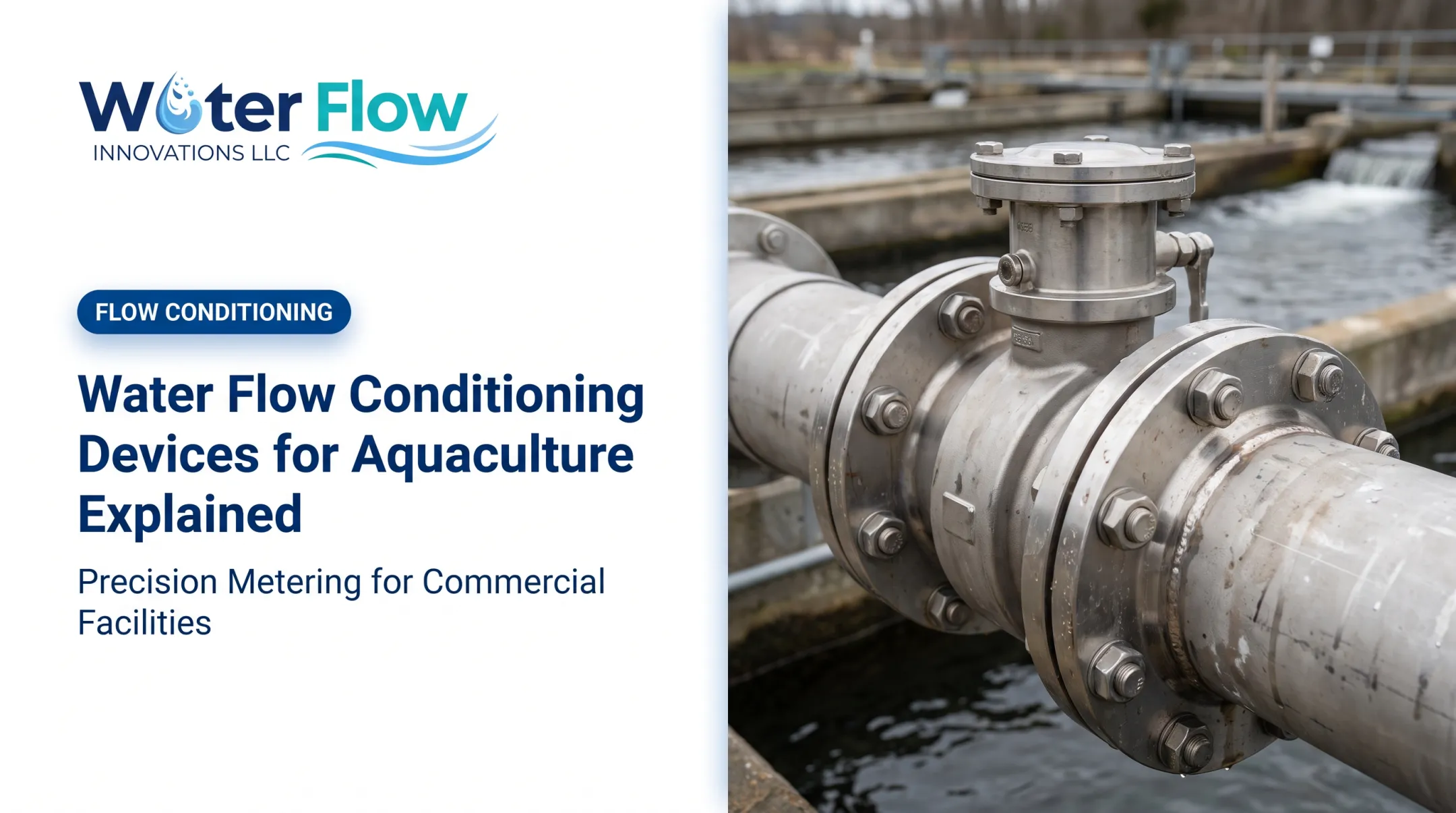

NSF/ANSI/CAN 61 certification addresses only the second concern. It evaluates whether materials in contact with drinking water can leach contaminants under defined test conditions. It says nothing about whether a flow-conditioning device improves meter accuracy or cuts your utility bill.
That distinction matters because NSF/ANSI/CAN 61 is a health-effects standard, not a performance guarantee. This article breaks down what the certification actually covers, how flow conditioning works, and what buyers should verify before specifying a device for a potable-water system.
Key Takeaways
- Wetted materials won't leach harmful contaminants into drinking water when listed to NSF/ANSI/CAN 61.
- Certification applies to a specific model and configuration, not an entire product line.
- NSF 61 certification doesn't prove meter accuracy, water bill savings, or pressure performance.
- Always verify the exact listing, operating limits, and installation requirements before purchase.
- Pair certification review with independent performance evidence and proper commissioning.
What Does NSF 61 Certification Mean for a Flow Conditioning Device?
NSF/ANSI/CAN 61 (Drinking Water System Components – Health Effects) sets health-effects criteria for products, materials, and components that contact potable water.
Testing exposes wetted surfaces to extraction water under standardized conditions, then measures what migrates into that water. Labs compare results against health-based acceptance limits that factor in material composition, surface area, temperature, and intended use.
Buyers often miss this: certification applies to a specific product, model, formulation, or component scope. It does not automatically cover every item a manufacturer makes.
NSF, ANSI, and Accredited Certifiers: Who Does What
These three terms get used almost interchangeably, but they describe different roles:
- ANSI approves the consensus process used to develop the standard. It doesn't test or certify products itself.
- NSF conducts product testing and issues certifications against standards it helped develop.
- Accredited certifiers such as IAPMO R&T, WQA, and Kiwa also offer conformity assessment against NSF/ANSI/CAN 61 and related standards.
Datasheets often list adjacent standards next to NSF 61. Those marks answer different questions:
- NSF/ANSI/CAN 372 — lead content limits in products
- NSF/ANSI 14 — plastic piping-system products
Whether any of these apply to a given flow conditioning device depends on its materials, intended use, and installation context.
What NSF 61 Does Not Establish
A valid health-effects listing tells you the wetted materials passed leachate testing. It does not tell you:
- Water-meter accuracy or correction performance
- Utility-bill savings or payback period
- Pressure-loss behavior under your system's conditions
- Durability or suitability across every temperature and flow range
Health-effects certification and operational-performance validation answer two separate questions. In procurement, verify the exact listing scope first, then request separate evidence for meter accuracy, pressure loss, and savings claims.
How Flow Conditioning Devices Work in Water Systems
Flow conditioning manages the hydraulic conditions around a measurement point: entrained air, turbulence, pressure variation, and irregular flow profiles. The goal is a more stable, predictable flow pattern reaching the meter.
Whether that stability changes accuracy depends heavily on meter type and installation. An AWWA-published study tested five electromagnetic flowmeters and found that a conditioner placed one pipe diameter upstream increased local turbulence roughly fourfold in one configuration. Accuracy deviations, however, did not track that turbulence proportionally.
A conditioner can change flow characteristics without producing a predictable, universal accuracy shift. Don't take device claims at face value for every meter technology without checking the supporting evidence.
The Four-Component Design Pattern
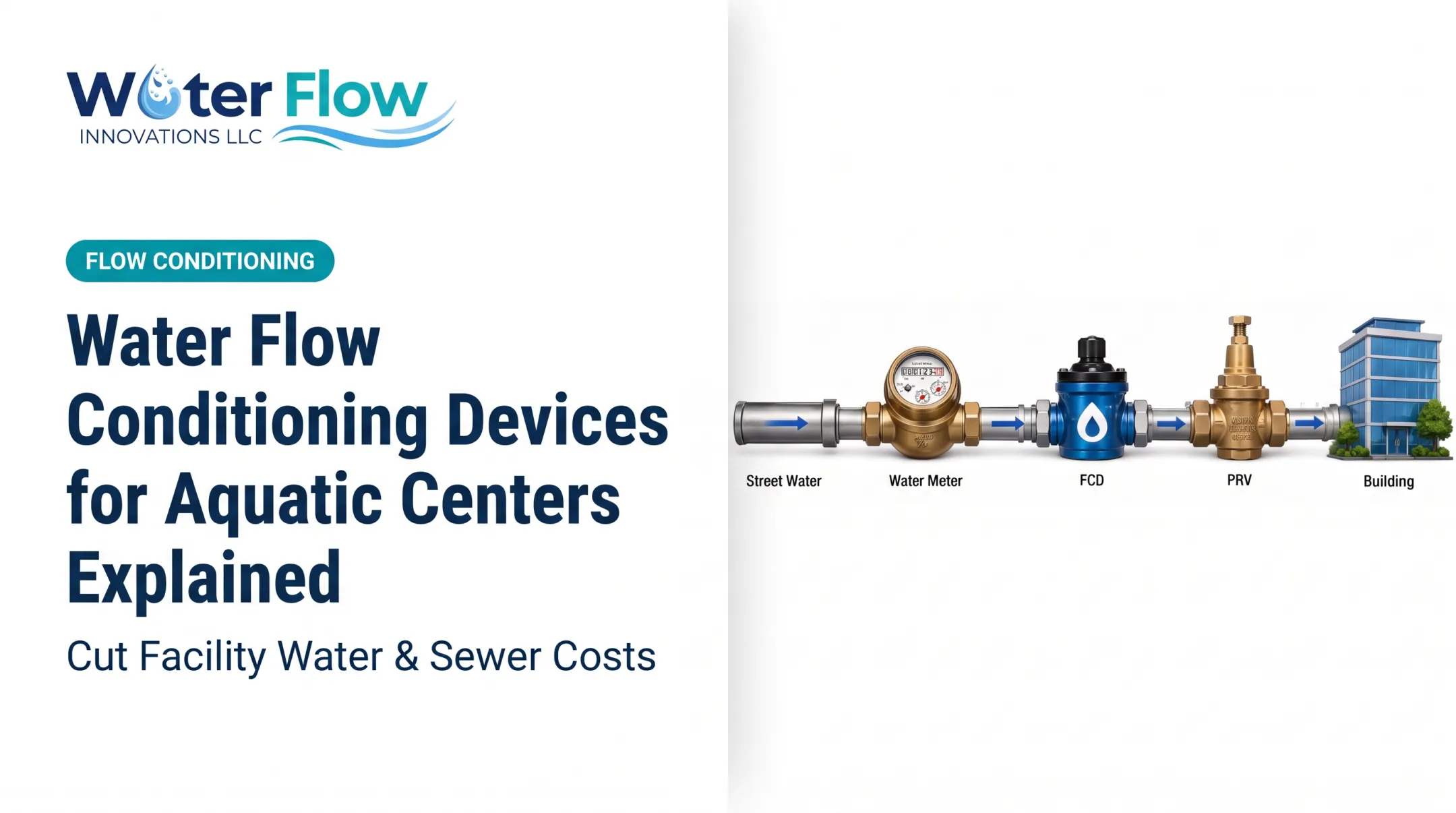
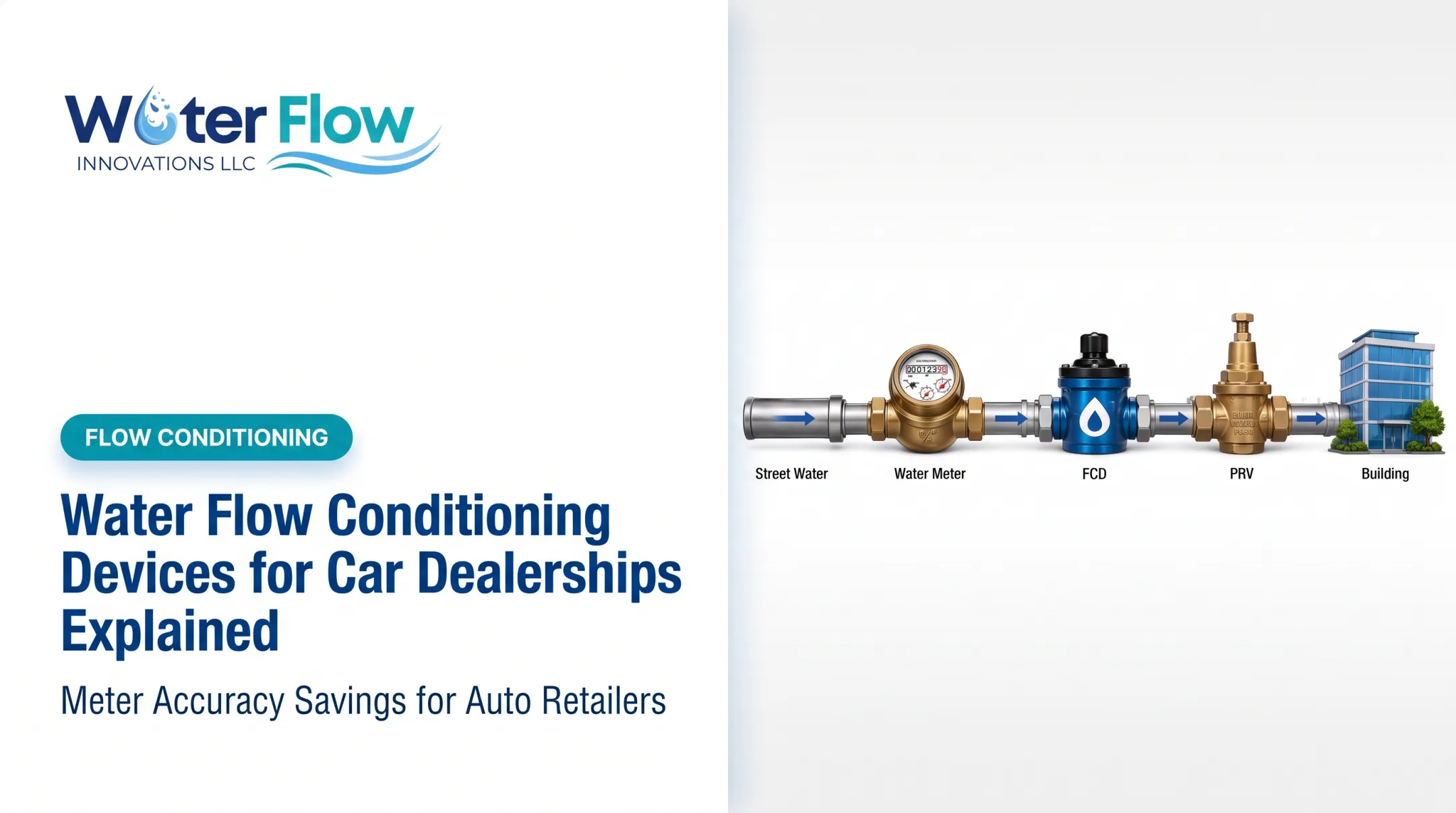
Multi-function flow-conditioning systems commonly combine several elements, each addressing a distinct flow issue:
- Air/gas separation – removes entrained air and micro-bubbles before the meter
- Pressure regulation – smooths pressure swings from on-off demand cycling
- Check valve – limits water hammer and reverse flow (not always required)
- Turbulence reduction – slows velocity to reduce vortex and swirl patterns
Water Flow Innovation's Flow Conditioning Device (FCD) uses this four-component approach, built in 316L stainless steel with a stated negligible-pressure-loss design.
If you're evaluating this or any similar unit, confirm the exact model's current NSF 61 listing and technical documentation directly from the manufacturer. Configuration, wetted materials, and flow range must match what is actually certified.
Flow Conditioning Is Not Filtration or Treatment
A flow conditioner manages hydraulic conditions. It doesn't change water chemistry, remove contaminants, soften water, or disinfect anything. If a product makes those claims, that's a different category of equipment entirely, and it needs different certifications to match.
Why NSF 61 Certification Matters for Facility Owners and Operators
Facilities serving patients, students, residents, or employees have a straightforward obligation: materials touching drinking water shouldn't introduce health risks. NSF/ANSI/CAN 61 gives engineers and procurement teams a recognized, independently verified way to document that obligation rather than relying on a manufacturer's word.
Risk Management Benefits
A verified listing supports several practical functions:
- Demonstrates wetted materials were evaluated against a recognized health-effects standard
- Strengthens procurement submittals and engineering review documentation
- Reduces dependence on unverified "food grade" or "lead free" claims about individual raw materials
- Provides a paper trail for regulatory inspections and QA files
This matters most in sensitive or high-use facilities: hospitals, food and beverage plants, hospitality properties, schools, and multifamily buildings where potable-water infrastructure sees constant use.
Pharmaceutical and life sciences facilities often fold this documentation into their own quality systems. Whether a flow conditioning device falls inside a formal IQ/OQ/PQ validation boundary depends on the facility's validation master plan. Many treat it as a utility infrastructure change rather than GMP process equipment.
A key caveat: certification is not a complete project approval. A 2022 NSF survey found that 49 states require NSF/ANSI/CAN 61 for components used in drinking-water treatment or distribution.

That figure describes state drinking-water program requirements; it isn't a blanket federal mandate covering every interior commercial device. Local plumbing codes, utility requirements, and your facility's own engineering specifications may add further conditions on top of the certification itself.
Where NSF 61 Certified Flow Conditioning Devices May Be Used
Suitability depends on system context, not just the presence of a certification mark. Common application categories include:
- Commercial and institutional buildings with potable-water service entrances or meter assemblies
- Food and beverage processing plants, dairy facilities, and industrial manufacturing sites where water-contact materials and uptime both matter
- Multifamily, hospitality, healthcare, education, and municipal facilities with significant utility infrastructure
Before specifying any device, confirm these project-specific conditions:
- Potable vs. non-potable service – certification covers drinking-water contact specifically
- Pipe size and meter type – devices are typically built or configured for a defined range
- Operating pressure and water temperature – NSF testing uses defined temperature designations (cold, domestic hot, commercial hot); match your application to the listed range
- Installation orientation and available space – flow direction and clearance both affect performance
A device certified for drinking-water contact can still be the wrong choice if a project exceeds its listed operating limits or requires an unlisted configuration. Fire-line systems, for example, are typically excluded from flow conditioning installations entirely.
Have your facility's engineer, water-system professional, or the authority having jurisdiction review the specific installation before approval.
How NSF 61 Certification Is Tested and Maintained
Certification follows a defined pathway, not a one-time check:
- Submission – the manufacturer provides product information, intended uses, formulations, and wetted materials
- Review – the certifier determines appropriate testing, exposure conditions, and analytes
- Testing – representative samples undergo extraction or leachate testing against health-based limits
- Listing – successful products get listed for defined applications and conditions
The finished device matters more than any individual raw material claim. A manufacturer calling a resin "lead free" or "food grade" doesn't substitute for testing the assembled seals, gaskets, valves, coatings, and housings that actually contact water.
Certification is not permanent on autopilot. NSF describes ongoing facility audits and periodic retesting—annually for most product categories, with some exceptions—as part of maintaining a listing.

Accredited certifiers like Kiwa also require manufacturers to report changes to production processes, raw materials, or formulations so reassessment can occur when needed. Changing a resin, elastomer, valve, or manufacturing location can affect certification scope.
For project records, keep these items on file:
- Submittals, batch records, and test reports
- Commissioning notes and installation documentation
- Flushing requirements, pressure limits, and orientation instructions from the certified listing
How to Evaluate and Verify an NSF 61 Certified Flow Conditioning Device
Don't take "NSF approved" at face value. Run through this checklist before specifying or purchasing:
- Get the exact details – manufacturer name, product name, model number, and revision or series designation
- Search the certifier's directory directly – NSF, IAPMO R&T, or WQA all maintain searchable, current listings
- Confirm potable-water scope – verify the listing covers drinking-water contact and the correct device category
- Check operating conditions – temperature, pressure, flow rate, pipe size, and installation requirements
- Clarify assembly vs. component scope – some listings cover only a single material, not the complete finished product
- Verify the certifying body – is it NSF itself, or an accredited organization certifying to the same standard?
Separate Certification From Performance Claims
Health-effects certification doesn't substitute for performance evidence. Ask for:
- Independent or manufacturer-supported test data on meter behavior, flow conditioning, and pressure loss
- Baseline measurements, meter type, site conditions, and verification methods behind any savings claim
- Clear labeling of company-reported ROI or billing results as documented claims tied to specific conditions, not universal outcomes
Before approval, engineers and facility managers should confirm installation location relative to the meter and how the system handles variable demand or backflow protection. They should also define what commissioning measurements will confirm the device performs as intended.

Manufacturers can support this verification process directly. Water Flow Innovation, for example, provides product documentation and application guidance for its Flow Conditioning Device, including its NSF/ANSI/CAN 61, IAPMO, KIWA, GMP, and SQF certifications. Still, verify the current listing, model scope, operating limits, and project-specific performance evidence before purchase. That's the same standard any credible vendor should meet.
Red Flags to Watch For
- Vague "NSF approved" language with no exact model number
- Expired or unverifiable directory listings
- Certification limited to a single component, not the whole assembly
- Missing operating limits (pressure, temperature, flow range)
- Performance claims without disclosed test conditions
Use Certification as One Part of a Complete Evaluation
NSF/ANSI/CAN 61 confirms that wetted materials are appropriate for defined drinking-water-contact conditions. That's valuable, but it doesn't prove meter correction, utility savings, zero pressure loss, or universal system compatibility on its own.
Treat certification as one checkpoint in a fuller evaluation:
- Verify the exact listing against your application
- Match the device to your system's real operating conditions
- Review independent performance evidence
- Secure any required local approvals
- Document installation and commissioning thoroughly
Before specifying or installing a flow conditioning device, request current certification documentation and technical specifications directly from the manufacturer. A credible vendor will have both ready.
Frequently Asked Questions
What is an NSF 61 certified flow conditioning device?
It's a device that contacts drinking water and has had its wetted materials tested against NSF/ANSI/CAN 61's health-effects criteria. The certification confirms material safety, not operational performance claims like meter accuracy or bill savings.
What does NSF 61 certification test?
It tests for contaminants that migrate from wetted materials into water through extraction or leachate testing. Results are compared against health-based limits under conditions specific to the product category and intended use.
Does NSF 61 certification prove that a device will reduce water bills?
No. NSF 61 addresses material safety, not meter accuracy or billing outcomes. Savings and accuracy claims require separate testing and site-specific verification using your actual meter type and flow conditions.
How can I verify that a flow conditioning device is NSF 61 certified?
Get the exact manufacturer name and model number, then search the current NSF, IAPMO R&T, or WQA directory. Confirm the listing covers potable-water contact, the right device category, and your operating conditions.
Can an NSF 61 certified device be used in any water system?
No. Certification is conditional on specific temperature, pressure, flow, and installation parameters. Potable versus non-potable use, meter type, and local plumbing code requirements all need separate confirmation.
Is NSF 61 the same as NSF 372 or ANSI certification?
No. NSF/ANSI/CAN 61 covers contaminant leaching from water-contact materials, while NSF/ANSI 372 addresses lead content specifically. ANSI approves the standards-development process but doesn't itself certify products.