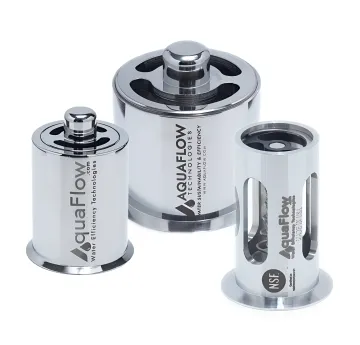
Flow Conditioning Device (FCD)
- Typically up to 30% lower combined water and sewer costs
- Negligible pressure loss to downstream equipment
- 316L stainless steel, custom-made to your facility


NSF International and ANSI Certified
IAPMO Certified
CAN 61 and KIWA Certified
Water Flow Conditioning Devices (FCDs) correct water meter over-registration caused by gas and vapor forming inside the meter during demand surges, with typically up to a 30% reduction in combined water and sewer costs (46% is the highest documented, a rare case). The FCD installs immediately after the meter in about an hour, with under 0.8 psi pressure loss across all flow conditions.
No. Water flow control devices such as valves and regulators manage how much water moves through a pipe. The Flow Conditioning Device (FCD) is different: it installs immediately after the water meter and creates a small, controlled back-pressure that extends back through the meter. During demand surges, water speeds up through the meter, pressure inside the meter drops, dissolved gas comes out of solution and vapor forms, and the meter counts that volume as water. Because the FCD holds pressure up during surges, far less gas and vapor form and are counted, so the meter records closer to what the facility actually receives, with no practical change to downstream pressure, flow rate, or equipment performance.
Pressure-reducing valves hold downstream pressure at a set level, flow restrictors limit or set how much water passes, and check valves prevent backflow. These are standard building components, not Water Flow Innovations products. The FCD is none of these: it corrects metering accuracy by holding pressure up through the meter during demand surges, rather than limiting what any downstream system receives.
The meter is usually accurate, and it can pass a utility test, because those tests use steady, controlled flow on a test bench. In a working building, demand surges speed water up through the meter, pressure inside it drops, dissolved gas comes out of solution and vapor forms, and the meter counts that volume as water, so it registers more than the facility received. The Flow Conditioning Device works alongside the existing meter, installed immediately after it, to correct this. The meter is not replaced, recalibrated, or modified in any way.
Documented installations typically show up to a 30% reduction in combined water and sewer costs (46% is the highest documented, a rare case). Savings depend on how much over-registration is present, meter and pipe configuration, line pressure, and facility water usage profile. Savings start on the next full billing cycle after installation, and 90% of customers reach full ROI in under 12 months. A free savings analysis projects a facility-specific range before purchase.
Pressure loss across the FCD is under 0.8 psi across all flow conditions, so downstream equipment, production processes, and pressure at fixtures see no practical change. The FCD is not a pressure reducing valve or a flow restrictor: it changes what the meter records, not the water your facility receives.
Installation takes about an hour, with the water off for about an hour, performed by a licensed plumber or mechanical contractor. Each FCD is sized to the facility’s pipe and meter, from 3/4″ up; Water Flow Innovations confirms the right size for your service line. Work is normally scheduled into a planned maintenance window or shift change.
No. The meter is usually accurate; if demand surges from your own pumps, wash-down, or on-off demand drop pressure inside the meter so gas and vapor form and are counted as water, a new meter reproduces the same over-registration. It’s not your meter. It’s your pipes. The FCD corrects it by holding pressure up through the meter during surges.
Yes. Each facility with its own metered connection is a separate installation opportunity, and volume purchase or lease arrangements are available for multi-site deployments. Sites can be prioritized by consumption volume and savings potential, and before-and-after billing documentation aggregated for corporate utility benchmarking, capital planning, and corrected sustainability reporting of metered water use.
Talk to our experts for custom solutions and tailored guidance.

Lowers billed water and sewer costs in high-volume processing plants with no practical change to sanitation or production.

Corrects water metering and lowers billed costs in hospitals and medical campuses with critical water demands.

Lowers billed utility costs across guest rooms, laundry, and pools with no practical change to water pressure for guests.

Corrects meter over-registration in manufacturing plants with frequent demand surges, lowering costs with no practical change to production.
Talk to our experts for custom solutions and tailored guidance.
Typically up to 30% lower combined water and sewer costs; 46% highest documented (rare), starting on the next full billing cycle, with 90% of customers reaching full ROI in under 12 months.
Under 0.8 psi pressure loss, so downstream equipment, production lines, and facility operations see no practical change.
Certified to NSF, IAPMO, ANSI, CAN 61, and KIWA.
Request a free savings analysis. Our team will review your water bills and meter setup to estimate your potential reduction.
For immediate assistance, feel free to give us a direct call at 1-844-934-8258. You can also send us a quick email at Info@WaterFlowInnovations.com.
For immediate assistance, feel free to give us a direct call at 1-844-934-8258. You can also send us a quick email at Info@WaterFlowInnovations.com.