Many engineers and facility managers understand turbulence in theory but miss how it plays out in practice. A NIST study on water-supply systems found that flow at just 1 gallon per minute or higher is typically turbulent, even in straight pipe sections. That means turbulence isn't rare. It's the default condition in most commercial and industrial water systems.
This article breaks down what turbulence actually is, how it's classified, its core measurable properties, and why it matters far beyond academic interest, including its surprisingly direct effect on your utility bills.
Key Takeaways
- Water turbulence is chaotic, three-dimensional flow with irregular velocity and pressure—unlike smooth laminar flow.
- The Reynolds number places flow on a spectrum from laminar to transitional to fully turbulent.
- Turbulence features irregularity, mixing, rotating eddies, and energy dissipation across scales.
- Turbulence and air entrainment near a meter can inflate utility bills without raising real use.
What Is Water Turbulence?
In fluid dynamics terms, turbulence describes chaotic changes in pressure and flow velocity. Laminar flow, by contrast, moves in smooth, orderly layers with minimal mixing between them.
Turbulence shows up differently depending on where you look:
- In rivers and open channels, it appears as surface boils, eddies, and visible swirling currents.
- In pipes, it's less visible but just as real: three-dimensional swirling that breaks up straight-line flow.
- At transitions and fittings, turbulence intensifies as water is forced to change direction or speed abruptly.
Turbulence isn't a fixed property of water itself. It's a flow regime, a state that emerges from the interaction between velocity, pipe or channel geometry, and fluid viscosity. Change any one of those three variables, and you change whether flow stays smooth or turns chaotic.
Factors That Influence Water Turbulence in Real-World Systems
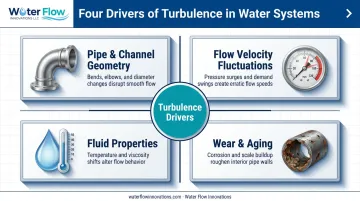
Textbook fluid dynamics assumes clean, idealized conditions. Real water systems rarely cooperate. Several factors push flow toward turbulence in the field:
- Pipe and channel geometry — bends, valves, fittings, sudden diameter changes, and obstructions like sediment or debris all disrupt smooth flow paths.
- Flow velocity and demand fluctuations — a facility's daily operating cycle rarely holds steady, and velocity swings introduce turbulence.
- Fluid properties — viscosity, temperature, and density variations all shift where flow sits on the laminar-to-turbulent spectrum.
- Wear and aging — corrosion, mineral scaling, and biofilm buildup increase pipe roughness over time, intensifying turbulence in systems that once ran cleaner.
Operational patterns matter just as much as pipe condition. High-frequency on/off cycling from equipment like cooling towers, irrigation zones, and CIP (clean-in-place) systems repeatedly introduces pressure events that generate turbulent, air-entrained flow. Hotels, food plants, and similar facilities see these conditions every operating day.
Types and Range of Water Turbulence
Where a flow sits on the turbulence spectrum is governed by the Reynolds number: the ratio of inertial forces to viscous forces within the fluid. Higher Reynolds numbers mean inertia dominates over viscosity, and flow becomes progressively more chaotic.
Laminar Flow (Low Reynolds Number)
Laminar flow moves in smooth, parallel layers with little mixing between them. It shows up at low velocities, usually when viscosity is high or flow rates stay very low. In practice, it's rare inside commercial water systems. Most municipal and industrial applications need flow rates well above the threshold where laminar behavior can persist.
Transitional Flow
This is the unstable middle ground. Flow intermittently switches between laminar and turbulent behavior, sometimes within the same pipe section, depending on minor changes in velocity or slight disturbances.
Turbulent Flow (High Reynolds Number)
Turbulent flow is fully chaotic and is the dominant condition in most municipal and commercial water systems. Purdue University's engineering fluid mechanics coursework defines the conventional Reynolds number boundaries for circular pipe flow as:
| Flow Regime | Reynolds Number Range |
|---|---|
| Laminar | Below 2,300 |
| Transitional | Approximately 2,300–4,000 |
| Turbulent | Above 4,000 |
These figures are conventional benchmarks, not universal cutoffs. Pipe geometry and boundary conditions shift where transition actually occurs.
Few real-world water systems ever run in true laminar flow. Municipal, commercial, and industrial systems need flow velocities that push Reynolds numbers well past the turbulent threshold. In your building's water lines, turbulence is the baseline condition.
Key Characteristics of Turbulent Flow
Whether in a river, a treatment plant, or a 2-inch commercial supply line, turbulent flow shares a consistent set of measurable behavioral properties.
Irregularity and Unpredictability
Turbulent flow is chaotic at the particle level. You can't predict exactly where a single water molecule will be a moment from now. But turbulence is repeatable in aggregate — engineers describe it statistically, using averages, variance, and fluctuation ranges rather than tracking individual particle paths.
Diffusivity and Mixing
Turbulence dramatically speeds up the mixing of fluid, energy, and dissolved substances. That is useful during water treatment, where fast, thorough mixing helps chemicals disperse evenly. The flip side: the same mixing introduces measurement noise at flow meters, where accuracy depends on a stable, undisturbed profile.
Rotationality: Eddies and Vortices
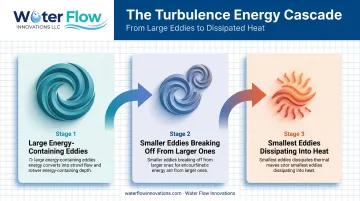
Turbulent flow generates eddies of varying sizes:
- Large, energy-containing eddies form first, driven by the primary flow disturbance.
- Smaller eddies spin off from larger ones as energy transfers downward through the scale range.
- The smallest eddies eventually dissipate, converting their remaining kinetic energy into heat.
This eddy formation is the visible, rotating signature of turbulence, whether you're watching river boils or measuring vortex flow inside a pipe.
Energy Dissipation
This eddy cascade isn't random. NIST's foundational shear-flow research describes a nonlinear energy transfer from large turbulent eddies into progressively smaller ones, where viscosity finally converts the smallest-scale motion into heat.
There's a real trade-off here. Turbulence helps mixing, but it also increases drag and friction losses.
The Department of Energy's pump sourcebook notes that pipe pressure loss scales with velocity squared, meaning doubling flow rate can quadruple friction loss at the same pipe size. That translates directly into higher pumping energy costs for any facility running turbulent flow at elevated velocities.
How Turbulence Is Measured and Its Hidden Impact on Water Systems
Turbulence isn't just an academic curiosity. It has to be quantified for engineering design and actively managed for accurate day-to-day operations.
Measurement and Detection Methods
Engineers and researchers rely on a handful of core approaches:
- Reynolds number calculation — the standard first step for classifying pipe or channel flow regime.
- Flow visualization — dye injection studies show a straight filament in laminar conditions versus rapid, chaotic dispersion in turbulent flow.
- Acoustic Doppler instruments — used in research settings to resolve velocity fluctuations and turbulence statistics in detail.
- Field indicators — surface boils and visible eddies in open channels offer a quick, low-tech way to spot turbulence without instrumentation.
Lab measurements assume stable, controlled conditions. Field turbulence is messier: unpredictable obstructions, fittings, and constantly shifting demand levels mean real-world readings rarely match textbook expectations.
Turbulence's Effect on Water Meter Accuracy and Utility Bills
Turbulence has a direct cost. Near a water meter, turbulence and air entrainment can cause the meter to over-register flow—billing facilities for water they never used.
International metering standards treat this as a real failure mode. The OIML R 49-2:2024 testing protocol tests meters under swirl and asymmetric flow profiles because those conditions can shift indication error.
Meter accuracy depends heavily on installation conditions, not just meter quality.
This is exactly what Water Flow Innovation's Flow Conditioning Device (FCD) is built to correct. The FCD is a certified device — carrying IAPMO, NSF, ANSI, CAN 61, KIWA, GMP, and SQF certifications — that combines four functions in one custom-fabricated unit:
- Air and gas separation — builds stable back-pressure so the meter reads a homogeneous water column, not water mixed with air.
- Pressure regulation — dampens water hammer and surges that pull air into the line.
- Check valve protection — blocks reverse flow from reintroducing air after correction.
- Turbulence elimination — slows velocity at the meter just enough to stop vortex formation.
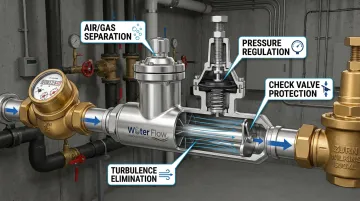
Each FCD is custom-fabricated in 316L stainless steel to match a facility's exact pipe size, flange pattern, and meter configuration (½-inch to 12-inch NPS).
Facilities using this certified flow conditioning have documented average water and sewer bill reductions of 5–30%, with a highest single result of 46%. Savings typically appear on the next billing cycle.
Common Misconceptions About Water Turbulence
Two assumptions trip people up consistently:
- "Turbulence only matters in big systems like rivers or oceans." It shows up at pipe and meter scale—and it shows up on the bill every cycle.
- "Higher velocity always means more accurate metering." Often the opposite: excess velocity intensifies turbulence and raises over-registration risk. That is why the FCD slows velocity at the meter instead of increasing it.
Conclusion
Water turbulence is a governing flow characteristic defined by measurable properties: irregularity, mixing, rotating eddies, and a predictable cascade of energy dissipation.
Understanding where turbulence sits on the Reynolds number spectrum matters for system design. It matters just as much if you pay for metered water every month. Turbulence at the meter has a real, quantifiable cost.
Addressing it doesn't require re-engineering your entire water system. Certified flow conditioning technology, like Water Flow Innovation's FCD, corrects the root cause at the meter itself. You get a practical, low-disruption path to more accurate billing without changing your facility's water usage or performance.
Frequently Asked Questions
What is water turbulence?
Water turbulence is chaotic, irregular fluid motion marked by fluctuating velocity and pressure, unlike the smooth, layered motion of laminar flow. It occurs in rivers, open channels, and pipes alike.
What are the three types of turbulence?
Turbulence is one of three flow regimes classified by Reynolds number: laminar (smooth, low Re), transitional (unstable, intermittent), and turbulent (fully chaotic, high Re). Most commercial water systems operate in the turbulent range.
What causes turbulence in water pipes?
Turbulence results from a combination of flow velocity, pipe fittings and bends, internal obstructions like sediment or scale, and abrupt diameter changes. Operational cycling, such as equipment turning on and off, adds further disruption.
How does turbulence affect water meter accuracy?
Turbulence and entrained air near a meter can cause it to over-register actual water delivered, since the meter counts air and turbulent flow disturbance as billable volume. This directly inflates utility bills without any change in real consumption.
Can water turbulence be reduced or eliminated?
Turbulence can be minimized, though rarely eliminated entirely. Straight pipe runs, flow diffusers, and certified flow conditioning devices are common methods for stabilizing flow at sensitive points like water meters.
What is the difference between laminar and turbulent flow?
Laminar flow moves in smooth, parallel layers with minimal mixing, while turbulent flow is chaotic and mixing-heavy. The Reynolds number is the key differentiator, with laminar flow occurring below roughly 2,300 and turbulent flow above roughly 4,000 in pipe flow.
How is turbulence-driven billing error identified from records alone?
Through a free review of your water and sewer bills alongside meter size, pipe size, line pressure, and PRV configuration. Those inputs establish whether over-reading conditions are present, with no site visit and no commitment.
Why does turbulence at the meter raise two charges rather than one?
Because sewer is normally derived from metered intake, commonly 80–120% of the water charge, instead of measured discharge. Volume the meter registers in error therefore appears on the water line and the sewer line together.