
Unstable water flow isn't just a comfort problem. It drives tenant complaints, chews through pump and valve equipment, and — less obviously — inflates utility bills through a mechanism most building owners never hear about.
This guide covers why flow destabilizes in tall buildings, the standard engineering fixes, and an overlooked cost driver: turbulence-induced water meter over-reading.
Key Takeaways
- Elevation loss and peak-demand surges are the two biggest drivers of unstable pressure in high-rises
- Multi-zone booster systems and PRVs remain the industry-standard fix for pressure consistency
- Turbulent flow near meters causes over-registration that quietly inflates water and sewer bills
- Flow conditioning devices restore meter accuracy without changing pressure or system performance
Why Water Flow Destabilizes in High-Rise Buildings
Gravity, Elevation, and the 80 PSI Ceiling
Every vertical foot of lift costs 0.433 psi, or roughly 1 psi per 2.31 feet. Push water up 300 feet and you've built enormous static pressure at the base. That pressure has to come back down through PRVs before it reaches upper floors safely.
That matters because the 2021 International Plumbing Code (Section 604.8) caps static pressure inside a building at 80 psi. Anywhere pressure would exceed that, an approved pressure-reducing valve must bring it back into range. On a 40-story tower, that's not one valve — it's a whole zoning strategy.

Peak Demand and Aging Risers
Two other forces compound the problem:
- Morning and evening spikes: Multifamily buildings see well-documented demand peaks when dozens of units run showers and taps at once
- Undersized or aging risers: Older piping often wasn't built for today's fixture counts and flow demands
The Meter Accuracy Problem
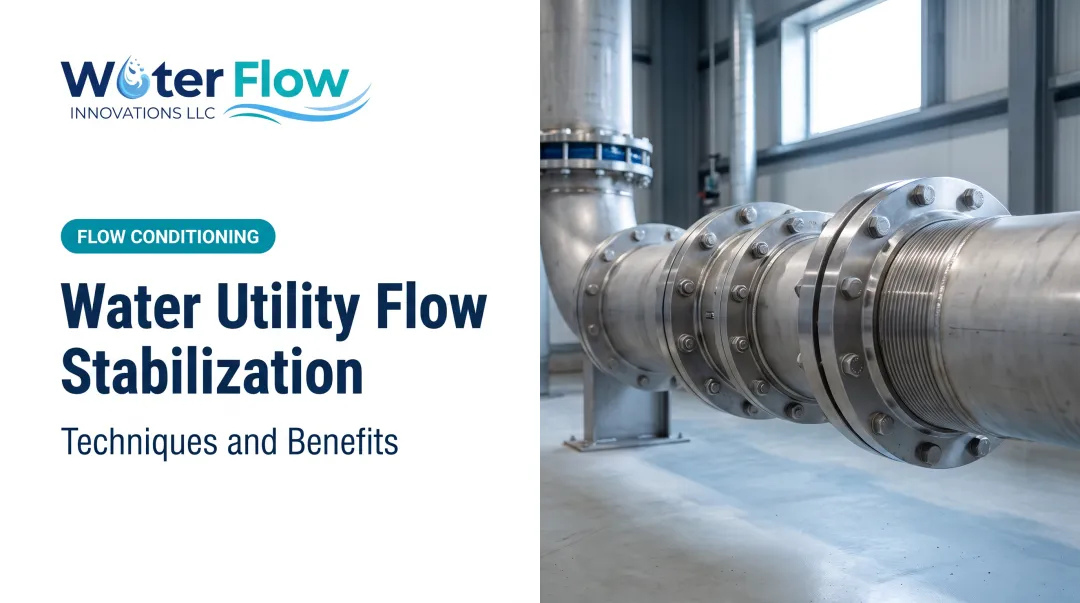
Elbows, valves, and pump cycling near a meter disturb the flow profile passing through it.
Compound and turbine meters (common in commercial buildings) need at least five pipe diameters of straight, undisturbed flow upstream and downstream to read accurately, according to Pacific Northwest National Laboratory's metering guidance. High-rise mechanical rooms rarely offer that kind of clean run.
Core High-Rise Flow Stabilization Solutions
Booster Pump Systems and Zoning
Single ground-level booster systems used to be the default. Today, most engineers recommend multi-zone booster setups for buildings where a full-head booster would push more than 80 psi through multiple lower floors. Typical layouts place one system at ground level and another in a mid-building mechanical room.
Benefits of splitting into two smaller systems:
- Each pump handles less flow, so equipment runs smaller and cheaper
- Fewer PRVs needed downstream
- Simplified maintenance since each zone's pump matches its own demand profile
- Many packages use N+1 redundancy, so one pump can be pulled for service without interrupting supply

Pressure Reducing and Safety Valves
PRV cascade systems reduce pressure in stages as water descends through zones. Watchdog backup valves and excessive-pressure shutoff valves sit behind the primary PRV, catching failures before they cause a burst.
For critical facilities like hospitals and hotels, dual-branch redundancy design is common practice, letting one branch carry the load if the other needs servicing.
Flow Conditioning for Accurate, Stable Readings
Pressure management solves comfort and safety. It does nothing for meter accuracy. That requires flow conditioning.
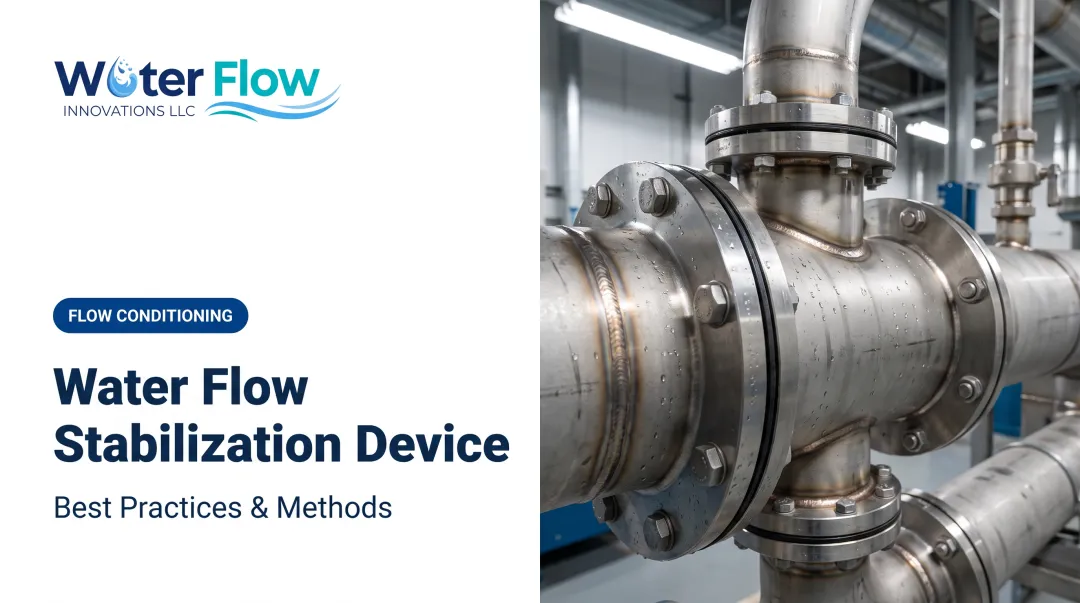
Water Flow Innovation builds a Flow Conditioning Device (FCD) that installs immediately after a building's master meter, using a four-component system:
- Air/gas removal: creates static back pressure that pushes air and gas bubbles back into the main line, leaving a homogeneous water column
- Pressure regulation: smooths flow at the meter entry point, reducing surges from pump cycling
- Check valve (when specified): prevents reverse flow, which can let air back into the line
- Turbulence elimination: slows velocity enough to prevent vortex flow at the meter
The device is passive, with negligible pressure loss in normal conditions, and comes in NPS sizes from 1/2" to 12", covering any high-rise meter configuration. It installs after the master meter and before the booster pump, so the booster keeps operating exactly as it does today.

Leak Detection Integration
Flow and pressure controls protect the riser system itself. Point-of-leak detectors at kitchens, bathrooms, HVAC units, and terrace doors add unit-level warning before a slow leak floods floors below. Early isolation matters more in high-rises, where a leak on floor 30 can damage everything beneath it before anyone notices.
The Hidden Financial Challenge: Meter Over-Reading
Turbulent flow and entrained air near a meter don't just distort readings temporarily. They can cause the meter to register more volume than actually passed through. Complex high-rise plumbing, full of bends, valves, and pressure transitions, is exactly the environment where this happens most.
Why this matters more for high-rises: Large properties with high consumption volumes see the effect compound across every billing cycle. A property paying $18,000 a month for water and sewer isn't looking at pocket change. A 20% correction on that bill is $3,600 monthly, or $43,200 annually.
Because sewer charges in cities like New York and Seattle are calculated directly from metered water consumption, correcting over-registration cuts both bills at once. No separate sewer fix is required.
For portfolio owners, the upside goes beyond the monthly bill:
- Documented before-and-after utility bills support ESG reporting, LEED water-efficiency credits, and sustainability targets
- Savings typically appear on the very first billing cycle after installation
- One correction cuts water and sewer charges together, with no change to actual usage
Water Flow Innovation customers see an average 5-30% reduction in combined water and sewer bills, with a documented high of 46%. Ninety percent reach return on investment in under 12 months.

Water Hammer, Surge, and Structural Considerations
Sudden valve closures or pump starts/stops in tall risers generate water hammer: a pressure spike that can crack fittings or blow out fixture connections several floors away from the source.
Standard mitigation includes:
- Water-hammer arrestors, required under IPC 604.9 wherever quick-closing valves are used
- Surge relief valves, sized to the system's specific hydraulic conditions
- Check valves, preventing the reverse-flow slam that often triggers hammer in the first place
Separately, supertall buildings (300 meters / about 984 feet or taller, per CTBUH criteria) sometimes use tuned liquid dampers: massive water tanks built into the upper floors to counteract building sway in high winds. Philadelphia's Comcast Center, for example, uses a tuned liquid column damper holding more than 1,300 tons of water.
That setup is a structural engineering solution, not a plumbing fix. The two systems are entirely separate concerns that both involve water at height.
Choosing the Right Stabilization Approach
There's no universal fix. The right combination depends on:
- Building height and number of zones needed
- Age and condition of existing riser piping
- Occupancy type (residential, hotel, hospital, mixed-use)
- Existing mechanical infrastructure and available room space
For retrofits in older buildings, hydraulic modeling by a qualified engineer before any pump or valve replacement prevents costly guesswork.
Combining pressure management with flow conditioning addresses both comfort and meter accuracy, without one solution undermining the other.
Flow conditioning devices typically install in about an hour. Work needs only a brief planned shutoff at the mechanical room, with no unit access required. Buy-or-lease options keep the upgrade accessible as a one-time capital purchase or a predictable monthly operating expense.
Frequently Asked Questions
Is 100 psi too high for a high-rise apartment or unit?
Yes. Most plumbing codes cap static pressure at 80 psi, and 100 psi risks fixture damage, leaks, and premature appliance wear. A pressure-reducing valve brings it into compliant range.
What is the maximum water pressure allowed in a high-rise building?
The 2021 IPC caps static pressure at 80 psi on any given floor. Because elevation naturally builds pressure at lower levels, high-rises use zoning with PRVs to keep every floor under that limit.
How often should high-rise water booster pumps be maintained?
Manufacturer guidance typically calls for monthly visual and sound checks, an annual detailed inspection, and mechanical seal replacement about every two years. Watch for unusual vibration, noise, or leaks between scheduled checks.
Can water meters really over-read due to turbulence?
Yes. Air entrainment and irregular flow near a meter are known causes of over-reading, especially where elbows and valves sit close to the meter. Certified flow conditioning devices correct this without altering system pressure.
Do flow stabilization upgrades disrupt building operations during installation?
Not significantly. Flow conditioning devices install in about an hour, with a brief water shutoff at the meter connection at the mechanical room. No unit access is needed, and pressure and performance stay unchanged afterward.
What's the difference between a booster pump and a pressure reducing valve?
A booster pump increases pressure and flow to overcome elevation loss. A PRV reduces excess pressure downstream. High-rises typically need both working together, one on each end of the pressure equation.
Does an inflated master reading raise the building's sewer charge?
In most cases yes. Sewer is generally calculated from metered intake rather than measured discharge, commonly 80–120% of the water charge, so the error is billed twice before any allocation to residents.
Which vertical residential property types share this exposure?
Luxury high-rise buildings, multifamily and apartment communities, HOAs, senior living communities, university dormitories, and hotels — anywhere booster pumps and constant demand cycling feed a single master meter.