
Stabilized water flow gets discussed mostly in hydraulic terms, turbulence coefficients, velocity profiles, and pressure differentials. But the real value shows up somewhere more practical: on the utility bill, in maintenance logs, and in ESG disclosure reports.
This article breaks down why stabilized flow matters operationally, not just theoretically, covering cost savings, equipment protection, and measurement accuracy.
Key Takeaways
- Stabilized flow cuts turbulence, air entrainment, and pressure surges that inflate meter readings
- Facilities using flow conditioning typically cut water/sewer bills 5–30% without changing actual consumption
- Pressure regulation, check valves, air/gas separation, and turbulence elimination keep flow conditions meter-accurate
- Secondary gains include equipment protection, fairer billing accuracy, and documentation for sustainability reporting
What Is Stabilized Water Flow
Stabilized water flow means water moving through pipes at consistent velocity and pressure, free from turbulence, air pockets, or surging. That consistency enables accurate measurement and efficient operation.
This matters most in facilities with high water volumes:
- Industrial and manufacturing plants
- Commercial buildings and multifamily properties
- Municipal systems and government facilities
- Hospitality and healthcare operations
The Pacific Northwest National Laboratory (PNNL) notes that nearby fittings and valves introduce turbulence that decreases most meters' accuracy. That disturbance is exactly what stabilization techniques target.
Key Advantages of Stabilized Water Flow
The advantages below focus on outcomes facilities managers actually track: utility costs, equipment longevity, compliance, and sustainability reporting. Each ties directly to a line item somewhere in a facility's budget.
Advantage 1: Accurate Water Metering
Turbulent or aerated flow disrupts a meter's ability to register consumption correctly. When air bubbles or unstable velocity profiles pass through the measurement zone, meters can count that disturbance as water that was never actually delivered.
Flow conditioning devices address this by removing entrained air and smoothing turbulence at the meter. A 2022 laboratory study documented over-registration of 0.45 to 0.86 cubic meters during pipe-refilling events involving trapped air, showing trapped air alone can inflate recorded volume.
Why this matters financially:
- Correcting meter over-reading lowers billed consumption without changing actual usage
- Water Flow Innovation's documented data shows a 5-30% average reduction in combined water and sewer bills, with a highest documented single result of 46%
- 90% of customers reach full ROI in under 12 months
- Predictable billing reduces disputes with utility providers
KPIs impacted: metered consumption accuracy, water bill cost, sewer discharge fees, ROI timeline

High-volume users feel this first—manufacturing plants, hotels, hospitals, and multifamily buildings. Aging or oversized meters that were never calibrated for current usage patterns make the gap worse.
Advantage 2: Reduced Equipment Wear and Operational Disruption
Turbulent, surging flow doesn't just distort billing. It physically stresses valves, pumps, and pipe fittings over time.
The American Society of Plumbing Engineers (ASPE) defines water hammer as a pressure change caused by rapid flow-rate variation, typically from sudden valve or pump starts and stops. Documented consequences include vacuum conditions, column separation, and in severe cases, pipe collapse.
Stabilization techniques counter this through:
- Pressure regulation that smooths downstream pressure regardless of upstream fluctuation
- Slower valve operation and controlled pump starts/stops
- Air/vacuum relief devices and surge arresters
Why this matters operationally:
- Stable flow reduces exposure to the pressure transients that damage plumbing components
- Fewer surge events mean fewer unplanned service interruptions
- Facilities with continuous water demand feel this most acutely
KPIs impacted: maintenance costs, equipment lifespan, downtime frequency, service call volume

Continuous-demand sites take the biggest hit—data centers, car washes, laundromats, and food & beverage lines. One surge event can stop production cold.
Advantage 3: Sustainability and ESG Reporting Support
Documented, verifiable water data is now a formal reporting requirement for many organizations. More than 8,500 companies disclosed water information through CDP in 2024, yet only 5% reported an internal water price, showing how much room exists for better data practices.
Corrected, accurate consumption data supports:
- LEED building-level water metering prerequisites
- GRI 303 water withdrawal and discharge disclosures
- CDP water disclosures and ESG scorecards
Why this matters:
- Facilities increasingly need quantifiable water-use data for compliance and stakeholder reporting
- Accurate meter readings improve the integrity of the source data feeding these reports
- Cleaner source data strengthens audit trails for regulators and ESG raters
KPIs impacted: ESG score components, LEED points, water stewardship metrics
Public companies, universities, municipal campuses, and any organization with a formal sustainability mandate face the sharpest pressure to produce this data on demand.
Common Techniques for Stabilizing Water Flow
Several hydraulic tools address different pieces of the stabilization puzzle:
- Pressure regulation devices maintain consistent downstream pressure regardless of upstream fluctuations, reducing the surges that cause water hammer.
- Check valves prevent backflow that disrupts meter accuracy and system stability.
- Turbulence-reduction components smooth flow patterns in the measurement zone.
- Air/gas removal mechanisms eliminate entrainment at the meter or sensitive equipment.
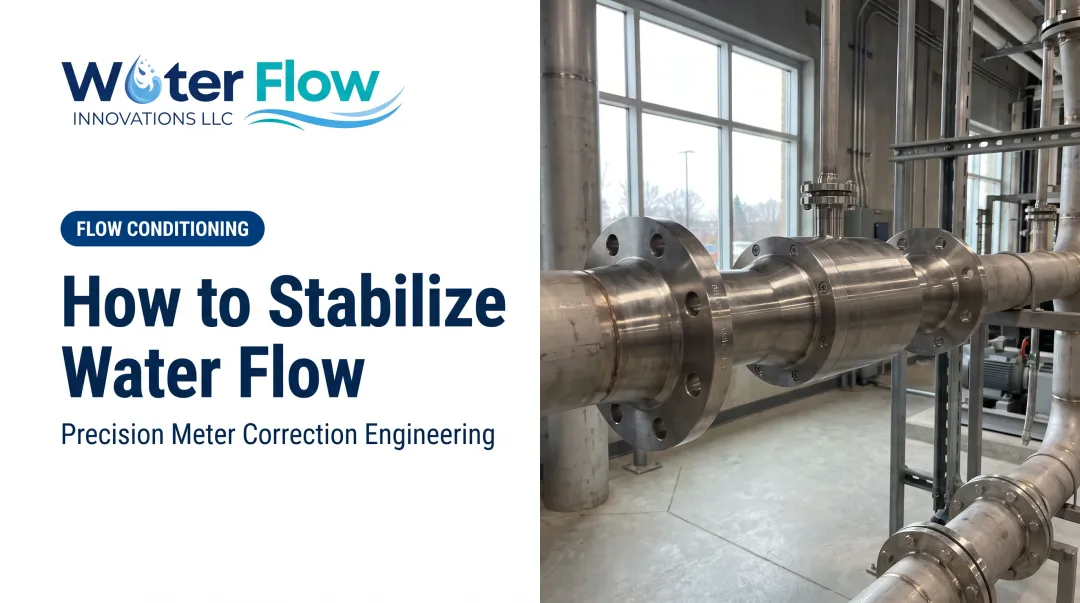
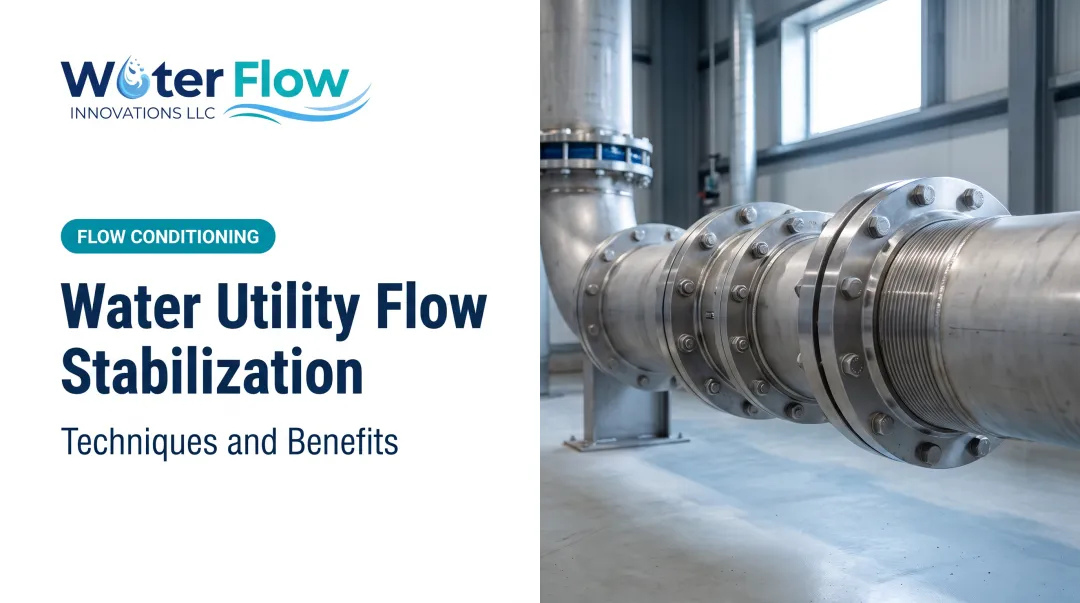
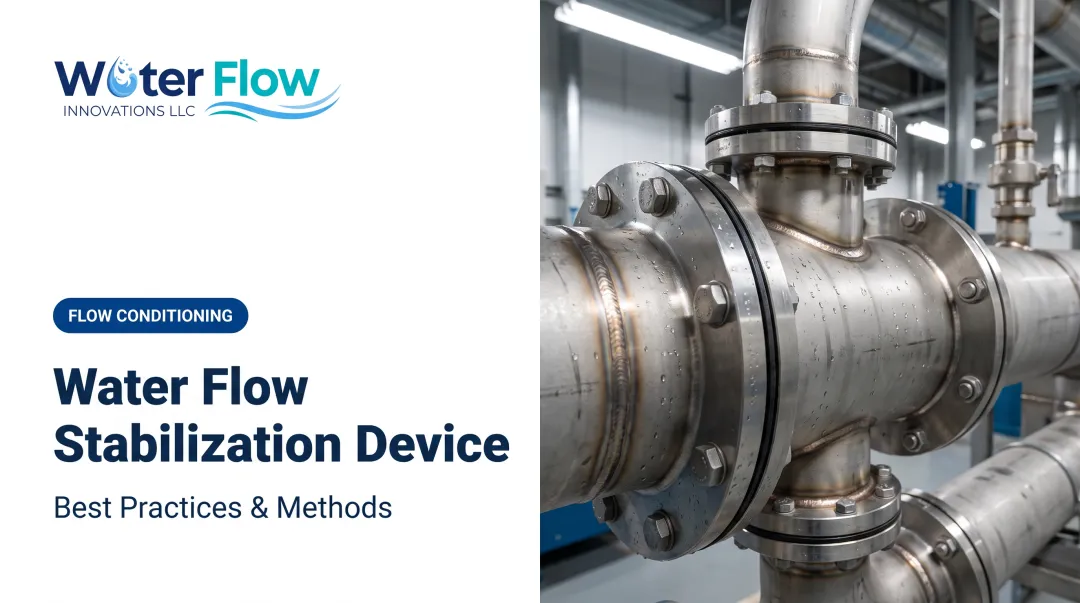
Most facilities historically needed separate devices for each function. Water Flow Innovation's Flow Conditioning Device (FCD) combines all four components—air/gas separation, pressure regulation, a check valve, and turbulence elimination—into a single custom-fabricated unit.

How it works:
- Creates static back-pressure that promotes laminar, bubble-free flow
- Regulates pressure at the meter entrance to reduce water hammer
- Slows velocity enough to prevent vortex flow during CIP cycles, tank filling, or irrigation spikes
The unit installs immediately after the water meter, on the consumer side of the connection. Installation typically takes about an hour for straightforward configurations, with negligible pressure loss and no changes to daily operations. Units are available from NPS 1/2" through 12", covering everything from small commercial connections to large industrial mains.
What Happens When Stabilized Flow Is Missing or Ignored
Skip flow stabilization and the same problems show up again and again:
- Chronic over-billing from meter over-reading that often goes undetected for years
- Accelerated wear on pipes, valves, and pumps from unmanaged pressure surges
- Inconsistent pressure that hurts product quality in food and beverage or manufacturing
- Weak sustainability data, undermining credible water-use figures for reporting

None of these show up as a single dramatic failure. They accumulate quietly, which is exactly why so many facilities never investigate their water bills until costs become impossible to ignore.
How to Get the Most Value from Stabilized Water Flow Solutions
Flow stabilization delivers the strongest results when a few conditions are met:
- Select certified equipment such as Water Flow Innovation's FCD (IAPMO, NSF, ANSI, CAN 61, KIWA, GMP, and SQF) for plumbing performance, potable-water safety, and manufacturing quality control.
- Compare actual before-and-after municipal bills across real billing cycles instead of relying on assumptions.
- Confirm pipe size and meter type so the unit fits existing infrastructure without costly retrofits.
A free water bill review and savings analysis can establish a facility-specific savings estimate before any purchase decision, using 12 months of billing history to account for seasonal variation.
Conclusion
Stabilized water flow's real value comes down to three things: accurate measurement, equipment protection, and verifiable cost control. These benefits compound over time. Lower bills this year, less maintenance next year, and stronger sustainability data whenever a report is due.
Flow stabilization works best as an ongoing operational practice, not a one-time fix. Water Flow Innovation's FCD delivers measurable results starting the very next billing cycle, backed by a 6-month money-back guarantee and a lifetime transferable warranty. Facilities ready to quantify the opportunity can start with a free water bill review.
Frequently Asked Questions
What is the name of a device that stabilizes water flow?
They are commonly called flow conditioning devices (FCDs) or water flow stabilizers. They correct turbulence and air entrainment at the meter.
How quickly can facilities see results from a flow stabilization device?
Savings typically appear on the very next billing cycle. The device corrects meter reading accuracy immediately upon installation, with no ramp-up period.
Does stabilizing water flow reduce actual water usage?
No. It corrects inaccurate meter over-reading caused by turbulence and air, so bills reflect only the water actually consumed.
Will a flow conditioning device affect water pressure or system performance?
Flow conditioning devices are designed for negligible pressure loss. Daily operations and system performance remain unaffected after installation.
What types of facilities benefit most from stabilized water flow?
High-volume water users see the greatest impact, including manufacturing plants, hotels, hospitals, multifamily buildings, and food & beverage facilities.
How long does installation of a flow stabilization device take?
Installation is typically quick, often around one hour for straightforward configurations, with a brief water shutoff at the meter connection and minimal operational disruption.
Does a stabilized reading lower the wastewater charge too?
In most cases yes. Utilities generally calculate sewer from metered intake rather than measured discharge, commonly at 80–120% of the water charge, so a corrected reading reduces both lines on the same cycle.
Can one operator roll this out across many sites?
Yes. Each site with its own metered municipal connection is a separate installation opportunity, so savings compound and before-and-after billing evidence can be aggregated for corporate benchmarking and capital planning.