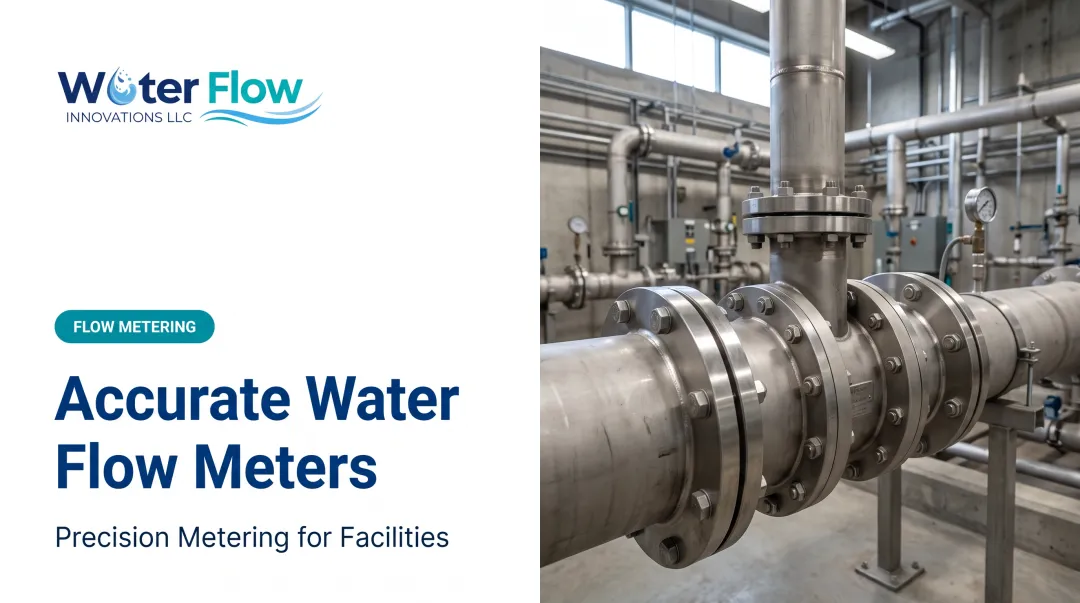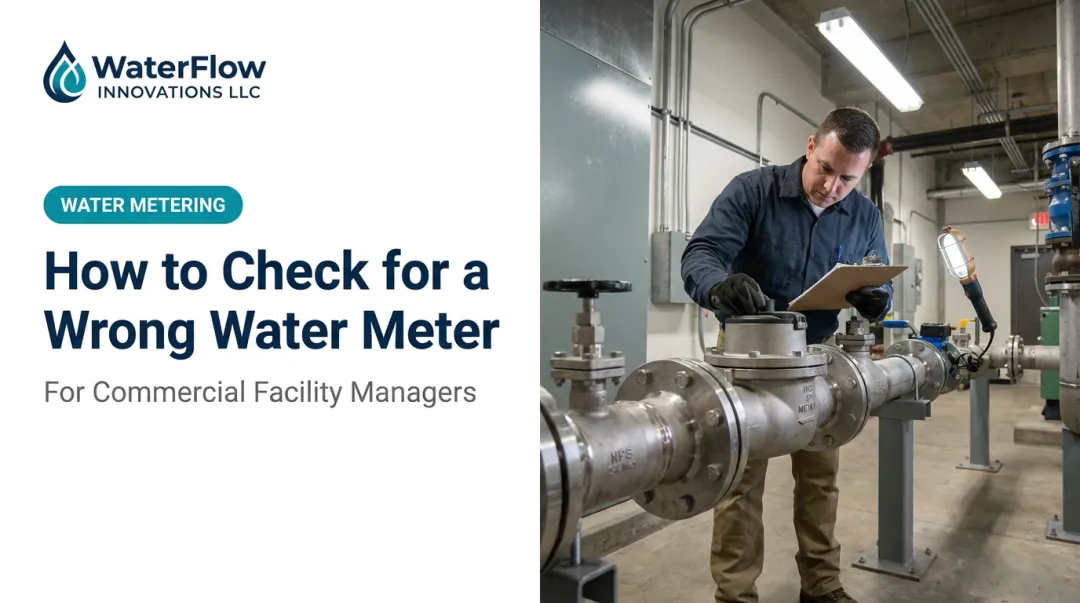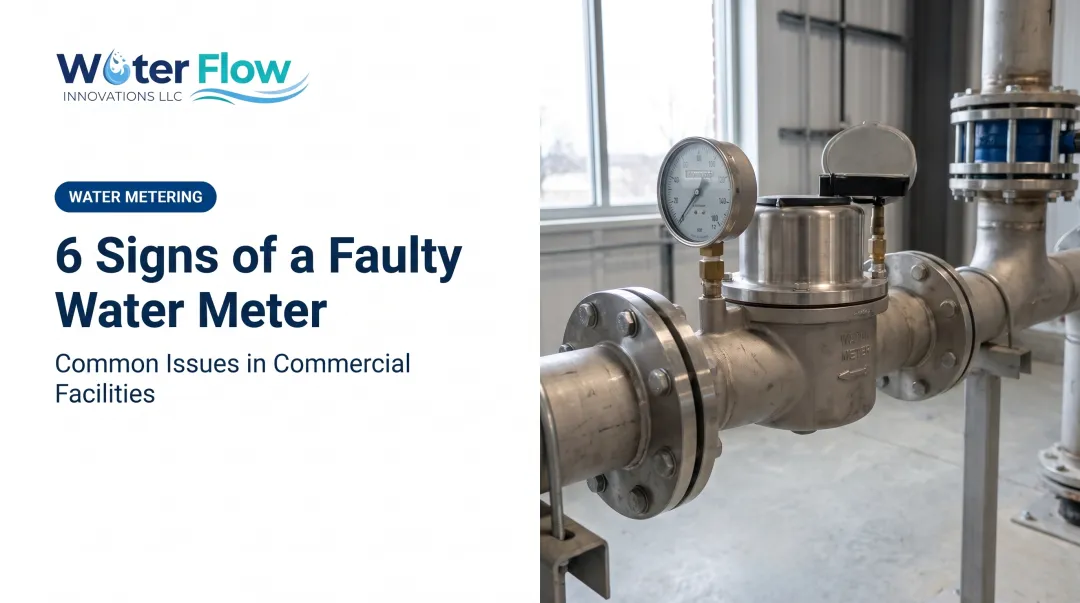

That box does more than sit there quietly. It's the single point that records every gallon entering your property and it determines every dollar you're billed. This post covers what a main water meter looks like, how it works, the different types you'll encounter, and how to spot billing problems that trace back to the meter itself rather than actual consumption.
Key Takeaways
- The main water meter tracks total flow into a facility and is the sole basis for utility billing
- Placement depends on climate: outdoor curb pits in warm regions, indoors near the main shutoff in cold ones
- Match meter type to demand—positive displacement and multi-jet for lower flows; turbine and compound for high-volume sites
- Aging meters or poor installation can over-register usage, inflating bills with no change in actual consumption
What Is a Main Water Meter?
A main water meter is the utility-owned device installed at the point where the municipal water supply enters your property. It sits at what's technically called the service connection, and it's distinct from any secondary or sub-meters used to allocate usage internally within a building.
This meter measures cumulative water volume, typically in cubic feet or gallons, and utilities read it periodically (either manually or remotely) to generate your bill. US utilities commonly bill in CCF or HCF units, where 1 CCF equals 100 cubic feet, or 748 gallons.
A "main" water meter is the whole-property measuring device, not the main shutoff valve. Those are two separate components that often sit near each other but serve entirely different functions.
Residential vs. Commercial Main Meters
Residential meters typically fall in the 5/8-inch to 1-inch range. Sizing isn't as simple as "bigger building, bigger meter." Manufacturer flow capacities vary by model: some 3/4-inch meters are rated for 30 gpm, while others handle very different maximum flows.
Commercial, industrial, and multifamily properties size their meters to anticipated peak demand, not just service line diameter. This often means:
- Compound meters that handle both low and high flow ranges
- Turbine meters for sustained high-volume applications
- Custom sizing based on manufacturer flow tables, not generic rules of thumb
Facilities like hotels, manufacturing plants, and multifamily buildings frequently use large or compound meters — and these carry higher error risk than a standard residential unit.

How Do Main Water Meters Work?
Inside every mechanical meter, water flow physically rotates an internal disc, piston, or impeller. That motion connects through a magnetic drive to the register, which accumulates total flow and displays it locally or transmits it remotely through radio or AMR/AMI technology.
Most meters also include a low-flow indicator, a small triangle or dial that spins with any water movement. This is a useful tool for checking hidden leaks: if it's spinning while every fixture in the building is off, water is moving somewhere it shouldn't be.
Why Accuracy Isn't Guaranteed
Meter accuracy depends heavily on installation conditions and flow rate. According to Neptune's 2024 technical guidance, most AWWA revenue meters operate within a 98.5%–101.5% accuracy allowance at normal flow, meaning a margin of error exists even under ideal conditions.
Installation problems compound that margin. Conditions that push a meter to register more volume than actually passed through include:
- Turbulent flow upstream of the meter
- Entrained air in the water line
- Pressure fluctuations during normal operation
This is not theoretical. A peer-reviewed study on intermittent water supply found that air expelled through customer meters during pipe refilling caused measurable over-reading in single-jet and multi-jet designs. Five of six tested meters failed during the trials.

What Are the Types of Main Water Meters?
Not every meter works the same way. Here's a quick breakdown of the main types you'll find on commercial and industrial service lines:
- Positive displacement meters: Nutating disc or oscillating piston designs. Accurate at low flows; common on smaller commercial services and many residential accounts.
- Multi-jet and single-jet meters: Impeller-driven designs used in mid-size residential and light commercial applications.
- Turbine meters: Built for larger commercial and industrial flows, where high-volume accuracy matters more than low-flow sensitivity.
- Compound meters: Combine a small meter for low flow with a larger meter for high flow. Common in multifamily and industrial buildings with fluctuating demand.
Smart or AMR/AMI meters are becoming standard across US utilities. These transmit readings electronically, sometimes as often as hourly, cutting down on manual reads. One distinction matters: AMI is a reading technology, not a measurement principle. It doesn't change how the meter physically measures flow.

Where Is It Located & What Should It Look Like?
Location depends mostly on climate and local utility practice.
Outdoor pit installations are typical in warmer regions. Look for a rectangular or round in-ground box near the property line or street, often marked "WATER METER." You'll usually need a meter key to open the lid.
Indoor installations are common in colder climates, where freezing is a real risk. These sit near the main shutoff valve, often in a basement, mechanical room, meter room, or utility closet.
Regardless of location, you should be able to spot:
- A round dial or digital display showing cumulative usage
- A low-flow indicator (the small spinning triangle mentioned earlier)
- One or two valves on either side — one utility-side, one customer-side
Common Main Water Meter Problems (and Hidden Billing Costs)
Watch for these warning signs:
- Unexplained bill spikes with no change in actual usage
- A spinning low-flow indicator with every fixture off
- Visible corrosion on the meter housing
- A stuck or frozen reading
Aging meters, or those installed under high-turbulence conditions, can systematically over-read actual usage. That inflated reading doesn't just hit your water bill. Because sewer charges are frequently calculated from metered water consumption, an over-reading meter silently inflates both charges, year after year.
Water Flow Innovation's Flow Conditioning Device (FCD) addresses this over-reading problem directly. The FCD corrects meter error caused by air entrainment and turbulent flow, without changing actual water usage or system performance.
It works through four components:
- Air and gas separation
- Pressure regulation
- A check valve (on select models)
- Turbulence elimination
FCD details that matter for facilities:
- Certified through IAPMO, NSF/ANSI, CAN 61, KIWA, GMP, and SQF
- Works with any meter type and pipe sizes from NPS 1/2" to 12" (custom sizes available)
- Installs in about an hour, usually during off-hours to limit disruption
- 6-month, no-questions-asked money-back guarantee plus a lifetime transferable warranty
- Documented savings of 5% to 30% on average, with a high of 46%

High-water-use facilities feel this most: hotels, manufacturing plants, multifamily buildings, and healthcare sites. Even a small over-registration rate compounds into significant annual overpayment.
A hotel running laundry, pools, and cooling towers accumulates far more meter cycles than a low-use property, and each cycle carries the same error potential.
If your property shows persistently high bills despite normal, unchanged usage, test the meter and have flow conditions professionally evaluated. Water Flow Innovation offers a free water bill review and a savings calculator that estimates potential reductions in about 30 seconds, no contact information required.
Frequently Asked Questions
What should a main water meter look like?
Expect a round dial or digital register and a small spinning low-flow indicator. It will sit in a pit housing outdoors or in a basement indoors, with shutoff valves visible on either side.
How do main water meters work?
Water flow rotates an internal disc, piston, or impeller, which connects through a magnetic drive to a register. That register tracks cumulative flow and generates the reading used for billing.
What are the types of main water meters?
Main types include positive displacement (strong low-flow accuracy), multi-jet and single-jet (light commercial), turbine (large sustained flows), and compound meters (wide-demand sites such as multifamily buildings).
Can a water meter cause my bill to be too high without a leak?
Yes. Entrained air and turbulent flow conditions can cause certain meter types to over-register actual usage. Flow conditioning devices are specifically designed to correct this without changing your actual water consumption.
How often should a water meter be tested or replaced?
AWWA guidance suggests testing 5/8–1 inch meters roughly every 10 years, meters between 1–4 inches every 5 years, and meters over 4 inches annually. There's no universal replacement mandate — it depends on utility policy and test results.
Who owns and maintains the main water meter?
The meter itself is typically utility-owned property, even though it physically sits on your land. Local municipal code or tariff terms determine exact ownership and maintenance responsibility.
Can a device be fitted without touching the utility-owned meter?
Yes. The correction sits on the main line after the meter, on the customer side, so the utility's asset is untouched and no meter replacement or plumbing redesign is needed. It works with any meter type and any standard pipe size (½-inch to 12-inch), and is fitted in about an hour, with only a brief water shutoff at the meter connection.
Which property types most often run an over-reading main meter?
Master-metered and high-cycling sites: multifamily and apartment communities, HOAs, luxury high-rise buildings, senior living, university dormitories, hotels, commercial office buildings, shopping malls, and municipal buildings.