Introduction
Most facility managers think their water bill is a simple math problem: usage times rate. Use less water, pay less money.
But that's only half the story. How water moves through your pipes matters just as much as how much you use. Pressure spikes and turbulence create air entrainment, which inflates your bill without you ever touching the tap.
Water flow conditioning covers a family of devices — restrictors, regulators, balancing valves, and conditioners — each solving a different problem. Confusing them costs facilities real money every billing cycle.
This article breaks down how each device works and where it's used. It also examines an overlooked issue that inflates utility bills across commercial and industrial buildings by 5% to 46%: turbulent flow causing water meters to over-read.
Key Takeaways
- Restrictors narrow the pipe to cap gallons per minute, raising upstream pressure.
- Regulators actively hold flow steady despite pressure swings in the supply line.
- Conditioners target a different issue: air and turbulence that make meters read higher than actual usage.
- Correcting meter over-reading can lower both your water charge and your sewer charge on the same bill.
What Is Water Flow Conditioning and Why Does It Matter?
Water flow conditioning is the practice of managing the volume, velocity, and consistency of water as it moves through a pipe, using inline devices rather than relying on gravity and demand alone. Uncontrolled flow doesn't just waste water — it stresses fittings, shortens equipment life, and skews the very meters that determine your bill.
For commercial and industrial operators, this isn't a minor conservation detail. Flow directly affects:
- Pressure stability across connected equipment and process lines
- Equipment lifespan, since pressure surges wear out valves, seals, and gaskets faster
- Billing accuracy, because meters are calibrated for specific flow conditions
The Scale of the Problem
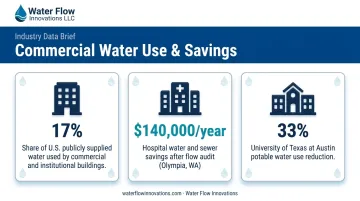
Commercial and institutional buildings account for roughly 17% of all U.S. publicly supplied water use, according to the EPA's WaterSense commercial and institutional fact sheet. That's a massive share of total demand running through pipes, valves, and meters that were rarely designed with flow-related billing errors in mind.
The EPA has documented individual facility results that hint at the size of the opportunity. A hospital in Olympia, Washington saved $140,000 a year in water and sewer costs, while the University of Texas at Austin cut campus potable water use by 33% after auditing its systems.
Flow issues rarely show up on a maintenance checklist. They show up on the invoice.
Types of Water Flow Conditioning Devices: Restrictors, Regulators, and Conditioners
Not every flow device does the same job. Facility teams often use "restrictor," "regulator," and "conditioner" interchangeably, but mixing them up leads to the wrong fix for the wrong problem.
Flow Restrictors
A flow restrictor is a passive, no-power device that physically narrows the flow path. Less cross-sectional area means less water gets through, regardless of pressure. You'll find these in:
- Residential showerheads and faucets
- Semiconductor manufacturing lines
- Reverse osmosis (RO) systems
They're simple and cheap, but flow through them still shifts with upstream pressure.
Flow Regulators
Also called rate-of-flow conditioning valves, regulators are active, pressure-compensated devices. A flexible orifice or spring mechanism adjusts automatically as pressure changes, holding flow near a target GPM.
Manufacturer specifications, such as Flomatic's Flo-Trol regulator line, list operating ranges around 15–125 psi differential pressure while keeping flow within ±15% of the rated setpoint. When consistent delivery matters more than a simple cap, regulators are the better fit.
Balancing Valves
Balancing valves serve a narrower purpose: distributing flow evenly across HVAC and hydronic branches. They're a distinct category, governed by ASHRAE guidance and standards like ANSI/ASHRAE 111, even though the term "flow conditioning" gets applied to them too.
Flow Conditioners
Flow conditioners are a fourth category entirely, and the one most facility teams have never heard of. Rather than limiting volume, a conditioner sits immediately after the water meter and corrects the conditions the meter is reading, removing air, smoothing turbulence, and stabilizing pressure so the measurement itself is accurate.
Correcting that reading matters financially: facilities typically see water and sewer bills drop 5–30% once the meter reads accurately, with some sites documenting savings as high as 46%.
Here's the quick distinction:
- Restrictor: passive, caps flow volume, used in fixtures and process lines
- Regulator: active, maintains constant GPM under pressure changes
- Balancing valve: active/passive hybrid, equalizes flow across HVAC zones
- Conditioner: passive, corrects meter accuracy rather than limiting flow
How Do Flow Restrictors Work?
Picture a garden hose with a spray nozzle attached. Squeeze the nozzle down, and water shoots out faster and farther, even though less total volume passes through per second. That's the core mechanic behind every flow restrictor.
A fixed or dynamic orifice reduces the area water can pass through. As more water gets pushed against that smaller opening:
- Downstream flow rate (GPM) drops
- Upstream pressure rises
- Exit velocity and force increase
That last point matters for equipment protection. A restrictor changes where the force goes, not just how fast water moves, so sizing decisions affect everything downstream, from spray nozzles to process valves.
Self-Actuating Mechanical Restrictors
Some restrictors use spring-loaded or flexible orifice elements that close as differential pressure increases and open as it drops, requiring no external power. These are engineered to operate within a defined pressure differential range and maintain flow within a percentage of their rated GPM, similar in principle to the 15–125 psi ranges published for pressure-compensated regulators.
The Cavitation Risk
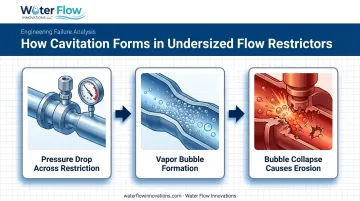
Undersized or improperly matched restrictors create a real hazard: cavitation. When pressure drops too far across a restriction, vapor bubbles form and then collapse violently against valve seats and pipe walls. Valve manufacturers like BERMAD and Cla-Val document this as a source of noise, vibration, and long-term erosion. Proper sizing means matching the restrictor to actual inlet pressure, outlet pressure, and flow rate, not just picking a size that "seems right" for the pipe diameter.
Installation Basics
Flow restrictors are inline devices, so installing one means interrupting the pipe run. Most mechanical restrictors don't require long straight inlet or outlet runs, but directional installation is non-negotiable. Install one backward, and it simply won't function as designed.
Beyond Restriction: How Turbulent Flow and Air Entrainment Cause Meter Over-Reading
Here's what most articles on flow conditioning skip entirely: water rarely moves through commercial plumbing in the smooth, laminar profile that meters are calibrated to measure. Elbows, tees, pumps, and pressure changes introduce turbulence and pull air into the line. That air travels straight to the meter.
The Meter Doesn't Know the Difference
A water meter measures everything passing through it: water, entrained air, micro-bubbles, and swirling vortices alike. It registers the volume of the whole turbulent mass, not just the water. The result: facilities get billed for water that was never actually delivered.
This happens through normal, everyday operations:
- Pressure changes from valves opening and closing
- On/off cycling of pumps and process equipment
- Cooling tower makeup water cycling
- CIP (Clean-in-Place) systems in food and beverage plants
- Irrigation zone switching
None of this shows up in a leak check, because no water is actually escaping. The meter simply counts air and turbulence as water.
This is a measurement accuracy problem: restrictors and regulators only manage flow rate, and neither one removes air or stabilizes the turbulence the meter reads. They weren't built to. That's the specific gap a flow conditioning device is designed to close.
What a Flow Conditioning Device Actually Does
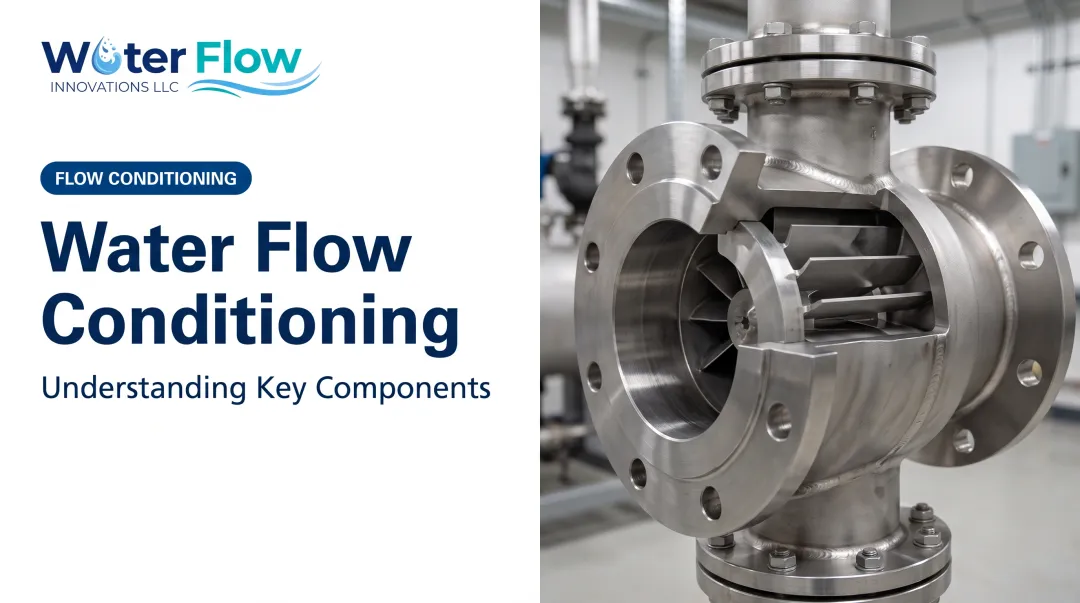
A flow conditioner is a multi-component system installed immediately after the water meter. Water Flow Innovation's Flow Conditioning Device (FCD) is one certified example (IAPMO, NSF, ANSI, CAN 61, KIWA, GMP, and SQF-certified), built around four components:
- Air and gas separation: creates static back pressure that forms a homogeneous water column back through the meter
- Pressure regulation: reduces water hammer from on-off cycling
- Check valve (select models): prevents reverse flow that lets air back into the line
- Turbulence elimination: slows velocity just enough to prevent vortex flow
The design goal is negligible pressure loss: the device conditions flow without restricting it, so downstream spray force and process performance stay effectively unchanged, with only a slight pressure loss (typically 0–3 psi) before and after installation. Documented results across installations show 5–30% average water and sewer bill reductions, with the highest single result on record at 46%.
The Dual-Savings Mechanism
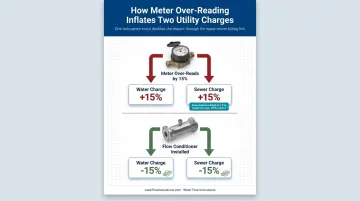
Here's why this matters financially in a way restriction alone doesn't. In many municipalities, sewer discharge fees are calculated as a percentage of metered water intake. New York City bills sewer at 159% of the water charge, for example, while other cities use different formulas.
If a meter over-reads by 15%, that inflates the water charge by 15% and the sewer charge by the same percentage, on every single bill.
Correct the meter reading, and both charges drop together. That's the ROI math that makes flow conditioning attractive for high-volume facilities. A facility manager can verify the potential savings with a free water bill savings calculator in under a minute.
Key Applications and Benefits Across Commercial Facilities
Flow conditioning delivers the biggest impact wherever water is a real line item on the budget, not an afterthought. That includes:
- Hotels and extended-stay properties
- Multifamily and high-rise residential buildings
- Food and beverage manufacturers running CIP cycles
- Healthcare facilities with 24/7 water demand
- Universities and dormitory campuses
- Data centers with cooling tower makeup water
- Industrial and chemical manufacturers
Operational Benefits Beyond the Bill
Reduced utility costs are the headline, but they're not the only payoff:
- Equipment protection: stable pressure means fewer surges hitting valves and seals
- Extended pipe and valve life: less stress translates to fewer replacements
- ESG and LEED support: documented, bill-based reductions require no modeling or estimates
Because savings appear as before-and-after numbers on an actual utility bill, they're verifiable data that sustainability and finance teams can use directly in ESG disclosures, LEED water-efficiency credits, or ENERGY STAR benchmarking. No separate audit is needed to prove the number is real.
Frequently Asked Questions
What is a control flow water saving device?
It's any inline component, such as a restrictor, regulator, or conditioner, built to manage the volume or quality of water moving through a pipe. The goal is either reducing unnecessary consumption or correcting metering inaccuracies that lead to overpayment.
Does a flow restrictor save water?
Yes, restrictors lower gallons per minute, which reduces total consumption over time. But they only address volume, not metering accuracy. Facilities over-billed due to turbulent flow or air entrainment still need flow conditioning to capture those savings.
Should I have flow conditioning on or off?
For nearly all commercial and industrial applications, flow conditioning devices should stay active. They protect equipment from pressure surges and stabilize performance. Removing them only makes sense when a specific process genuinely requires unrestricted maximum flow.
What is the difference between a flow restrictor and a flow regulator?
A restrictor is passive: it caps maximum flow but lets actual flow vary with pressure. A regulator is active: it uses a pressure-compensated mechanism to hold a constant GPM regardless of pressure swings. A conditioner does neither — it changes nothing about what your equipment receives.
Can flow conditioning or flow conditioning devices reduce my utility bills?
Flow conditioning devices that correct meter over-reading can lower both the water charge and the sewer charge, with savings visible on the very next billing cycle. Traditional restrictors reduce consumption but don't fix billing errors caused by inaccurate metering.
Which facility types most often need the conditioning rather than the restriction?
Sites where demand cycles constantly against one meter: hotels and hospitality, healthcare facilities, laundromats, car and truck washes, food and beverage and dairy plants, breweries and distilleries, data centers, and multifamily and apartment properties.
What cover comes with a conditioning device?
A 6-month money-back guarantee on the device purchase price, with installation cost non-refundable, so it can be returned if metered consumption does not measurably fall. A lifetime transferable warranty against manufacturing defects also applies.