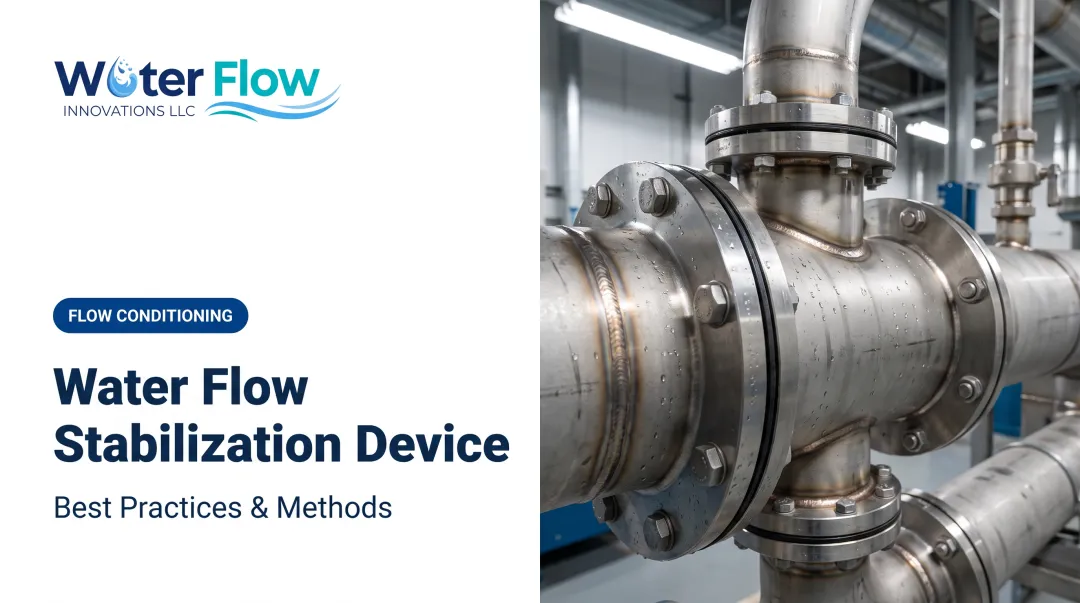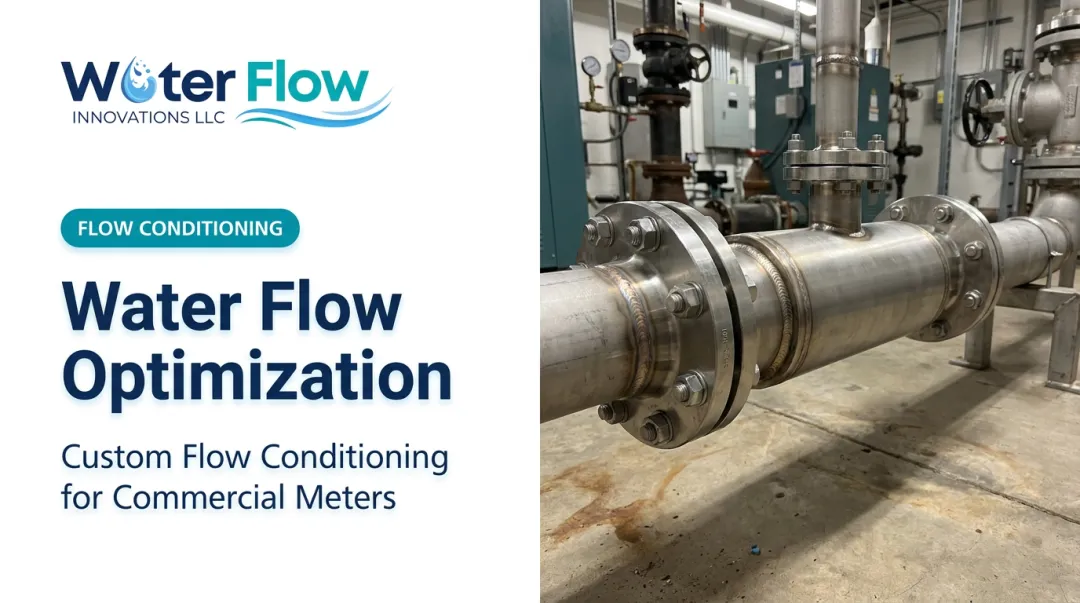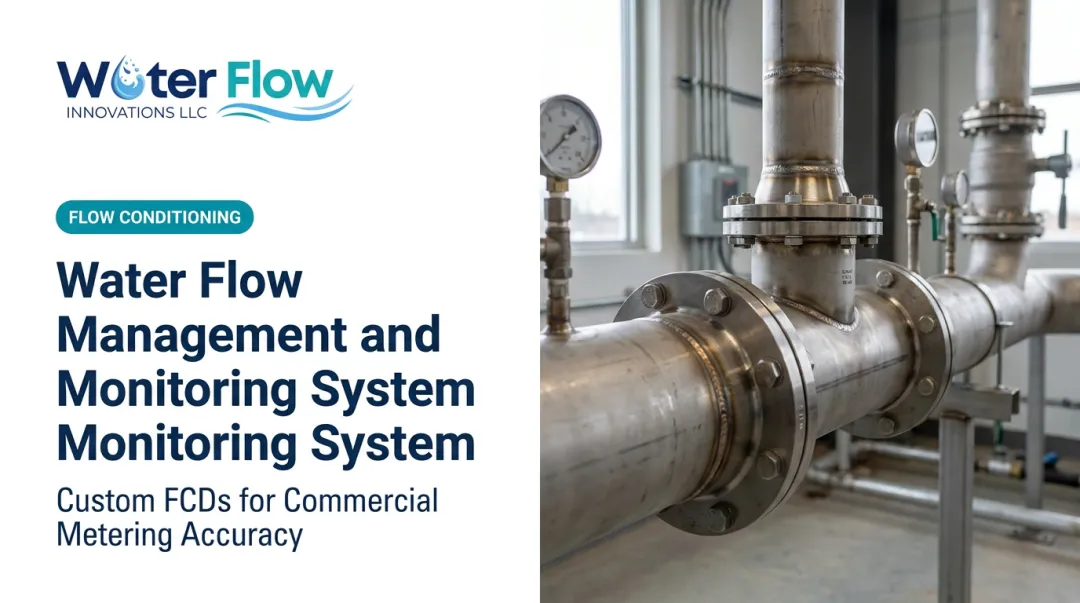

Water flow management covers both problems. It spans everything from ancient irrigation channels to today's smart metering and flow conditioning technology. This guide walks through the core methods, the modern tech reshaping the field, and how to pick the right approach for your facility.
Key Takeaways
- Effective flow management combines measurement, control structures, storage, and monitoring technology to cut waste and cost
- Air entrainment and turbulence can cause meters to bill facilities for water they never used
- Pairing traditional fixes (leak detection, fixture upgrades) with flow conditioning technology drives deeper bill reductions
- Many facilities see water/sewer bill reductions of 5-30%, with some cases reaching 46%
What Is Water Flow Management and Why It Matters
Water flow management is the measurement, control, and optimization of water as it moves through a system. Hydrologists define discharge using a simple formula: velocity multiplied by width multiplied by depth. Apply that same principle to a pipe network, and it becomes clear why every valve, meter, and bend affects how much water actually gets tracked.
Facilities need flow management for several reasons:
- Cost control: water and sewer rates keep climbing in most US metro areas
- Regulatory compliance: discharge permits and effluent guidelines apply to many industrial operations
- Sustainability reporting: ESG disclosures and LEED certification both require documented water metrics
- Infrastructure protection: pressure surges and water hammer damage pipes and equipment over time
Bluefield Research found that 19.5% of US treated drinking water is lost or improperly billed before reaching customers, costing utilities more than $6.4 billion annually. That's a utility-level figure, not a facility one, but it shows how deep measurement problems run in the water sector.
At the facility level, two goals often get conflated. Managing flow for supply (irrigation, process water, cooling makeup) focuses on getting enough water where it needs to go. Managing flow for accuracy, through metering and billing, focuses on making sure measured volumes match actual use.
Most facilities focus heavily on the first and overlook the second. That accuracy gap is often where avoidable water and sewer charges build up.
Core Water Flow Control Methods and Structures
You can't manage what you don't measure — so metering sits at the foundation of every flow management strategy.
Metering and Measurement
Commercial buildings have shifted steadily toward submetering: breaking a single master meter into building-level or tenant-level measurement points. The U.S. Green Building Council's LEED v4 standard now requires permanent meters that track total potable water use with monthly and annual reporting.
Meter selection matters more than most facility managers realize. Oversized meters often fail to register low-flow periods accurately, which hides leaks and off-hours waste. Calibration should follow manufacturer specs, not guesswork.
Flow Control Structures
Valves, gates, and pressure regulators direct and limit water movement throughout a system:
- Isolation and control valves start, stop, or throttle flow through a pipe
- Pressure-reducing valves bring high supply pressure down to a safe operating level
- Gates regulate open-channel or intake flow by changing opening size
- Weirs and flumes create defined hydraulic conditions for measuring open-channel discharge
Storage, Buffering, and Turbulence
Tanks, reservoirs, and check valves stabilize flow and prevent backflow, smoothing out the peaks and valleys that come from variable demand. But storage and control structures introduce their own complication: turbulence.
The Federal Energy Management Program notes that valves and fittings placed too close to a meter disturb the water's velocity profile, and turbine-style meters need at least five pipe diameters of straight, undisturbed pipe upstream to read accurately. When that condition isn't met, meters can over-register. Flow conditioning devices installed at the meter restore a stable velocity profile so the meter records actual volume instead of turbulence-driven error.

A 2025 laboratory study on intermittent water systems found something striking: when air displaced during system refilling passed through meters, 8 of 11 tested meters failed accuracy standards across 65 experiments, registering 33–63% of the discharged air volume as if it were water.
That case involves intermittent supply, but the mechanism is the same in everyday commercial systems: air and turbulence look like water to a meter that isn't built to tell the difference.
Reuse, Recovery, and Cooling Tower Optimization
Facilities increasingly capture and reuse water:
- Rainwater capture for irrigation or cooling makeup
- Condensate recovery from air handlers
- Graywater reuse loops for non-potable applications
Cooling towers deserve special attention since they're often a facility's single largest mechanical water draw. The EPA notes that increasing cycles of concentration from 3 to 6 can cut cooling-tower makeup water by 20% and blowdown by 50%.
One EPA facility recovered 540,000 gallons of air-handler condensate in eight months, covering 16% of its total water use.

Modern Smart Water Flow Technologies
Traditional flow control gets facilities most of the way there. Modern technology closes the remaining gap, especially around meter accuracy.
Smart Metering and Monitoring
Advanced Metering Infrastructure (AMI) gives facility managers real-time visibility into consumption patterns. Adoption has grown fast: 38 million AMI water meters were installed across North America by 2022, representing 33% market penetration.
That's an all-customer figure, not commercial/industrial-specific, but the trajectory is clear. Guidehouse Insights projected a 23% compound annual growth rate for smart water-management systems in commercial buildings through 2029.
Automated Leak Detection
Remote shut-off systems paired with continuous monitoring catch leaks before they become disasters. Instead of discovering a burst pipe on the next bill, facilities get alerted the moment usage patterns spike outside normal ranges.
Flow Conditioning Technology
Flow conditioning corrects turbulence and air entrainment at the meter. Devices sit immediately after the meter and restore a clean, laminar flow profile—without changing how much water the facility uses or how the system performs.
Water Flow Innovation offers a Flow Conditioning Device (FCD) built around four certified components:
- Air and gas separation — creates a homogeneous water column so the meter reads actual water, not entrained bubbles
- Pressure regulation — reduces water hammer and pressure surges from on-off cycling
- Check valve — prevents reverse flow and air re-entry (specified only when needed)
- Turbulence elimination — slows velocity enough to stop vortex formation at the meter
Facilities using the FCD report 5-30% average water and sewer bill reductions, with a documented high of 46%. Because sewer charges are frequently calculated from metered water intake, correcting the water reading often reduces both bills at once.
Each unit is custom-fabricated in 316L stainless steel to match a facility's exact pipe size, flange type, and meter model. Units cover pipe sizes from ½ inch to 12 inches (larger and metric sizes available), and installation typically takes about an hour.

Best Practices for Implementing a Water Flow Management Strategy
A scattershot approach to water flow rarely produces lasting savings. Facilities that see real results tend to follow a consistent sequence.
- Start with a water audit. Review utility bills, meter records, operating schedules, and major water-using processes. Look at both occupied and unoccupied periods to catch anomalies.
- Prioritize flow correction alongside efficiency upgrades. Flow conditioning corrects meter over-reading so bills reflect actual use. Low-flow fixtures and efficient cooling cut real consumption and compound those gains.
- Set measurable goals tied to a normalized metric such as gallons per occupied room, per bed, or per unit produced, and track that alongside total utility spend.
- Involve staff in day-to-day water habits. Technology investments perform better when paired with basic behavioral awareness on the floor.
A free bill review is a low-risk starting point. Water Flow Innovation, for example, evaluates 12 months of billing history alongside meter type, pipe size, and operating cycles to estimate savings potential before any purchase commitment.

Common Facility Types That Benefit Most
Not every facility gains equally from flow management investment. The biggest wins tend to show up where water use is high-frequency, high-volume, or heavily regulated.
- Industrial manufacturing — subject to EPA Effluent Guidelines and NPDES discharge permits, with clean-in-place (CIP) cycles that create major turbulence spikes
- Hospitality — lodging accounts for roughly 15% of US commercial/institutional water use, driven by laundry, kitchens, and landscaping
- Healthcare — hospitals represent about 7% of commercial/institutional water use, largely from cooling equipment and sterilization cycles
- Multifamily housing — pressure fluctuations across units and shared systems complicate accurate metering
- Food & beverage production — dish machines and CIP systems can cycle 40-60 times per hour at peak periods
These sectors face higher water and sewer costs and tighter regulatory scrutiny, so flow management typically pays off faster. The right approach still depends on facility size, pipe infrastructure, and metering setup.
Frequently Asked Questions
What is a device that regulates water flow?
Flow regulation devices include valves, pressure regulators, and flow conditioners. A flow conditioning device specifically targets turbulence and air entrainment near the meter to improve reading accuracy, rather than controlling flow rate itself.
How can a business reduce its water bill without changing usage?
If a meter is over-registering due to turbulence or air, correcting that condition lowers the bill even though actual consumption stays exactly the same. This is the core mechanism behind flow conditioning technology.
What is the difference between water flow management and water conservation?
Flow management focuses on controlling and optimizing how water moves through a system, including measurement accuracy. Conservation focuses on reducing the total volume of water used in the first place.
How long does it take to see ROI from water flow management upgrades?
Savings from flow conditioning often appear on the very next billing cycle. Full ROI is typically achieved within a year. Water Flow Innovation reports 90% of its customers reach full ROI in under 12 months.
Do flow management devices affect water pressure or system performance?
Certified flow conditioning devices are designed for negligible pressure loss. Installation happens downstream of the meter, before internal distribution, so operations continue without process changes.
What certifications should businesses look for in water flow devices?
Look for NSF, ANSI, IAPMO, CAN 61, and KIWA certifications. These confirm potable-water safety, code compliance, and tested performance against recognized industry standards.
Why does an accuracy correction lower two charges at once?
Because sewer is generally calculated from metered intake rather than measured discharge, commonly at 80–120% of the water charge. Correcting the reading therefore reduces the water line and the sewer line on the same cycle.
Can a management programme span an entire property group?
Yes. Each property with its own metered municipal connection is a separate installation opportunity, so results compound and the billing evidence aggregates for corporate benchmarking and capital planning.