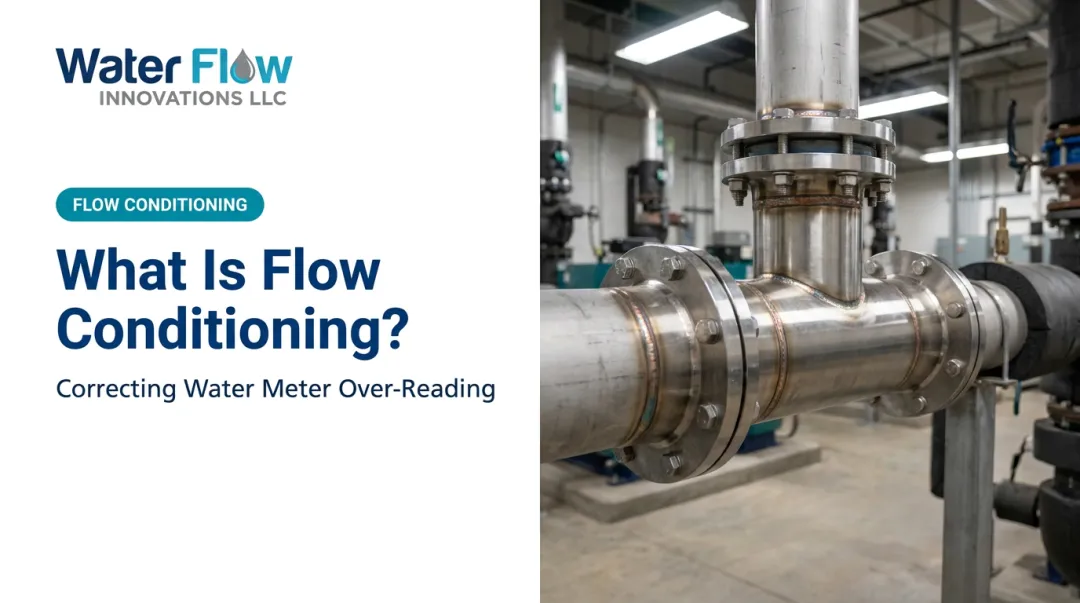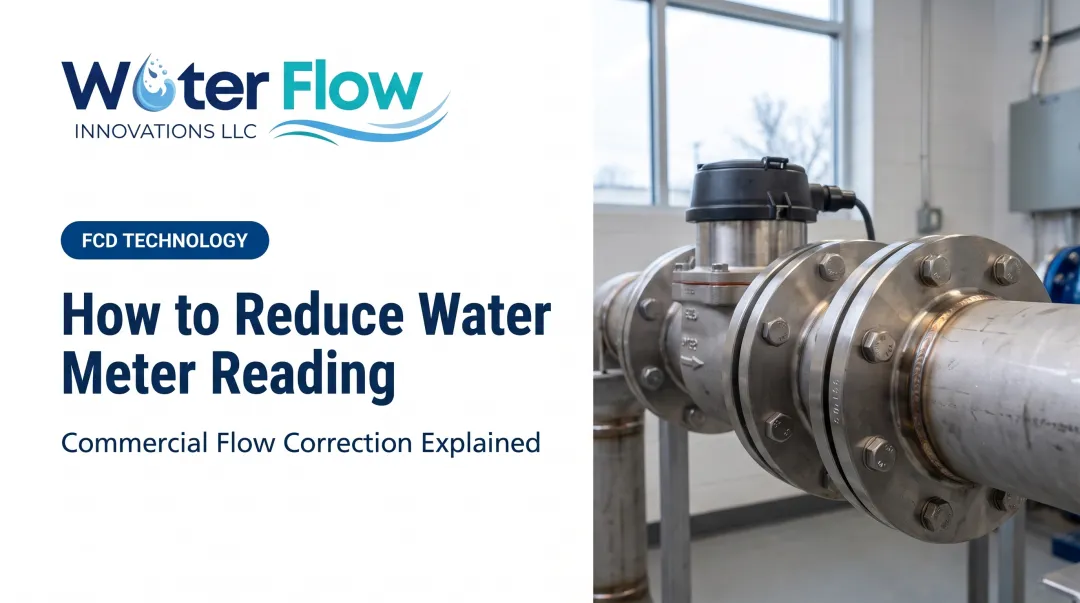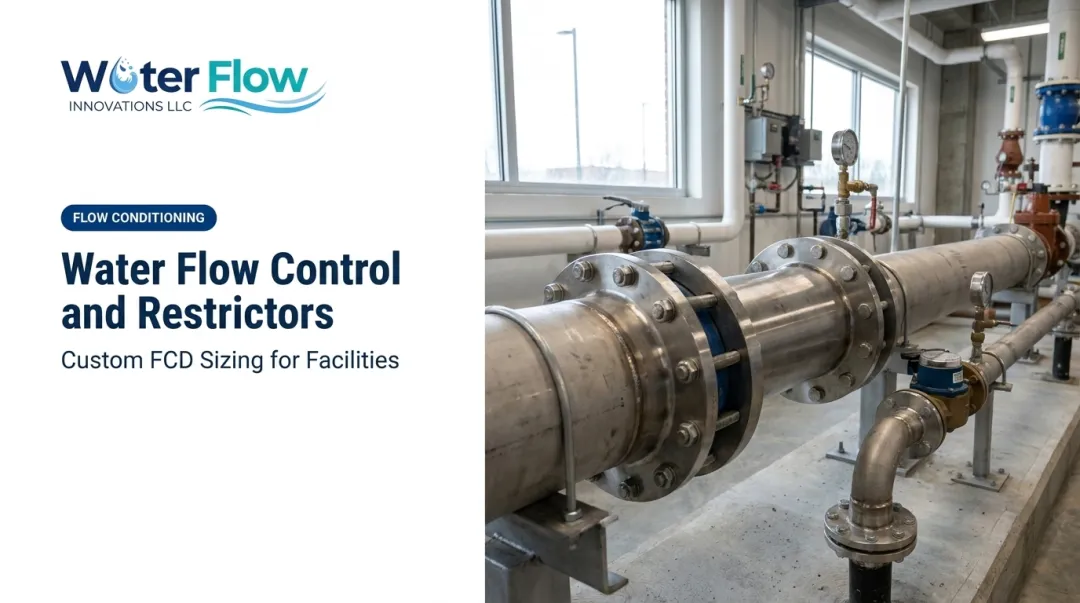

Flow control spans a wide range, from SCADA networks managing entire municipal networks down to individual valves and meter-correcting devices on a single building's water line. Picking the wrong layer for your problem wastes budget and time.
This guide breaks down what flow control systems actually are, the types available, a commonly overlooked issue called water meter over-reading, and how to choose the right fix for your facility.
Key Takeaways
- Flow control spans plant-wide SCADA/DCS networks down to valves and conditioning devices at the meter
- Match controller type—manual, automated, remote, or pressure-compensated—to your operation’s scale
- Turbulence and entrained air make meters over-read, so many facilities unknowingly overpay for water and sewer
- Certified flow conditioning devices can cut bills 5–30% without changing usage or system performance
- Size the solution to facility scale, budget, and the specific problem you need to solve
What Is a Flow Control System?
A flow control system is any combination of sensors, controllers, and actuators used to monitor and regulate fluid movement through pipes, channels, or distribution networks. According to NIST's guide to operational technology, this works as a three-part loop:
- Sensors/meters – measure flow, pressure, or level and report the data
- Controllers (PLCs or RTUs) – interpret that data and apply logic or set points
- Valves/actuators – execute the physical response, like opening or closing a valve

Scale Matters
Municipal utilities typically run SCADA or DCS platforms that manage entire distribution networks: pump stations, pressure zones, remote tanks, all monitored from a central control room.
Individual facilities often rely on localized flow stations or valve-level devices that don't need that level of infrastructure.
Either way, the core functions stay the same: flow regulation, pressure management, system balancing, and catching anomalies before they become expensive problems.
Here's the part that gets missed: a system can be perfectly controlled and still misreport actual usage. Control and measurement accuracy are two different things. You can have flawless valve sequencing and still be overbilled every month because the meter itself is reading wrong.
Municipal water-loss audits back this up. Galveston, Texas conducted a 2017 water audit that found customer-meter inaccuracies accounted for nearly 155 million gallons of apparent annual loss, worth close to $1.7 million a year at that city's rate structure. That's one city—and it shows how meter accuracy issues hide inside otherwise well-run systems.
What Are the Different Types of Flow Controllers?
Flow controllers range from hand-operated valves to fully networked SCADA systems. The right type depends on system complexity, how tightly you need to hold a setpoint, and whether operators must manage assets remotely.
Manual and Mechanical Flow Controllers
Gate, ball, and butterfly valves adjusted by hand remain common in smaller or lower-complexity systems. They are low-cost and simple, but they demand constant oversight. Gate valves are not built for throttling, and standard ball valves wear out fast if used that way.
Automated and Pressure-Compensated Controllers
These use flexible orifices that self-adjust flow regardless of upstream pressure swings. Common in irrigation and hydronic loops, they hold a consistent flow rate without an operator making constant adjustments.
Remote and SCADA-Integrated Controllers
PLC and RTU-based controllers connect to a central SCADA system. Utilities get real-time visibility and control over dispersed assets such as pump stations, remote valves, and pressure zones from a single screen. That centralized view is how most municipal networks run day to day.
Specialty Flow Conditioning Devices
Flow conditioning devices (FCDs) do not control flow rate at all. They correct turbulence and air entrainment at the meter so the meter reads accurately in the first place.
Water Flow Innovation's FCD is a clear example of this category. It is built around four components:
- Air/gas separation – creates back-pressure that keeps entrained air out of the measurement zone
- Pressure regulation – smooths out water hammer and surge from on/off cycling
- Check valve – prevents reverse flow, which can reintroduce air after purging
- Turbulence elimination – slows velocity enough to prevent the vortex flow that causes over-counting

Unlike a valve, an FCD does not move or throttle flow. It conditions the stream so the meter can measure it accurately.
The Hidden Problem: Water Meter Over-Reading in Utility Systems
Here's the physics: turbulent flow and air bubbles near a meter can cause mechanical and ultrasonic meters to register more volume than actually passed. The federal government's own metering guidance confirms that nearby fittings and valves create turbulence that decreases meter accuracy. Turbine-style meters specifically need a uniform, swirl-free flow profile to measure correctly.
Over-reading shows up across industrial, commercial, and municipal facilities—especially those with older piping or high-turbulence conditions like:
- Cooling tower and boiler cycling
- CIP (clean-in-place) cycles in food and beverage plants
- Irrigation and sprinkler zones
- Truck wash and vehicle wash operations
- Tank fill-and-drain events
The billing hit doubles in many jurisdictions. Many utilities calculate sewer discharge fees from metered water consumption—Front Royal, Virginia and Inver Grove Heights, Minnesota both bill commercial sewer service off actual metered water use. An over-reading meter can inflate your water bill and your sewer bill.
How Water Flow Innovation's FCD Fixes This
The FCD is a certified solution (IAPMO, NSF, ANSI, CAN 61, KIWA, GMP, SQF) that corrects over-reading at the point of installation:
- Works with any pipe size (standard NPS 1/2" to 12", custom sizes available) and any meter type
- Installs in about one hour, immediately after the municipal meter, during a brief planned shutoff
- Delivers negligible pressure loss — downstream pressure and flow stay effectively unchanged
- Documented average water and sewer bill reduction of 5-30%, with a highest documented result of 46%
- 90% of customers hit full ROI in under 12 months
- Savings typically appear on the very next billing cycle

These are documented billing outcomes, not a universal meter-error percentage. Every facility's over-reading conditions differ, so a facility-specific review matters more than a generic industry number.
Benefits of Advanced Flow Control for Utilities and Facilities
Operational side
- Steadier pressure for better system balancing and lower leak risk
- Cleaner data for maintenance planning and capital decisions
Independent research on 882 utilities found average water loss around 17%, with pressure reduction identified as the least-cost intervention available.
Financial side
- Lower consumption charges and, where applicable, lower sewer fees
- Documented, auditable savings for ESG disclosures and LEED water-efficiency credits
- Before-and-after billing data that gives those programs a clear audit trail
LEED requires permanent whole-project metering with multi-year data retention. Verified bill reductions meet that standard without estimated savings.
Continuity
Done right, neither SCADA upgrades nor device-level fixes like an FCD require shutting down production. FCD installation typically takes about an hour, with no ongoing process changes afterward.
How to Choose and Where to Get the Right Flow Control Solution
Start with these questions:
- Facility size and infrastructure – Are you managing one building or a distribution network?
- Budget – Is this a system-wide SCADA/PLC project, or a single conditioning device?
- The actual pain point – Is it inefficient system-wide control, or a suspiciously high water bill at one meter?
Where to Source Each
| Need | Where to Go |
|---|---|
| System-wide SCADA/PLC control | Industrial automation integrators |
| Meter accuracy and bill reduction | Specialized providers like Water Flow Innovation |

For meter accuracy and bill reduction, Water Flow Innovation offers purchase and lease options for its FCD. Purchase includes a 6-month money-back guarantee and a lifetime transferable warranty that stays with the property through ownership changes. Leasing avoids upfront capital cost and may qualify as an operating expense.
Before committing to either path, request a facility assessment. Water Flow Innovation's review is free and looks at your bills, meter type, pipe configuration, and usage patterns to project realistic savings before you spend a dollar.
Frequently Asked Questions
What are the different types of flow controllers?
Flow controllers include manual/mechanical valves, pressure-compensated automated valves, and remote PLC/SCADA-integrated systems. Specialty flow conditioning devices improve meter accuracy rather than control flow rate directly.
What is a flow control system?
A flow control system is a combination of sensors, controllers, and actuators that monitor and regulate fluid movement through a pipe or network. Sensors measure, controllers decide, and actuators act.
Where can I get a flow controller?
For system-wide control, industrial automation integrators handle SCADA/PLC setups. For meter-accuracy and bill-reduction solutions, providers like Water Flow Innovation serve facilities across the US.
How do I know if my facility has a water meter over-reading problem?
Watch for unexplained high water or sewer bills, known turbulence sources near the meter (pumps, elbows, cycling equipment), or older piping configurations. A professional flow assessment can confirm it.
Will installing a flow conditioning device disrupt my operations?
No. Installation typically takes about an hour, with a brief water shutoff at the meter connection, and the device causes negligible pressure loss with no lasting impact on system performance.
Can flow control savings be used for sustainability reporting?
Yes. Documented before-and-after water and sewer bill reductions provide auditable data that can support ESG reporting, LEED water-efficiency credits, and other sustainability programs.
Is there any risk if the accuracy device underdelivers?
A 6-month money-back guarantee on its purchase price, with installation cost non-refundable, so it can be returned if metered consumption does not measurably fall. A lifetime transferable warranty against manufacturing defects also applies.
Can a utility or operator standardize this across many connections?
Yes. Each connection with its own metered municipal supply is a separate installation opportunity, so sites can be ranked by consumption volume and the resulting evidence pooled for benchmarking and capital planning.