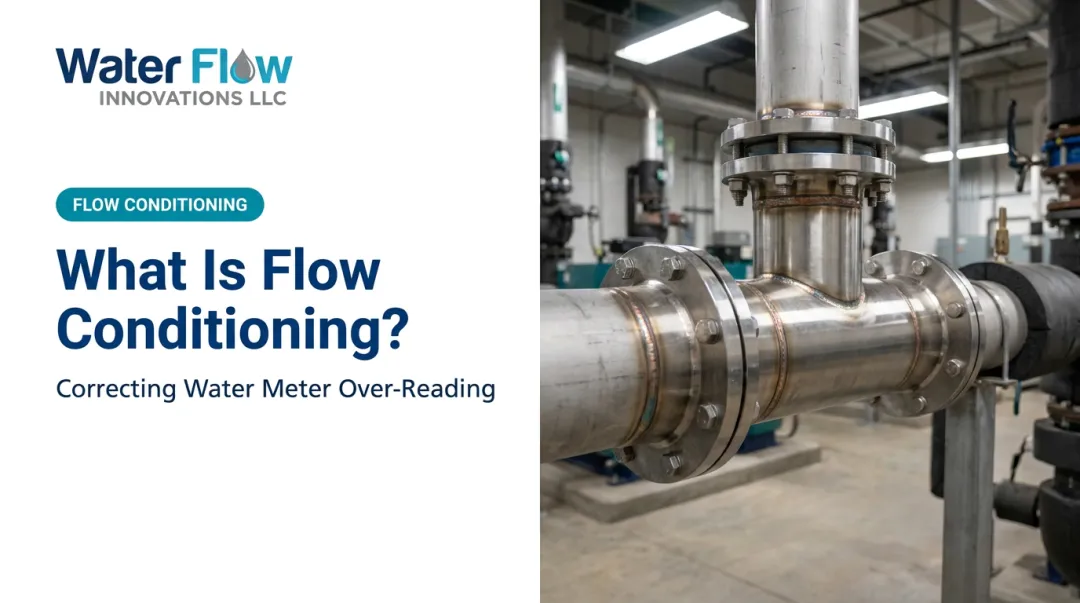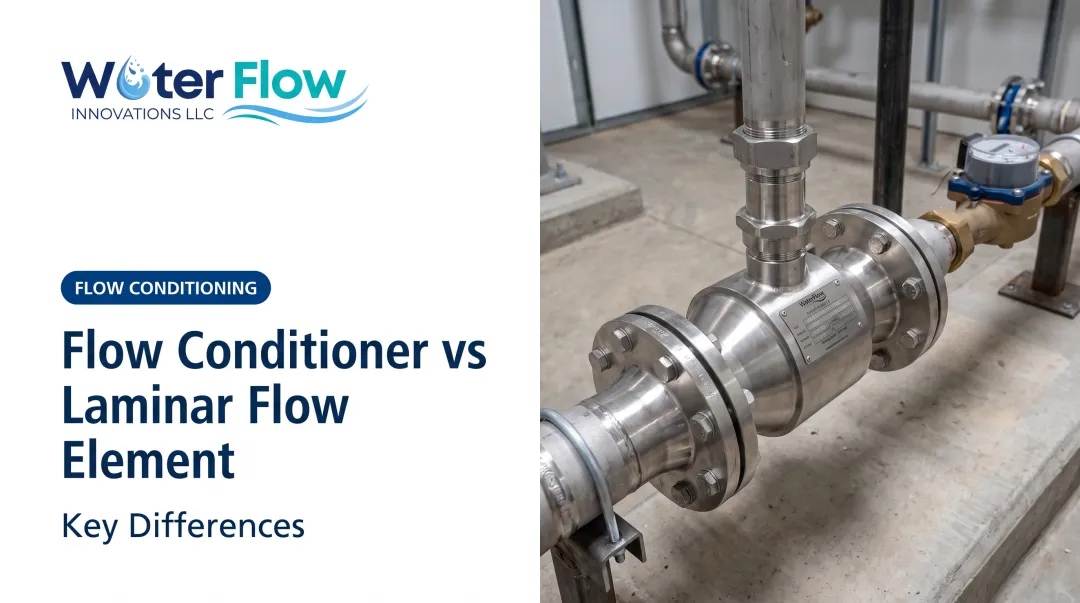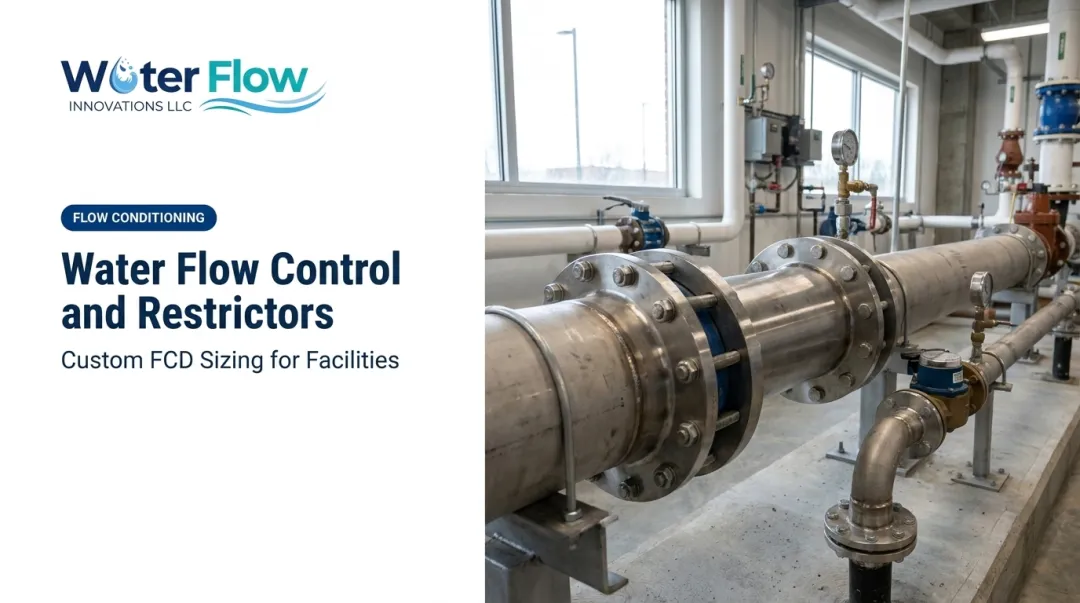

That distinction matters more than most facility managers realize. The wrong choice affects metering accuracy, pressure drop, maintenance schedules, and — for commercial and industrial water accounts — your monthly utility bill. Turbulence near a water meter can distort readings, and depending on the meter technology involved, that distortion doesn't always go one direction. Research from McCrometer notes that disturbances like butterfly valves can push certain meter errors above 50%, with the magnitude and direction varying by meter type.
This is exactly the gap Water Flow Innovation's FCD technology was built to close, correcting the turbulent, aerated flow conditions that lead many facilities to overpay on water and sewer bills.
Key Takeaways
- Perforated plates are simple, low-cost devices that cut swirl and reshape velocity profiles, but they ignore air entrainment
- Multi-component flow conditioners add air/gas removal and pressure regulation on top of turbulence control
- Plates still need careful sizing and run length; some profile distortion can persist either way
- Air entrainment is a separate, documented meter-error path that plates do not address
- Pick plates for swirl control in a metering study; pick full conditioners when billing accuracy is the goal
Flow Conditioner vs Perforated Plate: Quick Comparison
| Factor | Perforated Plate | Flow Conditioner (FCD-type) |
|---|---|---|
| Cost | Lower upfront; flat plate, minimal labor | Higher upfront, custom-fabricated to spec |
| Design | Single plate with graded hole pattern | Multi-component: turbulence, air removal, pressure stabilization |
| Pressure drop | Moderate to significant, depending on geometry | Engineered for negligible loss |
| Air entrainment | Not addressed | Directly targeted |
| Maintenance | Periodic inspection for wear, dirt, edge damage | Designed to be maintenance-free, no moving parts |
A note on sizing claims: You'll see plenty of generic figures online for perforated plate open-area ratios or "universal" straight-run requirements. Treat these skeptically.
The AGA-9 standard's 10D benchmark, for instance, applies specifically to high-pressure natural gas ultrasonic metering, not water systems. Always check your meter manufacturer's installation instructions rather than relying on borrowed gas-industry numbers.
What is a Perforated Plate?
A perforated plate flow conditioner is a flat plate fitted with a pattern of circular passages, installed in a pipeline to redistribute velocity and reduce swirl. The graded resistance created by the hole pattern suppresses rotational flow while reshaping the axial velocity profile.
Core benefit: plates can achieve a reasonably symmetrical flow profile within a relatively short pipe length, which matters where installation space is tight.

Plate designs vary by:
- Hole diameter and spacing (pitch pattern)
- Overall open area ratio
- Application: specialty geometries exist for orifice meters versus pump suction lines
Use Cases of Perforated Plates
Perforated plates show up most often in:
- Natural gas pipeline metering, where AGA-9 references a 10D minimum spacing between conditioner and ultrasonic meter
- Pump suction lines and industrial process piping needing a developed flow profile ahead of orifice or ultrasonic meters
- HVAC plenums and diffusers, for flow balancing rather than metering precision
PRCI's research on jetting behavior examined whether localized jets persist downstream of these plates, but the public summary doesn't publish a definitive result on how far jetting effects travel. Don't assume a plate fully "resets" the flow just because it's rated for a certain spacing.
What is a Flow Conditioner?
A flow conditioner corrects velocity profile, swirl, and turbulence in piping systems. Advanced designs also remove entrained air or gas that distorts meter readings.
That air and gas handling is the key difference from a perforated plate, and it ties directly to water billing accuracy.
Core benefit: Corrected flow readings mean accurate water and sewer billing, without disrupting system pressure or operations.
Flow conditioners come in a few forms:
- Tube bundles — older tech that suppresses rotation but can leave the profile flatter than fully developed flow
- Stepped-profile plate conditioners — improve on basic plates with graded resistance zones
- Multi-component systems — combine air/gas separation, pressure regulation, a check valve, and turbulence elimination in one unit (for example, Water Flow Innovation's Flow Conditioning Device, or FCD)

Use Cases of Flow Conditioners
Multi-component units like the FCD install immediately after a facility's water meter. They correct the turbulent, aerated flow common in commercial and industrial plumbing systems, and suit sites where water and sewer bills are a major recurring cost:
- Hotels and hospitality properties
- Hospitals and healthcare facilities
- Manufacturing plants
- Universities and multifamily buildings
Based on internal data, results often include:
- 5–30% average reduction in water and sewer bills (documented high of 46%)
- ROI in under 12 months for roughly 90% of customers
- Savings on the next billing cycle, since the meter reads more accurately right away
Flow Conditioner vs Perforated Plate: What is Better?
There's no universal winner here. It comes down to what you're trying to fix. Weigh these factors:
- Installation space — how many pipe diameters do you have upstream/downstream?
- Fluid type — gas pipeline metering research differs from commercial water billing
- End goal — velocity profile correction for a metering study, or billing accuracy for a facility
- Pressure drop tolerance — can your system absorb additional head loss?
- Budget — upfront cost versus measurable return
Choose a perforated plate if: you need a low-cost, straightforward solution for velocity profile correction for a flow meter in a research or industrial process context, and air entrainment isn't part of the problem.
Choose an advanced flow conditioner if: your priority is correcting air entrainment and turbulence that inflate commercial or industrial water bills, without impacting system pressure or requiring downtime.
The FCD's four-component design targets that use case directly: air and gas separation, pressure regulation, a check valve where needed, and turbulence elimination. Together they produce a more homogeneous water column through the meter.

Real-World Example: Correcting Water Meter Over-Reading
Picture a mid-size manufacturing facility that notices its water and sewer bills climbing month over month, despite no change in production volume or actual usage. Facility management rules out leaks and usage changes, then turns attention to the meter itself.
The likely culprit: turbulent, aerated flow disturbing the meter's readings. A 2022 peer-reviewed study in the journal AQUA found that during pipe-filling conditions with roughly 1.5 m³ of air present in the system, meters over-registered by 0.45 to 0.86 m³, with air causing the meter to spin at multiples of its calibrated maximum.
That error mechanism differs from swirl alone, and a basic perforated plate isn't designed to address it.
Faced with this, the facility opts for a certified flow conditioning device rather than a plate, because the fix needs to address air removal alongside turbulence correction. Savings typically show up on the very next billing cycle rather than requiring months of monitoring.
Takeaway: For facilities focused on stopping unexplained overpayment (not just improving velocity profile for a metering study), a certified flow conditioner offers a faster, more complete correction.
Curious if your facility's meter is over-registering? Request a free water bill analysis from Water Flow Innovation to find out.
Conclusion
Perforated plates and flow conditioners both correct flow disturbances, but they're not interchangeable. Plates address velocity profile and swirl. Advanced flow conditioners address the full range of disturbances, including the air entrainment that directly inflates water bills.
If your goal is research-grade metering work, a perforated plate may be all you need. If your goal is to stop overpaying on water and sewer bills, you need a certified, multi-component flow conditioning solution built for that job.
Frequently Asked Questions
What is a flow conditioner?
A flow conditioner is a device installed in a pipeline to correct turbulence, swirl, and other flow disturbances. This gives downstream meters and equipment a more stable, accurate flow profile to measure against.
Does an orifice plate restrict flow?
Yes. An orifice plate creates a deliberate, measured restriction used for differential pressure flow measurement. A perforated plate flow conditioner is different—it corrects flow profile rather than measuring it.
How often do perforated plates need maintenance or replacement?
Inspect them at least annually, or during scheduled meter maintenance. Fatigue, vibration damage, dirt buildup, and edge wear can degrade performance over time—especially in high-flow applications.
Can a flow conditioner reduce my water utility bill?
If your facility's water meter is over-registering due to turbulent or aerated flow, a certified flow conditioner like Water Flow Innovation's FCD can correct this. Customers see an average 5-30% reduction in water and sewer bills, with a highest documented result of 46%.
Is there a difference between a tube bundle and a perforated plate flow conditioner?
Yes. Tube bundles reduce swirl well but often leave a flatter, less-developed velocity profile downstream. Perforated plates redistribute velocity more actively and usually need less straight pipe length.
Will installing a flow conditioner affect my water pressure or system performance?
A properly engineered flow conditioner, such as Water Flow Innovation's FCD, is designed for negligible pressure loss. Installation typically takes about an hour, with a brief water shutoff at the meter connection, and no disruption to operations.
Where in the line is the conditioning device positioned?
At the municipal supply connection, immediately after the billing meter and upstream of every downstream system, with each unit custom-built for the facility. The utility's meter and the existing plumbing are left untouched.
Would fitting a new meter achieve the same correction?
Generally not. A replacement still registers everything reaching it, air included, so if aerated or turbulent flow is the cause, the same over-registration returns. The flow profile entering the meter is what has to change.