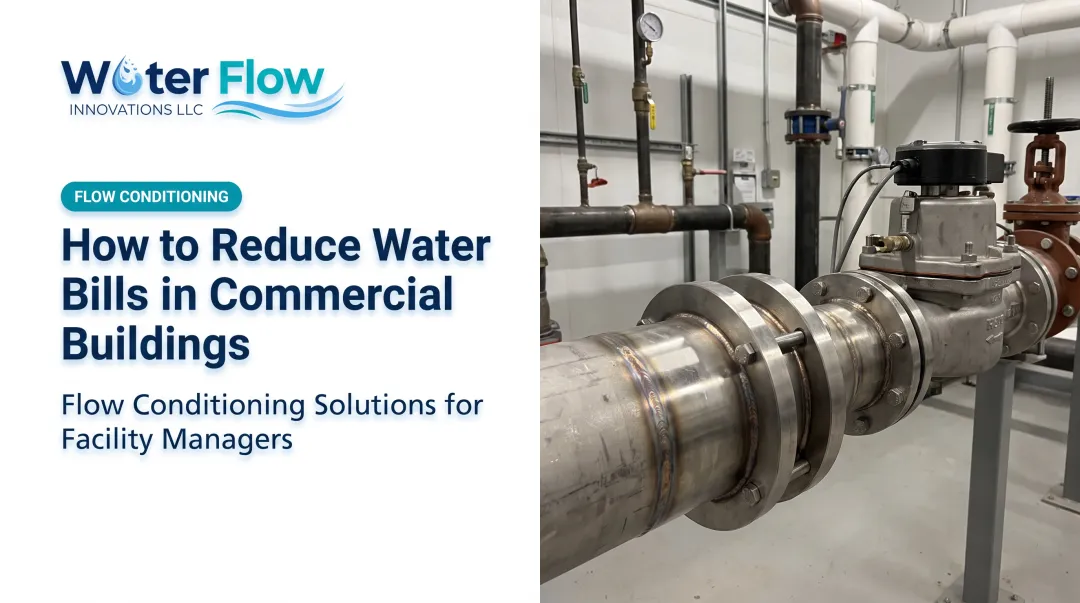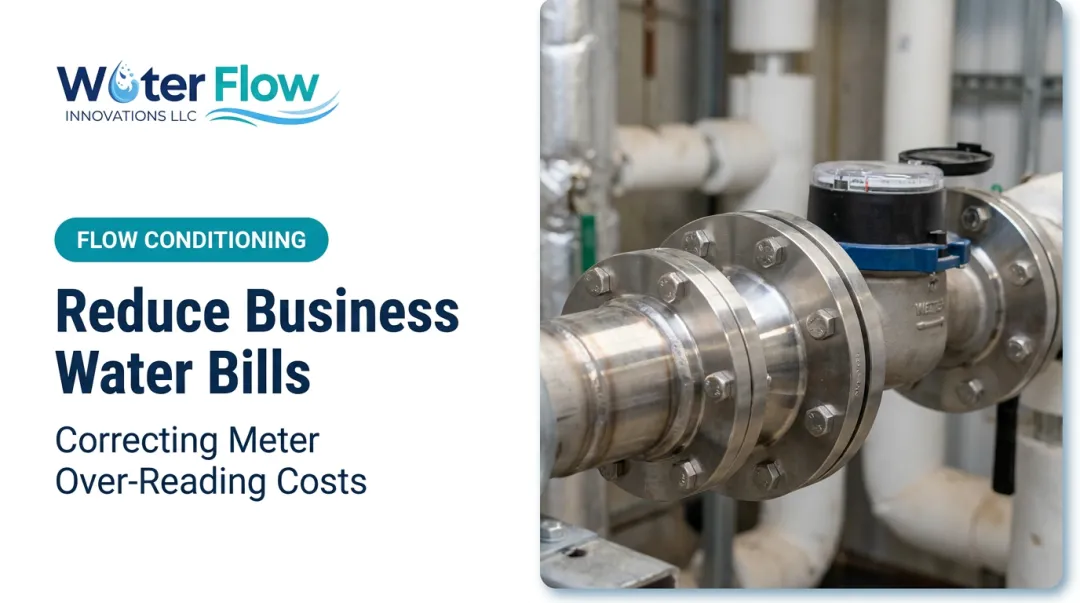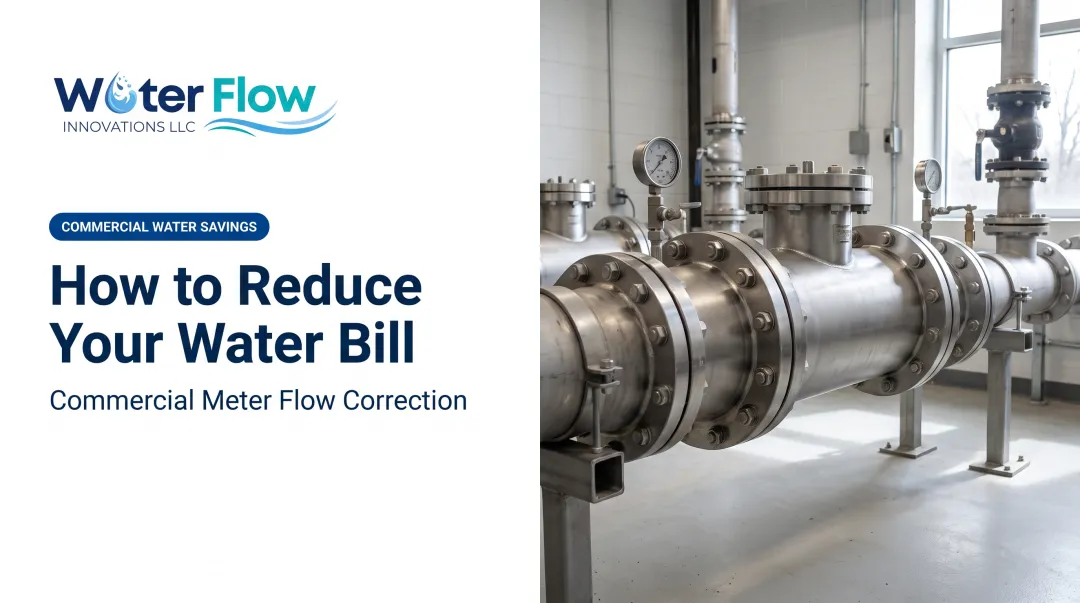

Here's the scale of the problem: EPA WaterSense puts the 2024 national-average combined commercial water and wastewater rate at $13.36 per 1,000 gallons (EPA WaterSense). At that rate, a facility using 10 million gallons a year is looking at roughly $133,600 annually. Add in meter inaccuracies, and that number climbs fast, hitting margins, straining budgets, and creating gaps in ESG reporting that finance teams hate explaining.
High water bills rarely come down to one cause. Usage volume matters, but so does meter accuracy, aging infrastructure, and basic oversight. This article breaks down how commercial water costs build up, what actually drives them, and the practical strategies facilities use to bring bills down without cutting operations.
Key Takeaways
- Commercial water bills stack usage charges, sewer fees, and waste from leaks and meter over-reading
- Aging fixtures, pressure swings, billing errors, and behavioral waste drive most excess cost
- Cut spend with smarter procurement, daily monitoring, and targeted infrastructure fixes
- Water Flow Innovation's FCD corrects meter over-reading for verifiable 5–30% bill savings
How Commercial Water Costs Typically Build Up
Your water bill isn't one line item. It's a stack of charges:
- Metered consumption
- Sewer/wastewater fees
- Meter-size charges
- Infrastructure fees
- Stormwater or impervious-area surcharges (in some markets)
Sewer charges usually ride on top of your metered water volume. Seattle, for example, bills nonresidential sewer customers at $20.18 per CCF (748 gallons) based on actual water use (Seattle Public Utilities). When sewer is billed from water volume, every gallon the meter records hits you twice.
Here's why it compounds: if your water meter over-reads by 15%, your water charge goes up 15% — and your sewer charge, calculated from that same inflated number, goes up another 15%. A single inaccuracy hits your bill twice.

Most of this stays invisible until someone audits the bill. Gradual meter drift and small leaks rarely show up as dramatic spikes. They compound month after month.
Key Cost Drivers for Commercial Water Bills
Water bills respond to four broad forces:
- Consumption volume: how much water the facility actually uses
- Infrastructure condition: pipe age, fixture efficiency, pump performance
- Meter accuracy: whether the meter is reporting real usage
- Rate structures: tariff tiers, fixed fees, and sewer allowances
Some of these are behavioral. Habits, maintenance schedules, and staff awareness all play a role. Others are purely mechanical, like a meter that's aged out of calibration or a pipe run that creates turbulence right at the measurement point.
The Overlooked Driver: Air and Turbulence
The lesser-known culprit is meter over-reading caused by air entrainment and turbulent flow. Research on Woltman meters found that a partially closed gate valve placed too close to the meter produced errors as high as +45.65% (Palau et al., 2019, MDPI Water). Move that valve further upstream and the error falls to +2.56%. A single valve position can inflate a commercial bill by nearly half.
How the dominant driver shifts by facility type:
| Facility Type | Dominant Driver |
|---|---|
| Hotels | Pools, laundry, guest-service peaks |
| Manufacturing | Cooling towers, process-water cycling |
| Multifamily | Master-meter over-reading, booster pumps, risers |

Cost-Reduction Strategies for Commercial Water Bills
Strategies fall into three buckets: decisions you make once, how you manage water day-to-day, and the systemic context around your facility's water flow.
Strategies That Change Your Decisions
These are the procurement and policy choices that set the stage for lower bills:
- Specify low-flow fixtures and WaterSense-certified equipment during any renovation or new build. EPA notes these products use at least 20% less water than standard alternatives (EPA WaterSense)
- Review your utility tariff structure for large-volume or tiered billing options that better match your usage pattern
- Install a certified flow conditioning device, like Water Flow Innovation's FCD, which corrects meter over-reading without changing your actual water use
- Build water-efficiency clauses into vendor contracts so contractors aren't defaulting to wasteful practices
Strategies That Change How You Manage Water Use
Once the big decisions are made, daily oversight keeps costs from creeping back up:
- Run regular sub-metering and leak audits. DOE recommends checking minimum unoccupied flow, often around 3-4 a.m., to catch phantom losses
- Track consumption against production or occupancy data to flag anomalies before they become a pattern
- Schedule preventive maintenance for cooling towers, irrigation, and plumbing systems
- Train staff to spot and report signs of waste, such as a running toilet or a dripping valve
Strategies That Change the Context Around Water Use
Facility-level conditions often drive costs as much as consumption volume. Turbulent flow and air entrainment can cause the meter itself to misreport usage—one of the most common sources of inflated bills.
- Recalibrate or upgrade aging meters that may be misreporting
- Fix facility-wide pressure irregularities, which contribute to both waste and inaccurate readings
- Investigate reclaimed water for non-potable uses like irrigation or cooling towers, where permitted locally
Why Meter Accuracy Matters More Than Most Facilities Realize
Here's something most facility managers don't know: your water meter can report more water than actually passed through the pipe. Air pockets and turbulent flow physically spin certain meter mechanisms faster than the real flow rate justifies, inflating your reading before a single gallon reaches your tenants or production line.
Water Flow Innovation built its Flow Conditioning Device (FCD) specifically to address this. It's a four-component system installed right after the water meter:
- Air & Gas Separation — creates a homogeneous water column, removing bubbles in the measurement zone
- Pressure Regulation — smooths out surges from on-off cycling and variable demand
- Check Valve — prevents reverse flow that can let air back into the line (not always needed, depending on the site)
- Turbulence Elimination — slows velocity enough to stop the vortex spin that causes over-counting

Facilities typically see:
- 5–30% lower combined water and sewer bills (one documented case hit 46%)
- Full ROI within 12 months for roughly 90% of customers
- Savings on the next billing cycle, once the meter reads correctly
Unlike most water-saving projects, the FCD does not disrupt operations. It works with any meter type and any pipe size from half an inch to 12 inches. Installation takes about an hour, usually during a scheduled shutoff outside business hours, and leaves production lines, tenant areas, and process equipment untouched.

Conclusion
Reducing a commercial water bill starts with diagnosis. Is the problem actual overuse? Operational inefficiency? Or a meter that's reporting water you never received?
Facilities that see the biggest, most sustainable savings usually combine all three approaches: smarter procurement, tighter daily management, and a hard look at whether their meter is even measuring correctly.
Skip that last piece and you may leave 5-30% of savings on the table—savings that require no change to how your facility operates.
Frequently Asked Questions
What is the "Save Water, Save Money" campaign?
It's a general public conservation message used by multiple water utilities and agencies, not one single national program. Commercial facilities can achieve comparable or larger savings through targeted efficiency upgrades and meter-accuracy corrections.
What are some effective "save water" slogans?
Common examples include "Every Drop Counts" and EPA's "Fight Leaks and Water Waste." For commercial facilities, though, measurable actions such as audits, upgrades, and meter correction matter far more than messaging.
How much can a commercial facility realistically save on its water bill?
Most facilities see 5-30% reductions, depending on existing inefficiencies and facility type. Some documented cases reach as high as 46%.
How do I know if my water meter is over-reading?
Compare metered usage against known fixture output or production data. If the numbers don't line up, a certified flow conditioning specialist can run a proper audit.
Does reducing water bills require reducing actual water usage?
No. Correcting meter over-reading lowers your bill without changing how much water your facility actually uses or how it operates.
How long does it take to see results after implementing water-saving measures?
Behavioral and maintenance changes take months to show up. Flow conditioning devices are different — savings typically appear on the very next billing cycle.
Which commercial sectors gain the most from a correction?
Hotels and hospitality, restaurants and fast food, supermarkets, shopping malls, commercial office buildings, laundromats, car and truck washes, healthcare facilities, schools and universities, and data centers — wherever many demand sources share one meter.
What approvals should the equipment hold for a commercial supply?
Recognized potable-water approvals: certification to IAPMO, NSF, ANSI, CAN 61, KIWA, GMP, and SQF, plus compliance with the EPA WaterSense program. The device is built from 316L stainless steel in the USA.