Here's the frustrating part: your bill can go up even if your usage doesn't change at all.
The average U.S. household paid $95.02 a month for combined water and sewer service in 2023, using about 6,200 gallons. That number has only grown since. For many families, it's becoming a budget line that's harder to ignore.
This guide covers the basics — habit changes and fixture upgrades — plus what's new for 2026: smart monitoring tools, leak detection tech, and a measurement issue many people never think to check.
Key Takeaways
- Small habits, hidden leaks, and aging fixtures compound gradually into higher water bills
- Free behavioral changes (shorter showers, full loads) deliver immediate savings
- Fixture upgrades like WaterSense toilets cut usage by thousands of gallons yearly
- Leak detection and meter monitoring catch invisible waste before it inflates your bill
- Multifamily, HOA, and commercial properties can overpay 5-30% due to meter inaccuracy alone
How Costs on Your Water Bill Typically Build Up
Nobody notices one extra minute of pre-rinse water or a slightly-too-long equipment wash cycle. That's the problem. Water costs build up in small increments, and most facilities don't see the total until the bill lands.
Some of this build-up is habitual: equipment left running between shifts, inefficient wash-down routines, fixtures that stay on longer than needed. These add up slowly, month after month.
Other spikes are sudden and one-time:
- A restroom valve that starts running silently overnight
- An irrigation zone stuck open on a commercial property
- A pipe leak behind a wall or under a slab that goes unseen for weeks
The real issue is visibility. Most facilities have no way to see usage in real time. You find out about the waste when the bill arrives weeks later — and by then, it's already happened. A single stuck valve can waste thousands of gallons before anyone notices.
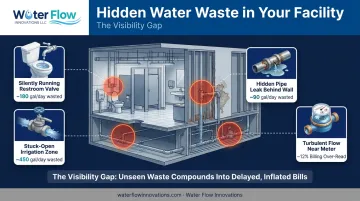
Not all of this hidden cost comes from actual water use, either. Turbulent flow inside the pipe can cause a meter to over-register consumption that never happened, adding a charge you can't see coming and can't fix by changing behavior.
Key Cost Drivers Behind a High Water Bill
Four categories drive most commercial and industrial water costs, and their weight shifts depending on facility type and climate.
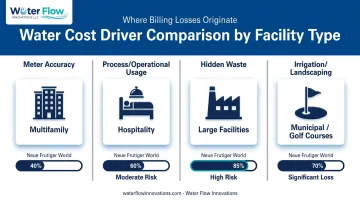
Meter accuracy is often the most overlooked driver. Turbulent flow near meters — caused by elbows, valves, or pump interference — creates air entrainment that makes meters over-register actual usage. This over-reading can inflate bills by 5-46% without any change in real consumption, a problem flow conditioning devices are specifically designed to correct.
Process and operational usage matters most for facilities like food & beverage plants, hotels, and healthcare centers. Laundry, kitchens, cooling towers, and cleaning cycles can account for the bulk of daily consumption, and inefficient equipment compounds the cost.
Hidden waste — leaks, running fixtures, degraded seals — adds up quietly across large facilities. It's invisible until someone goes looking for it, and by then it may have inflated months of billing.
Outdoor irrigation and landscaping can also spike costs for campuses, golf courses, and municipal properties, sometimes reaching 60-70% of total use during hot months, according to the EPA's WaterSense program. Sewer charges compound all of this since they're often billed at the same rate as water use, doubling the impact of any inefficiency.
Which driver matters most depends on your facility type:
- Hospitality and food & beverage facilities: process and operational usage usually dominates
- Multifamily and high-rise buildings: meter accuracy and measurement precision matter most
- Municipal, campus, and golf course properties: outdoor irrigation and sewer surcharges carry the most weight
Cost-Reduction Strategies for Lowering Your Water Bill
Strategies fall into three tiers: free habit changes, one-time equipment investments, and structural fixes. Not every household needs all three — but most benefit from at least the first two.
Strategies That Reduce Costs by Changing Daily Habits
These cost nothing and start saving immediately:
- Turn off the tap while brushing teeth or shaving, saving up to 8-10 gallons per use
- Shorten showers and shut off water while lathering (the average shower already runs 8 minutes and over 16 gallons)
- Run full loads only in dishwashers and washing machines since full dishwasher loads alone save roughly 320 gallons a year
- Skip unnecessary flushing and go easy on the garbage disposal
- Water outdoors early morning or evening to cut evaporation loss
None of these require spending a dollar. They just require consistency.
Strategies That Reduce Costs Through Fixtures, Appliances, and Detection
This tier requires upfront cost but pays back over time — often within a year or two.
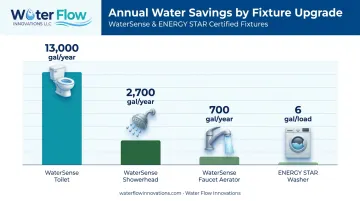
| Upgrade | Typical Saving |
|---|---|
| WaterSense toilet | ~13,000 gal/year (vs. old inefficient models) |
| WaterSense showerhead | ~2,700 gal/year |
| WaterSense bathroom faucet aerator | ~700 gal/year |
| ENERGY STAR washer | 14 gal/load vs. 20 gal/load standard |
Beyond fixtures, leak detection deserves real attention. The EPA estimates the average household leaks waste more than 9,300 gallons a year, and roughly 9% of homes have leaks losing 50+ gallons daily.
Run the two-hour meter test:
- Turn off every faucet and water-using appliance in the house
- Record your water meter reading
- Wait two hours without using any water
- Check the meter again : any movement means a leak
If you'd rather not wait, consider a leak detection device that flags abnormal flow or auto-shuts off water when something's wrong.
Strategies That Reduce Costs by Addressing the System Around Your Water Bill
Sometimes the problem isn't your usage at all. It's the system measuring it, or the landscape feeding your bill.
Landscaping and irrigation:
- Replace thirsty turf with drought-tolerant or xeriscape plants
- Install smart irrigation controllers that adjust automatically to weather
- Check municipal rebate programs : Austin Water offers up to $3,000 for landscape conversions, and Southern Nevada Water Authority pays $5 per square foot for the first 10,000 square feet of turf removed
Multifamily, HOA, hotel, and commercial properties have a factor most homeowners never consider: the water meter itself.
Here's what happens. Water meters measure total volume passing through; they can't distinguish liquid water from air. When water travels more than 30 feet through a pipe, it naturally becomes turbulent.
Pressure changes from pump cycling, valve operation, or demand spikes introduce air and micro-bubbles into the line. Meters count that air as billable water, even though it was never delivered.
A second mechanism compounds this: turbulent vortex flow. Displacement and turbine meters are built to measure steady, laminar flow. When water spins chaotically through the measurement zone, a common occurrence during high-frequency cycling like irrigation starts or wash cycles, the meter over-counts volume relative to what actually passed through.
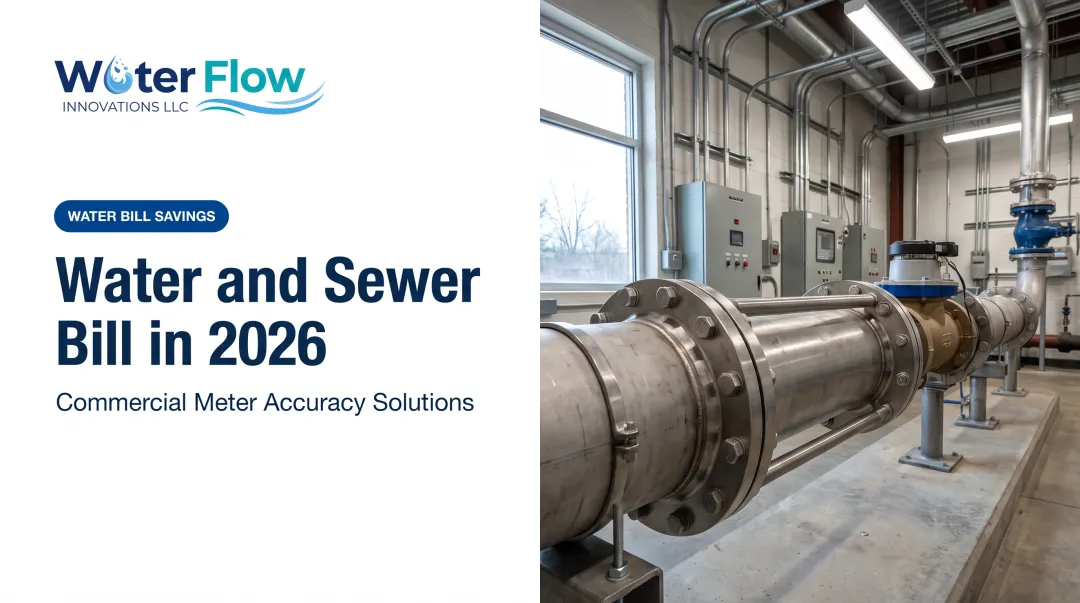
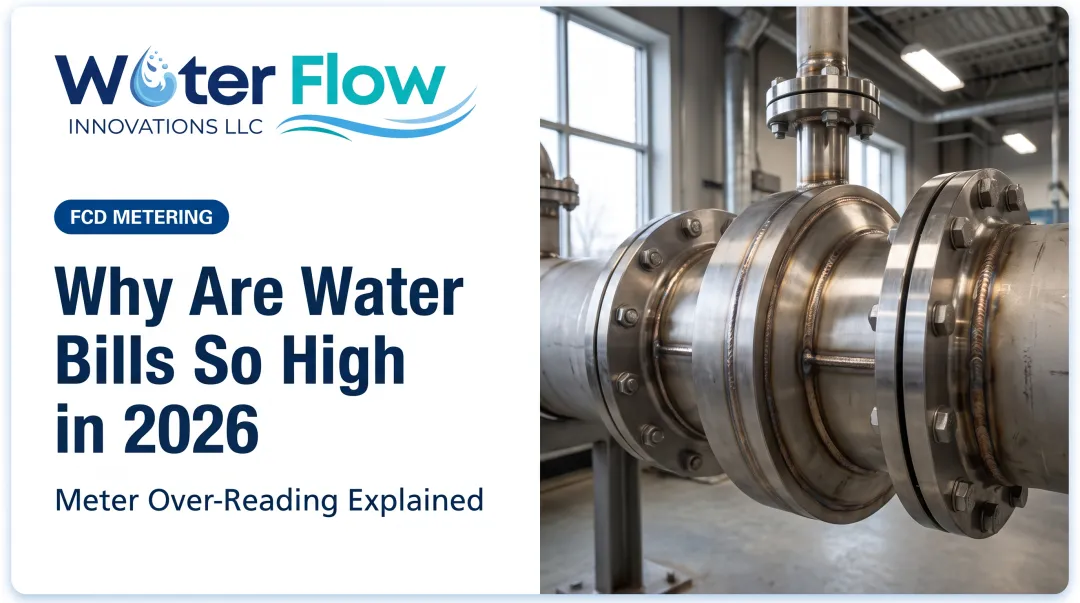
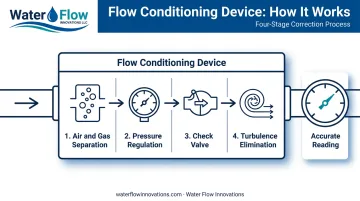
Water Flow Innovation's Flow Conditioning Devices (FCDs) are built to correct both of these issues. The device installs right after the meter and uses a four-part system:
- Air and gas separation : creates back-pressure that stabilizes flow into a homogeneous water column at the meter
- Pressure regulation : smooths the surges that trigger air entrainment in the first place
- Check valve : blocks reverse flow, which would otherwise reintroduce air
- Turbulence elimination : slows velocity just enough to prevent vortex formation, without reducing overall flow
The result: the meter reads actual water, not a mix of water and air. Properties typically see 5-30% average reductions in water and sewer charges, with a documented high of 46% in extreme cases, and no change to water pressure, usage, or operations. About 90% of customers hit full ROI within 12 months. Installation takes roughly one hour, with the only disruption being a brief water shutoff.
This applies broadly. Multifamily buildings correct it at the master meter with zero tenant impact. HOAs see it lower resident assessments, while hotels fix the issue without touching guest experience.
One more low-effort habit: for larger households or shared properties, compare your usage against similar-sized households through your utility's app or usage reports. Abnormal spikes get flagged faster this way.
Water-Saving Trends and Tools to Watch in 2026
A few shifts are changing how facilities manage water costs this year.
Smart monitoring is going mainstream. Real-time usage apps and flow-monitoring devices alert you to leaks or spikes as they happen, rather than making you wait for the bill. The global smart water metering market hit $6.8 billion in 2024, representing more than 20% of utility digital spending. Utility-side investment is clearly accelerating, though household adoption still lags.
Rebate and budget-billing programs are expanding. As rates climb, more utilities are rolling out landscape rebates, fixture rebates, and payment-smoothing programs. It's worth checking with your local provider annually since eligibility and funding change.
Beyond rebates, another shift is changing how facilities document their water performance: meter accuracy is entering sustainability reporting. Commercial, multifamily, and municipal properties increasingly use verified before-and-after utility bill reductions as documentation for LEED credits, ENERGY STAR scores, and ESG water intensity disclosures.
Flow Conditioning Devices (FCDs), like those installed by Water Flow Innovation, make this easier. Because FCD savings show up directly on standard billing records, facilities don't need separate measurement infrastructure to support certification review. That's a real advantage for asset owners tracking sustainability metrics alongside cost control.
Conclusion
Lowering your water bill meaningfully starts with figuring out where the cost is actually coming from: habits, aging fixtures, a hidden leak, or a measurement problem you can't see. Guessing wastes money.
The most effective approach layers all three:
- Daily habits — free behavioral changes that deliver immediate impact
- Fixture upgrades — targeted investments that create lasting reduction
- Meter accuracy — a factor multifamily, HOA, hotel, and commercial properties often overlook entirely
Combined, these compound into real, lasting savings instead of a one-time dip. If a measurement problem is inflating your bill, Water Flow Innovation offers a free water bill review to check for meter over-reading before you spend on anything else.
Frequently Asked Questions
Can you actually make your water bill cheaper?
Yes. Combining habit changes, fixture upgrades, and leak checks can meaningfully reduce most household water bills. Savings compound as multiple fixes work together over time.
Why did my water bill suddenly get so much higher?
Sudden spikes usually trace back to hidden leaks, a broken irrigation valve, seasonal outdoor watering, or a municipal rate hike. Check your water meter's leak indicator first before assuming it's usage-related.
What is a typical monthly water bill for a home or small facility?
The national average sits around $95 a month for combined water and sewer service, though this varies by region, usage, and local rate structures. Commercial facilities see far higher totals, and meter over-registration can quietly inflate them further. Check with your local utility for area-specific averages.
How can I tell if I have a hidden water leak?
Run the two-hour meter test: turn off all water use, record the meter reading, wait two hours, then check again. Any movement signals a probable leak, and unexplained bill spikes are another warning sign worth investigating.
Do water-saving fixtures really make a noticeable difference?
Yes. WaterSense-certified toilets alone can save around 13,000 gallons a year compared to old inefficient models, and efficient showerheads and faucets add further savings over the course of a year.
Is my water meter itself ever the reason my bill is high?
Yes, particularly in commercial and multifamily settings. Meters can over-register usage due to air entrainment and turbulent flow, but certified flow conditioning devices, like those built by Water Flow Innovation, correct this without changing actual water use.
How disruptive is a meter-side correction to fit?
Minimal. A licensed plumber or mechanical contractor installs the custom-built device at the supply connection in about an hour, with a brief water shutoff at the meter connection, and savings appear on the very next billing cycle.
Is flow conditioning a filter, softener, or pressure valve?
None of those. Filters and softeners change what is in the water; a pressure reducing valve changes what pressure reaches your fixtures. Flow conditioning changes only how the water moves so the meter measures accurately, leaving chemistry and pressure untouched.