Many facility managers struggle with a system that generates, distributes, and returns steam without any real visibility into where the losses happen. The Department of Energy estimates that system improvements can reduce a typical industrial steam system's energy costs by 10% to 15% — savings most plants leave on the table every year.
Rising fuel prices, tightening ESG disclosure rules, and aging infrastructure are pushing steam efficiency back onto the priority list. This guide walks through the four pillars of steam system optimization, the thermodynamics behind pressure reduction, the digital tools reshaping maintenance, and how the same audit mindset can uncover savings on your water bill too.
Key Takeaways
- Failed steam traps, bare piping, and lost condensate cause most steam system energy waste
- Trap monitoring, condensate recovery, insulation, and boiler tuning deliver the fastest ROI
- Lowering steam pressure to the minimum needed cuts fuel use and equipment wear
- IoT sensors and wireless monitors now replace annual surveys with real-time failure detection
- Boiler feedwater meters can over-read too, adding hidden water costs to steam operations
What Is Steam System Optimization and Why It Matters
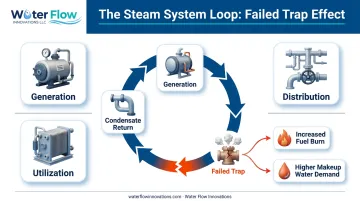
A steam system runs through four stages:
- Generation – the boiler produces steam
- Distribution – piping and valves carry it to equipment
- Utilization – process equipment consumes the steam
- Condensate return – hot water flows back to the boiler
Inefficiency at any single stage doesn't stay isolated. It compounds through the rest of the loop.
A failed trap in distribution wastes live steam. That waste forces the boiler to work harder. Harder boiler operation means more fuel burned and more makeup water pulled from the municipal supply. One weak link drags down the entire system. Trap replacement and condensate return optimization, two of Water Flow Innovation's steam repair services, stop this cascade before it reaches the boiler.
The scale here is bigger than most people assume. U.S. manufacturers consume roughly 4,762 trillion Btu of steam energy annually, equal to about 40% of total industrial process energy, according to DOE analysis of manufacturing energy data. In sectors like forest products, steam accounts for as much as 76% of onsite energy use.
An unoptimized system costs more than fuel. It also creates:
- Higher water and sewer bills from excess makeup water demand
- Safety hazards from failed traps, condensate hammer, and pressure stress on aging fittings
- Missed opportunities to document verified reductions for ESG and compliance reporting
The Four Pillars of Steam System Optimization
These four areas don't operate independently : they compound each other. Fix your traps, and you reduce condensate waste. Recover more condensate, and the boiler works less. Insulate distribution lines, and you cut radiant losses. Tune the boiler, and every pound of steam you generate costs less fuel.
Steam Trap Monitoring and Maintenance
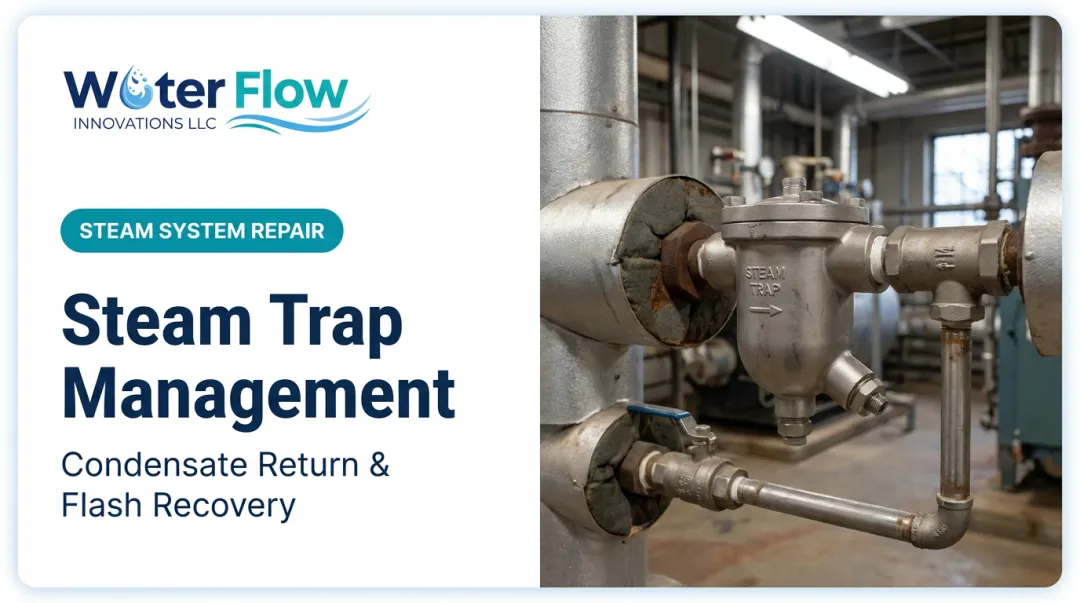
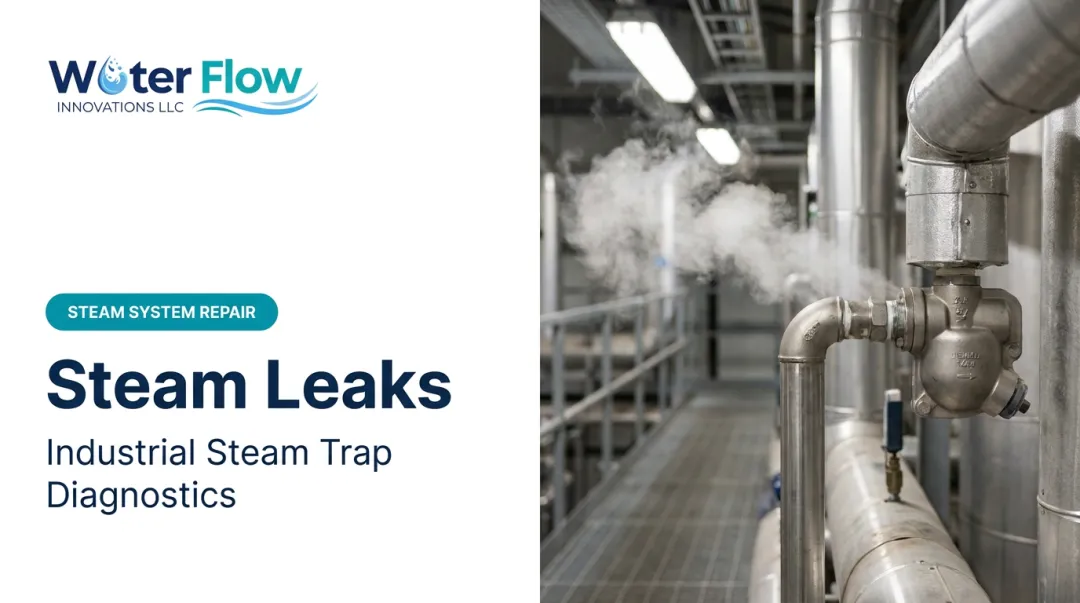
Steam traps fail two ways: stuck open, where live steam blows straight through into the condensate system, or stuck closed, where condensate backs up and floods steam lines, a direct setup for condensate hammer.
The scale of this problem surprises most plant managers. In systems left unmaintained for three to five years, 15% to 30% of installed traps may be in a failed state, per DOE's steam best-practices documentation. Water Flow Innovation sees similar patterns across the industrial facilities it assesses, with roughly 25-35% of traps failed at any given time. Those failures stay invisible without proper survey equipment.
A single failed trap adds up fast. DOE's own worked example shows a failed trap on a 150-psig line with a 1/8-inch orifice can lose over 75 pounds of steam per hour, a loss that runs into thousands of dollars annually once fuel cost and operating hours are factored in.
Recommended detection method:
- Ultrasonic testing to detect the acoustic signature of steam passing through a failed trap
- Infrared thermography to visualize temperature differentials across the trap body
- Combined survey approach, since each method catches failure modes the other can miss
Water Flow Innovation's Steam Trap Survey & Replacement service pairs both ultrasonic and thermal imaging during the initial site assessment, then runs a post-repair verification survey to confirm every replacement actually fixed the leak. That combination is standard practice because trap failures genuinely don't show up any other way.
Condensate Recovery
Condensate is treated water that still carries heat you already paid to generate. DOE estimates condensate can retain more than 10% of a system's total steam energy content, returning at 130-225°F compared to 50-60°F for cold makeup water.
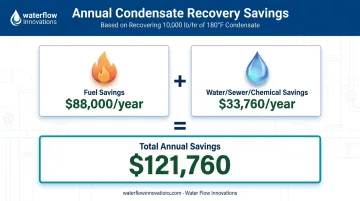
The financial case is concrete. In one DOE modeled example, returning an additional 10,000 lb/hr of 180°F condensate produced $88,000 a year in fuel savings plus roughly $33,760 in water, sewer, and chemical treatment savings. Together, that's a combined $121,760 annually from a single system improvement.
Every gallon of condensate lost to drain forces the boiler to pull fresh makeup water, which registers on your municipal meter and drives up both water and sewer charges simultaneously. Water Flow Innovation's condensate recovery service(covering receiver and pump installation, return line repair, and flash steam recovery) is built around exactly this compounding relationship between fuel, water, and sewer costs.
Insulation Upgrades
Bare or degraded insulation on pipes, valves, and traps radiates heat directly into the plant instead of into your process. DOE data shows insulation can typically cut steam distribution losses by 90% when applied to surfaces above 120°F.
The numbers on bare pipe are stark: a single uninsulated 1-inch, 150-psig line loses an estimated 285 MMBtu per year for every 100 feet of run. Multiply that across a plant with hundreds of feet of exposed piping, valves, and flanges, and the fuel waste becomes significant. Payback varies by pipe size and insulation type, so a site-specific calculation (DOE's 3E Plus tool is the industry standard) beats a generic estimate every time.
Boiler Efficiency Tuning
Combustion tuning, O2 trim, blowdown management, and economizers each add measurable efficiency gains on their own:
- Combustion tuning: Roughly 1 percentage point of efficiency gain for every 15% reduction in excess air, or every 40°F drop in stack temperature
- O2 trim: Continuously feeds flue-gas oxygen data back to burner controls, minimizing excess air automatically
- Blowdown management: Typical blowdown runs 4-8% of feedwater flow; automated control can trim this toward the lower end
- Economizers: Often reduce fuel requirements by 5-10% by recovering flue-gas heat to preheat feedwater
In one DOE case, combustion tuning alone raised efficiency from 78.2% to 83.1%, saving nearly 30,000 MMBtu a year.
Pressure Optimization: What Happens When Steam Pressure Is Reduced
Steam pressure and saturation temperature are directly linked. Higher pressure means higher saturation temperature but lower latent heat of evaporation. Lower pressure requires less energy and less fuel to generate the same pound of steam.
Reducing pressure delivers several compounding benefits:
- Less flash steam loss when condensate discharges through traps
- Reduced radiation and distribution losses across piping runs
- Lower mechanical stress on pipes, valves, and fittings
- Extended equipment life from reduced pressure cycling
DOE identifies four separate mechanisms through which pressure reduction saves energy: lower steam enthalpy, reduced boiler radiation and convection loss, lower leakage rates, and reduced flash steam loss. That said, no universal "cut pressure by X% and save Y%" figure exists in the research. Results depend entirely on your current pressure, load profile, and boiler efficiency.
Trade-offs to plan around:
Not every process can drop pressure without adjustment. Processes requiring a specific temperature or heat transfer rate may need larger heat exchanger surfaces or longer dwell times before pressure reduction becomes viable.
Practical steps to get there:
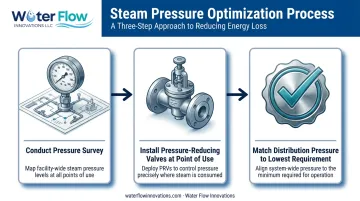
- Conduct a steam pressure survey across the full distribution system to map current operating pressures at every point of use
- Install pressure-reducing valves at the point of use rather than running the entire distribution system at the highest pressure any single process needs
- Match distribution pressure to the lowest level any downstream process genuinely requires, then verify performance before locking it in
Facilities running the same header pressure everywhere, often because it's what a process needed decades ago, are usually the best candidates for a pressure survey. Steam system repair providers, including Water Flow Innovation, offer trap replacement and condensate return optimization services that directly support this kind of pressure-reduction work.
Digital Monitoring and Predictive Maintenance for Steam Systems
Traditional steam trap surveys happen once a year. A trap can fail the day after a survey and run undetected for eleven months, silently wasting fuel the entire time.
Wireless IoT sensors and AI-powered dashboards change that math. Continuous monitoring catches trap failures within days instead of months, tracking condensate return rates and boiler cycling patterns in real time rather than through periodic snapshots.
DOE recommends testing frequency scale to system criticality:
- Weekly to monthly for traps on lines at or above 150 psig
- Monthly to quarterly for 30-150 psig systems
- Annually for systems below 30 psig, with online monitoring reserved for the most important traps
These guidelines hold up in real deployments. One documented wireless monitoring project on 76 high- and medium-pressure traps at a hospital campus reported average steam consumption dropping by 4,000 lb/hr. The project paid for itself in under a year, showing how much a single annual survey can miss.
Feeding this data into a CMMS or energy tracking platform turns raw sensor readings into a documented trail your finance team can use for budgeting and your sustainability team can use for ROI reporting. When sensors flag a failed trap, pairing the alert with a repair specialist such as Water Flow Innovation closes the loop between detection and fix.
Sustainability, ESG Reporting, and the Hidden Water Savings Opportunity
Fuel burned in boilers you own or control counts as Scope 1 stationary combustion under EPA reporting guidance. Facilities crossing 25,000 metric tons of CO2e annually generally fall under mandatory GHGRP reporting, and every documented steam efficiency gain feeds directly into a lower fuel-consumption figure for that inventory.
Here's what most steam optimization plans miss: the water side of the same system.
Those same meters are prone to a completely separate problem: over-reading caused by turbulence and entrained air, unrelated to actual steam losses.
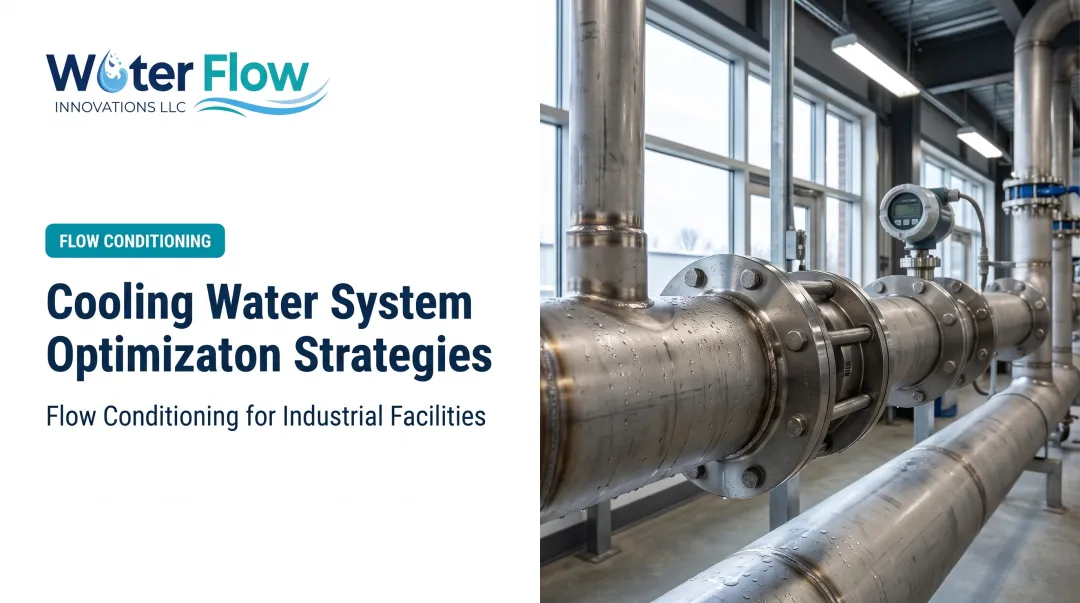
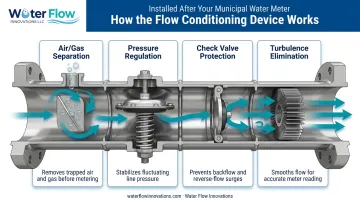
This is where Water Flow Innovation's certified Flow Conditioning Device (FCD) comes in. The FCD installs immediately after the municipal meter and corrects over-reading through four integrated components:
- Air and gas separation, ensuring only actual water, not entrained air, registers on the meter
- Pressure regulation, smoothing the surges caused by CIP cycles, boiler cycling, and variable demand
- Check valve protection, preventing reverse flow from reintroducing air after it's been removed
- Turbulence elimination, converting vortex flow into laminar flow through the measurement zone
Installation takes about 1-2 hours with negligible pressure loss to downstream systems, including boiler makeup water lines. Documented results across Water Flow Innovation's customer base show average water and sewer bill reductions of 5-30%, with a highest recorded result of 46%, and 90% of customers reaching full ROI within 12 months.
Because the FCD's savings show up as verifiable, before-and-after utility bill data, they satisfy the same documentation standards steam optimization projects target. These include LEED water efficiency credits, ISO 14001, CDP water disclosures, and ENERGY STAR scoring.
The practical recommendation: pair your steam system audit with a water metering accuracy check. One addresses fuel-side losses. The other addresses meter-side over-reading. Run together, they build a genuinely complete utility-cost-reduction strategy instead of a partial one.
Frequently Asked Questions
What happens when steam pressure is reduced?
Lowering steam pressure reduces the latent heat (and fuel) needed to generate steam, while also cutting flash steam and radiation losses. Downstream processes must still be able to meet their required temperature and heat transfer needs.
How often should steam traps be inspected in a manufacturing plant?
At minimum, run annual ultrasonic and infrared testing across the trap population. High-pressure lines above 150 psig or critical process lines warrant monthly, or even weekly, checks.
What is the typical ROI for a steam system optimization project?
Trap repair programs often pay back within a year, sometimes faster. Condensate recovery and insulation projects typically return investment within one to three years, depending on site-specific fuel and water costs.
What percentage of condensate should a well-managed steam system recover?
There's no single universal industry benchmark, but facilities recovering less than 70-80% of condensate by mass are leaving meaningful fuel and water savings unrealized. Site-specific factors like contamination and direct steam injection affect the achievable rate.
How does steam system optimization support decarbonization goals?
Reducing boiler fuel use directly lowers Scope 1 stationary combustion emissions, using the same fuel-consumption activity data required for GHG reporting. Lower steam loads also ease the path toward future electrification or renewable heat sources.
Can water metering accuracy affect total utility costs alongside steam efficiency?
Yes. Inaccurate meters can overstate consumption tied to boiler makeup and blowdown water, inflating bills independent of actual steam losses. Correcting this with certified flow conditioning technology adds savings beyond what steam-side efficiency work alone can capture.
What certifications should flow conditioning equipment carry?
Look for recognized potable-water and water-efficiency approvals. The FCD is certified to IAPMO, NSF, ANSI, CAN 61, KIWA, GMP, and SQF, and complies with the EPA WaterSense program. It is built from 316L stainless steel, made in the USA.
Can an optimization program be scaled across several plants?
Yes. Each plant with its own metered municipal connection is a separate installation opportunity, so savings compound across a portfolio. Before-and-after billing evidence can be aggregated for corporate benchmarking, capital planning, and ESG disclosure.