
Facility managers usually catch it in one of two ways: an unplanned pump replacement, or a water bill that doesn't match actual usage. Both are symptoms of the same root problem.
This guide covers what turbulent flow actually is, what causes it, the equipment damage it triggers, and the proven ways to protect your systems — including flow conditioning, a solution that also fixes a costly side effect: meter over-registration.
Key Takeaways
- Turbulent flow accelerates wear on pumps, valves, meters, and fittings, driving up maintenance costs
- Elbows, valves, pumps, reducers, and short straight-pipe runs are the usual sources of turbulence
- Flow conditioners restore a stable profile in a fraction of the straight-pipe length traditional design requires
- Turbulence and air entrainment at the meter can inflate water and sewer bills without any change in actual consumption
What Is Turbulent Flow (and Why It Matters for Equipment)
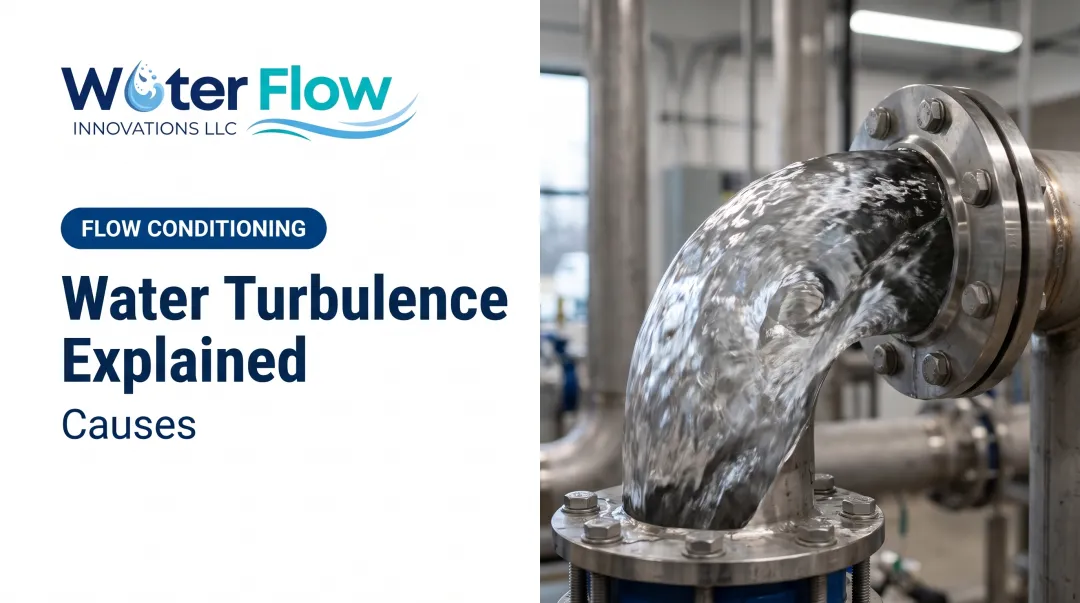
Turbulent flow is chaotic, non-uniform fluid motion: swirling, fluctuating in velocity and pressure, with no repeating pattern. Laminar flow, by contrast, moves in smooth, orderly layers. Think of a calm river versus rapids.
Engineers classify flow regime using the Reynolds number, a ratio of inertial to viscous forces. For circular pipe, the general convention is:
- Below 2,300: laminar flow
- 2,300–4,000: transitional
- Above 4,000: turbulent
These thresholds are useful engineering guidelines, not hard physical laws. Princeton's fluid dynamics research notes that the actual transition point depends on how much disturbance is present in the system.
Turbulence isn't always bad. It's useful for mixing and flushing. But when it shows up uninvited at a pump inlet or water meter, uneven pressure and velocity become a real liability: faster wear, vibration, skewed meter readings, and higher operating costs.
What Causes Turbulent Flow in Piping Systems
Most turbulence in commercial and industrial piping traces back to a handful of mechanical culprits.
Primary sources:
- Elbows and tees that force sudden direction changes
- Valves, strainers, and reducers/expanders that disrupt velocity profiles
- Pump discharges that inject swirl and uneven flow into the line
- Misaligned joints, protruding gaskets, and weld projections that disturb the flow path
Industry guidance from the American Petroleum Institute identifies these fittings, along with piping configuration itself, as primary sources of swirl and nonuniform velocity profiles that affect meter accuracy.
Insufficient straight pipe run compounds the problem. Turbulence needs distance to naturally dissipate before it hits sensitive equipment. Cramped mechanical rooms and retrofit installations often can't provide that length. Older hotels, hospitals, and multifamily buildings feel this most, where pipe runs get squeezed around existing infrastructure.
Fluid-property factors that raise turbulence likelihood:
- Higher velocity, which increases inertial forces in the fluid
- Lower viscosity, which offers less internal resistance to chaotic motion
- Larger pipe diameter, which raises the Reynolds number for the same fluid speed
Any one of these factors can push flow into the turbulent range. Together, they create the swirl and uneven velocity profiles that stress equipment and throw off meter readings downstream.

How Turbulent Flow Damages Equipment
This is where turbulence stops being a measurement footnote and starts costing real money.
Pumps: Uneven Loading and Cavitation Risk
A 2020 study on pump inlet conditions found that a 90-degree elbow upstream of a pump creates swirl and uneven velocity distribution entering the impeller. That leads to operation below best efficiency point, oscillating power draw, vibration, and localized cavitation risk. All of these point to premature bearing and seal wear.
Valves: Chatter and Erosion
When turbulent flow accelerates through a valve restriction, local pressure can drop below the liquid's vapor pressure. Vapor bubbles form and then collapse violently once pressure recovers downstream. Emerson's Control Valve Handbook describes this process as capable of eroding valve trim and damaging adjacent pipe.
Meters: Over-Registration and Inaccuracy
Swirling flow entering a meter distorts the velocity profile the meter is designed to read. Pacific Northwest National Laboratory notes that nearby fittings and valves introduce turbulence that reduces accuracy in most meters. In systems with intermittent supply and entrained air, that inaccuracy skews toward over-registration — meaning the meter reports more water than actually passed through it.
Energy and Throughput Costs
Turbulence-induced pressure drop forces pumps to work harder to maintain flow, according to guidance from the Hydraulic Institute. In food and beverage or pharmaceutical production, that same turbulence can also reduce throughput and create process quality inconsistencies.

Signs turbulence is damaging your equipment:
- Unusual pump vibration or noise
- Valve chatter
- Inconsistent or drifting meter readings
- Rising maintenance frequency on the same components
Proven Methods to Protect Equipment from Turbulent Flow
Fixing turbulence usually comes down to two core approaches: give the flow room to settle, or condition it artificially. Smart layout choices and ongoing monitoring strengthen either path when space is tight or redesign isn’t practical.
Straight Pipe Run (The Traditional Fix)
Meter manufacturers publish specific straight-run requirements. For example, one turbine meter manufacturer's installation guide calls for 4 pipe diameters upstream with a strainer, or 8–10 diameters without one, plus 2–4 diameters downstream. These requirements vary by meter technology, so always follow the manufacturer's tested specification, not a generic rule of thumb.
Mechanical Flow Conditioners
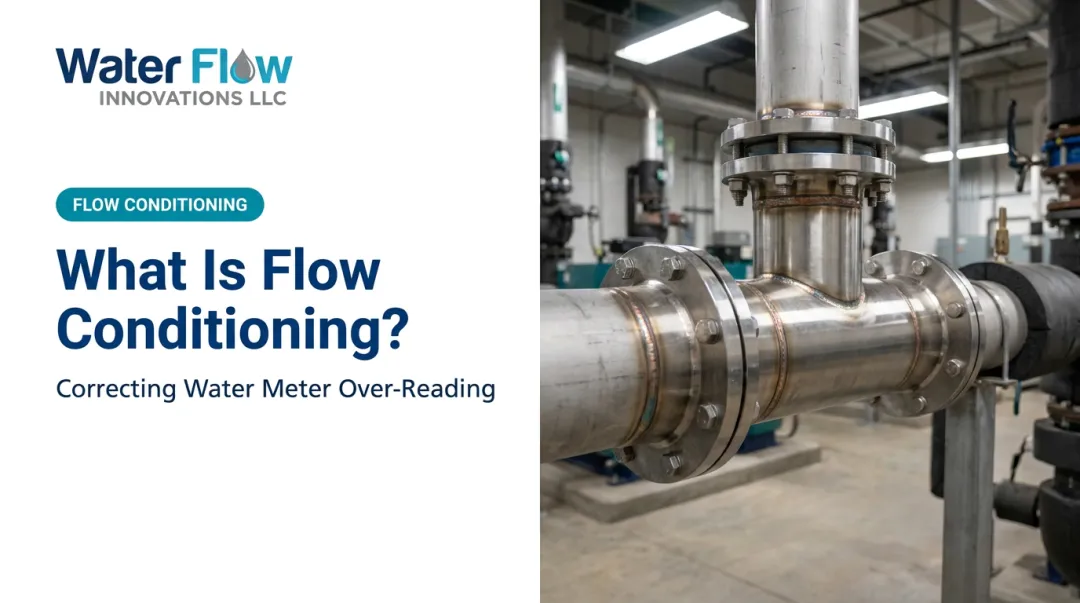
Flow conditioners insert a physical element (tubes, vanes, or perforated plates) into the pipe to strip out swirl and restore a uniform profile in a much shorter section than straight pipe alone would need. One published qualification study showed a conditioner producing fully developed flow in roughly 17 pipe diameters, versus the 100+ diameters severe swirl can otherwise require to dissipate naturally.
Smart Fitting Placement
- Sequence valves, pumps, and fittings to minimize turbulence generation at the source
- Avoid stacking two out-of-plane elbows close together: this combination creates severe swirl that can persist for well over 100 diameters
- Keep strainers and valves as far from meters as the layout allows
Ongoing Monitoring
Vibration analysis and flow profiling catch turbulence-related wear before it becomes a failure. Regular monitoring is especially valuable in facilities with tight pipe runs where redesign isn't practical.
Certified Flow Conditioning Devices
When straight-run length isn’t available, a certified unit can combine several protections in one assembly. Water Flow Innovation offers a Flow Conditioning Device (FCD) built around four components:
- Air/gas separation: creates back pressure that forces entrained air out of the measurement zone, producing a homogeneous water column
- Pressure regulation: stabilizes pressure at the meter entry point, reducing surges and water hammer
- Check valve: prevents reverse flow and pressure spikes (not required in every installation)
- Turbulence elimination: slows velocity enough to prevent vortex formation at the meter
Each FCD is custom-fabricated in 316L stainless steel to match the facility's exact pipe size, meter model, and flange pattern. Sizes range from ½ inch up to 12 inches, with larger and specialty-alloy options available.
It installs immediately after the meter with negligible pressure loss, correcting turbulence and equipment stress without a system redesign.

Turbulent Flow, Water Meters, and Hidden Utility Costs
Here's the mechanism most facility managers never learn until they see it explained: turbulence and air entrainment at the meter cause it to spin faster than actual water flow justifies.
A 2022 peer-reviewed study on intermittent water supply measured meter over-registration equal to 32–62% of incoming water volume during refill events with entrained air. Air and turbulence together push readings well above true usage.
That means your facility can be billed for water it never actually used. No leak. No wasted usage. Just a meter reading of conditions it wasn't designed to measure accurately.
This shows up across facility types:
- Manufacturing plants with cyclical demand
- Hotels with fluctuating guest-room and laundry loads
- Hospitals running continuous equipment cycles
- Multifamily buildings with irregular peak usage
Correcting the Reading with Flow Conditioning
Water Flow Innovation's FCD holds IAPMO, NSF, ANSI, CAN 61, KIWA, GMP, and SQF certifications, covering plumbing code compliance, potable water safety, and food-safety quality standards. It works with any meter type and any standard pipe size (½-inch to 12-inch), and typically installs in about an hour.
Documented outcomes across customer installations:
- 5–30% average reduction in water and sewer bills
- 46% highest documented result
- 90% of customers reach ROI within 12 months

Because the FCD corrects a measurement error rather than reducing actual water use, savings typically show up on the very next billing cycle.
Water Flow Innovation backs the FCD with a 6-month money-back guarantee and a lifetime transferable warranty that stays with the property through ownership or management changes.
Frequently Asked Questions
What does turbulent flow mean?
Turbulent flow is chaotic fluid motion with fluctuating velocity and pressure, unlike smooth, layered laminar flow. Engineers use the Reynolds number to classify which regime a system is in.
What can cause turbulent flow?
Common causes include elbows, valves, pumps, and reducers, along with insufficient straight pipe runs before sensitive equipment. High velocity and low-viscosity fluids also push flow toward turbulence.
How can I tell if turbulent flow is damaging my equipment?
Watch for unusual vibration, valve chatter, inconsistent meter readings, and rising maintenance frequency on the same components. These are the earliest reliable warning signs.
Can flow conditioners really replace long straight pipe runs?
Yes. Certified flow conditioners use internal elements like tubes or vanes to mimic the effect of many pipe diameters of straight run in a much shorter section, saving space without sacrificing accuracy.
Does turbulent flow affect my water utility bill?
Yes. Turbulence and air entrainment at the meter can cause over-registration, inflating water and sewer charges without any real increase in consumption. Correcting the flow profile brings billed usage in line with actual consumption.
How long does it take to install equipment protection like a flow conditioner?
Installation typically takes about an hour, with a brief water shutoff at the meter connection and access needed at the meter location. Most facilities schedule it during a low-impact window with no disruption to daily operations.
What billing improvement follows protecting the meter from turbulence?
Documented installations average a 5–30% reduction in combined water and sewer charges, with a highest documented single result of 46%, from measurement accuracy alone.
What cover protects the investment if results fall short?
A 6-month money-back guarantee on the device purchase price, with installation cost non-refundable, so it can be returned if metered consumption does not measurably fall. A lifetime transferable warranty against manufacturing defects also applies.