For property managers, that translates into a real budget problem. Rising water and sewer costs erode net operating income, complicate expense forecasting, and often get treated as a fixed cost nobody questions.
Here's the uncomfortable truth: high water bills rarely come from actual overuse. They come from billing errors, structural inefficiencies, and a lack of oversight that compounds quietly for months. This guide breaks down where those costs build up, what drives them, and the layered strategies that actually bring them down.
Key Takeaways
- Water bills combine supply, sewer, and demand charges that most facilities only see as one lump total
- Rising municipal rates, undetected leaks, inefficient cooling, and meter over-reading drive most excess cost
- Sewer fees amplify every water-side billing error because they're based on metered intake
- Fixes fall into three categories: decisions, operations, and structural corrections
- Corrections like fixing meter over-reading can show savings on the very next bill
How Costs Around Water Bills Typically Build Up
Commercial water costs rarely show up as a single visible line item. Every bill blends volumetric water charges, sewer fees, and fixed service charges, all stacked across a single billing cycle.
That structure makes cost creep almost invisible. A slow leak in a cooling tower line or a meter quietly over-reading won't spike a bill overnight. It adds a small percentage every month until the overage becomes thousands of dollars a year.
Most facility teams only catch this when:
- Bills spike noticeably compared to prior months
- Lease renewals force a line-by-line review of operating expenses
- Outside audits or ESG reporting requirements demand actual usage data
By the time any of those trigger a review, the facility has often been overpaying for a year or more without anyone noticing.
Key Cost Drivers for Water Bills in Commercial Buildings
Not every dollar on a water bill reflects water a building actually needed. Several drivers inflate costs regardless of how carefully occupants use fixtures.
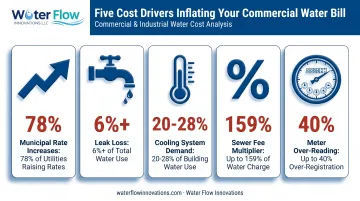
Municipal rates keep climbing. In AWWA's 2023 State of the Water Industry survey, 78% of responding utility executives and managers expected to raise water rates that year, up from 72% in 2022. That's a structural cost increase no facility can negotiate away, only manage around.
Leaks waste more than people assume. EPA guidance puts average facility leak loss at more than 6% of total water use. A single stuck 2.0 gpm tempering line can waste 86,400 gallons a month, adding roughly $11,500 a year to a bill without anyone touching a faucet.
Cooling systems consume a disproportionate share. For office buildings, heating and cooling processes account for an estimated 28% of total water use; for hospitals, around 20%. Poor blowdown control and low cycles of concentration in cooling towers waste makeup water that a few operational tweaks could recover.
Sewer fees double every mistake. Many utilities bill sewer as a percentage, or multiple, of metered water intake. Chicago bills sewer at 100% of the water charge; New York City's current rate table lists sewer at 159% of water. A 10% water billing error isn't a 10% mistake: it's closer to 20–25% once sewer is added.
Meter over-reading is the most overlooked driver. Independent lab studies confirm that air entrainment during pipe refilling and turbulence from upstream flow disturbances can cause meters to register more volume than actually passed through. In one modeled case, over-registration exceeded 40% under specific installation conditions. This isn't universal, but where it happens, it's invisible on the bill and easy to mistake for "high usage."
| Facility Type | Dominant Cost Driver |
|---|---|
| Office buildings | Cooling/HVAC water use, fixture leaks |
| Manufacturing plants | Cooling towers, process water cycling |
| Hotels & hospitality | Combined kitchen, laundry, and HVAC cycling |
| Multifamily buildings | Fixture demand, booster pump systems |
Cost-Reduction Strategies for Reducing Commercial Water Bills
Cost-Reduction Strategies for Commercial Water Bills
Effective cost reduction depends on correctly identifying whether a cost comes from a decision, an operational habit, or a structural/contextual issue. Fixing the wrong layer wastes time and budget. A rate audit won't stop a leaking cooling tower, and new fixtures won't fix a meter reading air as water.
Strategies That Reduce Costs by Changing Decisions
These are choices made before water is even used: fixtures, lease terms, and billing setup.
- Upgrade to WaterSense-certified fixtures. Low-flow toilets, faucets, and showerheads typically pay back their cost within a reasonable timeframe through reduced consumption alone.
- Shift lease structures toward submetering. Moving tenants from master-metered billing to submetered or RUBS-based allocation creates direct usage accountability instead of spreading costs evenly regardless of behavior.
- Run a full water-use audit before annual budgeting. This surfaces outdated fixture inventories and billing tier errors before they compound into next year's budget.
- Review your rate classification. Renovations, tenant mix changes, or added square footage can leave a property billed under an outdated (and costlier) tariff code without anyone flagging it.
Strategies That Reduce Costs by Changing How Water Is Managed
Operational management determines whether inefficiencies get caught in week one or persist for a year.
- Deploy real-time monitoring or submetering. Advanced metering has caught continuous flow near 140 gallons per hour running unnoticed for 48 hours, something a monthly bill would miss.
- Build a proactive leak detection schedule. One school district found more than 400 leaks, including a cooling-system leak wasting 1,000 gallons an hour. Reactive fixes miss that volume for months.
- Optimize cooling tower cycles of concentration. EPA guidance shows raising cycles from three to six can cut cooling-tower water use by roughly 20% with conductivity-based blowdown controls and dedicated makeup/blowdown meters.
- Train on-site staff to flag anomalies. The people walking the building daily are often the first to notice a running toilet or a dripping valve, if they know to report it.
Strategies That Reduce Costs by Changing the Context Around Water Use
In some buildings, the larger cost driver is how water is measured and priced, not how much is used.
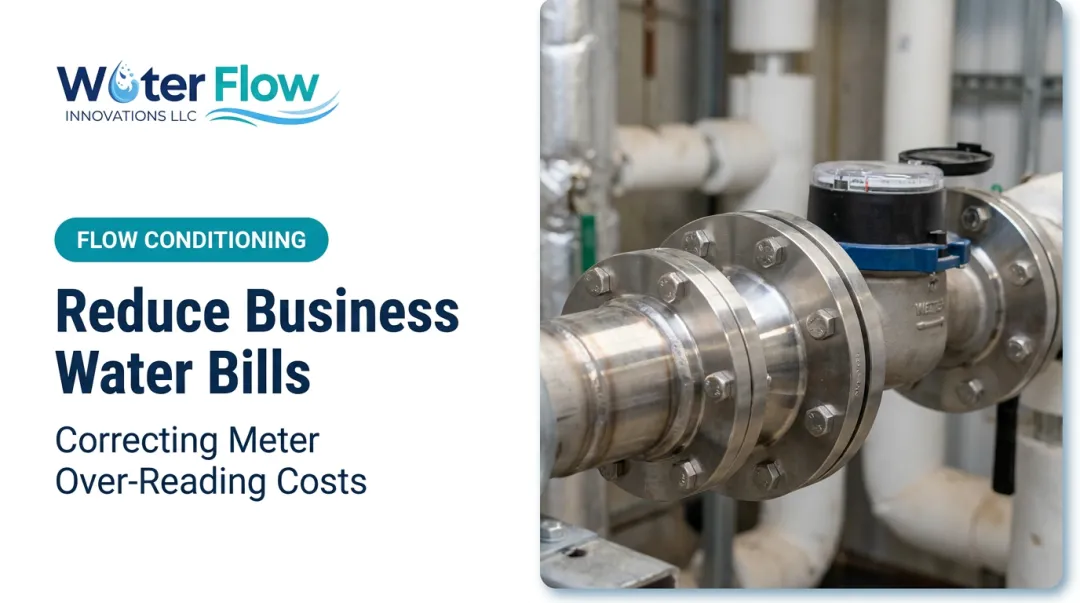
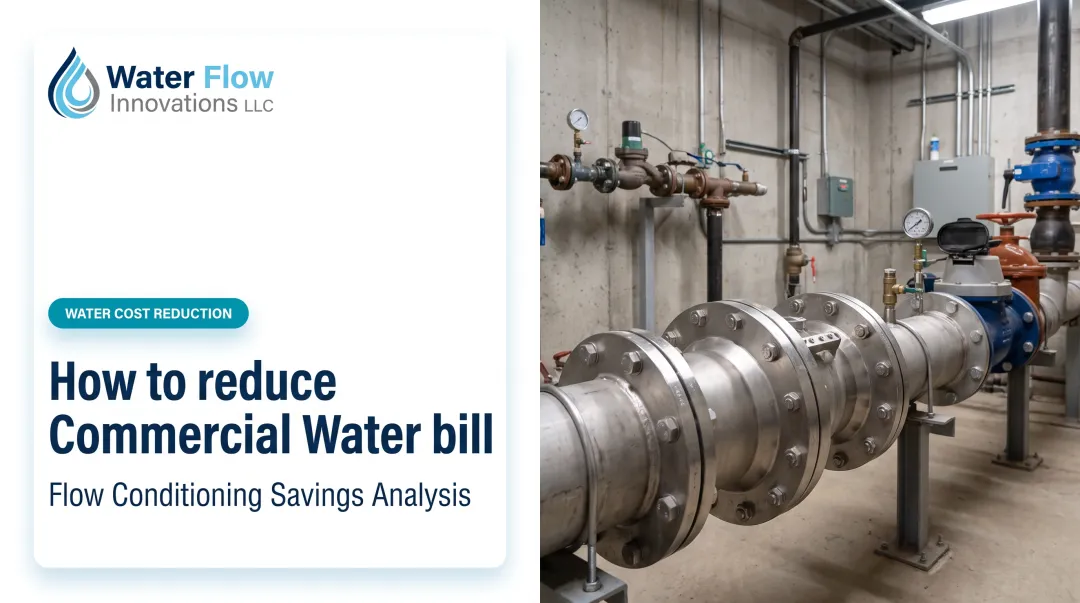
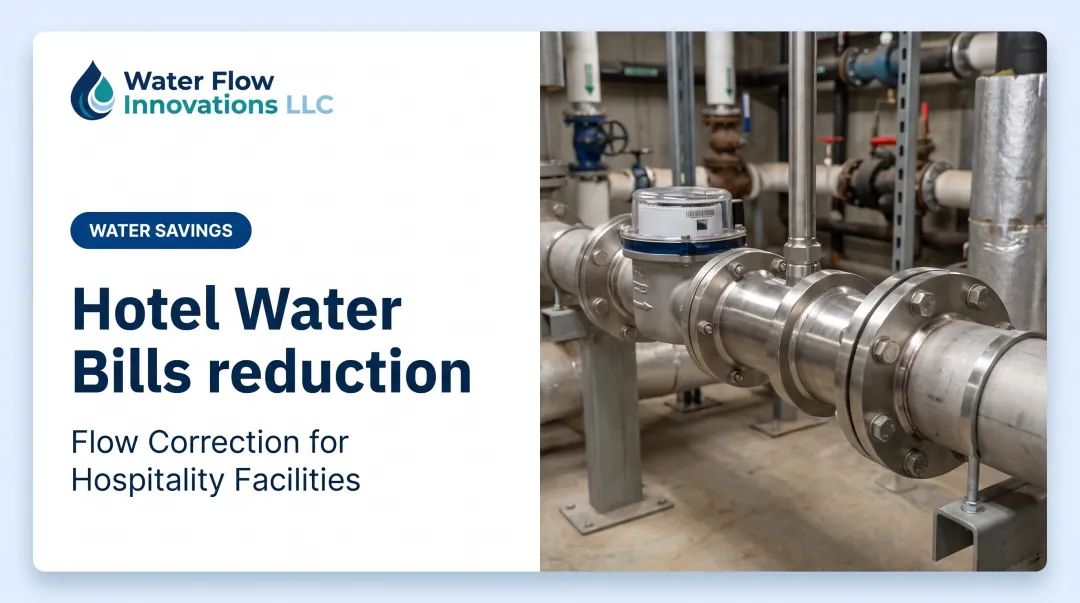
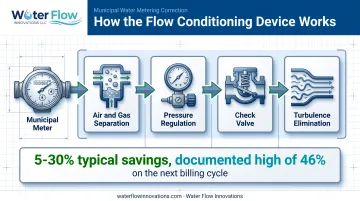
Correcting meter over-reading falls squarely in this category, and it's where Water Flow Innovation's Flow Conditioning Device (FCD) does its work. The FCD installs directly after the municipal meter and addresses the root causes of inflated readings through four coordinated components:
- Air and gas separation: creates a homogeneous water column so the meter measures only actual water, not entrained air
- Pressure regulation: smooths surges from cooling towers, CIP cycles, and irrigation starts that force air into the line
- Check valve (on select units): blocks reverse flow and pressure spikes that let air re-enter after purging
- Turbulence elimination: slows velocity just enough to convert chaotic vortex flow into laminar flow
Because the correction happens at the meter rather than in usage habits, facilities typically see 5-30% reductions in combined water and sewer charges on the next billing cycle, with a documented high of 46%. Standard installations take about an hour, with negligible pressure loss and no disruption to cooling systems, kitchens, or process lines.
Each unit is custom-fabricated for the site (½" to 12" / DN20-DN500) in 316L stainless steel, with IAPMO, NSF, ANSI, CAN 61, KIWA, GMP, and SQF certifications. Coverage includes a 6-month money-back guarantee and a lifetime warranty that transfers with the property.
Beyond meter correction, other contextual fixes worth pursuing:
- Pursue utility rebates for fixture upgrades or submetering through resources like the EPA's WaterSense Rebate Finder
- Document savings for ESG and LEED reporting. LEED's indoor water-use reduction prerequisite requires a 20% aggregate reduction from baseline, and LEED-certified U.S. office buildings have been associated with rent premiums in industry analyses
- Order a third-party bill audit to catch misclassified tariffs that persist no matter how efficient your fixtures or operations become
Conclusion
Reducing commercial water bills starts with correctly diagnosing where the cost actually comes from. Fixture upgrades won't fix a meter that's registering air as water. A rate classification audit won't stop a cooling tower leak.
The most durable results come from working all three layers together: decision-level changes set the foundation, operational management sustains the savings day to day, and structural corrections (like fixing meter over-reading) often unlock the fastest, most verifiable results. Those fixes can show up within a single billing cycle.
Start with a clear read on where your cost actually sits, then apply the layer that matches the problem.
Frequently Asked Questions
What runs your water bill up the most in commercial buildings?
High-consumption fixtures, undetected leaks, inefficient cooling systems, and water meter over-reading are the biggest drivers. Sewer fees compound all of these since they're billed from the same metered intake.
How can commercial buildings reduce water bills without changing usage habits?
Fixing meter over-reading, auditing billing and rate classifications, and optimizing cooling tower cycles all lower bills without requiring occupants to change how they use water.
What is water meter over-reading and how does it affect commercial water bills?
Meters can register more volume than actually flows through them due to air entrainment or turbulent flow. Properties then pay for water they never received, plus an inflated sewer charge on the same error.
How quickly can commercial properties expect to see water cost savings?
Fixture upgrades and leak repairs typically show results within one to two billing cycles. Flow conditioning corrections for meter over-reading can show savings on the very next bill.
How much can a commercial building typically save on its water bill?
Operational, billing, and system-level measures typically deliver 5-30% savings, with documented cases as high as 46%.
Does reducing water usage help with ESG or LEED certification?
Yes. Documented water reductions can satisfy LEED indoor water-use reduction thresholds and support ESG disclosures, especially when verified through actual utility bill records.
Can a landlord apply this across an entire property portfolio?
Yes. Every asset with its own metered municipal connection is a separate installation opportunity, so savings compound across the portfolio and buildings can be ranked by consumption volume. The lifetime transferable warranty follows each building through a sale.
What tells an asset manager a building is a candidate?
Metered consumption that no longer tracks with occupancy, sewer charges disproportionate to actual discharge, several demand sources sharing one connection, and charges that stayed high after the utility replaced the meter.