
Turbulence, air entrainment, and pressure surges don't just create operational headaches. They actively distort meter accuracy, which means facilities can pay for water they never actually used.
This guide breaks down what causes flow instability and the proven techniques — mechanical and certified — that bring it back under control. It's written for facility managers, plant engineers, and operations teams running high-water-use sites in manufacturing, food & beverage, healthcare, and hospitality.
Key Takeaways
- Flow instability stems from turbulence, air entrainment, pressure surges, and pipe/meter sizing mismatches
- Stabilization ranges from mechanical devices (PRVs, check valves) to conditioning equipment that removes turbulence at the source
- Unstable flow stresses equipment and inflates water and sewer bills through meter over-reading
- Certified flow conditioning can stabilize flow and cut utility costs simultaneously
What Causes Process Water Flow Instability?
Turbulence From Pipe Geometry
Flow regime comes down to the Reynolds number, the ratio of inertial to viscous forces in a moving fluid. Below roughly Re 2,000, flow stays laminar and predictable. Above Re 4,000, it's fully turbulent, per UTA Applied Fluid Mechanics. Between those numbers, flow is transitional and unstable.
Bends, valves, tees, and diameter changes all disrupt the velocity profile. Because electromagnetic and ultrasonic meters infer volume from velocity, a distorted profile at the measurement point can throw off readings entirely.
Air and Gas Entrainment
Air enters process water systems more often than most teams realize:
- Trapped air at system startup that never gets purged
- Dissolved air releasing as temperature rises or pressure drops
- Vacuum conditions pulling air in through loose fittings or pump seals
A 2022 peer-reviewed study in AQUA on intermittent water supply found air discharge through meters reached 424.5% to 1,403.2% of the meter's rated overload flow (Q4). Measured over-registration hit 0.86 m³ against roughly 1.50 m³ of initial system air. That's a massive distortion, and it happens because turbine-style meters respond to air velocity and density, not just water volume.

Pressure Fluctuations and Water Hammer
Pump cycling, sudden valve closures, and demand swings all generate pressure transients. Per the Hydraulic Institute, water hammer is a surge pressure event after a sudden change in liquid velocity (pump shutdown, valve closure, or flow blockage). Left unmanaged, these surges stress fittings, valves, and meters over time.
Pipe and Meter Sizing Mismatches
Oversized meters are common across North American utilities, and oversizing typically causes under-registration at low flows, an effect that worsens as meters age. Undersized piping, by contrast, accelerates velocity and increases turbulence. Either mismatch pushes flow outside the range where meters read accurately.
Those same conditions show up on the utility bill. Water Flow Innovation's internal data shows flow-measurement inaccuracy from entrained air and turbulence typically drives a 5–30% overstatement on water and sewer bills, with 46% the highest documented single case. Since sewer charges are often billed off metered water volume, one distortion effectively doubles into two inflated line items.

Core Techniques for Stabilizing Process Water Flow
Stable process water flow comes from fixing each disruption source on its own terms. The techniques below target swirl, pressure spikes, entrained air, reverse flow, and demand swings.
Flow Conditioning and Straightening
Flow conditioners use internal vanes or tube bundles to strip swirl and asymmetry from the velocity profile at the meter or sensitive process equipment. ASME-published testing on an optimized conditioner design confirmed it attenuated both swirl and asymmetric flow simultaneously. In constrained pipe runs where there isn't room for long straight sections, conditioners matter even more.
Pressure Regulation and Surge Control
Pressure-reducing valves (PRVs) maintain consistent downstream pressure even as supply pressure fluctuates upstream. They're covered under ASSE 1003/CSA B356, the governing standard for potable-water PRVs.
For sudden transients, facilities typically add:
- Surge tanks or air chambers: compressible air pockets absorb pressure spikes like a spring
- Water hammer arrestors: dedicated devices that cushion shock at fixture or equipment connections
- Transient modeling: AWWA recommends modeling operating procedures to select the right mitigation device for the system
Air and Gas Removal
Air eliminators separate entrained air from the water stream and vent it at the meter. Undetected air pockets are one of the most direct paths to meter over-registration, and the resulting distortion can be severe.
Check Valves and Backflow Prevention
Swing-check valves close automatically when flow reverses, preventing backflow-driven pressure disruption. One caution: a check valve slamming shut too quickly is itself a documented water hammer trigger, so valve selection matters as much as valve presence.
Automated Flow Control Systems
Variable frequency drives (VFDs) on pumps adjust speed in real time to match demand, replacing older throttle-valve control. The Department of Energy has documented cases of booster pump systems cutting energy use by 80% after VFD retrofits.

In low-flow or slow-recharge systems, aggressive automated cycling can introduce more instability than it solves. Manual calibration sometimes outperforms automation in these edge cases.
Certified Flow Conditioning: A Dual-Benefit Solution
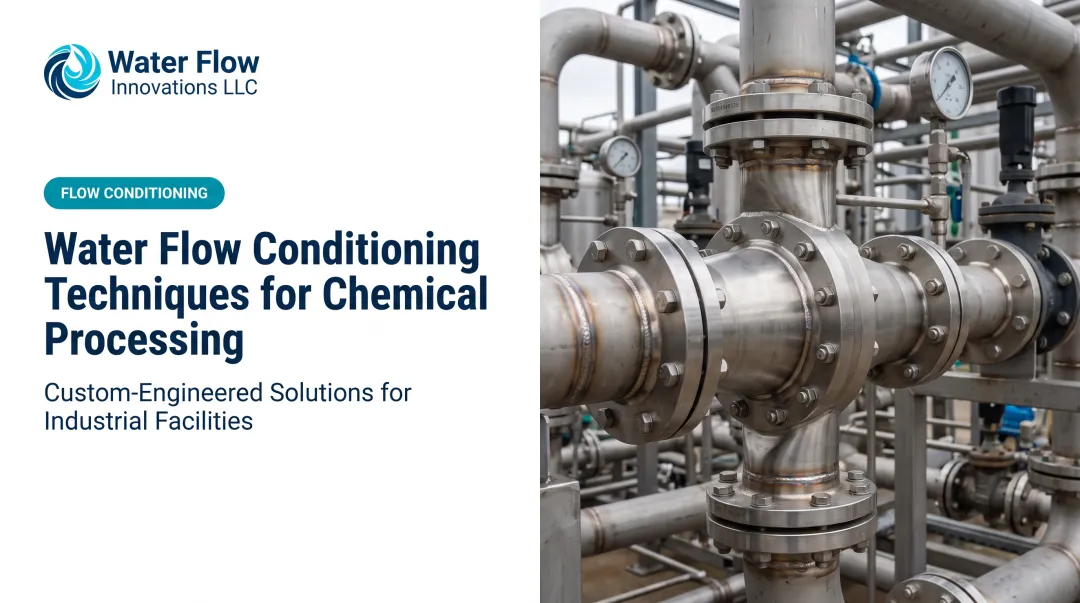
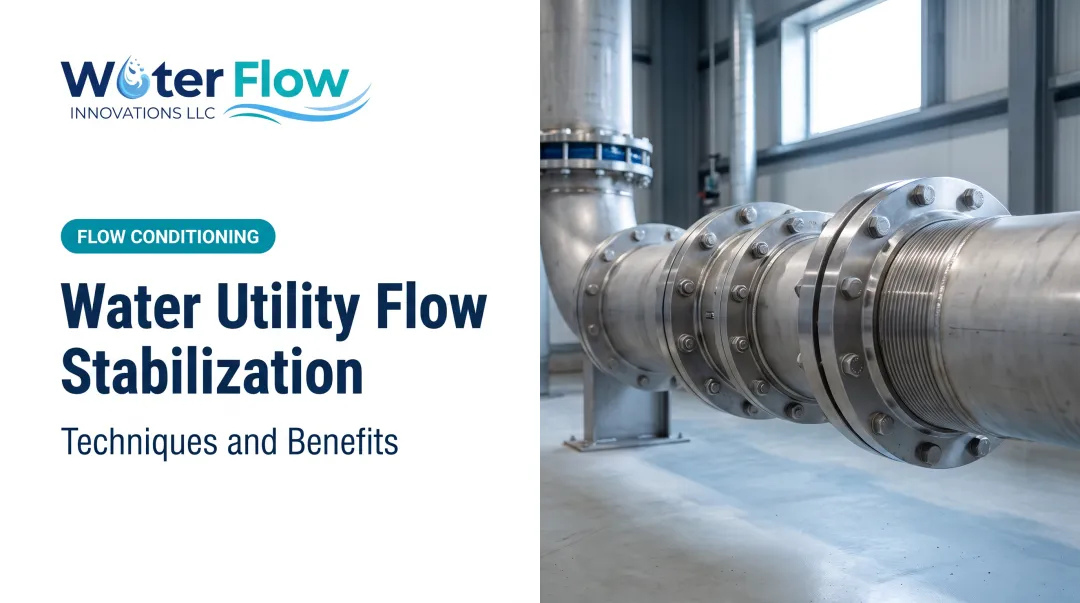
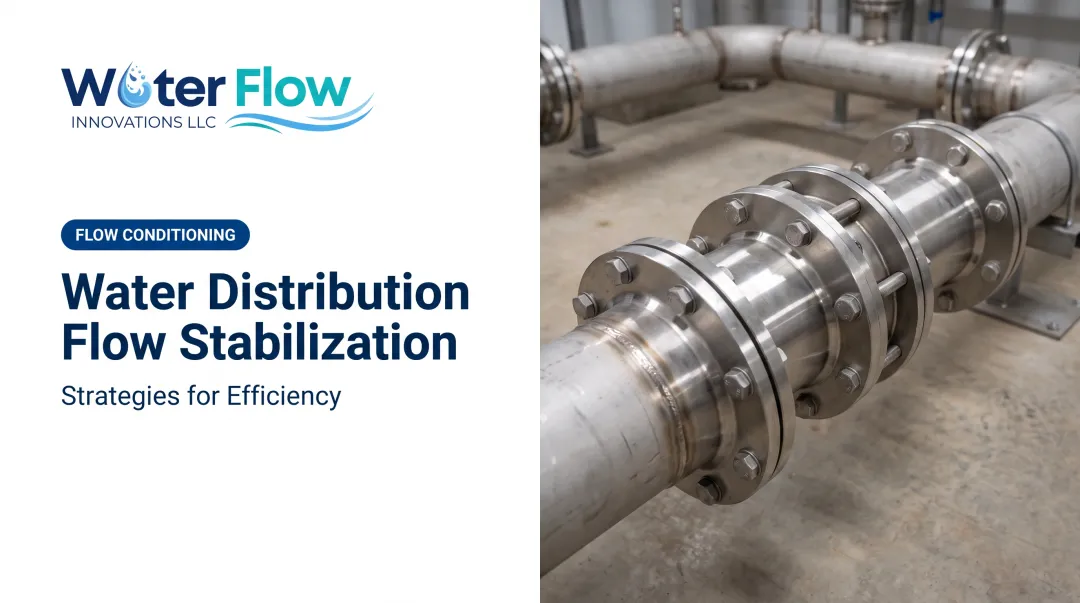
Most stabilization techniques above solve one problem each. Water Flow Innovation's Flow Conditioning Device (FCD) takes a different approach: a 4-in-1 system that combines air/gas removal, pressure regulation, check valve function, and turbulence elimination in a single certified unit. That dual benefit matters in practice—you correct meter error and cut both water and sewer charges at once.
How it works: The FCD creates static back pressure that pushes entrained air and gas back into the water column, rather than letting it pass through the meter as a mixture. The result is a more homogeneous flow at the measurement point, so the meter registers water — not air.
Key specs:
- Certified to IAPMO, NSF, ANSI, CAN 61, KIWA, GMP, and SQF standards
- Custom-fabricated in 316L stainless steel (titanium and specialty alloys available)
- Compatible with any pipe size (NPS ½" to 12", with larger custom sizes available) and any meter type
- Installed immediately after the municipal meter, before the PRV
- Negligible pressure loss, with no measurable impact on system performance in most installations

Because it corrects meter over-reading directly, facilities typically see a 5–30% average utility bill reduction, with some sites documenting up to 46%. Installation is generally about an hour, with 90% of customers reaching ROI within 12 months.
A facility with a $2,000 monthly water and sewer bill correcting a 20% over-reading saves roughly $400/month — without changing a single operational process.
Best Practices for Implementation and Ongoing Monitoring
Getting stabilization right requires sequencing the work correctly:
- Run a flow audit first. Review water bills, meter type, pipe size, and operating profile to pinpoint whether turbulence, air entrainment, or pressure cycling is the dominant issue.
- Install at correct positioning. Place conditioning equipment at the manufacturer-specified location relative to the meter. For the FCD, that means immediately after the municipal meter and before the PRV.
- Monitor results post-installation. Compare 3–6 months of pre-installation bills against 2–3 full billing cycles afterward. Where smart water sensors exist, use them to confirm consistency.
Keep that record set for more than internal tracking. The same bill comparisons support ESG reporting, LEED water-efficiency credits, and sustainability disclosures such as CDP or GRESB submissions.
Industries That Benefit Most from Flow Stabilization
Some sectors feel flow instability more acutely because of water volume, cyclical demand, or aging infrastructure:
- Food & beverage processing — Brewers Association data shows water-use ratios as high as 13.1 barrels per barrel packaged at smaller facilities; minor meter over-reading compounds quickly at that scale
- Healthcare facilities — median water use intensity of 55.71 gal/ft²/year, per EPA ENERGY STAR data
- Hotels — median WUI of 52.02 gal/ft²/year, with high-cycling demand from laundry and kitchens
- Data centers — 2023 direct water consumption hit about 17.4 billion gallons nationally, with hyperscale sites accounting for 84% of that total
- Manufacturing plants — direct industrial withdrawals exceed 18.2 billion gallons/day, per EPA estimates

Facilities with complex piping, multiple pumps, or older infrastructure typically see the largest stabilization gains. More turbulence and air entry points mean more over-reading to correct, so these sites often achieve the fastest payback with certified flow correction technology.
Frequently Asked Questions
What is process water flow stabilization?
Process water flow stabilization is the set of techniques used to keep flow consistent and turbulence-free. The goal is accurate metering and reliable process performance without pressure surges or air-driven distortion.
Why does unstable flow increase water bills?
Turbulence and entrained air cause meters to over-register actual usage, sometimes dramatically. Facilities end up paying for water and sewer volume they never actually consumed.
What is the difference between a flow conditioner and a flow straightener?
Straighteners primarily remove swirl from the flow path. Conditioners go further, addressing both swirl and velocity-profile asymmetry, and often combine additional functions like air removal or pressure regulation.
How do I know if my facility has flow stabilization issues?
Watch for inconsistent meter readings, unexplained water bill spikes, and noticeable pressure fluctuations at fixtures or equipment. A flow audit or bill review can confirm the root cause.
Can flow stabilization equipment reduce utility bills?
Yes. Certified conditioning devices that correct meter over-reading, such as the FCD, typically deliver 5–30% bill reductions without changing actual water consumption, with a highest documented result of 46%.
How long does it take to install a flow stabilization device?
Certified solutions like the FCD typically install in about an hour, with a brief water shutoff at the meter connection and no disruption to ongoing operations.
What protection accompanies a process-side installation?
A 6-month money-back guarantee on the device purchase price, with installation cost non-refundable, so it can be returned if metered consumption does not measurably fall. A lifetime transferable warranty against manufacturing defects also applies.
Which process industries most often carry this metering error?
Chemical manufacturing, pharmaceutical and biotech, semiconductor, food and beverage and dairy processing, breweries and distilleries, paper mills, textile mills, and metal finishing — all running continuous process water against one connection.