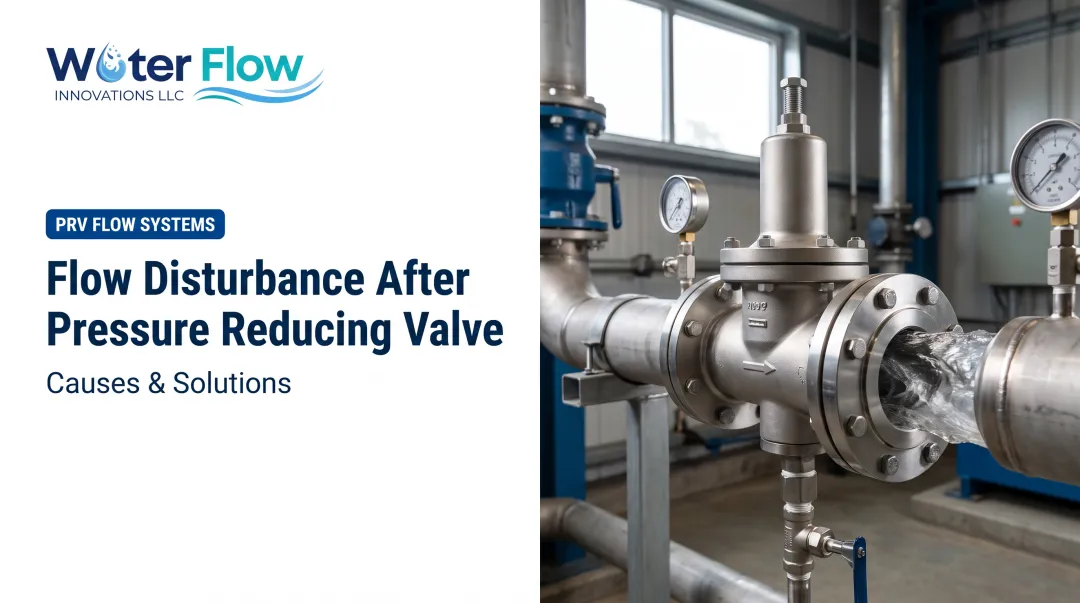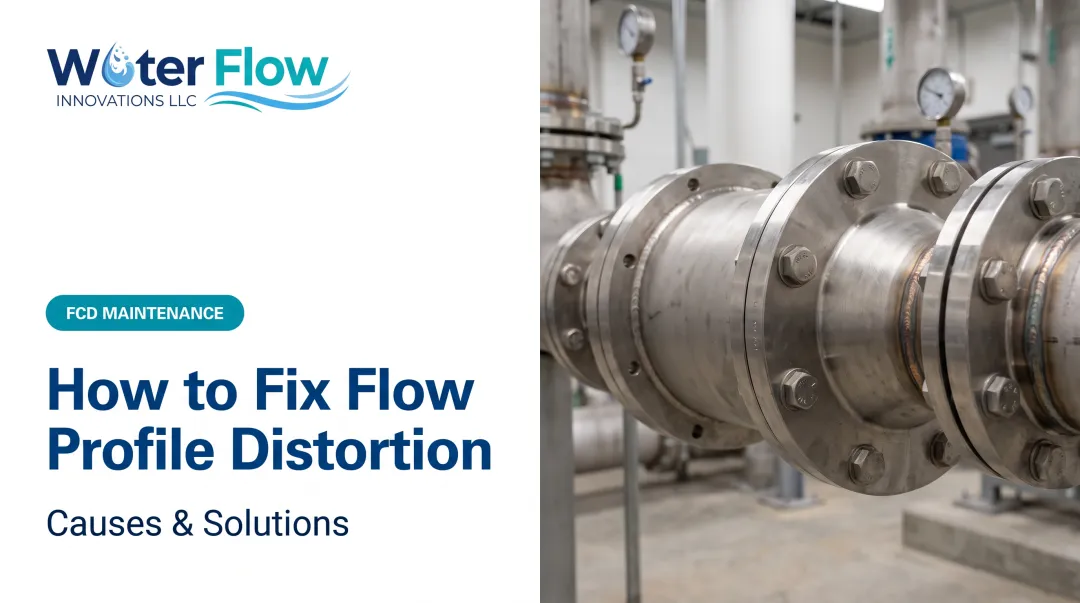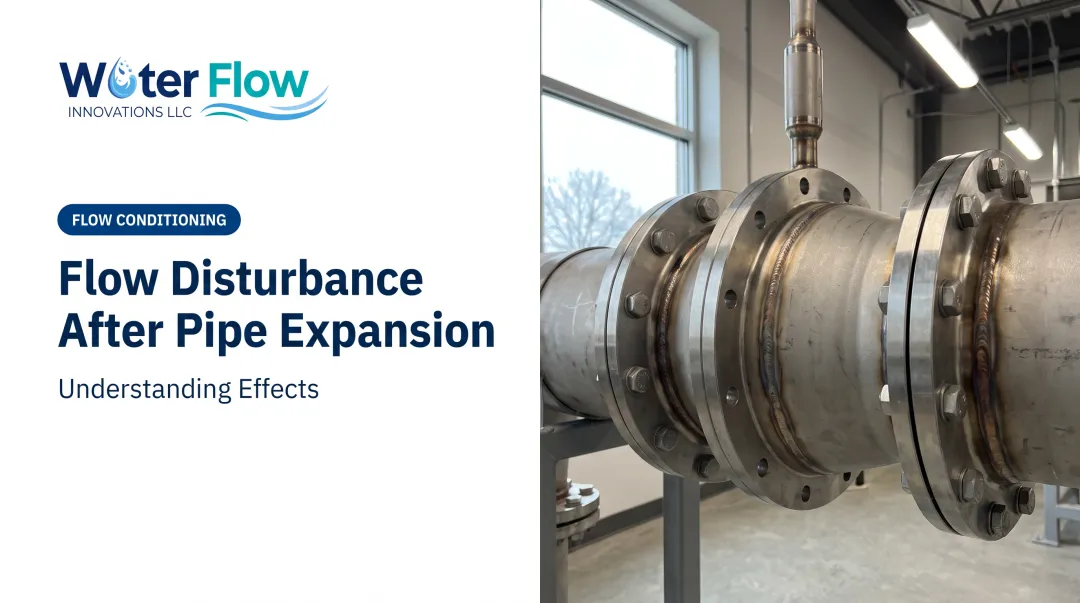

For facility managers and engineers, this isn't just a fluid dynamics curiosity. Disturbed flow skews meter readings, accelerates equipment wear, and quietly drives up utility costs. This article covers the root causes, warning signs, prevention strategies, and long-term fixes — including flow conditioning devices designed to correct the problem without touching your operations.
Key Takeaways
- Reducers cause sudden velocity changes, turbulence, swirl, and sometimes air entrainment
- Uncorrected disturbance drives meter over-reading, inflated water bills, and premature equipment wear
- Prevention starts with correct reducer selection, adequate straight-pipe runs, and gradual tapers
- Certified flow conditioning devices correct disturbance-driven meter errors without operational changes
- Documented savings of 5-30% (up to 46%) follow once meter accuracy is restored
Common Causes of Flow Disturbance After a Pipe Reducer
Flow disturbance is the disruption of a fluid's normal velocity profile: asymmetric flow, swirl, or turbulence as it moves through a pipe transition. After a reducer, this usually comes from abrupt geometry change, a velocity spike, and competing pressure differentials.
Cause 1: Sudden Velocity Increase (Venturi/Jetting Effect)
A reducer forces the same flow rate through a smaller cross-section. Per the continuity equation, A1V1 = A2V2. As area drops, velocity climbs with the square of the diameter ratio [17]. This creates a jetting effect right at the transition.
Typical scenario: High-flow industrial or municipal lines where reducers transition abruptly from large to small diameter, spiking velocity faster than the flow can adjust smoothly.
Cause 2: Turbulent Eddies and Vortex Shedding
Sudden contraction can separate flow from the pipe walls, creating swirling eddies downstream. The pressure drop across a sharp contraction depends on the contraction ratio: the steeper the taper, the worse the turbulence [10].

Typical scenario: Reducers installed too close to elbows, valves, or pumps. Nearby fittings compound the disturbance instead of giving flow room to settle [5].
Cause 3: Air Entrainment and Vapor Pockets
Reducer type matters here. Pump manufacturers specify eccentric reducers, flat-side up, for horizontal suction lines specifically to avoid trapping gas pockets at the pipe crown [16][18].
Typical scenario: Concentric reducers used in horizontal runs instead of eccentric ones, trapping air where a level reference edge should have prevented it.
Cause 4: Insufficient Straight Pipe Run Downstream
Flow needs distance to stabilize after any disturbance. Published guidance ranges from 5D to 10D+ depending on meter type [2][5], but tight layouts often don't allow for it.
Typical scenario: Retrofit or space-constrained installations where a meter or fitting sits just a few diameters past the reducer, with no room for the profile to recover.
What Happens If Flow Disturbance Is Ignored
Skewed velocity profiles throw off flow meters. Depending on meter type and disturbance severity, this shows up as meter over-reading. Utilities bill based on metered volume, not actual usage, so that gap becomes real money on every billing cycle.
Beyond billing, ignored disturbance leads to:
- Premature valve and pump wear from cavitation-prone turbulent flow
- Inaccurate process control in systems relying on flow data for dosing or batching
- Regulatory reporting errors when metered data feeds compliance documentation
Warning Signs of Flow Disturbance
These indicators often show up before anyone runs a full diagnostic:
- Bills that don't match usage — consumption stays flat, but the water bill climbs
- Unusual vibration, noise, or pressure swings near the reducer or downstream fittings
- Erratic flow meter readings during what should be steady-state operation
Any one of these alone might be coincidence. Two or more together usually point to something upstream of the meter.

How to Prevent and Correct Flow Disturbance After a Reducer
Prevention comes down to three things: design choices, installation discipline, and corrective technology for when the first two aren't enough.
Prevention Measure 1: Choose the Right Reducer Type
Use concentric reducers for vertical runs and eccentric reducers for horizontal runs. This directly blocks air entrainment by keeping a level reference edge instead of a symmetric taper that can trap gas at the crown. Implement this at initial system design or during a piping retrofit. It's far cheaper to specify correctly than to fix later.
Prevention Measure 2: Maintain Adequate Straight-Pipe Length
Follow manufacturer-recommended distances (often 5D to 10D+ upstream and downstream) around reducers and meters [2][5]. This gives turbulent flow room to settle out along the run. Build this into layout planning before meter installation, not after.
Prevention Measure 3: Use a Gradual Transition Angle
Specify reducers with a gentler taper rather than an abrupt cone. Easing the change in cross-sectional area reduces both the velocity shock and the eddies it creates. Address this when ordering reducer fittings for new installations, not as a retrofit afterthought.
Prevention Measure 4: Install a Certified Flow Conditioning Device
Sometimes space constraints simply won't allow for a longer straight run. That's where a flow conditioning device earns its keep. It corrects turbulence, swirl, and air entrainment at the source instead of waiting for the pipe to fix itself.
Water Flow Innovation's Flow Conditioning Device (FCD) is a custom-fabricated, 316L stainless steel unit built for pipe sizes NPS 1/2" through 12" (DN20-DN500), with titanium or specialty alloys available on request. It combines four functions in one unit:
- Air & gas separation: creates back-pressure that promotes laminar flow and produces a homogeneous water column through the measurement zone
- Pressure regulation: reduces surges and water hammer from cycling demand
- Check valve function: prevents reverse flow and the pressure spikes that let air back into the line (not always required)
- Turbulence elimination: slows velocity enough at the meter to prevent vortex flow
Because it's installed right after the meter, it directly resolves the over-reading that post-reducer disturbance causes, without changing actual water usage.
Installation takes about an hour and works with any meter type and any standard pipe size (½-inch to 12-inch). The unit carries IAPMO, NSF/ANSI, CAN 61, KIWA, GMP, and SQF certification. Documented results average 5-30% water/sewer bill savings, with 46% as the highest recorded outcome.

Tips for Long-Term Prevention and Control
One-time fixes help, but ongoing discipline keeps disturbance from creeping back in:
- Schedule routine meter calibration and cross-check readings against utility bills to catch drift early
- Train installation crews on correct reducer orientation, especially eccentric flat-side placement
- Document piping layouts and reducer specs so future maintenance and audits aren't guesswork
- Track flow conditioning results with before-and-after utility bills for LEED, ESG, and ISO 14001 reporting

Conclusion
Flow disturbance after a pipe reducer has identifiable, correctable causes: geometry, velocity, and installation practices, not a mystery. Proactive prevention paired with certified flow conditioning protects both system performance and utility budgets. Hidden metering costs become measurable, verifiable savings on the next bill.
Frequently Asked Questions
What happens to pressure when pipe diameter decreases?
Velocity increases and static pressure drops as diameter decreases, following continuity and Bernoulli's principles [6][17]. That pressure-velocity shift can intensify turbulence downstream, especially with abrupt transitions.
What is the purpose of a reducer in piping?
Reducers connect pipes of different diameters, maintaining fluid continuity while adapting to equipment sizing, flow requirements, or layout constraints. They're a standard, necessary fitting; disturbance comes from poor selection or placement, not the reducer itself.
How much pressure loss does a 90-degree bend cause?
Pressure loss depends on the bend's radius-to-diameter ratio, construction, and velocity; there's no single universal figure. Check the fitting's K-factor from Hydraulic Institute data or Crane TP-410 for exact values [9][14].
How long should straight pipe be after a reducer for accurate flow measurement?
Industry guidance typically ranges from 5D to 10D or more, depending on meter type and how severe the disturbance is [2][5]. Always confirm against your specific meter manufacturer's installation manual.
Can a flow conditioning device fix meter over-reading caused by a reducer?
Yes. Certified flow conditioning devices (FCDs) correct turbulence and air entrainment at the meter, restoring accurate readings without changing system usage or operations.
Does an eccentric or concentric reducer cause more flow disturbance?
Neither is inherently worse — using the wrong type for the orientation is the problem. Concentric reducers in horizontal lines can trap air at the crown, increasing disturbance compared to a correctly oriented eccentric reducer.
Would fitting a different meter compensate for the reducer?
Generally not. Any meter registers what reaches it, entrained air included, so a swap reproduces the same error while the reducer keeps generating the disturbance. The flow profile has to be corrected, not the instrument.
Does correcting it require altering the reducer or pipework?
No. The device is custom-built and fitted at the supply connection in about an hour, with a brief water shutoff at the meter connection. The existing reducer, orientation, and downstream pipework all stay as they are.