Introduction
Every hydropower system, from a 500 MW dam to a micro-hydro unit tucked into a mountain pipeline, depends on one thing: water reaching the turbine in a controlled, predictable state. Not just a high volume of water — a stable one.
In practice, that stability is hard to come by. Bends, valves, pump discharges, and elevation drops in penstocks generate turbulence and trapped air.
Left unchecked, these disturbances can be severe: ASME researchers documented rapid-filling events where trapped air pushed pressure spikes up to 10 times the upstream hydrostatic pressure.
Most explanations of hydropower jump straight to turbines and generators. Few explain the step that determines how well that hardware actually performs: flow conditioning. Here's how it works.
Key Takeaways
- Flow conditioning stabilizes turbulent, aerated, or pressure-inconsistent water for a turbine or meter.
- Turbulence elimination, air/gas removal, and pressure regulation happen in one inline process.
- Conditioned flow protects turbine blades, improves energy conversion, and cuts cavitation risk.
- The same physics also corrects water meter over-reading in commercial and industrial facilities.
- Conditioning devices produce negligible pressure loss, with zero disruption to output.
What Is Water Flow Conditioning?
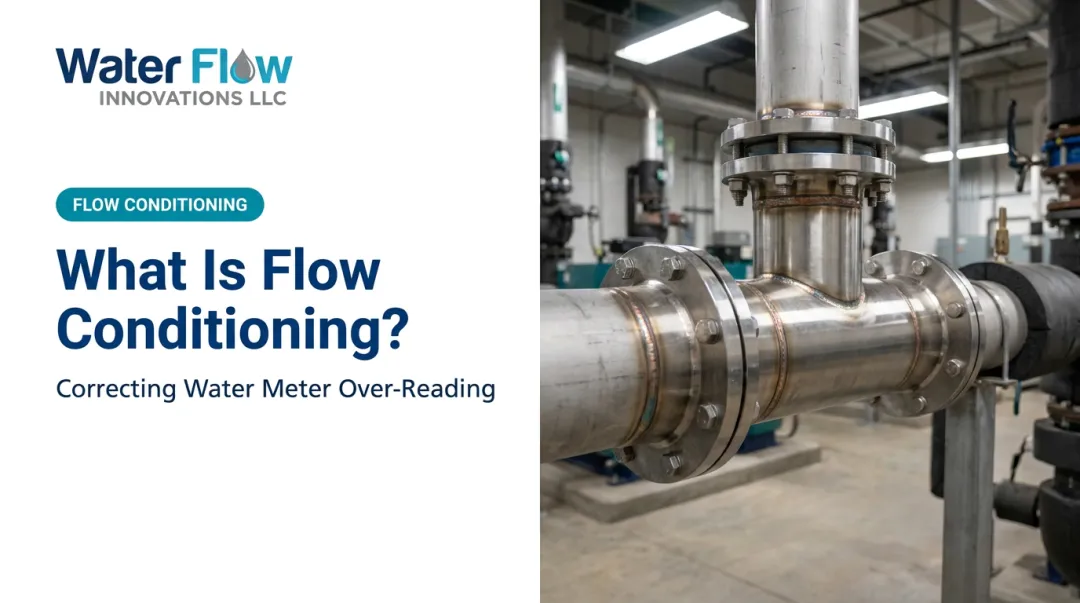
Water flow conditioning is the process of converting turbulent, swirling, or aerated flow into a stable, uniform profile before it reaches downstream equipment. It's a correction step, not a generation step.
Raw water in a real pipeline is almost never smooth. Every elbow, valve, pump, and turbine runner introduces some degree of swirl or air entrainment that hurts equipment performance and throws off meter accuracy. Flow conditioning exists to undo that distortion before it causes damage or inaccuracy.
What it is not:
- Filtration: it does not remove particulates or debris
- The turbine or generator: it is a preparatory stage that improves what feeds those components
Better turbine and generator technology has not eliminated the need for conditioning. A modern Francis or Kaplan runner still underperforms if the water hitting its blades is turbulent or full of air bubbles.
Hardware improvements raise the ceiling. Flow conditioning determines whether you actually reach it.
Common Conditioning Components
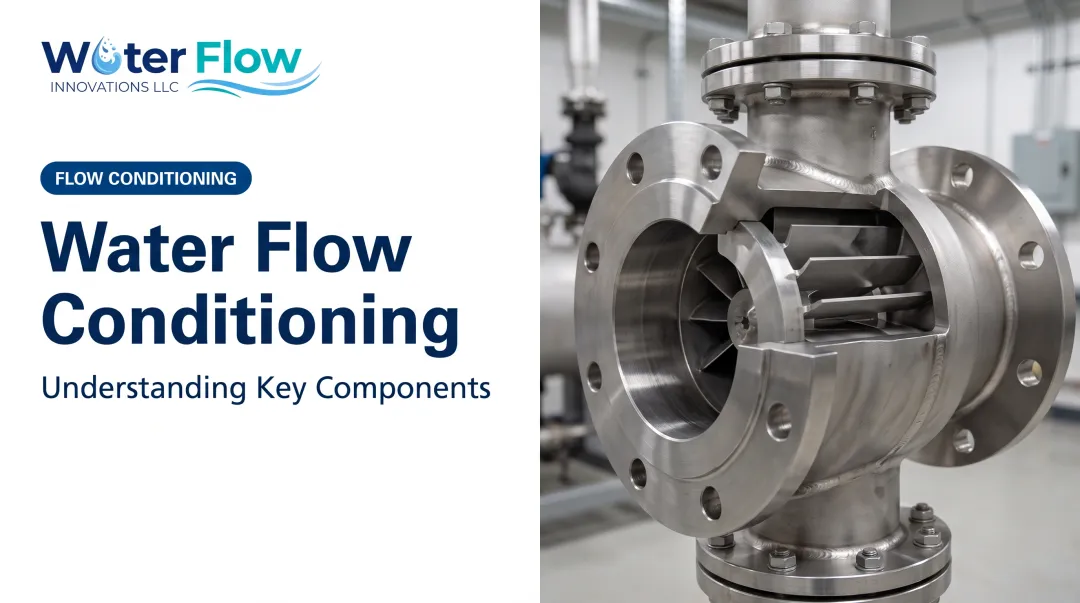
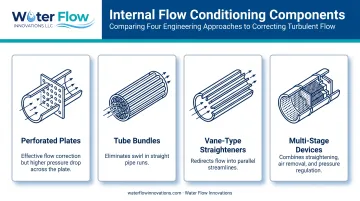
Flow conditioning systems typically rely on a small set of internal elements, often combined in a single multi-stage device:
- Perforated plates break up large-scale turbulence, though they often create more pressure drop than other options
- Tube bundles use clusters of small tubes to eliminate swirl in straight pipe runs
- Vane-type straighteners use longitudinal vanes to redirect swirling flow into parallel streamlines
- Multi-stage devices combine straightening with air/gas removal and pressure regulation
The underlying physics stays consistent whether you're conditioning flow for a 12-inch penstock or a 2-inch commercial water line. Only the scale changes.
How Does Water Flow Conditioning Work?
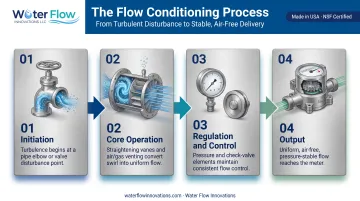
Flow conditioning is a sequence of initiation, core operation, regulation, and output. Each stage turns disturbed flow into a stable profile a turbine runner or measurement device can use reliably.
Initiation
Conditioning begins the instant water passes a disturbance point: an elbow, a pump discharge, a valve, or a drop in elevation common along penstocks and supply lines. In most systems, this is continuous and automatic. The device sits inline, so every unit of flow passes through it without any manual triggering.
The common bottleneck here is straight pipe length. If there isn't enough straight run before the conditioning point, the device has less room to work with, and turbulence correction suffers.
Core Operation
This is where the actual correction happens. Internal elements such as straightening vanes, chambers, or baffles break up swirling eddies and redirect water into parallel, uniform streamlines.
At the same time, the device separates entrained air and gas bubbles and vents them. Aerated flow behaves inconsistently under pressure, which can cause uneven turbine loading or skewed meter readings.
The payoff shows up in three measurable ways:
- More consistent flow velocity across the pipe cross-section
- Reduced risk of micro-cavitation on turbine surfaces
- More predictable energy transfer to the turbine runner
Regulation and Control
Flow rate and pressure fluctuate throughout the day and across seasons as demand cycles, seasonal snowmelt, and grid load shift the picture. A flow conditioning system needs to hold stability through those swings, not only in ideal, steady-state conditions.
Pressure regulation and check-valve elements do the heavy lifting here, preventing backflow surges or pressure spikes from reintroducing turbulence downstream of the conditioning point. Without this ongoing regulation, uncorrected pressure transients compound over time.
At a three-unit, 210 MW Francis plant sharing a common penstock, pressure pulsation grew severe at low output. Researchers recommended keeping the operating unit above 78% of full load, or roughly 55 MW to avoid destructive pulsation—a clear case of what happens when pressure is not actively managed.
Output and Result
The end result is a uniform, air-free, pressure-stable flow profile delivered right to the turbine intake or measurement device. That cleaner flow improves blade contact consistency in hydropower applications and reading accuracy in metering contexts.
A peer-reviewed study on a 318 kW Francis turbine found a maximum efficiency decrease of 2.8% near a 5% air void fraction, with most effects below that threshold falling within the study's own measurement accuracy. Uncontrolled aeration produces measurable losses at specific operating points, not just theoretical inefficiency.
Where Is Water Flow Conditioning Used?
In hydropower specifically, flow conditioning shows up at penstock inlets, immediately before turbine runners, and inside micro-hydro pipeline installations where space is tight and consistent output matters.
It delivers the most value where:
- Pipelines have bends or pump stations upstream of the turbine
- Flow rates vary significantly throughout the day
- Every percentage point of efficiency has a direct revenue impact
Beyond Power Generation
The same turbulence and air-entrainment problems show up outside the powerhouse. Commercial and industrial pipelines that feed utility meters face the same flow issues, with a different cost: meters that over-read and inflate the water bill.
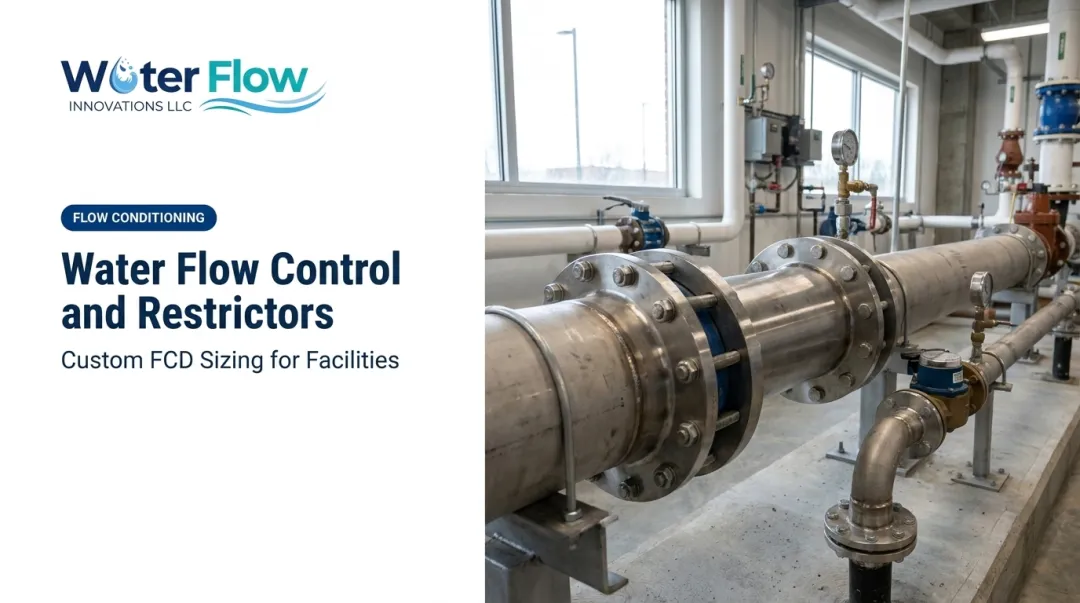
Water Flow Innovation' certified Flow Conditioning Device (FCD) applies the same core principle used in hydropower, adapted for metering:
- Slows water velocity at the meter enough to limit vortex flow that drives over-counting
- Removes air and gas so a homogeneous water column, not water mixed with micro-bubbles, passes through the measurement zone
- Smooths pressure surges from CIP cycles, irrigation zone startup, or cooling tower makeup demand
- Uses check-valve control to stop reverse flow from pulling air back in after separation
Installation takes about an hour, typically right after the meter, and produces negligible pressure loss—the same design idea used in penstock conditioning.
Facilities across more than 25 verticals, from food and beverage plants to data centers and hospitals, have documented 5–30% average reductions in water and sewer bills, with one case reaching 46%. Roughly 90% of customers reach full ROI within 12 months.
Conclusion
Flow conditioning is the overlooked variable that decides whether a turbine, a meter, or any downstream system performs at its true potential, or a distorted, less efficient version of it.
If you're evaluating hydropower efficiency or explaining a water bill that doesn't match usage, the answer often isn't the equipment itself. It's what's happening upstream, in the flow feeding it.
A free savings analysis is a solid place to start when a commercial or industrial water bill has never quite added up.
Frequently Asked Questions
What is the difference between a flow conditioner and a flow straightener?
A straightener primarily addresses swirl and turbulence. A flow conditioner combines straightening with air removal and pressure regulation for a more complete correction of the flow profile.
Why does turbulent water reduce hydropower turbine efficiency?
Turbulence and entrained air cause inconsistent blade contact and uneven energy transfer. That means less usable output from the same volume of water passing through the turbine.
Does adding a flow conditioning device cause pressure loss in the system?
Properly designed flow conditioners create negligible pressure loss. Downstream pressure, flow rate, and system performance stay effectively unchanged after installation.
Can flow conditioning correct inaccurate water meter readings?
Yes. Turbulent, aerated flow at the meter causes over-registration. Correcting the flow at the meter resolves this without changing actual water consumption.
How is flow conditioning different in a hydropower system versus a commercial building's water line?
The underlying physics, turbulence and air entrainment, is identical in both cases. What differs is placement: penstock or turbine intake in hydropower, versus the meter inlet in a commercial facility.
Where should a flow conditioning device be installed in a pipeline?
Install it inline, close to the point of measurement or turbine intake. Leave adequate straight pipe run upstream so the device can correct disturbed flow.
What does the metered-supply correction return at a generating site?
Documented installations average a 5–30% reduction in combined water and sewer charges on the metered municipal connection, with a highest documented single result of 46%, separate from any turbine efficiency gain.
What guarantee accompanies the installed device?
A 6-month money-back guarantee on the purchase price, with installation cost non-refundable, so it can be returned if metered consumption does not measurably fall. A lifetime transferable warranty against manufacturing defects also applies.