Water meter calibration is the process used to verify and correct that accuracy. Understanding how it works, what drives inaccuracy, and where calibration falls short is essential for any facility trying to control utility costs and ensure billing fairness.
Key Takeaways
- Water meter calibration compares a meter's readings against a known reference standard to identify and correct measurement errors
- Meters can under-read (utilities lose revenue) or over-read (customers overpay) — and both errors have real financial consequences
- EPA WaterSense guidance recommends calibration every 1–10 years depending on meter size, with larger meters requiring more frequent checks
- A calibrated meter can still over-read in real-world conditions — air entrainment and turbulent flow distort the measurement even after calibration
- Flow conditioning targets the root cause of meter over-reading — correcting the flow signal upstream so calibration results hold under actual operating conditions
What Is Water Meter Calibration?
Water meter calibration is the process of testing a meter's measurement performance against a traceable reference standard to determine its error rate and verify it falls within acceptable accuracy tolerances.
According to OIML R 49-1:2024, acceptable limits vary by class and flow zone:
- Class 1 meters: ±3% in the lower flow zone; ±1% to ±2% in the upper zone
- Class 2 meters: ±5% in the lower flow zone; ±2% to ±3% in the upper zone
These are not blanket tolerances — they apply to specific test conditions and flow points.
Where Calibration Fits in a Metering Program
Calibration is distinct from two other common meter activities:
- Meter reading — recording usage from the register
- Meter replacement — swapping out hardware
Calibration specifically evaluates whether the meter is measuring correctly, then informs decisions about adjustment, repair, or replacement. The results tell you what action to take — they don't take it for you.
Lab vs. Field Calibration
Testing can occur in two settings:
- Accredited laboratory (offline): The meter is removed from service and tested under controlled conditions, typically using gravimetric or volumetric methods
- Field verification (on-site): Technicians install a portable reference meter in series with the unit under test, enabling assessment without pulling it from service
Whichever setting applies, the testing must follow recognized standards. For U.S. commercial and industrial users, the primary governing frameworks are AWWA C700 Series standards and ISO 4064, which define requirements for test methods, accuracy limits, and documentation.
Why Water Meter Accuracy Matters for Commercial and Industrial Facilities
Meter inaccuracy carries direct financial and operational consequences that compound across multiple budget lines simultaneously.
The Financial Impact
An over-reading meter creates two simultaneous billing errors. Most utilities calculate sewer/wastewater discharge charges directly from metered water consumption — often assuming 80–100% of metered water becomes wastewater. So every gallon the meter over-registers inflates both the water bill and the sewer bill at the same time.
To put this in concrete terms: NYC's FY2026 combined water and sewer rate is $13.50 per 100 cubic feet. Every 100 cubic feet falsely registered by an over-reading meter costs a facility $13.50 in combined charges — not just the water portion.
Operational and Sustainability Risks
Facilities that rely on metered water data for sustainability targets, ESG disclosures, or LEED certification are working from corrupted baseline data when meters are inaccurate. Inaccurate readings lead to:
- Flawed decisions on water conservation investments
- Understated or overstated water intensity metrics in ESG reports
- Potentially non-compliant LEED water efficiency credit submissions
Regulatory Exposure
For facilities subject to water withdrawal permits or NPDES compliance requirements, EPA's NPDES Inspection Manual directs inspectors to verify that flow measurement systems are calibrated annually by a qualified source and accurate within ±10%. Meter data that doesn't meet this standard creates audit vulnerabilities.
The Asymmetric Risk for Customers
Utilities are primarily concerned with under-reading — meters that fail to register flow, resulting in unbilled water. For commercial customers, the bigger financial risk runs the other direction: over-reading, where billing reflects consumption that never occurred. The two parties have opposing interests. Utilities have no financial incentive to identify over-reading, so the burden of verifying meter accuracy — through calibration testing, flow conditioning, or third-party review — falls entirely on the customer.
How Water Meter Calibration Works
Calibration methods vary based on meter type, required accuracy level, size, and whether testing happens in a lab or in the field. Every calibration produces a certificate documenting the meter's measured error at multiple flow rates and the conditions under which the test was performed.
The Three Main Calibration Methods
ISO 4064-2:2024 recognizes three valid test methods:
| Method | How It Works | Best For |
|---|---|---|
| Gravimetric | Water is collected and weighed on precision scales over a defined period; mass is a primary SI measurement | Highest absolute accuracy; accredited lab use |
| Volumetric | Water is collected into a container of known volume and compared against the meter's reading | Smaller meters; offline testing |
| Reference (Master) Meter | A calibrated reference meter is installed in series; both meters measure the same flow simultaneously | Large commercial/industrial meters; field use |
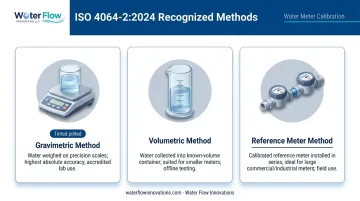
NIST's gravimetric facilities achieve expanded uncertainty of 0.021%, placing it at the top of the accuracy hierarchy for laboratory testing. The reference meter method suits large-diameter commercial meters well because it keeps the meter in service throughout the test.
Calibration Standards and Frequency Guidelines
The AWWA M6 program guidance, cited in the EPA's WaterSense at Work guide, establishes that 95% of scheduled meters should be tested, with at least 95% of those tested falling within accuracy limits at both normal and minimum flow rates.
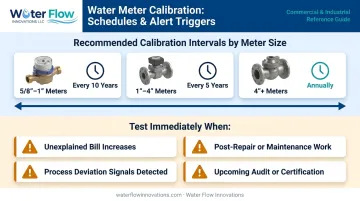
Recommended testing intervals by meter size:
- 5/8" to 1" meters: Every 10 years
- 1" to 4" meters: Every 5 years
- 4" and larger: Annually
State utility commissions can set stricter requirements. Wisconsin PSC 185.76, for example, requires 6" and larger meters to be tested annually — the same as the AWWA guideline — but mandates 3"–4" meters every 2 years rather than 5.
When to Test Outside the Schedule
Immediate calibration or testing is warranted regardless of the regular interval when:
- Unexplained increases appear in water or sewer bills
- A meter has been repaired or maintained
- Process data or facility knowledge suggests measurement deviations
- A major audit, permit renewal, or sustainability certification review is approaching
What Causes Water Meters to Lose Accuracy — And Why Calibration Alone May Not Be Enough
Mechanical Wear: The Problem Calibration Is Designed to Catch
The most common cause of meter inaccuracy is mechanical wear. In displacement and turbine meters, moving components — gears, impellers, discs — degrade over time. This typically causes under-registration, where the meter fails to count all the flow passing through it. Sediment buildup, mineral scaling, and physical damage accelerate this degradation.
Calibration programs are specifically designed to identify this type of degradation before the error becomes significant. A meter that shows increasing under-registration at minimum flow rates is a clear candidate for repair or replacement.
Air Entrainment and Turbulent Flow: The Problem Calibration Can't Catch
Most calibration programs address mechanical failure — but meters can also over-read due to conditions in the line itself, not the meter's components.
Commercial and industrial meters cannot distinguish between water and entrained air. When air enters the line, the meter counts it as billable water volume. Common causes include:
- Pressure fluctuations or intermittent supply
- Pump cycling and valve actuation
- Partially drained lines during system shutdowns
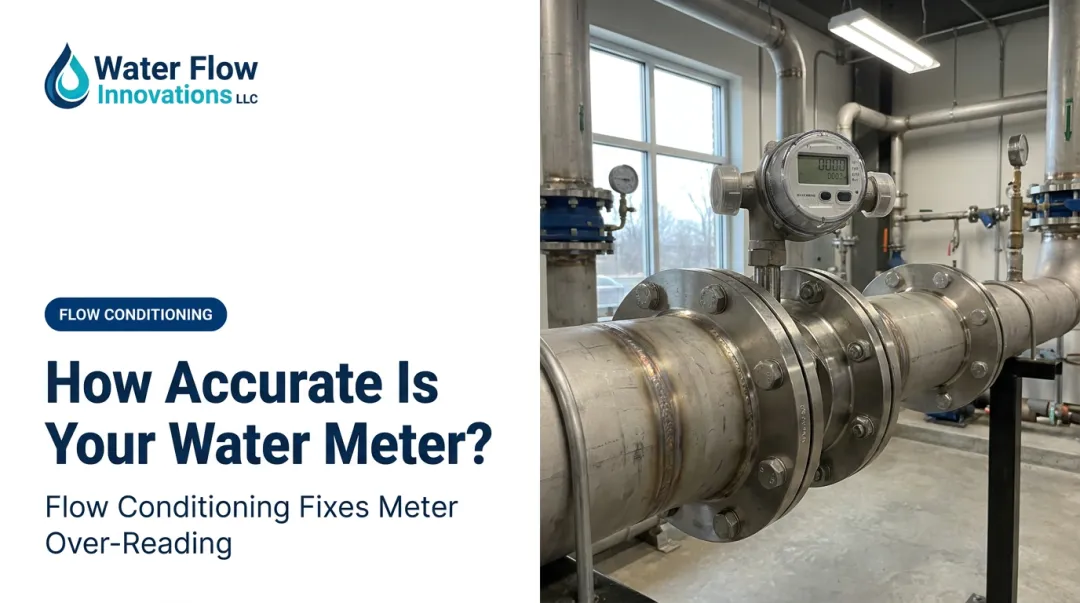
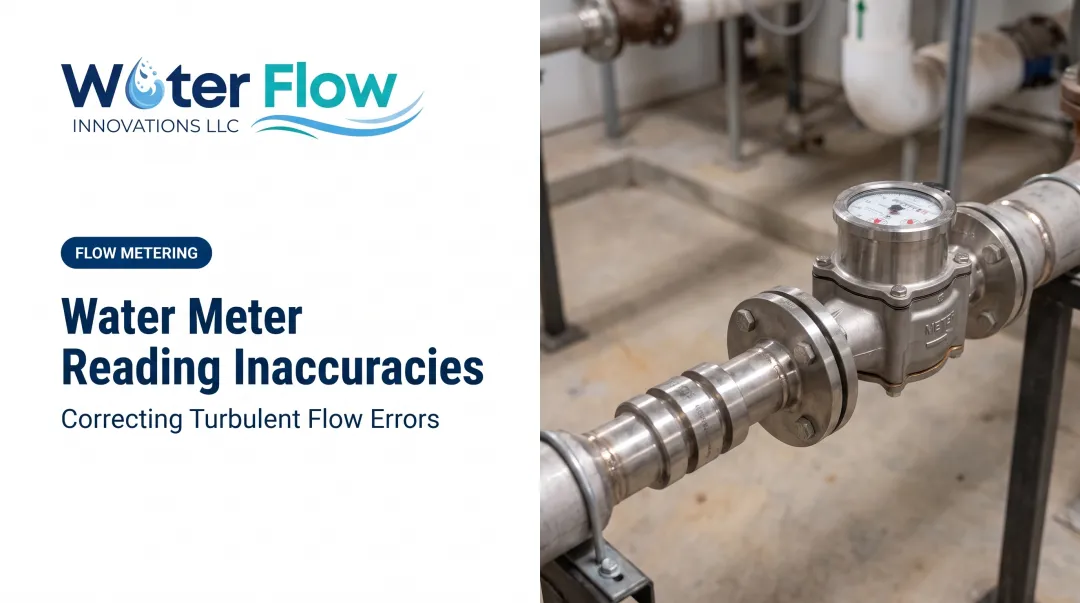
Turbulent or chaotic flow profiles create a separate problem. Nearby bends, valves, pump discharge, or CIP system cycling can distort the meter's measurement element, causing it to register more volume than actually passed.
OIML R 49-2:2024 requires testing with specified flow disturbers and addresses declared upstream straight-run lengths, confirming that installation conditions materially affect meter accuracy. A bench calibration certificate documents performance under controlled lab conditions. It does not capture what happens when the meter is installed in a real operating environment with pressure cycling, air pockets, and turbulent flow upstream.
The Critical Distinction
A meter can pass calibration in a controlled lab setting and still over-read significantly in service, because the source of error is the flow condition entering the meter, not the meter's mechanical components. These are two separate problems requiring two separate solutions.
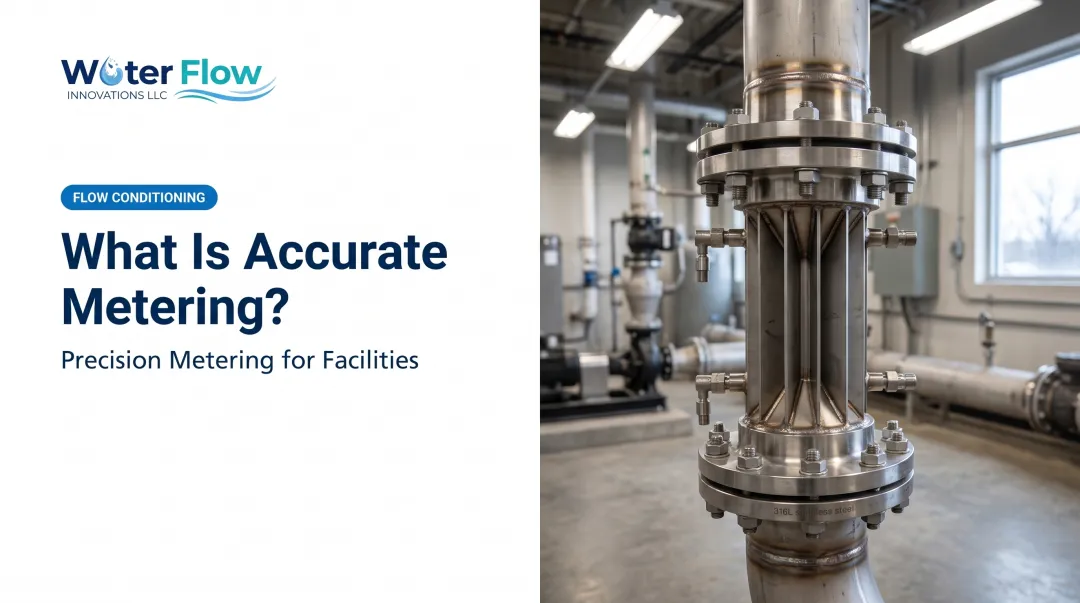
Addressing upstream flow conditions often delivers faster billing accuracy improvements than periodic recalibration alone. Water Flow Innovation's Flow Conditioning Device (FCD) targets this directly: it installs immediately after the water meter and eliminates entrained air and turbulent vortex flow in the measurement zone, correcting over-reading at the source rather than at the next calibration cycle.
How Water Flow Innovation Can Help
Water Flow Innovation distributes and installs the only certified flow conditioning solution designed to eliminate water meter over-reading caused by air entrainment and turbulent flow. The core of that solution is the Flow Conditioning Device (FCD) — here's how it works.
How the FCD Works
The FCD is a proprietary 4-component system installed immediately after the meter. Installation is usually about an hour (+/-) with no operational disruption:
- Air & Gas Separation — Creates back-pressure that prevents bubble formation, ensuring a 100% homogeneous water column through the measurement zone
- Pressure Regulation — Smooths pressure spikes and surges that introduce air into the line during valve cycling and variable demand events
- Check Valve (select configurations) — Prevents reverse flow and pressure events that would reintroduce air after initial purging
- Turbulence Elimination — Reduces water velocity just enough to prevent vortex flow with only a slight pressure loss (typically 0–3 psi) and no meaningful change to downstream flow rate
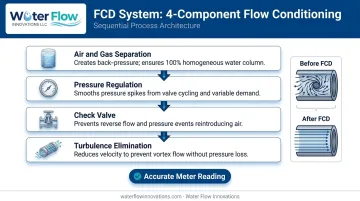
The result is straightforward: the meter reads actual consumption, the bill reflects actual usage, and there is negligible pressure loss or operational impact downstream.
Documented Performance
- Delivers a 5–30% average reduction in combined water and sewer bills; the highest documented single result is 46%
- 90% of customers achieve full ROI in under 12 months
- Savings appear on the next billing cycle after installation
- Compatible with any pipe size (NPS 1/2" to 12") and any meter type
- Certified by IAPMO, NSF, ANSI, CAN 61, KIWA, GMP, and SQF
- Savings documentation suitable for ESG reporting and LEED certification
- Backed by a 6-month money-back guarantee and lifetime transferable warranty
- Available to purchase or lease, with every unit custom made to pipe size and configuration
For facility managers, operations directors, or sustainability teams at commercial or industrial facilities across the U.S.: contact Water Flow Innovation at 1-844-934-8258 or Info@WaterFlowInnovations.com to request a free water bill review and savings analysis — no obligation.
Conclusion
Water meter calibration is an essential tool for verifying measurement accuracy — but it's only part of the picture. Calibration tests meter performance under controlled conditions. It cannot account for air entrainment and turbulent flow that occur in real operating environments, which cause meters to over-read regardless of how well they perform on a test bench.
Facilities that manage both their calibration schedules and their upstream flow conditions stop paying for water they never received. Companies like Water Flow Innovation address the upstream side directly — correcting the turbulent flow conditions that skew meter readings before water even registers on the dial. That combination of calibrated meters and conditioned flow is what produces billing data accurate enough to trust for operational decisions and sustainability reporting.
Frequently Asked Questions
What is a calibrated water meter?
A calibrated water meter is one that has been tested against a traceable reference standard and verified to measure within acceptable accuracy tolerances — typically expressed as a percentage error at various flow rates. Results are documented in a calibration certificate that includes the test method, conditions, and measured error at each test point.
What is the most accurate water meter?
Electromagnetic and ultrasonic meters offer strong accuracy for commercial applications because they have no moving mechanical parts that wear over time. Positive displacement meters deliver high accuracy at low flow rates. In practice, accuracy in practice depends heavily on flow conditions entering the meter — meter type alone doesn't guarantee accurate billing.
How much does it cost to calibrate a water meter?
Published utility challenge-test fees for small meters range from roughly $75 to $114, but these are not market prices for accredited calibration. For large meters, cost varies by size, test method, and whether lab or on-site testing is used — contact an accredited lab for a site-specific quote.
How often should commercial water meters be calibrated?
Per AWWA M6 guidelines: meters 5/8" to 1" every 10 years; 1" to 4" every 5 years; 4" and larger annually. Test immediately after repairs, unexplained billing spikes, or before any audit or certification review.
Can a calibrated water meter still over-read?
Yes. A meter can pass calibration under controlled lab conditions and still over-read significantly in the field — because lab tests don't replicate the air entrainment and turbulent flow conditions present in real operating environments. The meter passes because its mechanical components are functioning correctly; the over-reading happens because of what's entering the meter, not the meter itself.
What are the signs that my water meter may be inaccurate?
Common warning signs include:
- Unexplained increases in water or sewer bills not tied to operational changes
- Billing inconsistent with production volumes or occupancy levels
- A meter that has exceeded its recommended calibration interval
- Visible pressure fluctuations that could indicate air in the line
Any of these warrants immediate testing or a professional bill review.
What does a professional bill review actually assess?
Your water and sewer bills, meter size, pipe size, line pressure, and PRV configuration. Together these establish whether the operating environment is causing over-reading and what correction the connection needs. The review is free, remote, and carries no commitment.
What cover applies once a correction is fitted?
A 6-month money-back guarantee on the device purchase price, with installation cost non-refundable, so it can be returned if metered consumption does not measurably fall. A lifetime transferable warranty against manufacturing defects also applies and follows the property on sale.