
So what exactly is a water flow conditioning device? Is it a treatment system, a conservation tool, or something else entirely? It's none of those in the traditional sense. A flow conditioning device primarily smooths out flow conditions before water reaches the meter, so the meter reads what actually moves through the line.
This article breaks down how these devices work, where they may fit into a winery's plumbing, what they don't do, and how to verify any financial claims before committing.
Key Takeaways
- Flow conditioning devices stabilize flow at the meter — they don't purify water or change your winemaking process.
- Suitability depends on water source, meter type, pipe layout, air entrainment, and utility billing structure.
- Pull several billing cycles of data and confirm device certifications before you install.
- Verify any savings projections independently—don't rely on vendor estimates alone.
What Is a Water Flow Conditioning Device?
A water flow conditioning device is a mechanical component installed in a water line that stabilizes air content, pressure, and turbulence before water reaches the meter. It is not a filter, softener, disinfection unit, wastewater treatment system, or leak detector. Those technologies change water quality or find physical losses. A flow conditioner addresses how water presents itself at the point of measurement.
NIST's water-flow calibration facility uses upstream flow conditioners to create a symmetric, fully developed velocity profile before water hits a test meter, establishing consistent flow conditions for accurate measurement. The goal is reliable meter reading, not a change in water volume used.
Why Air and Turbulence Matter at the Meter
Aerated or turbulent flow can distort how a meter registers volume. A 2023 laboratory study in Water Resources Management documented meter over-reading when air passed through a meter as an intermittently supplied pipe refilled. Treat site-specific claims as provisional until confirmed by manufacturer documentation or your utility's metering guidance.
The Four Components of Water Flow Innovation's FCD
Water Flow Innovation's Flow Conditioning Device (FCD) combines four functional elements:
- Separates entrained air or gas from the water column
- Regulates pressure to reduce water hammer and on-off surges
- Blocks reverse flow through the meter with a check valve
- Smooths turbulence ahead of the measurement zone
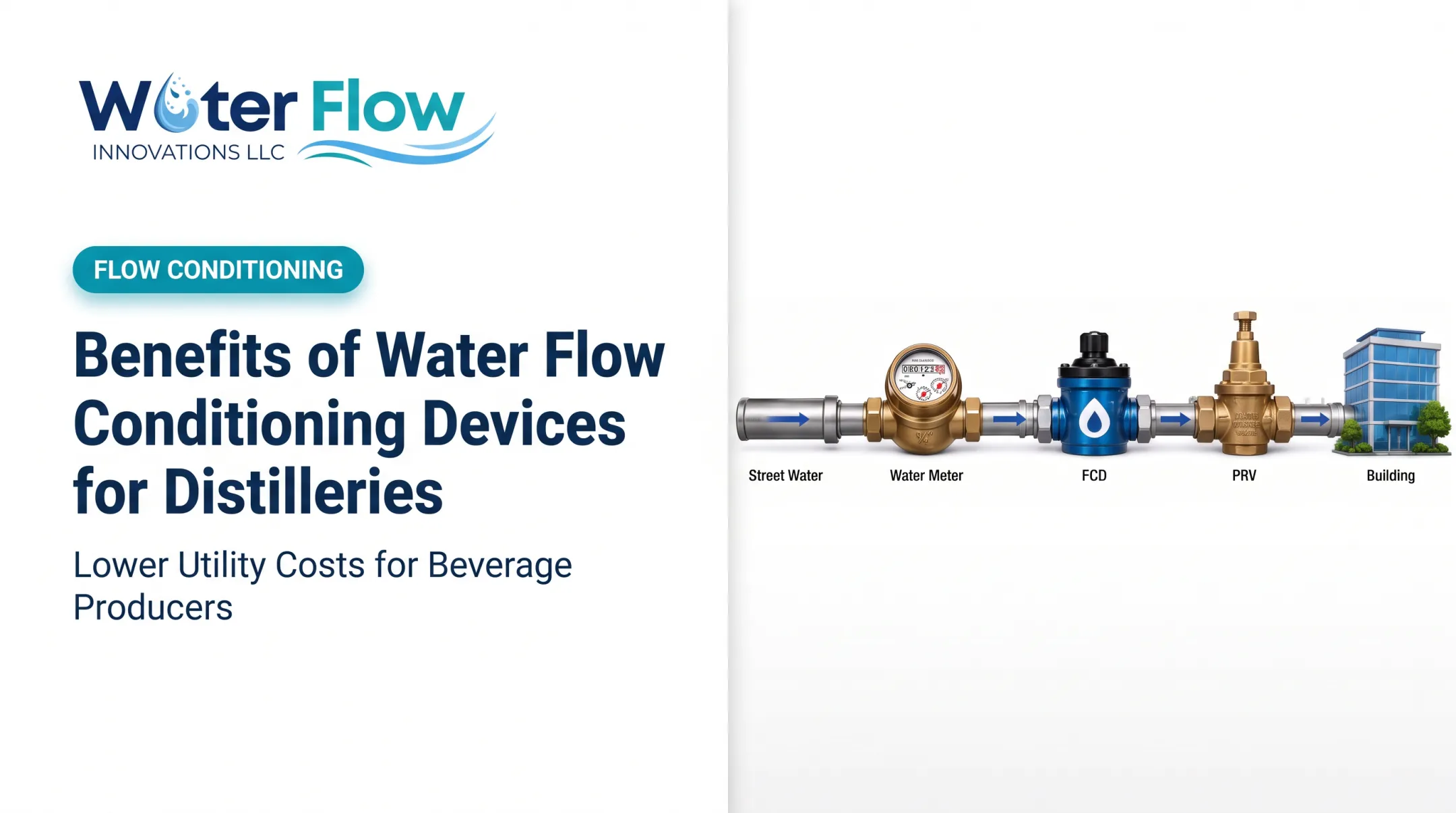
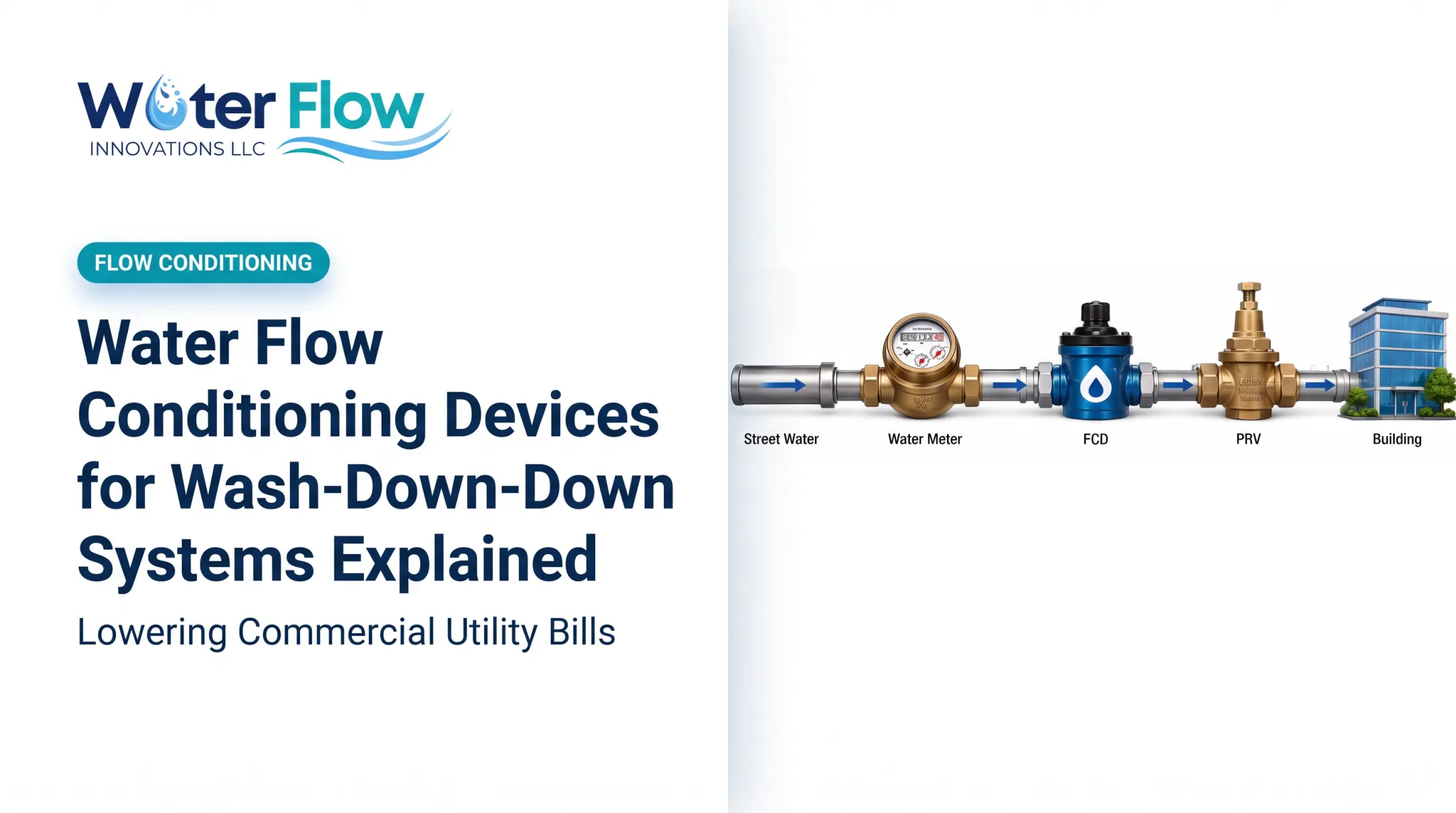
Typical path: incoming municipal supply → conditioning device → meter → winery distribution → cellar, bottling line, or tasting room. The device sits in that narrow window between the street connection and your meter.
For a winery, two factors matter beyond basic function: pressure loss and flow-rate compatibility. A device that drops even a few psi, or cannot handle bottling-line or CIP flow rates, creates new problems instead of solving billing ones.

Water Flow Innovation lists IAPMO, NSF International, ANSI, CAN 61, KIWA, GMP, and SQF certifications for its FCD. Confirm the exact certification scope against your facility's water-contact and regulatory requirements before purchase.
Where Flow Conditioning May Help a Winery
Most wineries run multiple functions off a single incoming meter: cellar work, cleaning and sanitation, bottling, cooling, employee facilities, tasting rooms, and sometimes irrigation. Each use pulls water differently. That variability is where flow conditioning matters most for meter accuracy.
Where Variable Demand Creates Measurement Noise
Facilities with pumps, automatic valves, pressure-reducing equipment, elevation changes, or long pipe runs often see flow conditions change throughout the day.
California's winery process-water order identifies production activities including bottling and cleaning of processing equipment, tanks, and barrels as core winery water uses. Each of those activities is a point where demand spikes and settles quickly.
Common winery triggers for flow instability include:
- Crush-pad wash-down during harvest
- Fermentation-tank clean-in-place (CIP) cycles
- Bottling-line rinse operations
- Irrigation-zone startups
- Cooling equipment cycling on and off
Important Caveat: Flow Conditioning Isn't a Compliance Substitute
A flow conditioner should never replace validated cleaning procedures, water-quality testing, filtration, disinfection, or legally required treatment. It addresses how water is measured, not whether it meets potable or process-water standards.
Which Meter Are You Actually Looking At?
Multi-building wineries often have more than one meter. Before evaluating any device, identify whether the relevant point is:
- The main incoming utility meter
- A process submeter
- An irrigation meter
- A separate billing point for a tasting room or hospitality building
A UC Agriculture and Natural Resources-hosted presentation on a large California winery mapped 3 existing, 2 virtual, and 6 new meter points across supply, bottling, and cellar locations. Virtual meter points are not the same as physically tested utility meters, and that distinction matters when projecting billing impact.
Equipment with minimum or fluctuating flow requirements, such as spray nozzles, rinsing lines, heat exchangers, and pumps, also depends on stable pressure. When flow conditions affect both meter readings and equipment performance, the incoming plumbing arrangement deserves a closer look.
Flow Conditioning Compared With Other Water Strategies
Flow conditioning gets confused with water conservation because both can lower a bill. They're not the same thing.
| Strategy | What it changes | Bill impact vs. actual use |
|---|---|---|
| Flow conditioning | How the meter reads existing flow | May correct billed volume without reducing water drawn |
| Low-flow spray nozzles | Volume delivered per cleaning cycle | Reduces actual water used |
| Closed-loop rinsing | Process design, water reuse | Reduces new-water demand |
| Leak repair | Physical water loss | Reduces actual water used |
| Sediment/carbon filters, RO, softeners | Water quality or mineral content | No effect on meter accuracy |
| UV systems, chemical dosing | Disinfection or chemistry | No effect on meter accuracy |
A flow conditioner shouldn't get credit for reducing real water consumption unless the winery also cuts process demand or confirms lower physical draw with submeters, tank levels, or process data. Bill savings and physical water conservation are two different outcomes, even though they can show up on the same invoice.
Where potable-water standards, product-contact requirements, boiler chemistry, or wastewater permits apply, a winery may need both flow conditioning and conventional treatment equipment. One corrects measurement. The other changes the water itself. Neither substitutes for the other.
How to Evaluate, Select, and Install a Device
Start with data, not a sales pitch.
Build Your Baseline First
Before evaluating any device, collect:
- Several billing cycles of water and sewer charges
- Meter readings over the same period
- Production volumes and operating hours
- Water-quality records
- Notes on unusual events: leaks, line flushing, harvest peaks
Inspect the Incoming Plumbing
Walk the line from street connection to meter and check for:
- Air pockets or high points in the pipe run
- Required straight-run lengths upstream of the meter
- Existing check valves, pressure regulators, or backflow devices
- Pipe diameter changes and any bypass piping
Compare Technical Specifications
When comparing devices, line up these details side by side:
- Design flow range and maximum pressure
- Pressure drop across the device
- Connection size and installation orientation
- Meter compatibility
- Water-contact materials and temperature limits
- Maintenance requirements and service access
Confirm the device carries certifications relevant to your water use — applicable NSF/ANSI standards, GMP or SQF relevance if you're running food-grade processes, and compliance with local plumbing code. A certification label isn't a blanket approval for every application.

Plan the Installation Window
Installation planning should cover:
- Shutdown duration and lockout/safety procedures
- Bypass capacity, valves, unions, and drainage
- Coordination with production and sanitation teams
Schedule around harvest when you can, so crush and sanitation work stay online.
Water Flow Innovation states that its FCD installs in roughly an hour on straightforward configurations. The unit sits immediately after the meter on the consumer side and does not require replacing existing piping.
Buy or lease terms, a six-month money-back guarantee, and a lifetime transferable warranty (stays with the device if the facility changes hands) are available. Confirm current terms with the manufacturer, since program details can shift.
Financial, Utility-Bill, and Sustainability Considerations
Water and sewer charges don't always move together, and that distinction matters for any savings model.
Model Both Charges Separately
Most utilities assume 80-100% of metered water becomes wastewater and calculate sewer charges from metered water consumption, not actual discharge volume. That means a correction to over-registration can lower both charges at once, but only if your utility's sewer billing is tied to the same meter.
Some cities, like Portland, offer approved submeter arrangements for water that doesn't return to the sewer or for metered discharge, which changes the math entirely. Check your specific utility's billing method before projecting anything.
Verify With Normalized Data
Compare pre- and post-installation readings against:
- Production volume
- Operating days
- Seasonal demand shifts
- Any process changes made in the same period
Don't compare raw totals across a non-harvest month and a crush-season month and call the difference "savings."
Treat Vendor Claims as Starting Points, Not Guarantees
Water Flow Innovation reports an average 5-30% reduction in water and sewer bills, a documented maximum of 46%, and that roughly 90% of customers reach ROI in under 12 months, with savings appearing on the next billing cycle. These are company-reported figures tied to its own installed base.

Treat them as a starting range, then validate against your own baseline data and utility bill review.
Connect Verified Savings to Sustainability Reporting
Documented reductions can support ESG, LEED, or internal water-stewardship reporting, but only when the winery can show the measurement method, baseline period, and operational context behind the numbers.
Frameworks like GRI 303 draw a clear line between water withdrawal and consumption figures. Vague "we installed a device and saved X%" claims won't hold up in a formal reporting process without the supporting data trail.
Frequently Asked Questions
What is a water flow conditioning device?
A water flow conditioning device is a plumbing component that manages air, pressure, and turbulence in a water line before the meter. It does not purify, soften, or replace water treatment.
How does a flow conditioning device help a winery?
It can improve metering accuracy, flow stability, and billing precision at the meter. Results still depend on your pipe layout, meter type, and water conditions, so verify performance before assuming savings.
Does a flow conditioner reduce the amount of water a winery uses?
Not directly. It can reduce over-registration at the meter, which is different from physical water conservation. Process optimization, leak repair, and water reuse are the actual conservation strategies.
Can a flow conditioning device affect both water and sewer bills?
Yes—if your utility calculates sewer charges from the same water meter. Confirm that billing structure before projecting any sewer savings.
Is a flow conditioning device safe for potable or process water?
Verify the specific device's material certifications, intended use, and regulatory approvals before connecting it to any potable or process line. Certification scope varies by product and application.
How can a winery verify whether a flow conditioner is working?
Compare baseline and post-installation meter readings against production volume and seasonal demand. Then review several utility billing cycles and confirm system pressure is unchanged.