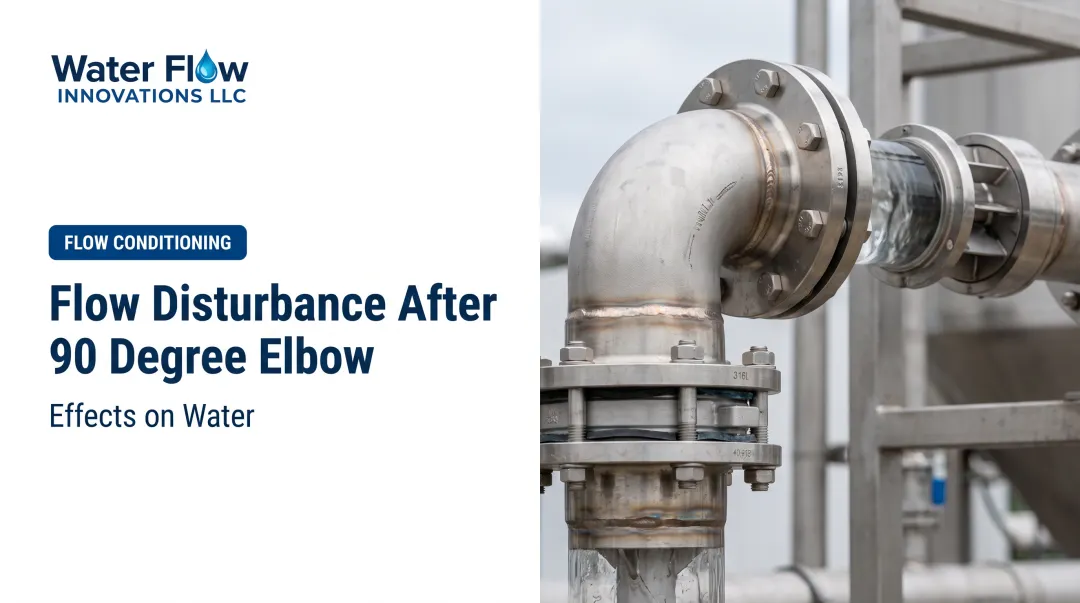

But every time fluid changes direction through an elbow, it leaves something behind: a swirling disturbance called secondary flow. Engineers often treat elbows as simple, low-risk fittings. In reality, the vortices they generate can distort velocity profiles for dozens of pipe diameters downstream, throwing off flow meter readings, straining pumps, and accelerating wear at fitting exits.
This guide breaks down what secondary flow after an elbow actually is, how it forms, and why it matters for anyone responsible for accurate measurement or utility costs.
Key Takeaways
- Secondary flow is a rotational motion (Dean vortices) layered on top of the main flow, caused by an elbow's curvature
- Velocity profiles stay distorted well beyond the elbow — sometimes tens of pipe diameters downstream
- Distorted flow makes meters misread, raises pressure drop, and drives localized erosion
- Fixes include long straight-pipe runs, flow straighteners, or certified flow conditioning devices
What Is Secondary Flow After an Elbow?
Secondary flow is a pair of counter-rotating vortices (often called Dean vortices) superimposed on the primary axial flow as fluid moves through a curved pipe or elbow. The effect is real and shows up in instrument readings and system performance.
Here's why it happens: as fluid rounds a bend, centrifugal force pushes the faster-moving core of the flow toward the outer wall. Meanwhile, slower fluid near the boundary layer gets pushed toward the inner wall. This uneven push sets up a circulating pattern that persists downstream long after the bend itself.
Secondary flow is not the same as generic turbulence (though the two can coexist), and it is distinct from the primary directional change caused by the bend itself.
Even with modern piping materials and design software, secondary flow hasn't gone away. Any time fluid moves through a curve, this physics applies, regardless of pipe size, material, or how well the system is engineered otherwise.
Single vs. Double Elbows
A single 90-degree elbow produces a fairly symmetric vortex pair that decays over distance. Two elbows installed in different planes, common in tight mechanical rooms, create a compounded spiral swirl.
A 2013 experimental study on out-of-plane double elbows found that at high Reynolds numbers, 60-80% of the secondary flow energy was still present at 7 pipe diameters downstream, with little change through 8 diameters. That's a much longer-lived disturbance than most engineers assume.

How Does Secondary Flow Develop After an Elbow?
Secondary flow doesn't appear instantly and then vanish. It moves through distinct stages as fluid travels through and past the bend.
Initiation at the Bend
The moment fluid enters the curved section, centrifugal acceleration acts unevenly across the velocity profile. It starts automatically whenever flow velocity and pipe curvature cross a certain threshold. Tighter bend radii and higher velocities simply make the resulting vortices stronger.
Vortex Formation and Distortion
A pressure differential builds between the inner and outer bend walls. This drives boundary-layer fluid to migrate sideways, forming the counter-rotating vortex pair. The result:
- The normal symmetric velocity profile skews into a distorted, sometimes double-peaked shape
- The fastest-moving fluid ends up off-center
- Pump loading and sensor placement decisions made assuming a centered profile become inaccurate
Decay and Redevelopment
Secondary flow gradually dissipates as fluid travels downstream, but there's no single "magic number" of diameters where it disappears. Research findings vary widely by geometry and disturbance type:
| Disturbance Type | Reported Recovery Distance |
|---|---|
| Sharp single elbow (turbulent) | Roughly 10D–40D depending on Reynolds number (2024 MDPI study) |
| Out-of-plane double elbow | 60–80% of energy remained at 7D–8D |
| Turbulent swirl, smooth pipe | Up to 89D needed to reduce swirl angle below 2 degrees |

Pipe roughness, Reynolds number, and additional downstream fittings all affect how quickly (or slowly) the flow redevelops. This matters most for instrumentation: any meter or sensor placed within this developing zone is reading a distorted signal, not true flow.
Downstream Impact
The end result of unresolved secondary flow includes uneven velocity distribution, localized turbulence, and, at certain fitting geometries, air entrainment risk. This cascades into real operational problems:
- Flow meters can over-read or under-read depending on swirl direction and meter technology
- Pumps experience uneven loading and increased vibration risk
- Elbow exits can see localized erosion or cavitation
One 2023 water meter study found a specific meter model undercounting by as much as 12% downstream of double elbows, while a different meter model stayed within tighter tolerance under the same conditions. The error is real, but it is meter- and configuration-specific, not a fixed industry number.
Why Secondary Flow Matters for Flow Measurement and Utility Costs
Most water and utility meters are calibrated assuming a fully developed, symmetric flow profile. Secondary flow after an elbow directly violates that assumption.
When turbulence and entrained air pass through the measurement zone, many meters interpret that disturbance as additional flow volume. The practical result: facilities get billed for water they never actually used.
Water Flow Innovation's Flow Conditioning Device (FCD) corrects that over-reading at the meter. The FCD uses a four-component system:
- Air and gas separation: stabilizes flow so bubbles don't form, producing a homogeneous water column through the meter
- Pressure regulation: reduces water hammer and pressure surges from cycling equipment
- Check valve (on select models): prevents reverse flow and limits air re-entry
- Turbulence elimination: slows velocity enough to prevent vortex formation at the meter
Facilities across manufacturing, healthcare, and hospitality have installed flow conditioning and seen documented utility bill reductions typically in the 5-30% range. The highest recorded single result is 46%, all without any change in actual water usage. Because savings show up on the very next billing cycle, the correction is verifiable almost immediately.

This accuracy also matters beyond the bill. Documented, corrected metering data supports ESG reporting, LEED tracking, and other sustainability programs where water usage figures need to hold up to scrutiny.
Where Elbow-Induced Secondary Flow Is Commonly Encountered
Elbows are unavoidable in most real-world piping layouts. Secondary flow that interferes with measurement shows up in a few predictable spots:
- Pump suction and discharge lines: Short-radius elbows close to a pump nozzle create non-uniform flow and raise vibration risk
- Meter runs: Especially where two elbows sit close together in different planes
- Tight mechanical room layouts: Space constraints force back-to-back elbows with no room for straight-pipe buffers
- HVAC piping: Frequent direction changes in confined spaces
Conditions that make the problem worse include:
- High flow velocity
- Out-of-plane double elbows
- Undersized straight-pipe runs before instrumentation
Older municipal buildings, multifamily properties, and hospitals tend to see the most severe issues. Retrofit piping often winds through whatever space is available, leaving no room to fix secondary flow with distance alone.
Mitigating Secondary Flow: Design and Retrofit Solutions
The textbook engineering fix is straightforward: specify enough straight pipe length (measured in pipe diameters) upstream of the meter or sensitive equipment. In new construction, that's manageable. In an existing building with a meter jammed next to two elbows and a wall, it usually isn't.
That's where flow straighteners and flow conditioners come in. These devices artificially accelerate profile redevelopment, allowing accurate readings even where there's no room for a long straight run.
Why this approach works for retrofits specifically:
- Installs into the existing line with no re-piping or layout redesign
- Installs in about an hour after a site survey of pipe size, meter type, and nearby elbows
- Works across pipe sizes from 1/2" to 12" and with any meter type
- Adds negligible pressure loss, so system performance stays intact

For facilities where a meter sits close to an elbow with no straight-run buffer available, a flow conditioner retrofit is often the only practical path to accurate readings.
Conclusion
Secondary flow is a physical, predictable consequence of directional change in piping. It is not a design flaw or a sign of poor installation. Every elbow creates it, and the resulting vortices persist far longer than most facility teams expect.
Understanding this phenomenon changes how you approach meter placement, piping layout decisions, and billing accuracy audits. If a meter sits close to an elbow, the readings deserve a second look.
Frequently Asked Questions
What is secondary flow?
Secondary flow is a rotational flow pattern superimposed on the primary flow direction, commonly caused by curvature such as elbows or bends. It appears as a pair of counter-rotating vortices distinct from general turbulence.
How much do 90-degree elbows affect water flow?
A single 90-degree elbow can distort velocity profiles for anywhere from 10 to 40 pipe diameters downstream, depending on flow conditions. This affects both measurement accuracy and pressure drop.
How far downstream does secondary flow persist after an elbow?
There's no universal number. studies show recovery ranging from roughly 10D for simple single elbows up to 89D for severe double-elbow swirl. The right distance depends on elbow configuration, Reynolds number, and pipe roughness.
Can secondary flow cause water meters to read incorrectly?
Yes. Disturbed flow profiles can cause meters to over-read or under-read depending on the meter type and swirl pattern. Flow conditioning devices correct this by stabilizing flow in the measurement zone.
Do two elbows in series make secondary flow worse?
Generally, yes, especially when the elbows sit in different planes. Out-of-plane double elbows create compounded swirl that can persist much farther downstream than a single elbow's disturbance.
What is the difference between primary flow and secondary flow?
Primary flow is the dominant, bulk movement of fluid along the pipe's axis. Secondary flow is the weaker, rotational motion superimposed on top of it, generated by curvature at bends and elbows.
If 89D of straight run isn't available, what are the options?
Conditioning the flow rather than lengthening the run. A custom-built device fits at the supply connection in about an hour, with a brief water shutoff at the meter connection, so no elbow has to be relocated and no pipework rerouted.
What happens if the swirl correction doesn't change the bill?
The device carries a 6-month money-back guarantee on its purchase price, with installation cost non-refundable, so it can be returned if metered consumption does not measurably fall. A lifetime transferable warranty against defects also applies.