
A growing body of research shows that commercial water meters can register air, micro-bubbles, and turbulent flow as if they were liquid volume. One 2025 peer-reviewed study found that some mechanical water meters registered discharged air as water under intermittent-supply conditions, conditions that resemble the rapid on-off draws a batch plant produces dozens of times a day.
None of this means a plant is leaking water or over-batching. It means the gap between what the mix design calls for and what the meter bills for deserves a second look.
This article covers how flow conditioning differs from flow measurement and PLC control, where it fits in an RMC plant, and how to build the business case from your own bills, not a generic estimate.
Key Takeaways
- A flow conditioning device improves meter conditions; it does not replace meters, PLCs, batch controllers, leak detection, or hydration stabilizers.
- Build the business case on water and sewer charges, meter type, pipe layout, pressure conditions, and billing history.
- Confirm concrete-process compatibility, pressure-drop limits, certifications, and installation location before approving any project.
- Base savings figures on your own bills and a documented baseline, not an industry average.
Why Water Flow Control Matters in Ready-Mix Concrete Plants
Ready-mix plants use water well beyond the mixer. On a typical yard, water also moves through:
- Batching and mixer rinsing
- Truck and drum washdown
- Aggregate washing
- Dust suppression
- Employee facilities and general site cleanup
Most of these uses pass through the same municipal service meter, so a single reading can obscure what's actually happening on the yard.
Your mix design controls the water that goes into the drum, not what the utility bills you for. The batch computer measures and logs that figure independently. The municipal meter sits upstream and measures everything else moving through the service line. If air, pressure swings, or turbulence enter that flow, the meter can log more than you actually received.
This isn't theoretical. Production data from ready-mix facilities shows that a batch-water draw typically lasts 30 to 60 seconds and pulls hard enough to drop line pressure and pull air into the water column. A plant dispatching 40 to 80 loads a day repeats that cycle dozens of times before lunch. Add drum washes, mixer rinses, and end-of-day washdown, and the number of high-turbulence events climbs further.

Independent research on mechanical water meters found that air discharged through a meter can be registered as water under intermittent-supply conditions. That's a lab finding, not proof it's happening at your plant, but it's a documented mechanism worth checking.
Why this can show up twice on your bill:
- Many utilities calculate sewer charges as a function of metered water consumption, assuming 80 to 100% of metered water becomes wastewater.
- If the water side is over-registering, the sewer side often inherits the same inflated number.
- Billing structures vary by city and utility, so the exact sewer impact has to be confirmed against your own tariff.
A plant can run a clean batch, hit every slump target, and still carry a billing problem that has nothing to do with concrete quality. A water-bill review or meter comparison is the only way to tell the difference between normal production and an inflated meter.
How Water Flow Conditioning Devices Work
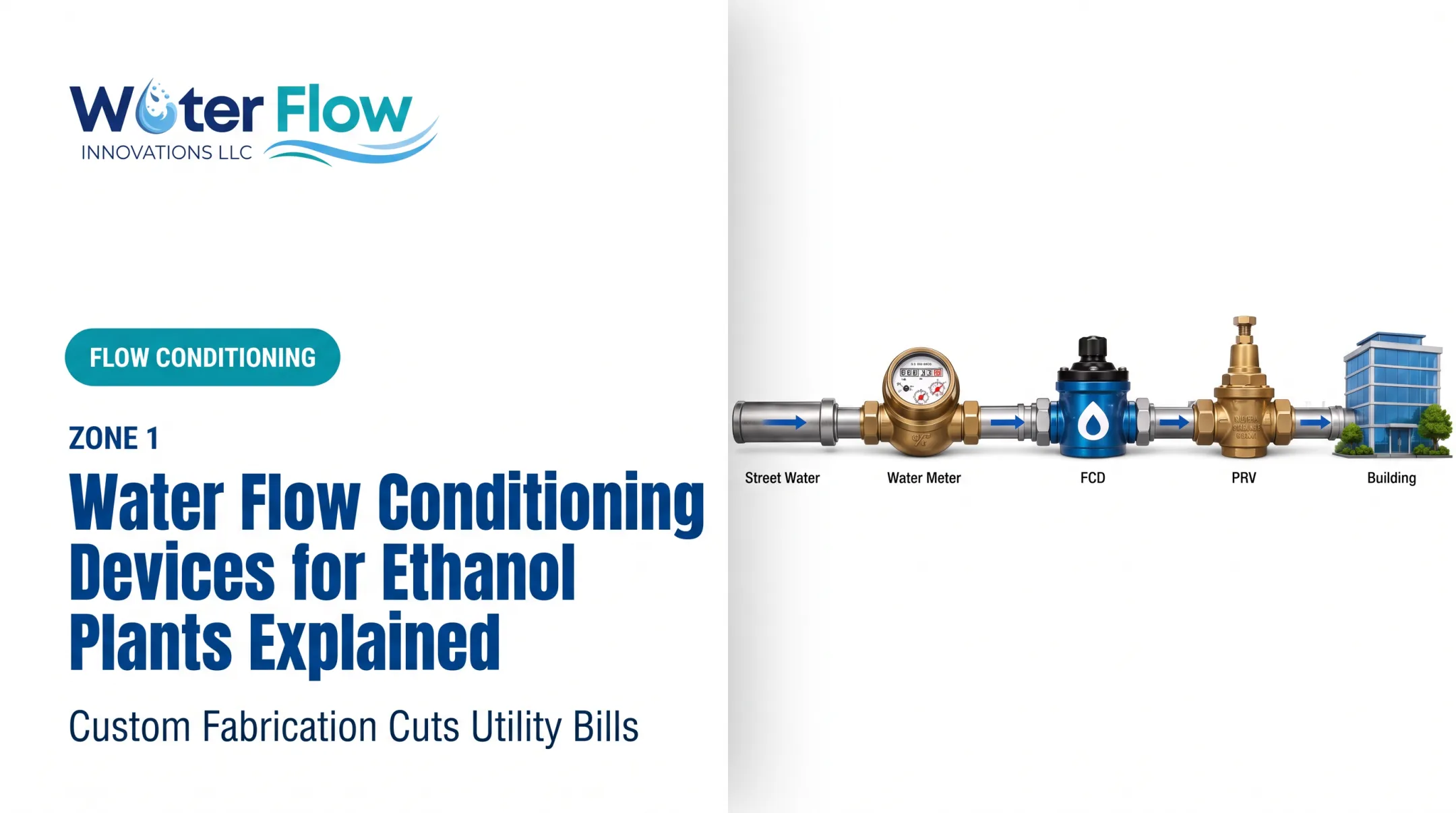
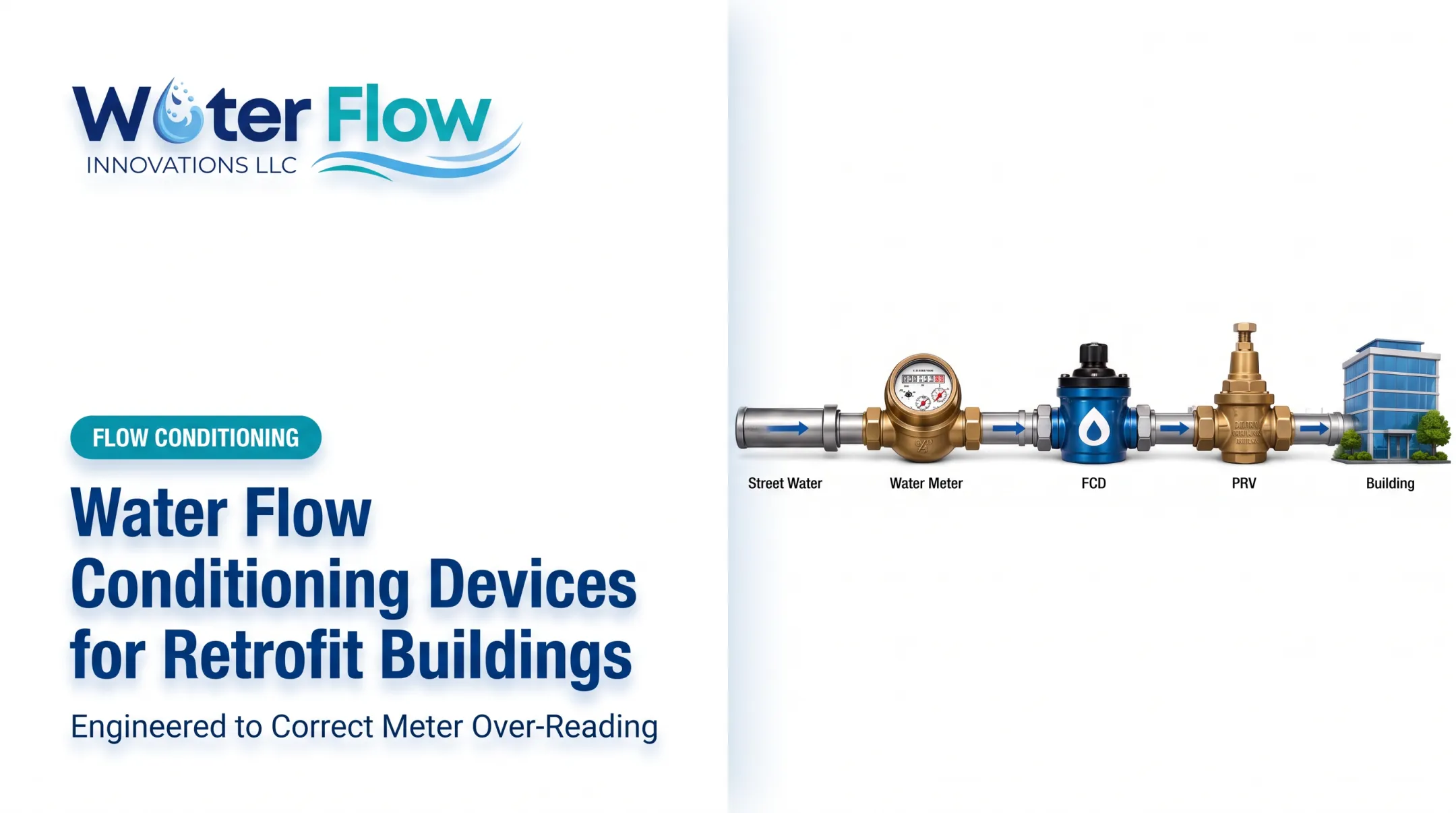
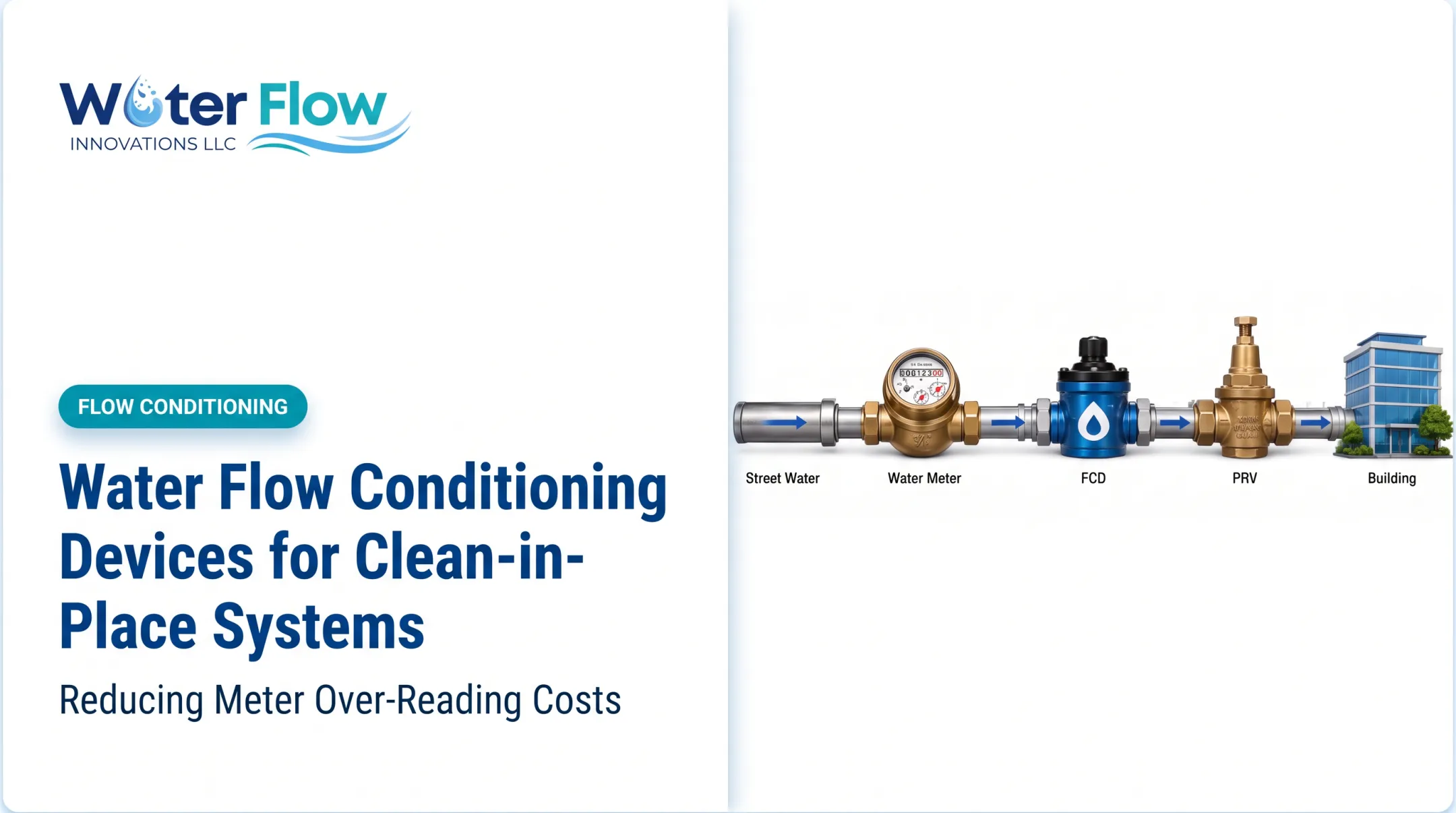
A flow conditioning device is a mechanical fitting installed in the water line, usually right after the meter. It smooths out the flow profile before or as water reaches the measurement point. It isn't a meter, totalizer, pressure regulator, backflow preventer, strainer, or PLC-controlled valve.
Those components measure, control, or protect the system. A conditioning device changes the physical condition of the water itself: reducing entrained air, stabilizing pressure, and breaking up turbulent or swirling flow.
Why does that matter? Research from the Pacific Northwest National Laboratory notes that nearby fittings and valves can disrupt a meter's flow profile. Straight-run requirements also differ by meter type—turbine meters are generally more sensitive to upstream disturbance than positive-displacement meters. The fix has to match the meter you actually have.
Water Flow Innovation's FCD is built around four functional elements:
- Air and gas separation: Creates back-pressure and a more uniform water column ahead of the meter.
- Pressure regulation: Reduces water hammer and pressure surges from on-off batch cycling.
- Check-valve protection: Prevents reverse flow through the meter (not required on every installation).
- Turbulence reduction: Slows velocity enough to break up vortex patterns that cause over-counting.
Not every plant needs all four elements at full capacity:
- Stable pressure, short straight run: Lean on turbulence control and air separation
- Frequent surges from simultaneous batch draws: Lean harder on pressure regulation
Pressure loss matters because an RMC plant can't afford to lose flow during peak demand. Batching, washdown, and truck turnaround all compete for water at the same time of day.
A device that drops pressure meaningfully solves a billing question while creating a production one. Negligible pressure loss is the baseline requirement before a device is worth installing at all. Ask any supplier for engineering specifications or test documentation, not a marketing claim.
Water Flow Innovation's FCD is custom-fabricated per facility for pipe sizes from half an inch to 12 inches and any meter type. It is built in 316L stainless steel in the US and carries IAPMO, NSF, ANSI, CAN 61, KIWA, GMP, and SQF certifications.
Those certifications confirm drinking-water contact, material, and manufacturing-practice requirements within each listing’s scope—what the device is built from and where it is approved for use, not a promised percentage of bill savings. Ask for the exact product listing under each certification before relying on it.
Where Flow Conditioning Can Help in an RMC Plant
Most ready-mix plants have one municipal service meter feeding the whole site, which makes installation straightforward: immediately after the meter, ahead of any pressure-reducing valve.
Plants running multiple meters—such as a separate line for a batch plant and an aggregate yard—need each metered intake evaluated on its own. A device sized for one service line won't fix a different meter down the yard.
Signs worth investigating before calling anyone:
- Water costs climbing faster than production volume, year over year
- Water and sewer charges rising together without a matching usage change
- Pressure drops when two or more batch systems draw simultaneously
- Metered intake that doesn't reconcile with batch-computer water totals
- A meter reading that looks inconsistent cycle to cycle with no obvious cause
What it won't fix
A flow conditioning device isn't a catch-all fix. It will not:
- Find a physical leak
- Correct an inaccurate batch scale
- Fix an aggregate-moisture adjustment
- Stop excessive washdown practices
- Repair a faulty valve
- Catch unauthorized water use
- Correct a utility billing error
Those issues need a leak survey, scale calibration, or a direct conversation with your utility.
Upstream of plant controls
This is separate from what your PLC, HMI, SCADA system, or batch controller already handles. Those systems record and control water additions inside the plant, which is why mix design holds steady batch after batch.
A conditioning device works upstream of all that: it addresses the hydraulic condition of water arriving at the meter, before the water is measured for billing.
| Technology | What it's designed to solve |
|---|---|
| Flow conditioning | Meter over-registration from air, turbulence, or pressure instability |
| Flow metering | Measuring and totalizing water volume |
| PLC / batch control | Automating and recording in-plant water and admixture additions |
| Leak detection | Identifying physical water loss from the system |
| Water conservation | Reducing actual water consumption or reuse |
Each one solves a different problem. Confusing one for another is how plants end up buying the wrong equipment, or expecting a conditioning device to fix something it was never built to touch.
Operational, Financial, and Sustainability Benefits
Correcting a meter's registration doesn't touch your mix design, truck loading, water pressure, or production schedule. That's the operational appeal, but it still needs site validation, not an assumption.
Installation is designed to be low-disruption: on the main service line, after the meter, in about an hour, with no mix-design or batch-system changes. Before signing off, confirm the installation won't affect batching, washdown pressure, backflow protection, or production uptime at your specific site.
Water Flow Innovation reports an average water-and-sewer bill reduction of 5-30%, with a 46% highest documented single result. These are company-reported figures, not a guarantee for every facility. The real number for your plant depends on your tariff, your billing formula, and your own meter data. Confirm projected savings against your actual billing cycle before counting on them.

Where the financial impact can show up:
- Lower metered water consumption charges
- Lower sewer charges when wastewater fees track metered water (utilities often assume 80 to 100% becomes wastewater)
- Documentation for ESG reporting, LEED water-metering credits, or internal sustainability tracking when baseline and methodology are recorded
Those figures support water-intensity metrics and sustainability disclosures because the device corrects meter registration rather than changing how much water the plant actually uses.
A basic business-case framework:
- Baseline water and sewer bills across several cycles
- Calculate production volume and billed water per unit of concrete
- Assess sewer-fee exposure under your local tariff
- Include installation cost
- Define the verification period and payback assumptions
How to Evaluate and Install a Device
Before selecting equipment, build a baseline that reflects normal operations—not one unusual production week. Pull several billing cycles of:
- Water and sewer statements
- Production volumes and meter readings
- Operating schedules
- Major washdown or usage changes
A single month misses seasonal swings in batching and washdown demand, so use enough history to show how the plant actually runs.
Information a supplier or engineer needs before sizing anything:
- Service-line diameter and pipe material
- Meter make, model, and type
- Flow range, pressure, and water temperature
- Backflow arrangement and available straight-run length
- Access conditions and applicable local plumbing codes
Confirm up front that the device won't interfere with potable-water requirements, batch controls, fire-line protection, backflow prevention, or your utility's ownership of the meter. Fire lines are off-limits for this kind of device entirely, so check local permitting and inspection obligations before scheduling anything.
Installation on a live plant needs its own plan:
- Isolation and shutdown window, coordinated with dispatch
- Bypass options if continuous supply is required
- Lockout/tagout procedures
- Flushing, pressure testing, and leak checks after installation
- Sign-off from production before resuming normal operations
Water Flow Innovation's documented process supports this kind of planning. Installation is typically about an hour, regardless of pipe size or meter type.
Confirm commercial terms before you budget:
- Purchase or lease options
- Six-month money-back guarantee (installation cost excluded)
- Lifetime warranty that transfers if the plant changes ownership
Verify current terms directly before locking numbers into a project budget.
How to Verify Performance and Build a Defensible ROI Case
A single billing cycle isn't enough to prove anything. Weather, production mix, washdown frequency, and even a meter swap can shift a bill independent of any device you install. Build a before-and-after measurement plan across multiple billing cycles. Capture:
- Water and sewer bills plus meter readings
- Production volume and operating hours
- Unusual water-consuming events (washdowns, leaks, meter swaps) Compare, don't assume:
- Water and sewer charges separately, then combined
- Any tariff changes or rate increases during the comparison window
- Meter replacements, leak repairs, or production changes that could distort the numbers
- Estimated versus actual bills from your utility Track indicators specific to your plant, not generic industry figures:
- Billed gallons per cubic yard of concrete produced
- Utility cost per unit of production
- Peak-flow stability and pressure at critical points
- Any production interruptions tied to the installation
Separate lab context from plant proof
Published research is useful context, not proof of your outcome. A laboratory study in the ASME Journal of Fluids Engineering tested a flow conditioner against disturbed flow in an orifice-meter setup, which supports the flow-conditioning mechanism. It is not a documented before-and-after water-and-sewer case from a US ready-mix plant. No independent public study of that exact scenario exists, so treat blanket savings percentages as unverified until your own data confirms them.

Company-reported figures vs. your baseline
Water Flow Innovation reports average bill reductions of 5–30%, a highest documented result of 46%, savings on the next billing cycle, and roughly 90% of customers reaching ROI within 12 months. Those are company-reported figures. Ask for the methodology, customer context, and limitations behind them. Then measure your plant against your own baseline before calling it a result.
Frequently Asked Questions
What is the 90-minute rule for concrete?
Historically, ASTM C94 capped discharge at 90 minutes or 300 mixer revolutions after water contacted cement. Since the 2021 edition, the limit is a time agreed by purchaser and producer, so check your project's specification. This is separate from water-meter conditioning.
What is a hydration stabilizer in concrete?
A hydration stabilizer is an admixture that delays cement hydration for extended delivery, returned concrete, or wash-water recycling. It changes concrete chemistry, not the flow profile or registration of a utility water meter.
What is a PLC in an RMC plant?
A PLC (Programmable Logic Controller) automates batching, water and admixture additions, equipment sequencing, alarms, and data recording. It runs plant operations; flow conditioning addresses hydraulic conditions at or before the meter.