That growth shows up on utility bills. Water and sewer rates keep rising in cities across the US, wastewater treatment surcharges add up fast, and regulators expect documented water balances that leave no room for guesswork.
High water use in pharma is expected. GMP purity requirements for WFI, Purified Water, and cleaning validation demand it. What's not expected, and what quietly drains budgets, is water spend driven by inefficiency, aging infrastructure, or billing inaccuracies rather than actual production needs.
This article breaks down how those costs build up, what drives them, and the practical strategies plants can apply at the design table, on the floor, and in their utility relationships.
Key Takeaways
- Water costs stack across API synthesis, formulation, CIP/sterilization, and utilities—not one line item
- Purification, cleaning intensity, cooling/steam load, and rising utility rates drive costs up
- Billing and metering errors inflate water and sewer bills even when usage is flat
- Cut costs in three places: design choices, day-to-day operations, and bill/meter accuracy
- Fixing the real cost driver beats blanket usage cuts every time
How Costs Around Water Use Typically Build Up
Water costs in a pharma plant rarely show up as a single expense. They build layer by layer, tied to how much the facility produces and how tightly regulators control the process.
Gradual buildup tracks production volume. Every new batch, product line, or facility expansion adds proportional demand across CIP, WFI generation, and cooling systems. A plant that doubles output doesn't just double API synthesis water; it multiplies cleaning cycles, rinse water, and utility load right alongside it.
Regulatory Triggers Add Sudden Cost
Sometimes the increase isn't gradual at all. The revised EU GMP Annex 1, which took effect in August 2023 for sterile drug manufacturers, tightened contamination control requirements across the board.
Facilities now must maintain an active Contamination Control Strategy. In many cases that means more frequent cleaning and sanitization cycles than before.
Most of this cost hides inside a combined water/sewer utility bill until something forces a closer look:
- A formal water audit triggered by a capital project
- A municipal rate increase that forces a line-by-line budget review
- An expansion project requiring closer scrutiny of existing capacity
Meter over-reading is the sneakiest contributor of all. A meter over-registering flow due to turbulence can inflate bills for years before anyone traces the discrepancy back to the hardware rather than actual consumption.
Key Cost Drivers for Water Use in Pharmaceutical Manufacturing
Not every gallon of water costs the same to deliver. Where that gallon ends up in the process, and what purity grade it needs, determines most of the expense.
Purification and Treatment Complexity
Purified Water and WFI don't come out of the tap. Getting there requires multi-stage systems:
- Pretreatment (filtration, activated carbon, softening)
- Reverse osmosis, often double-pass
- Electrodeionization or ultrafiltration
- Continuous-loop storage kept hot or constantly circulating to prevent microbial growth
Each stage adds pumping energy, membrane replacement, chemical dosing, and reject water that never reaches the process, all before a single vial gets filled.
Cleaning and Sterilization Intensity
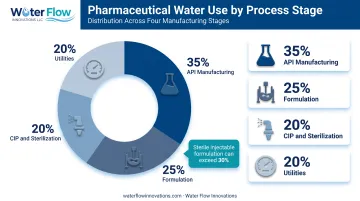
Contamination control isn't optional, and it isn't cheap in water terms. According to industry water-management research from A3P, water use across a typical pharmaceutical facility breaks down roughly like this:
| Process Stage | Share of Water Use |
|---|---|
| API manufacturing | 25%-35% |
| Formulation | 5%-30% |
| CIP and sterilization | 15%-20% |
| Utilities | 15%-20% |
Formulating sterile injectables, ophthalmic solutions, and infusion products can push water use above 30% for that stage alone, a direct result of repeated CIP cycles and final WFI rinses.
Cooling, Steam, and Utility Demand
Cooling towers, boilers, and steam generation round out the utility side of the ledger. Freeze-drying, sterilization, and general HVAC cooling all pull from the same supply, and little of it appears as production water on the bill.
Billing and Metering Accuracy
Not every dollar on a water bill reflects water the plant actually used. Aging municipal infrastructure and turbulent flow at the meter can cause over-registration, where the meter reports more volume than actually passed through. That's a billing accuracy issue, not a consumption issue, yet it inflates costs identically to real waste.
Correcting turbulence and air entrainment at the meter can bring billed volume back in line with true throughput—without changing process water use.
The dominant driver shifts by facility type:
- API synthesis plants: process water and solvent recovery dominate cost
- Formulation facilities: CIP cycles and final-product water quality drive spend
- Sterile injectable manufacturers: combined WFI, CIP, and sterilization load—often the highest water cost per unit in the industry
Cost-Reduction Strategies for Water Use in Pharmaceutical Manufacturing
Effective strategies depend on where you're standing: designing a new line, running daily operations, or negotiating with a municipal utility. Each stage calls for different fixes, and mixing them up wastes effort chasing savings in the wrong place.
Strategies That Reduce Costs by Changing Decisions
The cheapest gallon of water is the one you never had to treat in the first place. Decisions made at the design and procurement stage lock in water costs for the life of the facility, often 15 to 20 years.
Start with an audit, not a purchase order. Before committing capital, map consumption by process stage: API synthesis, formulation, CIP, and utilities. This shows where the highest-impact targets actually sit, instead of guessing based on which system looks biggest.
From there:
- Specify high-efficiency treatment technology upfront. Multi-stage RO, EDI, and ultrafiltration systems with built-in concentrate recovery cost more at purchase but cut ongoing discharge volume for years. Retrofitting later almost always costs more.
- Right-size WFI and Purified Water capacity to actual demand. Excess design margin feels safe, but oversized systems run inefficiently at partial load, wasting both water and the energy needed to heat and circulate it continuously.
- Build water-footprint targets into product design from the outset. Treating conservation as an afterthought locks in avoidable waste that's expensive to fix retroactively.
These choices align with WHO guidance on pharmaceutical water systems, which recommends sizing capacity for both minimum and peak demand while avoiding inefficient on/off cycling—whether you're specifying a new RO train or a cooling tower.
Strategies That Reduce Costs by Changing How Water Use Is Managed
Once a facility is running, the biggest wins come from control and visibility, not new capital projects.
- Deploy real-time metering across high-consumption zones. Dashboards that flag leaks, overflows, and abnormal usage patterns catch problems in hours instead of months, before they become a mysterious spike on next quarter's bill.
- Optimize CIP cycles with demand-based rinse protocols. Fixed-time cleaning schedules run long "just in case." Automated, sensor-driven rinse cycles cut water use without touching validated cleaning efficacy: the cycle stops when the rinse water tests clean, not when a timer runs out.
- Train staff on water-conscious practices. Equipment left running between batches and hoses left open during changeovers move the needle more than most plants assume.
Then verify the bill itself. Many facilities assume a high water bill simply means high consumption. That's not always true.
Turbulent flow and air entrainment, common downstream of pumps and from pressure swings caused by CIP cycling and WFI stills, can cause a water meter to over-register actual flow. The facility pays for water it never received.
This matters more in pharmaceutical facilities than almost anywhere else. Producing one gallon of WFI typically requires 5-10 gallons of municipal input through the purification train, so every over-read gallon at the meter gets amplified across the entire purification cost structure, not just the utility bill.
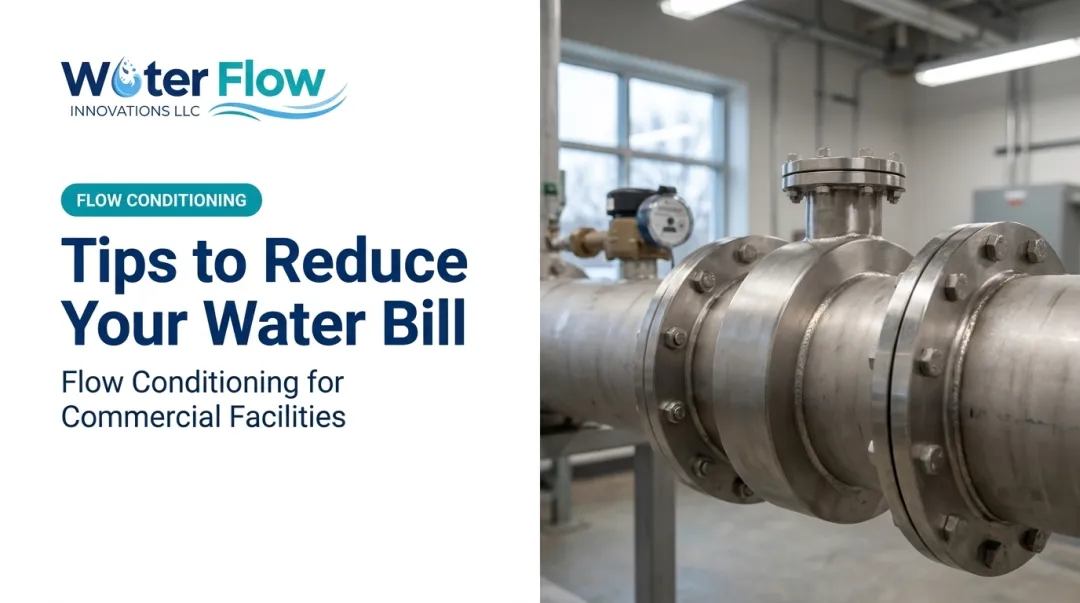
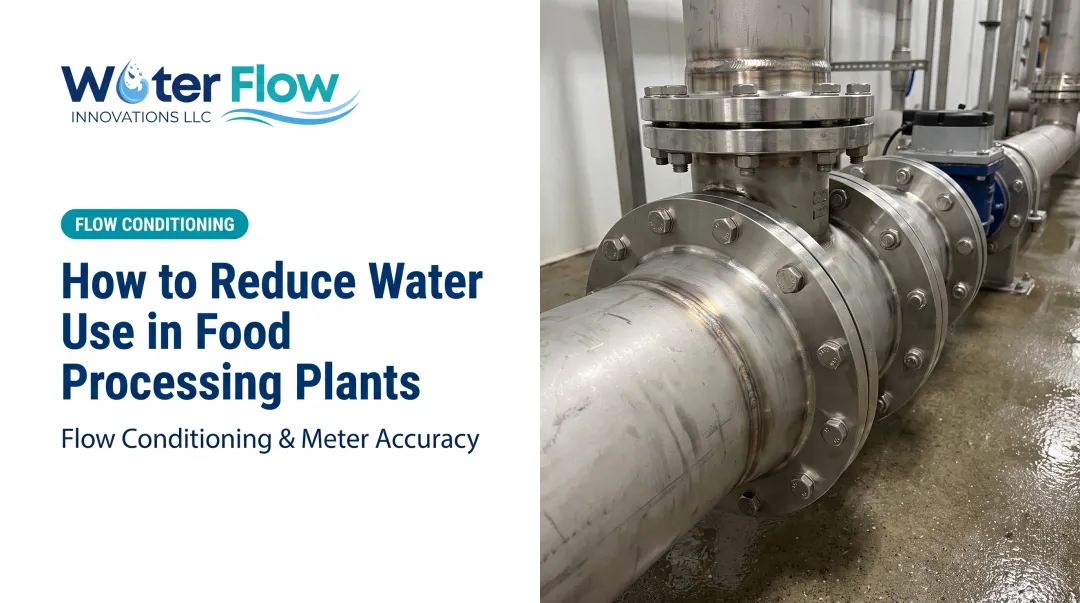
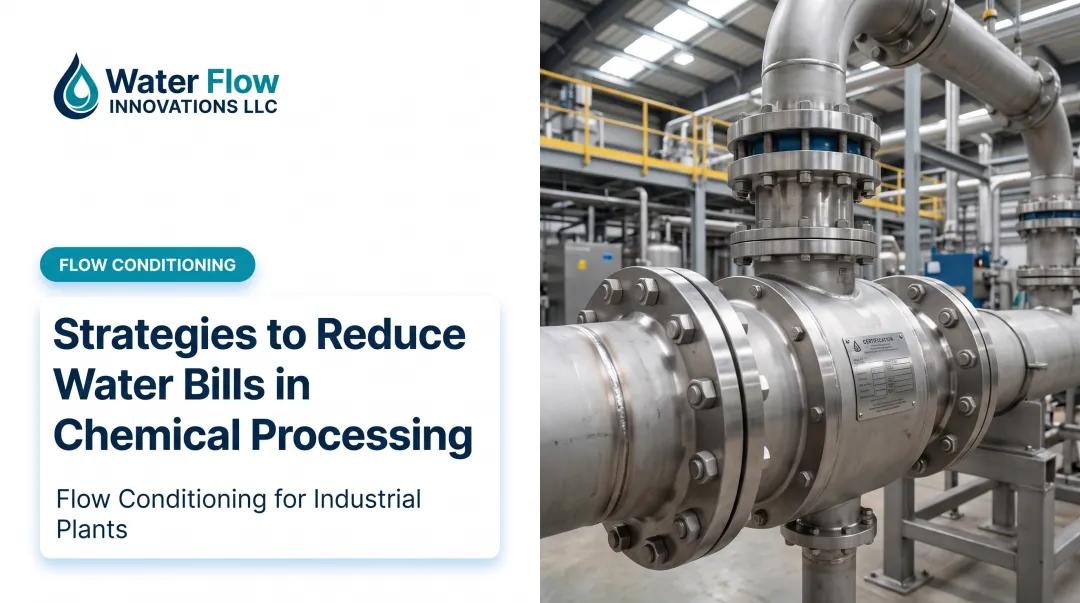
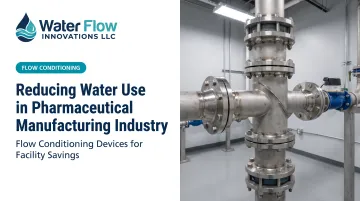
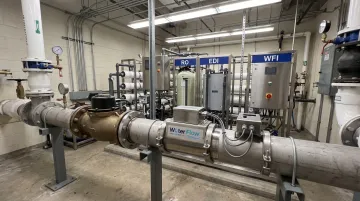
Water Flow Innovation's Flow Conditioning Device (FCD) addresses this directly. It installs immediately after the municipal meter, upstream of RO, EDI, and WFI generation systems, and corrects the turbulence and air entrainment that cause over-registration. Because it sits outside the validated purification boundary:
- Feed pressure to RO, EDI, and WFI systems stays unchanged
- No process revalidation is triggered
- Installation takes about an hour, typically scheduled off-shift
The correction appears on the very next billing cycle, with documented reductions in the 5-30% range across installations (46% at the high end).
For pharma plants, there's a second benefit: correcting the meter also tightens cGMP water balance records, closing the gap between metered intake and documented purified water output that QA teams often have to explain during audits.
Strategies That Reduce Costs by Changing the Context Around Water Use
Sometimes the process is fine. The environment around it is the real cost driver.
- Regional water stress changes the math. The World Resources Institute identifies 25 countries facing extremely high water stress, withdrawing at least 80% of available supply annually. Facilities there face different rate pressure and reuse incentives.
- GMP restrictions limit where reuse makes sense. Recycled water can't replace WFI or Purified Water at critical process points, that's a hard regulatory line. Treated water works fine for cooling towers, boiler feed, non-GMP cleaning, and irrigation instead.
- Work with your municipal utility on infrastructure issues outside your fence line. Aging meters and supply-side turbulence aren't always caused by the facility, and they're not always something a facility can fix alone.
- Look at water and sewer together, not separately. Most utilities calculate sewer charges as a percentage of metered intake, so fees often rival the water charge. Fixing meter over-registration cuts both at once and supports ESG water-intensity and CDP disclosures.
Conclusion
Reducing water costs in pharmaceutical manufacturing starts with finding where those costs originate: a design decision made years ago, an operational habit on the floor today, or a billing inaccuracy buried in a utility account.
Audits reveal the design gaps. Real-time monitoring and CIP optimization fix operational waste. Verifying meter accuracy closes the billing gap most facilities never think to check.
Lasting results combine all three—technology, staff engagement, and ongoing utility verification—applied continuously rather than as a one-time fix.
Frequently Asked Questions
How can pharmaceutical manufacturers reduce water usage and lower their water bills?
Use water audits, CIP optimization, closed-loop reuse in non-critical applications, and staff training to cut real consumption. To lower the bill itself, also verify meter accuracy—over-reading can inflate charges even when usage does not change.
Does pharmaceutical manufacturing use a lot of water?
Yes. Pharma is among the most water-intensive industries because of Purified Water and WFI production, cleaning validation, and heavy utility demand in API synthesis, formulation, and CIP.
What is Water for Injection (WFI) and why does it require so much water?
WFI is the highest purity grade of pharmaceutical water, produced through multi-stage treatment and kept in continuous, sanitized circulation. That constant purification and recirculation drives heavy water and energy use.
Can wastewater be reused in pharmaceutical manufacturing?
Yes, but only in non-critical applications like cooling towers, boiler feed, and irrigation. GMP contamination control rules prohibit reusing reclaimed water at WFI or Purified Water process points.
What percentage of water used in a pharmaceutical plant typically goes to waste or inefficiency?
There is no single industry-wide percentage—it varies by facility design and operations. Unoptimized CIP cycles, cooling losses, and meter over-reading usually drive more waste than the core production process itself.
What is the biggest hidden cost in pharmaceutical facility water bills?
Combined water/sewer billing errors from meter over-reading. Most facilities assume the bill matches actual consumption and never verify meter accuracy, so avoidable charges go unchallenged.
How is that hidden billing error actually quantified?
Through a free review of your water and sewer bills alongside meter size, pipe size, line pressure, and PRV configuration. Those inputs confirm whether over-reading is present and size the correction, with no commitment.
Can a correction be fitted without touching validated systems?
Yes. It installs at the municipal supply connection, upstream of purified water generation and every process point, in about an hour with a brief water shutoff at the meter connection. No validated system is modified.