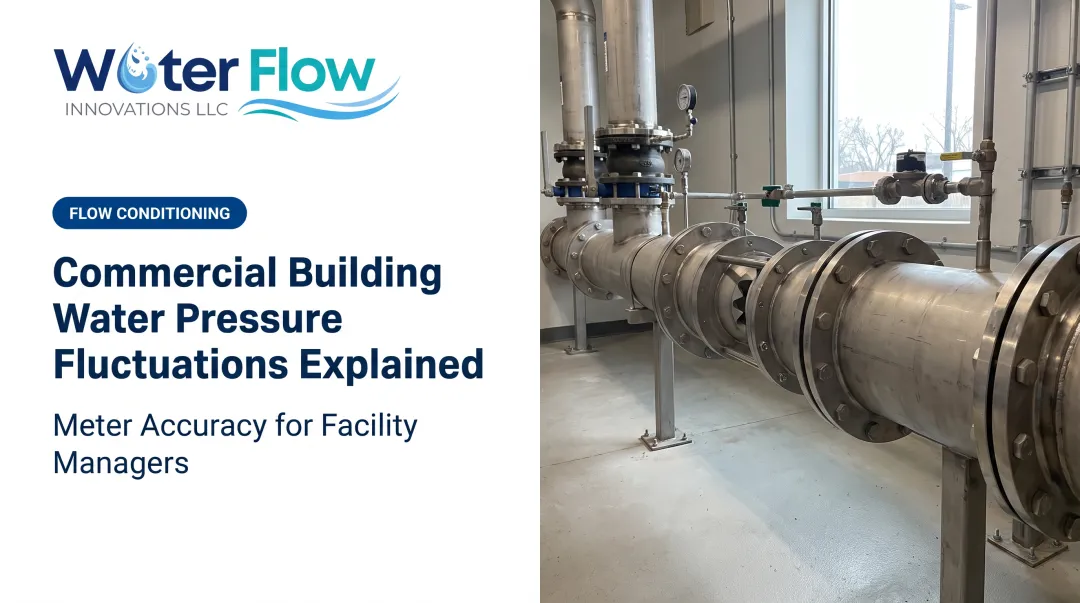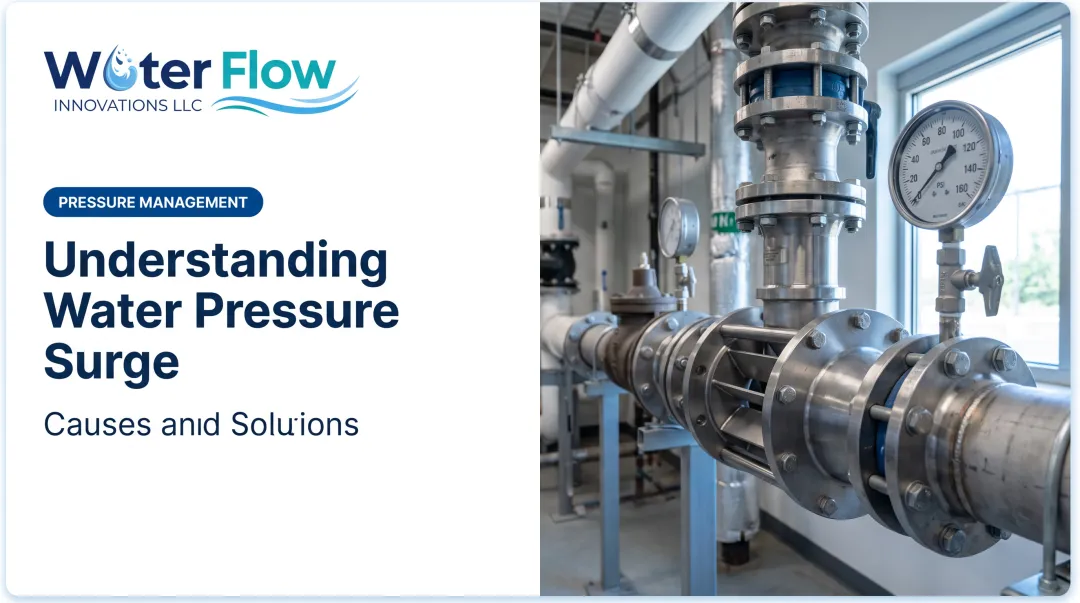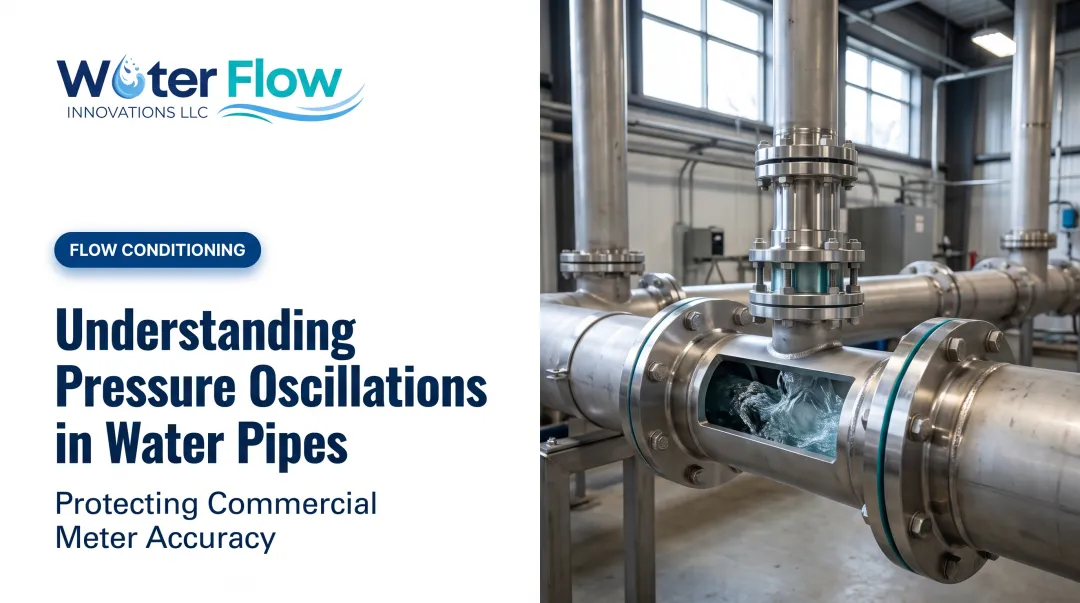

Left unaddressed, these surges cause pipe bursts, joint failures, and expensive unplanned downtime. This guide breaks down what causes pressure surge, the warning signs to watch for, and the fixes that actually work, from valve timing to flow conditioning.
Key Takeaways
- Pressure surge (water hammer) is a sudden pressure spike or drop from rapid flow velocity changes
- Top causes: quick valve closure, pump trip/start, check valve slam, power failure
- Risks of ignoring it: pipe rupture, leaks, and equipment damage
- Prevention tools: slower valve operation, surge tanks, air/vacuum valves, properly sized check valves
- Long-term control: monitoring, maintenance, and flow conditioning technology
Common Causes of Pressure Surge in Water Pipelines
Pressure surge, often called water hammer, is an abrupt pressure wave triggered by a rapid change in fluid velocity. Engineers describe this using the Joukowsky relationship: ΔP = -ρaΔV, where a sudden velocity change (ΔV) produces a proportional pressure change.
Per ASME analysis of the Joukowsky equation's limits, that formula is a useful first-pass estimate. It assumes straight pipe and ignores cavitation or air entrainment, both of which can push real-world pressures higher.
Most surges trace back to specific equipment operations or system disturbances:
Rapid Valve Closure or Opening
Shutting a valve quickly stops fluid momentum almost instantly. That kinetic energy has to go somewhere, and it converts into a pressure spike that travels back through the pipe.
Common triggers:
- Fire hydrant flushing operations
- Automated valve systems closing too fast
- Manual operator error during routine shutoffs
Pump Trip or Power Failure
A sudden pump shutdown creates an immediate velocity change. Common scenarios include:
- Power loss or emergency trip
- Grid stress during peak demand at municipal pump stations
- Unplanned shutdowns in multi-pump headers
Check Valve Slam
When a pump stops, flow can briefly reverse before the check valve slams shut. That abrupt closure generates a secondary pressure surge on top of the initial event.
This is especially common in multi-pump stations, where one unit trips while the others keep running and create conflicting flow directions in the same header.
Air Entrainment and Column Separation
Trapped air or cavitation (where pressure drops below the water's vapor pressure) creates a vacuum pocket. When that pocket collapses, it can generate pressure spikes even higher than the standard Joukowsky prediction.
Case in point: a documented cavitation experiment measured a peak head of roughly 235 meters (~770 ft) against a Joukowsky-predicted 171 meters (~560 ft)—a gap of nearly 40%, according to the same ASME water hammer analysis. This typically happens at high points in a pipeline profile or during rapid draining events.

What Happens If Pressure Surge Is Ignored
Unresolved surges don't just cause the occasional startling bang. Repeated pressure cycling puts real, cumulative stress on infrastructure.
The consequences build over time:
- Pipe rupture and joint leaks from cyclic fatigue
- Gasket failure and pump or valve seal damage
- Non-revenue water loss through hidden leaks
- Contamination risk when negative-pressure zones pull in outside water or soil
One peer-reviewed engineering analysis found that water hammer dynamic stresses can reach four times the calculated static stress on pipe walls, a major contributor to fatigue cracking over repeated cycles. No reliable national figure isolates water hammer's annual cost, but fatigue alone explains why many "mystery" main breaks trace to surge events rather than age or corrosion.
Warning Signs of Pressure Surge Problems
Catching these early can mean the difference between a maintenance ticket and an emergency repair crew.
- Audible banging or hammering when valves close or pumps stop
- Visible pipe vibration or movement at bends, joints, or supports
- Frequent unexplained leaks at joints, fittings, or valve seals

The location where you hear or see damage isn't always where the surge originated. Pressure waves travel, and pipe materials respond differently along the route.
How to Prevent Pressure Surge in Water Pipelines
Effective prevention blends operational habits, mechanical safeguards, and smart design decisions. No single fix covers every scenario.
Slow Valve Operation and Controlled Closure Times
What to do: Replace quick-closing manual valves with actuated valves that have programmable closing speeds.
How it helps: Extending the valve's closing time relative to the pipeline's pressure-wave reflection time reduces peak pressure significantly, straight from the Joukowsky principle.
When to implement: During valve replacement cycles or automation upgrades.
Install Surge Tanks, Air Chambers, or Vacuum Relief Valves
What to do: Add pressure-relief devices at high-risk points flagged by a surge analysis.
How it helps: These devices absorb excess pressure energy and prevent the vacuum conditions that lead to column separation.
When to implement: At the design stage, or immediately after a surge study identifies a vulnerable section.
Use Properly Sized and Maintained Check Valves
What to do: Match check valve selection to your system's actual flow characteristics, not just pipe diameter.
How it helps: A properly sized valve reduces the secondary pressure spike caused by reverse flow after pump shutdown. Get this wrong, and the valve can protect your pump while making the pipeline surge worse. ASCE modeling of pump-trip scenarios has confirmed that risk.
When to implement: During pump station design or scheduled check valve replacement.
Optimize Pump Start-Up and Shutdown Sequencing
What to do: Stabilize flow with sequencing controls and flow conditioning devices during pump cycling events.
How it helps: Controlled sequencing ramps pumps up and down gradually, limiting the rapid flow changes that trigger surge. Flow conditioning reinforces that stability at the system level. Water Flow Innovation's Flow Conditioning Device (FCD) combines four functions:
- Air & gas separation creates static back-pressure for a homogeneous water column, preventing bubble formation.
- Pressure regulation stabilizes flow at the meter entry point, reducing surges from pump cycling and shifting demand.
- Check valve limits reverse flow and the water-hammer events that follow (not every installation needs one).
- Turbulence elimination slows velocity enough to stop vortex patterns that destabilize flow.

Negligible pressure loss means it stabilizes flow without hurting system performance. High-frequency pump cycling sites, such as ready-mix concrete plants running 40 to 80 high-flow load cycles daily, see this instability most often.
When to implement: As part of routine facility upgrades across commercial, industrial, or municipal systems.
Tips for Long-Term Prevention and Control
A one-time fix rarely holds. Surge risk changes as pipelines age, demand patterns shift, and equipment gets replaced.
Build these habits into your maintenance program:
- Run transient analysis after any pipeline modification, pump replacement, or valve upgrade
- Train operators on proper valve sequencing and emergency shutdown procedures
- Document everything: pressure readings, incident logs, and maintenance schedules for trend analysis
- Deploy pressure sensors to catch anomalies before they escalate into failures
Those habits hold up when they rest on real system data. AWWA guidance recommends using transient models to select mitigation devices instead of guesswork—and that only works with an accurate, regularly updated hydraulic model of your actual system, not a generic template.
Conclusion
Pressure surge isn't random. It has identifiable causes rooted in sudden velocity changes, whether from a slammed valve, a tripped pump, or a collapsing air pocket.
Combining mechanical safeguards, like properly sized check valves and surge relief devices, with operational discipline stops most surge-related failures before they start.
Protecting your pipeline infrastructure now costs far less than an emergency repair crew and a flooded mechanical room later.
Frequently Asked Questions
What is a pressure surge in water pipelines?
A pressure surge, also called water hammer, is a sudden, transient pressure spike or drop caused by a rapid change in fluid velocity. It usually happens when flow stops or reverses abruptly.
What causes a pressure surge in water pipelines?
The main triggers are rapid valve closure, pump trips or power failures, check valve slam, and air entrainment or cavitation. Each changes flow velocity fast enough to launch a pressure wave through the line.
What causes a pressure drop in water pipelines?
Pressure drops can come from friction losses, elevation changes, pipe blockages, or the negative-pressure phase of a surge event. Not every drop is surge-related.
How can I tell if my pipeline is experiencing water hammer?
Listen for audible banging when valves close or pumps stop, and watch for pipe vibration at bends or joints. Recurring leaks at fittings without an obvious cause are another red flag.
Can pressure surges damage water meters or affect billing accuracy?
Repeated surge stress can wear meter internals over time. Turbulence and air entrainment also make meters over-register volume—flow conditioning corrects that over-reading at the meter.
What is the most cost-effective way to prevent pressure surge damage?
Slower valve operation, surge relief devices, and flow conditioning together cut mechanical surge risk without major system changes. That mix also limits the turbulence and air issues that drive meter over-reading and inflated bills.
Why does surge-driven over-registration hit two line items?
Sewer is normally billed as a proportion of metered intake rather than measured discharge, commonly 80–120% of the water charge. Volume registered during surge events therefore carries a matching sewer charge for water that never reached a drain.
What recourse exists if correcting the surge doesn't help the bill?
The device carries a 6-month money-back guarantee on its purchase price, with installation cost non-refundable, so it can be returned if metered consumption does not measurably fall. A lifetime transferable warranty against manufacturing defects also applies.