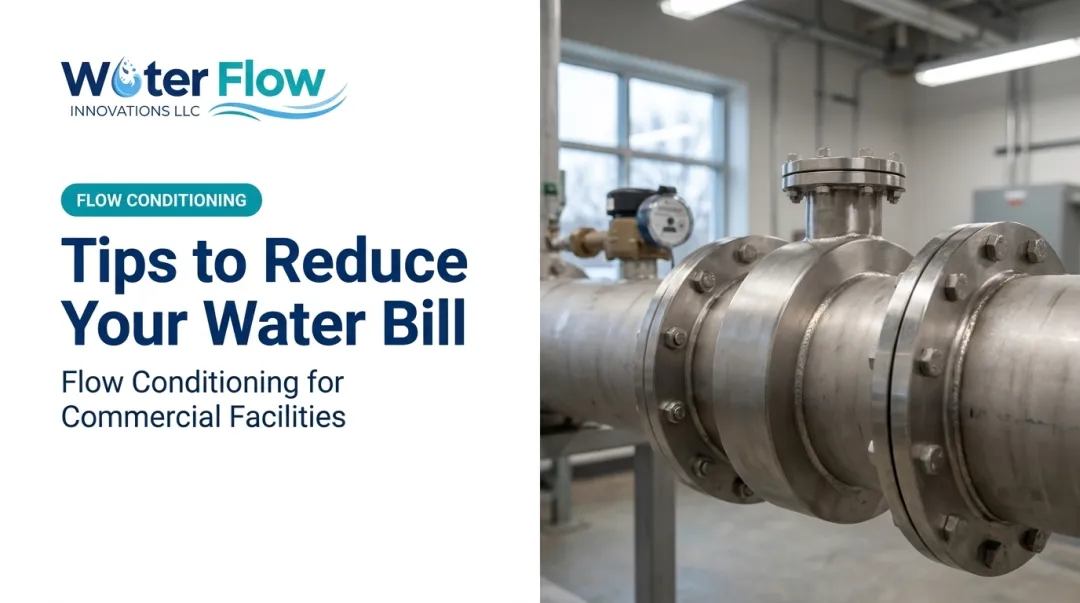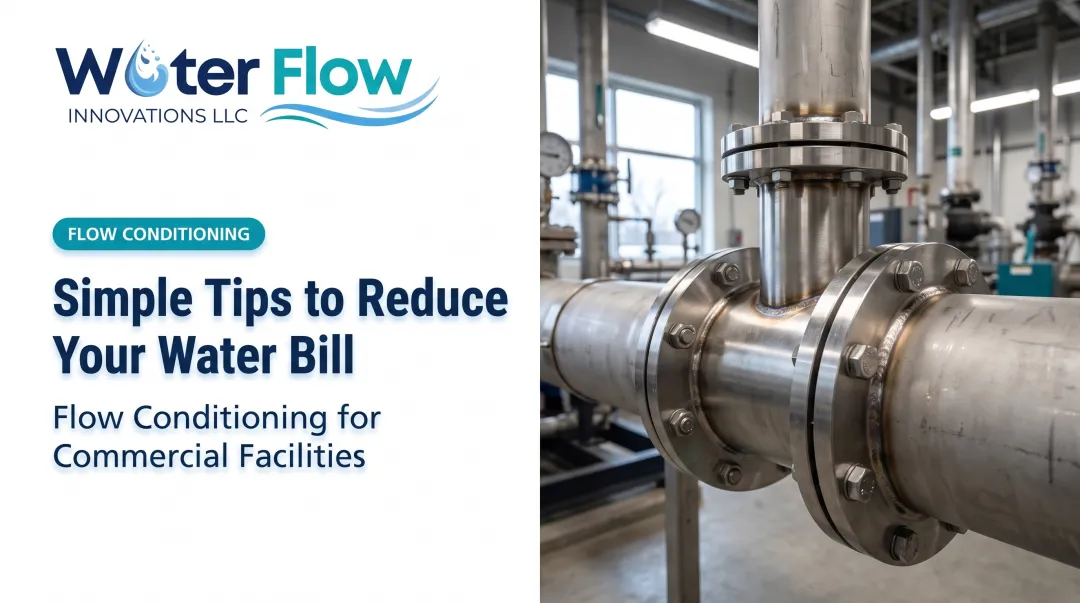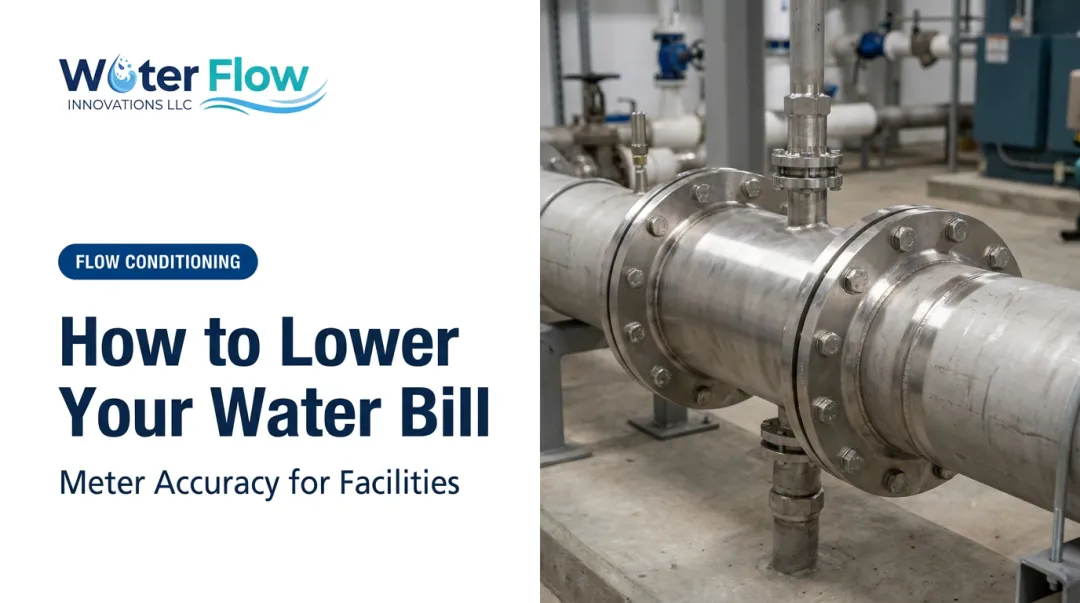

What makes this harder to manage is that high water bills aren't always the result of using too much water. Undetected leaks, outdated equipment, inefficient habits, and even measurement inaccuracies at the meter can all drive costs upward — without any obvious warning sign.
This article covers 15 concrete strategies across three dimensions: the decisions you make about equipment and setup, the daily habits and maintenance practices that govern usage, and the system-level factors — including how water is measured — that can inflate what you're billed regardless of how much you actually use.
Key Takeaways
- Water and sewer bills in the U.S. have risen over 24% in five years, with no signs of slowing.
- Sewer charges account for roughly 59% of the average combined bill, meaning every wasted gallon gets billed twice.
- Leaks waste an average of 9,400 gallons per household annually — fixing them can cut water bills by ~10%.
- Equipment upgrades (WaterSense fixtures, Energy Star appliances) deliver ongoing savings often at no extra cost.
- Meter over-reading caused by air entrainment silently inflates commercial water bills for water never actually used — often for years before anyone investigates.
How Water Bills Actually Build Up
Most water waste is easy to miss. A dripping faucet, an extra five minutes in the shower, an irrigation system running after rain — none seem costly on their own. Together, they can add up to hundreds of dollars in unnecessary annual spending.
The billing structure makes this worse. Most utility bills carry two separate charges — a water consumption fee and a sewer/wastewater discharge fee. Bluefield Research found sewer charges account for roughly 59% of the average combined residential bill. Every unnecessary gallon gets billed twice: once when it enters, once when it exits.
Beyond consumption and sewer charges, a third cost driver is harder to spot: meter over-reading. Turbulent pipe conditions, entrained air, and meter inaccuracies can cause meters to register more water than was actually consumed — generating charges for usage that never happened. Three factors typically drive bill increases:
- Behavioral waste — leaks, long showers, and unmanaged irrigation running when not needed
- Billing structure — sewer fees that mirror consumption, doubling the cost of every wasted gallon
- Meter over-reading — turbulent flow and air entrainment causing meters to log phantom usage
Key Cost Drivers to Understand
Before jumping to solutions, it helps to understand what's actually driving your bill.
The three main culprits:
- Habitual overconsumption — Process water use, restroom fixtures, cooling systems, and facility irrigation running at default settings that were never evaluated for efficiency
- Outdated equipment — Older toilets, pre-1992 fixtures, standard washing machines, and clock-based irrigation systems built to higher water-use standards than modern equivalents
- Infrastructure and measurement issues — Leaks, pipe conditions, and meter behavior that affect how much consumption gets recorded, regardless of actual usage
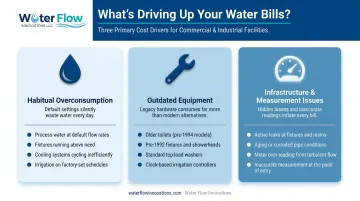
Each driver calls for a different fix — which is why the strategies below are organized around the root cause, not just the symptom.
Cost-Reduction Strategies for Your Water Bill
Reducing your water bill means looking at three distinct areas: the equipment and setup decisions you make upfront, the daily habits and maintenance practices that govern usage, and the broader system factors — including meter accuracy — that affect what you're ultimately charged.
Strategies That Change Your Equipment and Setup Decisions
These approaches reduce your baseline consumption by changing what fixtures, appliances, and landscaping you have in place.
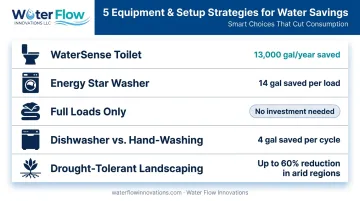
Install WaterSense-certified fixtures. Replacing standard faucets, showerheads, and toilets with WaterSense-labeled models delivers real savings. EPA WaterSense data shows WaterSense toilets save the average family 13,000 gallons and $130 per year; certified showerheads save another 2,700 gallons annually. Most models cost no more than standard versions, and many utilities offer rebates through the EPA WaterSense Rebate Finder.
Upgrade to Energy Star-certified appliances. Full-sized Energy Star washers use 14 gallons per load versus 20 for a standard machine — a 33% reduction. Certified dishwashers use 30% less water than standard models. If either appliance is more than 10 years old, water savings alone often justify replacement.
Run appliances only at full capacity. Dishwashers and washing machines use roughly the same water whether the load is full or half-empty. Waiting for a full load eliminates that waste entirely — no new equipment, no investment, just a habit shift.
Use the dishwasher instead of hand-washing. Running a faucet for five minutes wastes 10 gallons. A modern Energy Star dishwasher uses as little as 6 gallons per cycle — switching from hand-washing saves thousands of gallons annually.
Switch to drought-tolerant landscaping. Outdoor irrigation accounts for nearly one-third of all residential water use — and up to 60% of household consumption in arid regions. Replacing water-intensive grass with native or drought-tolerant species (xeriscaping) dramatically reduces irrigation demand. Many municipalities offer rebates for turf replacement; check your local utility's conservation programs.
Strategies That Change How You Manage Water Day-to-Day
These approaches don't require capital investment. They require behavioral consistency and maintenance discipline.
Detect and fix leaks immediately. The average household wastes more than 9,300 gallons per year from leaks — fixing them cuts bills by roughly 10%, per EPA estimates. Check toilets with the food dye test: drop dye in the tank and watch for color in the bowl without flushing. Nine percent of homes have leaks wasting 50+ gallons per day, most undetected for months.
Stop leaving taps running unnecessarily. Leaving the tap on while brushing teeth wastes 8 gallons per day. Over a year, that's nearly 3,000 gallons for a single habit. The same applies to shaving, hand-lathering, or rinsing produce — turn the tap off when water isn't actively needed.
Shorten showers. Showers account for nearly 17% of residential indoor water use and total nearly 1.2 trillion gallons nationally per year. A standard showerhead flows at 2.5 gallons per minute. Cutting two minutes off a daily shower saves over 1,800 gallons per year. A full bathtub uses roughly 36 gallons on average — significantly more than a short shower.
Monitor your bill monthly for unexplained spikes. Comparing month-over-month consumption is one of the simplest early-warning systems for hidden leaks or equipment issues. Most utilities now offer apps or online portals showing daily or weekly usage data. A sudden 20% increase with no change in household activity almost always points to a leak or a running toilet.
Maintain your water heater. Sediment buildup in water heaters reduces efficiency and slows the time it takes hot water to reach fixtures. During that waiting period, cold water runs down the drain unused. Flushing the tank annually reduces sediment accumulation and shortens that dead-run time.
Strategies That Address Your Water System's Environment and Context
These approaches target the infrastructure, configuration, and system-level factors that affect how water is used — and how it's measured.
Upgrade to smart irrigation controllers. Standard clock-based sprinkler systems run regardless of weather. A WaterSense labeled smart controller uses local weather data and soil moisture sensors to adjust automatically — skipping cycles after rain, reducing run times in cool periods. EPA estimates replacing a clock-based controller with a WaterSense model can reduce irrigation water use by up to 30% and save up to 15,000 gallons per year.
Sweep outdoor surfaces instead of hosing. Driveways, patios, and walkways are routinely hosed down when a broom accomplishes the same result at zero water cost. Keep a broom accessible — that single change is usually enough to shift the default.
Collect and reuse rainwater or greywater where permitted. Rainwater collection systems and greywater recycling — reusing sink, shower, and washing machine drain water — reduce dependence on metered municipal water for non-potable uses like irrigation and toilet flushing. Legality varies by state and jurisdiction, so check local regulations before installation.
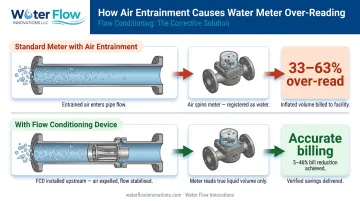
Address water meter over-reading caused by air entrainment and turbulent flow. This applies primarily to commercial and industrial facilities. Water meters can systematically register more consumption than actually occurred when air bubbles or turbulent flow are present in the supply pipe. A peer-reviewed 2025 laboratory study in Water Resources Management found that rapid pipe filling caused meters to register 33–63% of air volume as water — facilities may be paying for water never delivered.
For commercial facilities, this structural billing error compounds across every billing cycle. Water Flow Innovation offers a Flow Conditioning Device (FCD) engineered to eliminate this problem by removing entrained air and stabilizing flow at the meter. Because sewer charges are calculated from the same metered figure, correcting over-reading reduces both water and sewer charges starting with the first billing cycle after installation. Water Flow Innovation offers a free bill review and savings calculator for facilities assessing their exposure.
- Audit your sewer and wastewater discharge fees. Most utility bills calculate sewer charges as a percentage of metered water consumption — and that percentage is significant. Any reduction in your metered consumption figure, whether from conservation or corrected meter over-reading, reduces your sewer charge automatically. In some utility structures, the sewer rate multiplier exceeds the water rate, meaning the sewer savings from a given reduction can be larger in dollar terms than the water savings.
Conclusion
Water costs come from three places: how you use water, the equipment moving it through your facility, and whether your meter is actually recording what you consumed. Addressing only one of those rarely produces lasting results.
The strategies that work long-term tackle all three. Behavioral habits and routine maintenance cost nothing to start and show up on the next billing cycle. Equipment upgrades take more planning but pay back quickly. For commercial and industrial facilities, meter accuracy deserves its own line on the checklist — over-reading caused by turbulent flow can inflate bills by 5–46%, regardless of how efficiently the facility operates.
Start with the no-cost items. Then assess fixtures and appliances. If you manage a commercial property, verify your meter is measuring accurately before assuming your usage is the problem.
Frequently Asked Questions
What increases your water bill the most?
The leading drivers are leaks, inefficient fixtures and appliances, and outdoor irrigation overuse. For commercial and high-volume facilities, meter inaccuracies caused by air entrainment — registering more consumption than actually occurred — add a significant hidden cost to every billing cycle.
How much water should a 2-person household use a month?
EPA estimates the average American uses 82 gallons per day at home. For two people over 30 days, that's roughly 4,920 gallons per month in total household use. If your bill consistently reflects significantly more than that, a leak audit or fixture efficiency review is worth doing.
Does fixing leaks actually make a noticeable difference on a water bill?
Yes. The EPA estimates the average household loses more than 9,300 gallons per year to leaks, and fixing them can cut water bills by approximately 10%. A slow-running toilet or dripping faucet — operating 24/7 — adds up to hundreds of extra dollars per year when water and sewer charges are combined.
Are WaterSense fixtures worth the upfront cost?
WaterSense-labeled products generally carry no significant price premium over standard equivalents. The EPA publishes annual savings estimates for each fixture type, and many utilities offer rebates through the WaterSense Rebate Finder that can offset the purchase cost entirely.
Can a water meter be inaccurate and cause overbilling?
Yes. Water meters can over-register consumption when air bubbles or turbulent flow conditions are present in the supply pipe — a condition especially common in larger commercial facilities. Correcting this measurement error reduces what you're billed without any change to operations or water use.
How do I know if my water bill is higher than it should be?
Compare your monthly consumption against the EPA benchmark of roughly 82 gallons per person per day, and flag any unexplained month-over-month spikes for a leak check. Commercial facility managers should also consider whether meter over-reading is inflating their consumption figures.
How much does correcting a measurement error typically recover?
Documented installations average a 5–30% reduction in combined water and sewer bills, with a highest documented single result of 46%. Savings land on the very next billing cycle, since the correction takes effect the moment the device is installed.
What is involved in fitting the correction?
A licensed plumber or mechanical contractor installs a custom-built device at the municipal supply connection in about an hour, with a brief water shutoff at the meter connection. No fixture, appliance, or process downstream is altered.